
#On the Taxation of the Unborn
Future burden, present duty. — Bureau of Tithes slogan, A.S. 157
The Cradle Decree is the moment at which the Bureau of Tithes looked upon pregnancy and saw a promissory note with fingernails. Promulgated in A.S. 157, during the famine-year when the Iberian campaigns had stripped the western granaries and made every ration card a small confession, it established that a household expecting a child owed dues upon the child’s projected ration consumption from the date of confirmed pregnancy. Birth was too late. Birth permitted sentiment to enter the room. The Bureau prefers to arrive before the crying starts.
The old levies taxed what existed: grain, salt, coin, hearth, widowhood, livestock, windows, smoke, passage, privilege, sin if conveniently assessed. The Cradle Decree taxed arrival. A future mouth became a present line item. A cradle became an account category. A mother’s body became, in Tithes language, “the first chamber of civic consumption.”
#On the Famine Year
A.S. 157 was an excellent year for bad ideas. The Iberian campaigns had consumed stores faster than Tithes could rename scarcity as discipline. The Famine of A.S. 157 revived the Widow’s Pennies in their harsher form, sharpened ration scrutiny, and placed every district office under a pressure that makes accountants speak like prophets and behave like rats in a grain bin.
The Bureau’s argument was immaculate, which is to say indecent. An infant receives ration allocation after birth. Ration allocation must be provisioned before birth. Provisioning requires funds. Funds require dues. Dues require a debtor. The debtor, since the infant had not yet committed the administrative courtesy of existing separately, must be the household. The household meant the mother, because fathers can vanish into war, work, drink, fog, heresy, or a Records category with the ease of mice escaping a chapel cat.
Kaethus Brenn appears in the margin of the later Cradle files, his earlier phrase “Creator forgive us for the arithmetic” still circulating like an infection the Bureau could not fully cauterise. Doctrine corrected the phrase to “The Creator requires the arithmetic.” Tithes took the correction as permission.
A nursery catechism issued in A.S. 161 described the Cradle Decree as “a blessing of provision laid upon expectant households.”
Corrected after three parishes began using the catechism to petition for grain advances. The Decree is not a blessing. It is an assessment instrument. Blessings do not require receipt countersignature.
#On Confirmation and Calculation
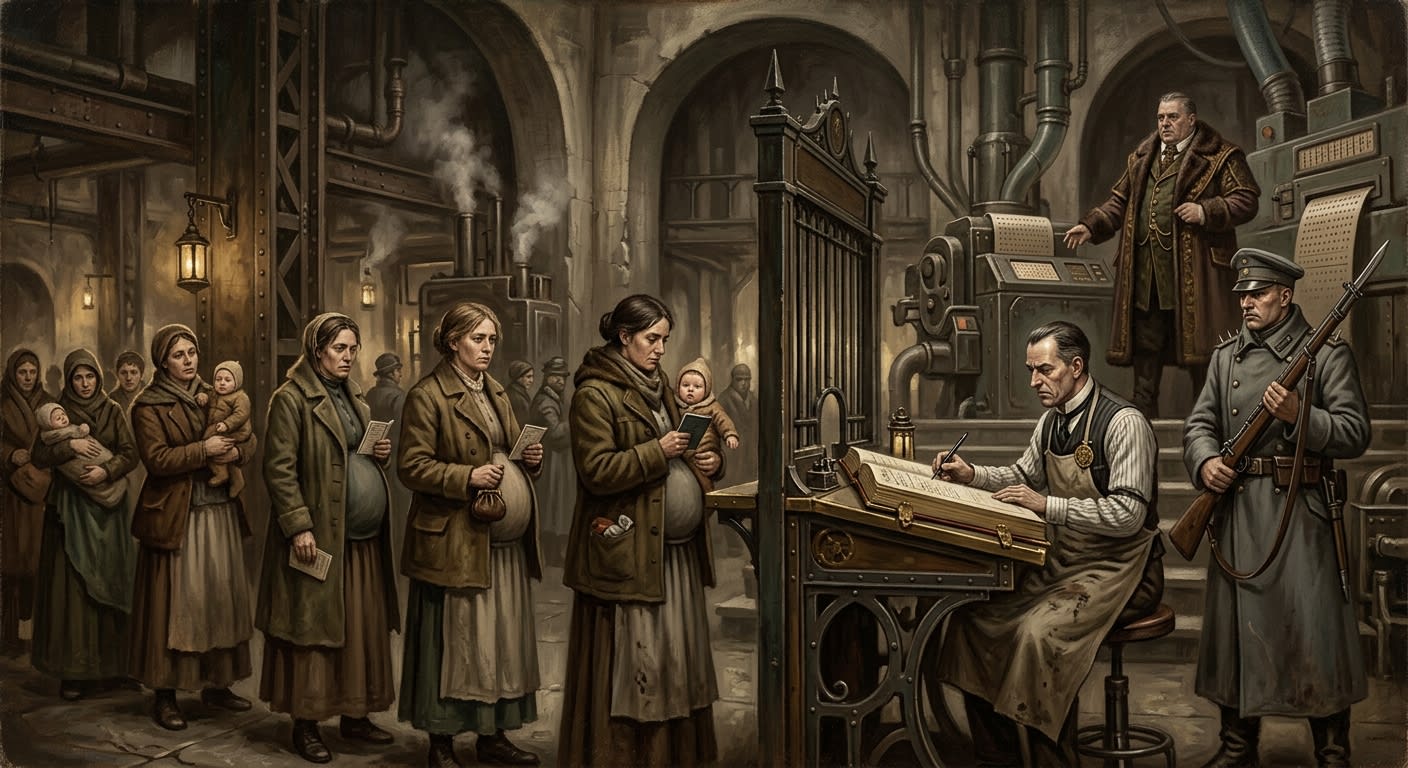
The Decree begins with confirmation. A parish midwife, medical clerk, or district matrons’ witness signs the pregnancy notice and forwards it to the Route Assessor. The household is then entered into the Prenatal Assessment Roll (Unregistered), a ledger kept in blue-black ink because red ink was judged “inflammatory” after the Widow Riot. The mother’s name is written first. The expected child is entered as Pending Issue, ration class provisional, soul status anticipated.
The Tithe Assessor calculates the charge through four figures: current household due, district ration allocation, prior arrears, and the Burden Index. A low Index softens the payment schedule. A high Index hardens it, because the Bureau has long understood that a household already sinking should be charged for the water. The unborn child is then inserted into the household score as projected consumption. The score rises. The due rises. The mother learns arithmetic by nausea.
The due may be paid in salt, coin, goods, or labour tokens. Labour tokens are the Decree’s most elegant cruelty: a promissory claim against future work, redeemable by the Bureau of War, Engineering, licensed factories, trench laundries, ration kitchens, and any contractor whose paperwork has survived inspection. A mother short of salt may pay with weeks not yet lived. The Ledger accepts time in instalments.
#On Labour Tokens
The labour token is a small brass disc stamped with household number, district mark, gestation certification, and redemption category. In theory, the token records voluntary substitution: labour in place of coin. In practice, “voluntary” is the word a clerk uses when the alternative is seizure. The mother signs, the Assessor seals, the Quota Captain records, and somewhere far from the room a future foreman acquires a claim upon her hands.
These tokens can be redeemed after birth, after recovery, or, in hardship districts, before either term has acquired mercy’s permission. The Bureau insists that no woman may be assigned labour “medically inconsistent with civic continuation.” The phrase has carried many buckets.
MEDICAL-TITHES JOINT REVIEW — EXCERPT, A.S. 163 Subject: early redemption of Cradle labour tokens. Finding: “Recovery intervals in famine districts may be shortened where household arrears threaten ration continuity.” Dissenting note by Medical Clerk Serafin: ███████████████████████████████████████████████ Disposition: dissent struck as sentimental speculation; Serafin reassigned to trench fever laundry.
#On the Infant-Tooth Tray
The Palatine Counting House preserves the Decree in hardware as well as ink. In its weigh-chapels, beside the widow’s black penny and the famine spoon, sits the infant-tooth tray introduced after A.S. 157 and later denied by three Archons who had signed the acquisition orders. The tray is silver, shallow, and engraved with a cradle whose rails resemble prison bars because artisans sometimes tell the truth by accident.
Tithes claims the tray was ceremonial. Assessors claim it trained the hand: small weights, small debts, small lives made measurable. Relics objected to the use of infant teeth as calibration tokens after several families began treating extracted first teeth as collateral against Cradle arrears. Tithes replied that collateralisation proved the Decree had entered public understanding. Relics withdrew the objection and requested a receipt for the teeth already taken.
An A.S. 172 Archonate statement denied that infant-tooth trays were ever procured for Bureau use.
Corrected by acquisition order T-157-44, signed under three district seals and countersigned by the Palatine chapel steward. The denial remains in circulation for morale purposes. The trays remain in drawers for practical purposes.
#On Domestic Consequences
The Cradle Decree changed the household before it changed the ledger. Pregnancy became reportable. Midwives became informants by licence or by fear. Parish neighbours learned to hear absence: the woman no longer at the washhouse, the bowl left unfinished, the sudden visit from a mother-in-law carrying broth. Hidden pregnancies multiplied. So did denunciations. A concealed pregnancy, once discovered, carried arrears from the probable date of quickening, plus concealment penalty, plus confession review, plus the particular look an Assessor gives when he realises someone has tried to keep life private.
Fathers became suspiciously pious. Men who had ignored confession for years appeared at parish desks eager to clarify household status before an anticipated child raised the Index. Some attempted pre-birth abandonment, filing separation notices so the due would fall upon the mother’s family. Records closed that gate in A.S. 160 with the Presumptive Paternity Attachment (Unregistered), a little masterpiece of adhesive law: if a man had eaten at the household table within the probable conception season, he could be assessed.
The table became evidence. Marriage always was.
#On Assessor Hatred
Assessors despise the Cradle calculation more than the Widow Route, which tells the reader everything necessary and several things the Bureau would prefer left in a locked drawer. Widow’s Pennies can be collected from grief already hardened by burial. Cradle dues arrive while fear is still soft. The mother bargains. The father lies. The grandmother produces saint cards, old receipts, mouldy salt, and threats in descending order. The Assessor must calculate while everyone in the room imagines the child.
Veteran Assessors speak of the Cradle face: the moment a household understands that the unborn has entered the Ledger before entering the world. Some men drink after. Some cheat downward. Some harden into fine instruments and are promoted. The Bureau needs all three kinds, though it prosecutes only the second.
#On Present Application
As of A.S. 201, the Cradle Decree remains active across Synod territory, except in districts under plague suspension, siege ration emergency, or clerical exemption pending the immortal review already noted. Its calculations now feed directly into the household Burden Index, making the unborn a future ration claimant and a present administrative risk. The Bureau considers this efficient. Efficiency is what cruelty calls itself when it has learned sums.
Saint Ysolt receives petitions from expectant mothers on 11 Martius, the Feast of Balanced Scales, when one approved Cradle charge may be forgiven by a licensed Assessor if properly sealed. The line outside the Tithes chapel begins before dawn. The chapel bell rings once for each forgiveness granted. In the poorer districts it rings so rarely that children think the silence is part of the rite.
The cradle rocks. The receipt dries.