
#On the Assessor and His Scales
"No bread without burden." — Bureau of Tithes, Ration Directive 14-C, A.S. 112
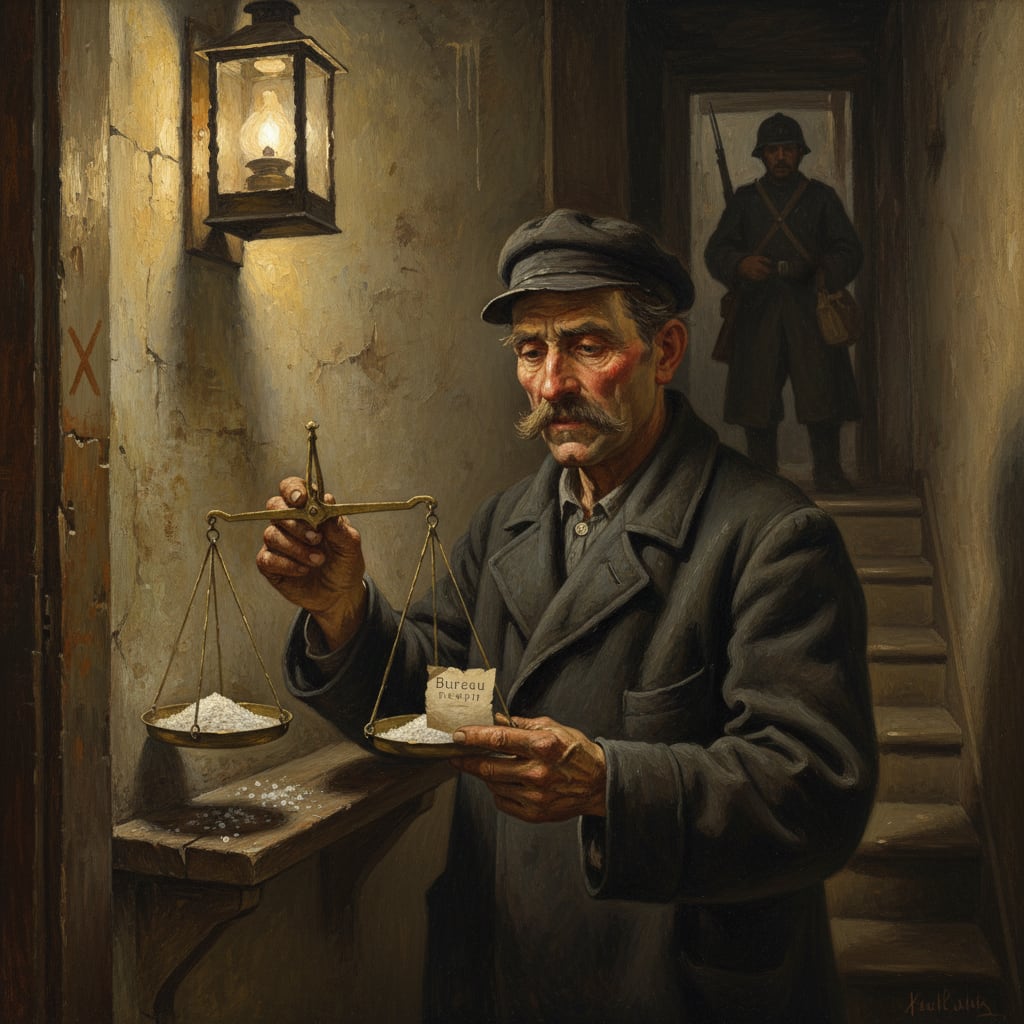
I have watched Assessors work the poor districts of Strasbourg on collection day. I have stood in the doorways of the widowed and the wretched while a man with ink-stained thumbs and a folding scale decided whether a family's salt was sufficient to purchase another week of existence. I found the experience instructive. The Assessors found my presence inconvenient, because Assessors prefer to work without witnesses of rank, and because a Hieromnemon standing in a tenement stairwell raises questions that no receipt stamp can answer.
The Tithe Assessor is the Bureau of Tithes' walking appetite. Where the Bureau itself sits in the Palatine Counting House and tallies the vast continental ledger of Salt Dues, Widow's Pennies, hearth taxes, and the preemptive infant levies that make the Synod's accountancy the envy of Hell's own bookkeepers, the Assessor carries that appetite into kitchens, market stalls, sickrooms, and funeral parlours. He arrives with scales, ledger, seal cord, receipt blanks, and an armed escort whose primary function is to remind the household that arithmetic is compulsory.
#On the Instruments
The Assessor's kit is prescribed by the Bureau down to the grain-weight of the scale pans, the thread-count of the seal cord, and the particular shade of rust-brown ink reserved for arrears notices. A Tithe Runner — the lowest rank, the boy who carries the receipt blanks and learns by watching the senior man's hands — is given his kit on the first morning of service and warned, in language the Bureau considers liturgical, that the loss of a single blank receipt is grounds for dismissal, investigation, and a notation in the Ledger that will follow him into whatever ditch his career ends in.
The folding scale is the profession's sacrament. Brass pans, iron pivot, a calibration bead of certified salt sealed in a glass vial at the hinge. The Assessor weighs salt, grain, coin, and — in the frontier bastions where currency has collapsed into barter — dried fish, candle-stubs, bootlaces, and the occasional tooth pulled in payment of a debt the debtor could not otherwise settle. The Bureau insists that all payments are converted to standard units. The Assessor insists that standard units are a fiction invented by men who have never weighed a widow's last handful of grey salt against a quota that was set in Strasbourg by a clerk who eats white bread.
The brine-testing stone — a small slab of fired clay that changes colour when pressed against adulterated salt — is the Assessor's second instrument of authority. Salt purity is covenant. The Bureau's position, stated in the Salt Dues framework of Marseille and reiterated in every training manual since, is that impure salt is impure payment, and impure payment is incomplete tithe, and incomplete tithe is a species of heresy that the Bureau of Purity has been known to investigate with the same enthusiasm it brings to unauthorized prayer.

#On Salt Dues and Widow's Pennies
The Salt Dues were devised during the great Marseille crisis, when a winter of failed convoys made salt worth more than silver in the southern corridor and the Bureau discovered — with the mixture of horror and professional admiration that characterizes all its fiscal epiphanies — that an economy can be governed more precisely through salt than through coin. Salt preserves food. Salt purifies water. Salt, in the liturgical imagination of a Synod that had just survived the collapse of three provincial treasuries, binds the covenant between the faithful and the wall.
The Widow's Pennies followed. Their origin is uglier and the Bureau's official account is a lie of such architectural perfection that I have considered submitting it to the Bureau of Doctrine as a model of revisionist prose. The truth, which survives in the private correspondence of Assessor-General Kaethus Brenn (A.S. 138), is that the Synod had been granting pity exemptions to widows, and the exemptions had grown until a quarter of the households in the northern corridor were paying nothing at all, because widowhood in wartime is not a rare condition, and the definition of "widow" had expanded to include women whose husbands were missing, deployed, imprisoned, conscripted, excommunicated, or simply absent long enough for the parish clerk to stop asking.
Earlier accounts attributed the Widow's Pennies to "compassionate reform" under the Concordat's Second Fiscal Synod.
The Second Fiscal Synod (Unregistered) did not discuss widows. It discussed salt futures. The confusion arises from a filing error in the Bureau of Records, where the minutes of the Second Fiscal Synod were bound into the same folio as the Brenn Memorandum. The Bureau of Records considers the matter "resolved by proximity."
The pity exemptions were revoked. The Widow Riot followed — three days of pot-banging, cobblestone barricades, and a fire in the Tithe Office of the Königsberg Lower District that destroyed four hundred years of collection records and, the Bureau suspects, was not entirely accidental. The Bureau's response was to make Widow's Pennies mandatory and universal, assessed at a reduced rate, with the explicit doctrinal justification that "shared burden is shared grace, and exemption from burden is exemption from grace, and the graceless are the Enemy's harvest."
The logic is perfect. The logic is always perfect. The widows still hate it.
#On the Preemptive Infant Dues
The Cradle Decree is the Bureau's masterwork of anticipatory extraction. Promulgated in A.S. 157, it establishes that a household expecting a child owes tithe on the child's projected ration burden from the date of confirmed pregnancy — "future burden, present duty," as the Bureau's slogan has it, with the cheerful brutality of an institution that has learned to tax the unborn.
The Assessor calculates the due based on household size, district ration allocation, and a formula the Bureau calls the "Burden Index" — a composite score that measures, in the Bureau's own words, "the weight a household places upon the collective covenant." A high Burden Index means higher dues, fewer exemptions, and a shorter queue at the seizure yard. A low Burden Index means the household is useful, productive, and unlikely to cause the sort of public spectacle that makes the escort captain's job difficult.
The infant due is payable in salt, coin, or labour tokens — the last of these being a promissory note against future work, redeemable by the Bureau of War, the Bureau of Engineering, or any licensed factory foreman. A mother who cannot pay in salt or coin can pay in the promise of her own labour, which is to say that the Bureau has devised a system in which pregnancy is a form of debt and birth is the first installment.
I do not editorialize. The Bureau does not editorialize. I merely record that Assessor-General Brenn's private notes on the Cradle Decree include the phrase "Creator forgive us for the arithmetic," and that the Bureau of Doctrine, upon reviewing the notes, crossed out "Creator forgive us" and wrote "Creator requires" in the margin.
#On Collection Day
A Tithe Assessor's route is a liturgy of graduated misery. The morning begins at the Tithe Office, where the Route Assessor collects his day's assignments, counts his receipt blanks under the eye of a Quota Captain who records the number in triplicate, and brine-washes his hands in a basin by the door — a ritual the Bureau calls "purification" and the Assessors call "getting the smell of the last shift off."
The first stops are compliant merchants. Easy numbers. The butcher pays in coin and salt. The chandler pays in wax tokens. The licensed baker pays in flour-weight and receives a stamped receipt that permits him to continue baking, which is the Bureau's way of reminding the baker that his oven belongs to the Synod and his bread is a concession.
The midday collections are where the work turns. Poor districts. Tenement blocks where six families share a stairwell and the salt is grey and the children watch from behind doors that do not close properly. The Assessor weighs, counts, stamps, and — when the payment is short — marks the doorframe with arrears chalk. The chalk is rust-brown. It does not wash off in rain. The neighbours see it. The neighbourhood knows.
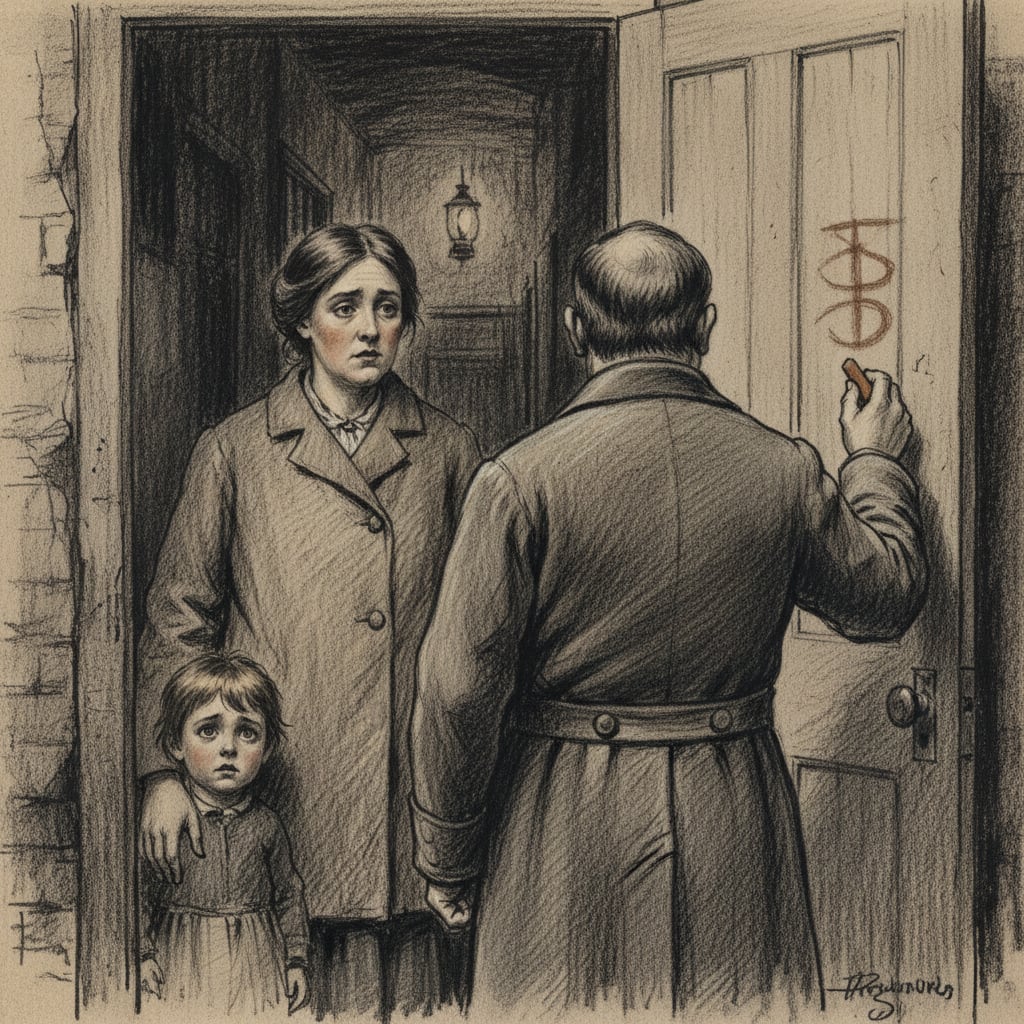
The widow routes are the profession's crucible. Every Assessor of sufficient rank has worked the Widow Route — the designated collection circuit through districts with the highest concentration of war-widows, famine-widows, plague-widows, and the particular category the Bureau files as "administrative widows," meaning women whose husbands have been erased by the Bureau of Records and who are therefore married to no one, owed by no one, and taxable as independent households at the full rate.
A man who survives the Widow Route without either corruption or collapse is promoted. A man who does not survive it is reassigned to trench camp dues, where the collections are simpler, the debtors are soldiers, and the violence is at least professional.
#On Corruption and Its Instruments
Every Assessor cheats. The Bureau knows this. The Bureau has, in a series of internal memoranda I was not supposed to read but did, calculated the acceptable rate of corruption at approximately seven percent of total collection — the threshold below which prosecution costs more than the stolen revenue, and above which the Bureau's own credibility begins to decompose.
The standard instruments are three. The "split due" — recording a higher assessment than collected and pocketing the difference. The "arrears leash" — keeping a household perpetually one payment behind, controllable by the threat of seizure, available for favours. And the "salt test" — rejecting a payment as impure salt, demanding replacement, and selling the rejected salt back into the market through a fence who operates out of the seizure yards.
An earlier edition of this entry described the Bureau's internal corruption threshold as "approximately five percent."
The figure was revised upward in A.S. 194 following an audit that revealed the five-percent threshold had been calculated using data from districts that did not, technically, exist. The auditor responsible for the original calculation has been reassigned. The districts continue to not exist. The tithes collected from them continue to appear in the Ledger.
The Assessor who is caught — and some are caught, because the Bureau employs Audit Liaisons whose sole purpose is to count other people's counting — faces a progression of consequences that begins with demotion to the worst routes, passes through public accounting (a ritual in which the Assessor's ledger is read aloud in the district market while the district watches), and terminates, for systemic fraud, in immurement. The Bureau walls its worst offenders into the basement vaults of the Palatine Counting House, behind the very ledgers they falsified. The symbolism is the Bureau's, and the Bureau is proud of it.
#On Saint Ysolt of the Scales
The profession's patron is Saint Ysolt (Unregistered), depicted in the canonical iconography with a set of brass scales in her right hand and a single grain of wheat in her left. The official hagiography — ratified by the Bureau of Doctrine in A.S. 104, revised in A.S. 131, revised again in A.S. 167, and currently under "ongoing doctrinal review" that has lasted thirty-four years — holds that Ysolt balanced a starving bastion during the early Line years by weighing tears against grain and finding the tears heavier, thereby proving that suffering has measurable weight and that the Bureau's scales can quantify it.
Her feast day — the Feast of Balanced Scales, observed on the eleventh of Martius — is the only day of the year on which Assessors are permitted to forgive a single debt of their choosing, provided the forgiveness is documented, sealed, and submitted to the Quota Captain for review. The Bureau calls this "structured mercy." The Assessors call it "the day you find out which widow has been saving her story."
█████████████████████████████████████████████████████████████████████████████████████████████████████████████████████████████████████████████████████████████████████████████████████████████████████████████████████████████████████████████████████████████████████████████████████
#On the Burden Index and Its Consequences
The Burden Index deserves its own notation, because it is the Bureau's most elegant instrument of control and the one the Bureau is least willing to explain.
Every household in the Synod carries a Burden Index score. The score is calculated from household size, income estimate (often fictional), ration allocation, district classification, tithe history, and a variable the Bureau calls "doctrinal compliance" — a number that the Bureau of Purity supplies and the Bureau of Tithes does not question, because questioning the Bureau of Purity's numbers is a form of professional suicide that even the Bureau of Tithes' actuaries consider reckless.
A household with a low Burden Index pays less, receives better ration allocation, and is left alone. A household with a high Burden Index pays more, receives reduced rations, is visited more frequently, and is flagged in the Bureau of Records' household registry with a notation that makes every subsequent interaction with any Bureau — permits, marriages, births, deaths, travel, employment — slightly more difficult, slightly more expensive, and slightly more watched.
The Index is self-reinforcing. A high score generates higher dues. Higher dues generate arrears. Arrears generate seizures. Seizures generate poverty. Poverty generates a higher score. The Bureau is aware of this. The Bureau considers it a feature of the system, because a household trapped in the Index is a household that cannot afford disobedience, and a household that cannot afford disobedience is a household that pays.
#On the Assessor's Enemies
The Assessor's enemies are everyone. The poor hate him because he takes what they need. The merchants hate him because he takes what they earned. The widows hate him because he quantified their grief. The smugglers hate him because he is the reason smuggling is necessary. The Bureau of Purity hates him because he is evidence that the Synod's apparatus of faith runs on money, and the Bureau of Purity prefers not to acknowledge this. The Bureau of Mercy hates him because the Assessor's seizure orders generate the orphans and the destitute that the Bureau of Mercy must then house, feed, and document.
His escort captain hates him because escort duty is the worst posting in the military hierarchy — too dangerous to be comfortable, too boring to be glorious, and too intimate to pretend the man you are protecting is anything other than a clerk with a scale who makes people cry for a living.
His own family hates the smell of brine on his hands.
The Assessor who lasts — who survives the Widow Route, who learns to sleep after chalking a door, who develops the particular deafness that permits him to hear a mother's account of her dead son and then weigh her salt without his hands shaking — becomes something the Bureau values and the district fears. He becomes a hard weight. An old salt. A man whose scales are clean because he has learned that a clean scale is a lie, and the lie is the job, and the job is the wall, and the wall does not care about spoons.
Nihil debitum sine ratione. Nihil rationis sine dolore.