

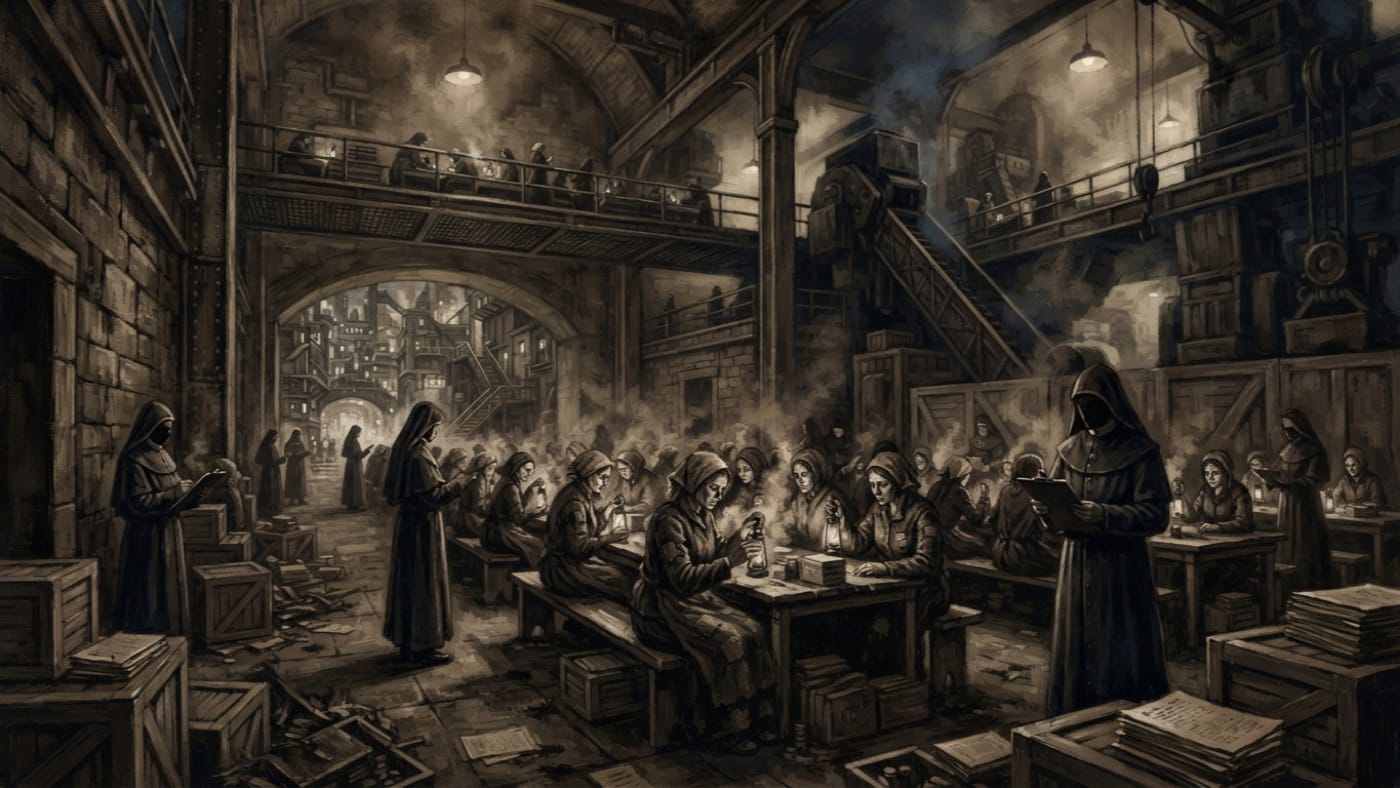
#On the Office and Its Charge
"Honoring the dead through service." — Public formula of the Widowlight Wardens
The Widowlight Wardens are a monastery that keeps a labor office, or a labor office that keeps a monastery. No ledger opened to the Codex settles which comes first, and the Wardens have shown no interest in supplying one. Their jurisdiction is the Widowlight Quarter, sixth of Rheinscarp's nine terraces, in the Rhine gorge of the central Heartlands, Zone 2. The Ledger Cloister lies one terrace below. The Ash Exchange lies one terrace above. The Wardens hold the floor between the filing of names and the pricing of corpses, and they have made of that floor a warehouse.
Their holdings are three: warehouses, lamp-oil and inspectors. The first holds the stock, the second lights it, and the third watches the women who handle it. A cloister under a vow of poverty would envy the arrangement. A cloister under a vow of poverty that also held a shipping contract would recognize it at once.
Their founding year is unrecorded. So is the name of any founder, abbot or prior, and the Codex declines to invent one. An office need not remember its birth to know its business. The Wardens' business is the night, and on the sixth terrace the night belongs to whoever holds the oil.
#On the Draft and the Debt
The workforce comes to the Wardens by way of the Sagittal Line. A man goes to the Line, the Line keeps him, and his debts climb back to Rheinscarp without him. They outlast him because they are made of paper. They come to rest on the household, and where the household is a widow, the widow is drafted.
The draft assigns her to night warehouse service under the Wardens, sorting, packing and keeping inventory through the lamp-oil shifts. The goods she counts are not hers. Neither was the debt she now discharges, until the morning it was. Rheinscarp holds that an obligation survives its debtor as a relic survives its saint. The comparison flatters the obligation, which is why the city favors it.
Here the formula does its work. Honoring the dead through service. Weigh the grammar. The dead man receives the honor and the service is rendered, while the widow who renders it appears in the sentence only as the space between those two nouns. Moral blackmail is the documented method, and it needs no seal. A woman who hesitates at the bench is reminded of what she owes the man in the ground. Grief is a cheaper overseer than a guard, since it draws no wage, no ration and no lamp of its own.
The Codex keeps its categories clean even where the Wardens might prefer them smudged. The Wardens administer. Their inspectors inspect. The drafted women work. No source records whether any widow has ever crossed from the bench to the inspectorate, or who takes the monastery's vows. The Bureau does not know who wears the habit. It knows who carries the crates.
#On the Quota Lamps
The lamps are tallow and they are issued on quota. The rest of the Wardens' authority follows from that.
A warehouse at night is a dark room full of someone else's property. A woman needs light to sort it, and she needs the Wardens to get light. Her lamp is issued, the issue is marked with a lamp-tag, and the tag binds that light to the hand that carries it. Widowlight Stores is the warehouse name that appears most often in the returns, although the Codex holds no count of how many others stand beside it. On its packing benches the tallow gutters, the oil-smoke gathers under the rafters, and the inventory moves at whatever pace the quota allows.
The Codex does not publish the quota because the Wardens do not publish it. No register opened to this survey records the size of the allotment, the terms of its repayment, the calendar of inspection or the penalty for a lamp that burns short. The terrace has supplied its own word where the schedule is missing: lamp-debt. It means what a worker owes for the light she works by while she pays off what her husband owed. It appears on no form. It is street vocabulary, and in Rheinscarp the street is the only ledger kept by the people it describes.
On technical grounds the arrangement deserves a commendation. The worker needs the lamp in order to labor, labors in order to discharge the debt, and owes something further for the lamp. The oil and the tallow belong to the Wardens. The night falls to them by default, since no other office has bid for it.
#On the Other Offices
The Wardens own the shift. Of the woman working it they own only what the other offices have not already claimed.
Her name is held one terrace down by the Bureau of Records annex under Praetor-Registrar Ysabeau Kelm. Her crossings are registered under the Tribunal of Stairs, and each terrace boundary demands verse, coin and stamp. Her ration priority depends on bell-hours and time-credits whose windows are set by the office of Cantor-Marshal Hrodric Venn. If she misses a window her priority collapses, and the Bureau of Tithes reads her claim against the whole stack. Above them all sits the Synod Chapterhouse in formal supremacy. Its silence does not reduce that supremacy, and the Bureau of Doctrine has said so in writing.
A woman can therefore stand at the bench with a lamp in her hand and the inventory half-entered while every register that feeds her lists her as absent. The Wardens' roster may record her shift faithfully. That roster cannot spell her name, stamp her crossing or book her bell. If any of those fails, she goes on laboring for the dead while the city loses track of her. The Absence Quota needs nothing more elaborate.
The Wardens command none of this. They hold no seal over names, no writ over stairs, no contract over bells and no share in Broker-Saintsman Damas Rohe's ash trade on the terrace above. Their power is narrower and closer to the skin. They decide whether her hands can see.
#On the Desired Enlargement
The Wardens are said to want more. Specifically, they are said to want the widow draft extended to every debtor in Rheinscarp.
The Codex will be exact, since exactness is the only charity it dispenses. The extension is an ambition. It takes the form of attributed and persistent pressure from an office that already holds the warehouses and would welcome the extra hands. No ordinance enacts it and no Chapterhouse decree ratifies it. At the date of this survey the draft remains confined to widows, which in Rheinscarp passes for clemency.
The proposal can be worked through without figures, since none are published. Every household in the city owes something, whether stair-tokens, ration advances, confession fees or bell-credits bought forward. The widow draft takes the debtors whose men the Line has already removed. An all-debtor draft would take everyone else, and the formula would need only one word changed: honoring the creditors through service. The Wardens have not proposed that amendment. They have no need to.
The ground beneath the ambition is unsteady. In A.S. 198 (1908 CE) a single grain consignment was entered as received by both the Mill-Crown Terraces and the Widowlight Quarter. It was allocated twice and delivered once, and forty-one people died across the two districts. The ledgers do not divide the dead between the terraces, name whoever wrote the duplicate receipt or say where the real grain went. The Codex will not do any of those things for them, and no record places the Wardens at the receipt. The double-entry famine exposed the Absence Quota. It did not found it.
The deaths of A.S. 198 fall within acceptable seasonal parameters and are recorded as variance.
Withdrawn. The Bureau of Doctrine, after reviewing the parish burial rolls, classifies the matter as an administrative incident, non-recurring. The earlier wording remains in the Tithes files, where it is still consulted and has never been corrected.
The present quarrel concerns the same benches. Mercy's hunger-waiver advocates would feed a body whose papers have failed. The Tribunal-Tithes axis holds that toll sanctity is doctrinal. The dust-futures scandal of A.S. 199 sharpened that quarrel, but it belongs to the Ash Exchange and to another terrace. An all-debtor draft would only multiply the bodies whose papers can fail.
An office whose authority rests on issuing light has one obvious frailty. If the lamps failed together, the Wardens would be left with warehouses, inspectors and a workforce with nothing to see by. No such failure is recorded. The Codex enters it as a vulnerability and nothing more.
#On the Present Application
The survey is taken in A.S. 201 (1911 CE). The warehouses operate and the widow draft continues. Lamps are issued on quota and tagged to the hands that carry them, the inventory goes down to the Cloister, and the inspectors inspect. The extension to all debtors has been neither achieved nor renounced. The reports of whispering lamps remain unresolved. They are filed without a speaker or a message, and no finding connects them to the famine, to the absences or to the booths below that write in empty rooms.
The Wardens issued no statement for this survey. Their formula stands in for one.