

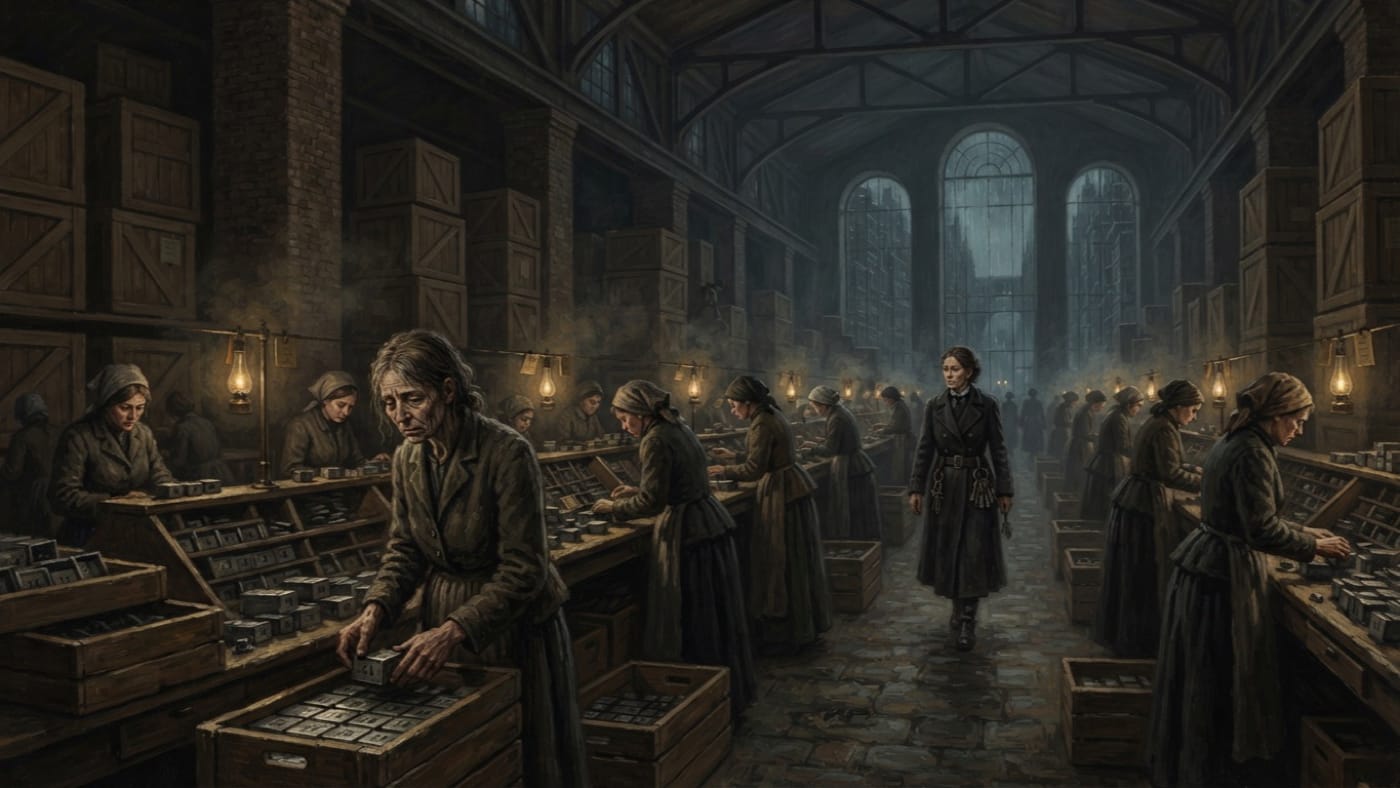
#On the Sixth Terrace
Lamp-debt: a Widowlight obligation. Rheinscarp street usage; absent from every official form.
The Widowlight Quarter occupies the sixth of Rheinscarp's nine terraces, in the Rhine gorge of the central Heartlands, Zone 2. Below it lies the Ledger Cloister, where the city keeps its names. Above it rises the Ash Exchange, where the city prices its dead. The quarter sits between the filing and the appraisal, and it works at night.
Every terrace in Rheinscarp has a trade and a smell. The Mill-Crown has flour-dust and hot gears. The Cloister has wax and old paper. Widowlight has night warehouses, oil-smoke, and a workforce recruited by the Sagittal Line, which kills the husbands and sends what they owed upward.
The city's registered population is approximately two hundred and forty thousand. The Bureau holds no separate figure for Widowlight. It has no census of the quarter, no count of its warehouses and no tally of the women on shift. A district that exists to take inventory has never been inventoried itself. I note this as a scholar. The Wardens would call it discretion.
#On the Warehouses and Their Draft
When a man dies on the Line, his debt survives him. Stair-token arrears, ration advances and confession penalties are written against households, and the household that remains is often a single woman. At that point the Widowlight draft takes her. She is assigned to the night warehouses, of which Widowlight Stores is the name most often entered in the returns, and put on the lamp-oil shifts to sort, pack and keep inventory. The goods go into crates, the crates go onto lists, and the lists go down to the Cloister, which is the nearest office that wants them.
The Widowlight Wardens run the work. They are half monastery and half labour office, and they have never said which half signs the rosters. They hold the warehouses, the lamp-oil and the inspectors. Their public formula is honouring the dead through service. The formula is accurate except about who is being served.
The Wardens issue tallow lamps on quota. A worker gets the light she is allotted, works by it and answers for it. Her lamp-tag marks the issue. What she owes the Wardens is called lamp-debt on the terrace and nothing at all in writing. The rate is unpublished. So are the repayment term and the conditions of release, if release exists. I have looked. When a Bureau is completely silent on a point, the silence is a policy.
Beyond the quota, the Wardens' method is moral. A widow who falters is reminded of what she owes the dead man whose debt she carries, and a reminder costs less than a guard. They are also said to want the draft extended from widows to every debtor in the city. No such extension has been enacted. I record the ambition anyway, because in Rheinscarp ambitions acquire seals faster than statutes do.
#On Lamps, Tokens, and Entitlement
A woman on the sixth terrace must agree with herself in five places. The Wardens must record her shift. Her name must match the entry Records holds one terrace down. Her crossings must stand in the stair-token registers: each clipped brass token is good for one terrace boundary, and every crossing requires authorized verse, payment and registration. Her bell-credit window must fall where the office of Cantor-Marshal Hrodric Venn has placed it, because a missed window collapses ration priority. Finally, the Bureau of Tithes must read her ration claim against the other four.
Night labour sits awkwardly inside a curfew city. After curfew the stairs become confession corridors and only licensed cargo moves. The warehouses keep running because they hold licences. The workers inside them are covered only as far as their papers hold.
If the five records agree, she eats. If they disagree, the city believes the paper. A failed crossing can produce administrative absence, and a worker can be corrected off the entitlement rolls while she stands at a sorting bench with the city's stock in her hands. One of the corrections documented under the Absence Quota is a widow's shift credited to her dead husband. The dead man stays in service, and the living woman disappears from the record of her own work.
The Wardens own the shift. The rest of the apparatus belongs to others. The Synod Chapterhouse holds formal supremacy. The Tribunal of Stairs, the Records annex and the Tithes machinery control movement and entitlement across the whole city. Praetor-Registrar Ysabeau Kelm keeps the names, Venn keeps the hours, and Broker-Saintsman Damas Rohe keeps the Ash Exchange. None of them governs Widowlight, and any of them can starve it.
#On the Grain Received Twice
In A.S. 198 (1908 CE), a single grain shipment was entered as received by both the Mill-Crown Terraces on the fourth terrace and the Widowlight Quarter on the sixth. The receipts on both sides carried authentic stamps. The grain was counted twice, allocated twice and delivered once. Between the two districts lay the fifth terrace and two boundary crossings. Those were two sets of windows where the discrepancy could have been noticed. At both, it was charged for instead.
Forty-one people died across the incident. The ledgers do not divide them between the two terraces, and I will not do the dividing for the ledgers. No source available to this survey records where the real grain went, who wrote the duplicate receipt or what the shipment weighed. Records audited the matter. The audit found the stamps genuine, which was the problem.
The deaths of the double-entry famine are to be understood as a variance within acceptable seasonal parameters, in accordance with Bureau of Tithes usage.
Withdrawn. The governing classification, entered by the Bureau of Doctrine after review of the parish burial rolls, is administrative incident, non-recurring. The Tithes wording remains in the Tithes files, where it still describes forty-one persons as weather.
The famine did not begin the Absence Quota. It exposed it. Living people could be struck from the entitlement rolls while they were still present, still working and still hungry, so that the ration tables would balance. The street puts the city's rate at one in forty per quarter. That figure is an estimate. It is not in any official table, and nobody has measured it for Widowlight. A district whose workers must agree with themselves in five registers gives the Quota five places to start.
#On a Sorter Marked Absent
The record holds one case from the quarter.
CASE FILE AQ-198/17 — WIDOWLIGHT QUARTER Subject: Mara Senn, lamp-oil sorter, registered living A.S. 197. A.S. 198 status: "temporarily absent — ration already satisfied." Appeal: denied; appellant lacked proof of presence. Burial-precredit opened: same week. Final notation: █████████████████████████
The file says what it says. Mara Senn sorted lamp-oil. She was registered living in A.S. 197. In A.S. 198 the ration column declared her already satisfied and the register declared her temporarily absent. Her appeal failed for want of proof that she was present, a proof she was presumably trying to supply by appearing to appeal.
In the same week, burial-precredit was opened against her name. The Ash Exchange may open collateral against anyone whose record has begun to drift. A precredit shows that someone on the seventh terrace has put a price on her. It says nothing about whether she died. Her labour was on the sixth terrace and her collateral on the seventh, one stair apart. The paper climbed that stair without a token. She would have needed one.
Her final notation is redacted. The Codex does not know whether she died, survived or left Rheinscarp, or whether she was one of the forty-one. The file does not say, and this survey will not say it on the file's behalf.
#On the Present Shift
In A.S. 201 the warehouses are running. Quota lamps are issued, tags are kept and the inventory goes down to the Cloister. The draft is still limited to widows, which in Rheinscarp counts as restraint.
Above the shift, the city argues. The hunger-waiver advocates of the Bureau of Mercy hold that a body should be fed when its papers fail. The Tribunal-Tithes axis holds that toll sanctity is doctrinal and that hunger is no argument against doctrine. The dust futures scandal of A.S. 199, in which futures were traded on the cremains of people not yet dead, has sharpened the quarrel without settling it. On the sixth terrace the question is simple. A waiver would feed a woman at the bench whose name has drifted. Toll sanctity keeps her at the bench and keeps the window shut. No reform has reached the quarter. The advocates file petitions, the Tribunal receives them, and the shifts go on.
There is also the matter of the lamps. People who work at Widowlight Stores say the lamps whisper, and men swear to it too. The claim is old enough to be repeated and plain enough to be tedious. The quota tallow, burning through the night shift, makes a sound some listeners take for speech. The Bureau records the claim. It records no speaker and no message, and it has found no link between the sound and the famine, the absences or the booths below that write in empty rooms. The workers say what they hear and are logged as having said it.