

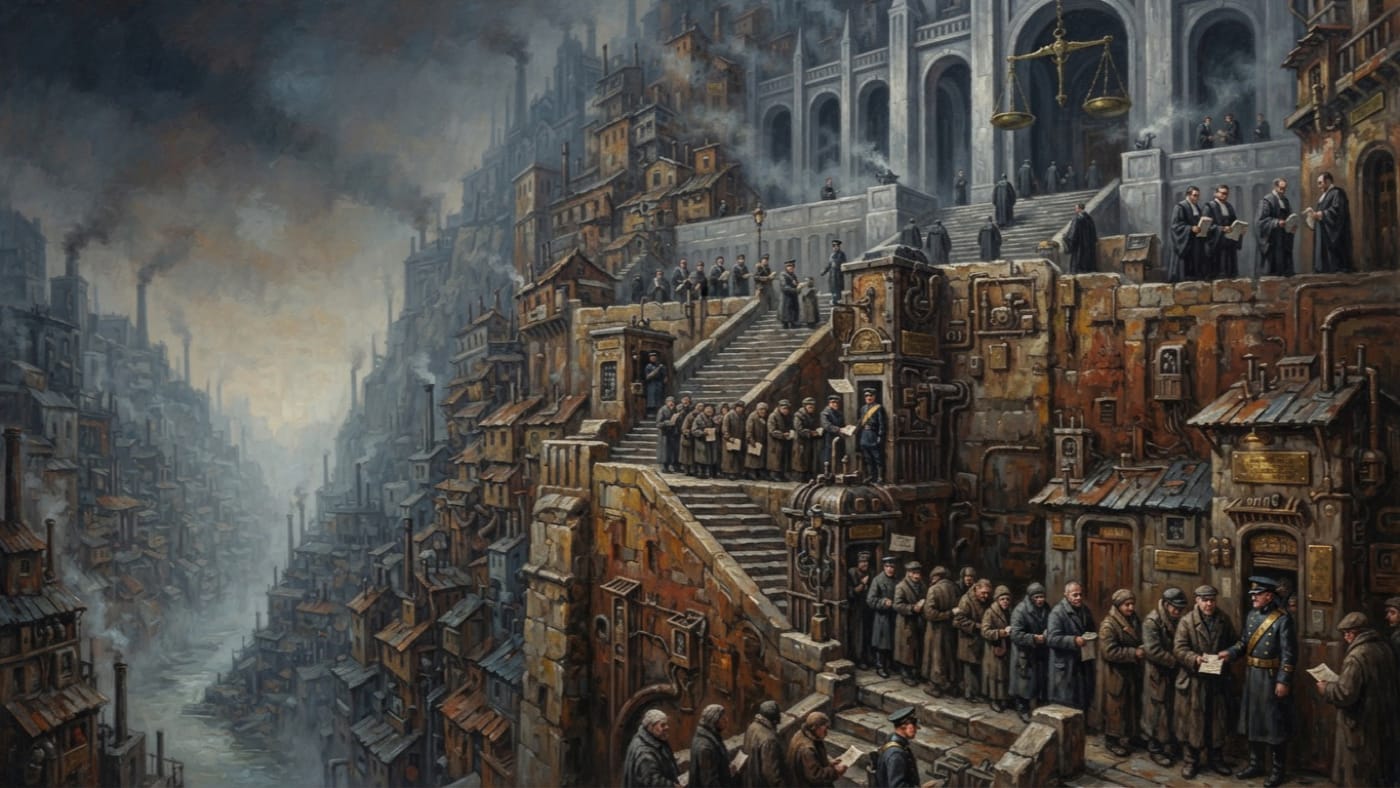
#On the Station of the Summit Court
"Orderly movement is holy." — Public formula of the Tribunal of Stairs
The Tribunal of Stairs decides who may climb Rheinscarp. It also hears the complaints of people who have been forbidden to climb, and it hears them at the top. Every lawful petition against the stair must first survive the stair. The Tribunal does not count this as a defect. It counts it as proof that the system is coherent.
The court sits in the High Step Precinct, the ninth and last of the Nine Steps. The air there is clean and the marble is cold, and the names in the registers are spelled to the satisfaction of the people who spell them. Its territory runs from that summit down through the stair corridors: the Hundred Steps, the toll-stairs, and the gatehouse landings, where one clipped brass plaque buys exactly one terrace and no more. Below the Precinct lie eight altitudes of flour dust, lamp-smoke, ash brokerage and river silt. The Tribunal does not govern them. It governs the joints between them, which is a cheaper way of governing everything.
A person in Rheinscarp moves lawfully only while recognized. Recognition belongs to the Bureau of Records and movement belongs to the Tribunal. The two keep their ledgers close together, so a failure at one window is entered at the other before the person who failed has finished walking back down.
#On the Toll Before the Sacrament
The stairs were once free. The quarry scars on the upper terraces keep the work of Rationalist masons who cut stone without reciting any verse. The old lockworks at the foot of the cliff took coin from barges, and people walked upward for nothing. The Tribunal does not dispute this history. It merely finds it actionable.
The Sundering of A.S. 45 sent refugees and convoys up the river. The Silt Year of A.S. 78 drowned the lower terraces and drove the survivors upward. A river-warden whom the Ledger remembers only as Warden K. then enacted the first stair-toll regime. That regime was practical. The cliff had suddenly become too small for the people living on it, and the toll rationed the space. In those years a toll was a fee for a step.
The sacrament came later. The Concordat of Strasbourg set up the formal Synod in A.S. 90, and the Tribunal's local charter is reported in A.S. 92. Somewhere between the constitution of the whole Church and the charter of this one court, crossing stopped being traffic and became registration: coin, verse, stamp. If you misspeak the verse at a terrace boundary, you are entered as absent. Confession can repair the entry, and confession is billed.
By A.S. 92, when the first Bureaus received their formal constitutions under the Concordat, Rheinscarp had already built the architecture of its own tyranny.
Corrected. The constitutional settlement of the Concordat belongs to A.S. 90. The Tribunal of Stairs received its local charter in the reported year A.S. 92. The Bureau regrets that it let one city's paperwork borrow the Synod's dignity. Rheinscarp needs no help inflating itself.
The day of the charter, its signatories and the hand that drafted it appear in no register available to this office. The founders were dead before A.S. 90. They will not be dragged up the Hundred Steps to sign anything.
#On Judges, Provosts, and Writs
The Tribunal has three instruments and uses all of them without embarrassment.
The judges sit in the Hall of Steps, a chamber of hot wax and cold marble whose main product is summary erasure. They hear stair disputes after the midday mills start roaring and before curfew turns every stairway into a single-file line of penitents. The judges are said to keep a private register called the Absent Book. They have not told the Bureau of Doctrine what it contains, who keeps it, or what it is for. Doctrine has not asked, because any question put to the Hall of Steps gets entered somewhere.
The provosts enforce. Their brass sashes are the first ornament a newcomer at the First Step Market learns to dread. They work the tollhouse windows beside the Records clerks. They check tokens for clipping and listen to the verse, and in the space of a breath they decide whether a stumble was a stammer or a heresy.
The writs complete the arrangement. A Tribunal writ can seize a purse of tokens, a cargo, a lift-cage licence or a whole staircase. Seizure is the Tribunal's favourite sermon and a public example is its favourite congregation. When a forged Step-Seal is marched through the market at noon, the market learns the theology of movement faster than any cantor could teach it.
The Tribunal now wants toll jurisdiction over private stairwells too: the back stairs of warehouses, the steps between a widow's door and her landlord's, the ladders in the mill-chutes. No such jurisdiction has been granted across the city. The Tribunal is patient. It has already persuaded a whole cliff that walking is a sacrament, and a cellar staircase will not hold out for long.
#On the Appeal of the Absent
The Absence Quota takes living people out of the ration count through small corrections. A name loses a letter. A stair receipt is entered on the wrong terrace. A parish line stops matching a residence. The corrected person keeps their body and loses everything their body needs. The flour window refuses them, and so do the parish dole and the stair.
The appeal against absence lies before the Tribunal of Stairs, and the Tribunal sits at the summit.
Follow the route as the regulations lay it out. The appellant starts somewhere below, in the Sump Docks, the Widowlight Quarter or the Mill-Crown. Between them and the Hall of Steps stand terrace boundaries, and each one demands the authorized verse, the payment and registration. Registration requires a valid present status, and present status is exactly what the appellant is appealing. Every window they fail confirms the condition they are climbing to contest. Each failure goes into the same ledgers the Tribunal will consult when they arrive, if they arrive.
The Tribunal says appeal exists, and it does. If an applicant cannot prove presence when filing, the rules let them appoint a present advocate. The advocate climbs and the advocate pays. The advocate also takes on limited liability for the client's absence, and none of the surviving warnings says where that limit lies. A false claim of presence is punished by descent without a return stamp: the claimant goes down the stair, and the stair keeps no record that they may come back.
Now do the advocate's arithmetic. Someone in good standing, with tokens enough for nine boundaries, must take on an undefined share of a stranger's nonexistence in order to carry that stranger's case uphill. Some advocates do it for pay. Some do it out of mercy. Some do it once.
The surviving rules do not say what happens to appeals once they are filed. The Bureau keeps no tally of successes or refusals and will print none. The record shows that appeals reach the Hall, and the Quota's own case files show that some are denied. Everything else is in registers sealed above the fog.
#On Those Who Profit and Those Who Object
The double-entry famine of A.S. 198 killed forty-one people when one grain shipment was allocated twice and delivered once. It made the Quota visible. It did not invent the Quota, and it did not create the Tribunal. It showed which offices eat when a mouth is misfiled.
Three powers profit. The Tribunal gets order: fewer claimants on the stair, and fewer hungry bodies at the window whose presence argues against the tariff. Records gets control. Praetor-Registrar Ysabeau Kelm holds the spelling of every name, and a population afraid of being misspelled comes to her clerks on its knees. The Ash Exchange gets collateral, because Broker-Saintsman Damas Rohe's brokers can price a drifting name as future dust. Cantor-Marshal Hrodric Venn keeps the bell-hours that open and close the ration windows. None of these officers is the Tribunal's presiding judge, and none needs to be. No register shows the Tribunal choosing who becomes absent. It needs no such register. It only has to make sure that the absent stay where the ledger put them.
The main objection comes from the Bureau of Mercy. Its hunger-waiver advocates argue that a body standing at the window should get bread when its papers fail. The Tribunal, standing with the Bureau of Tithes, replies that the sanctity of the toll is doctrine and doctrine does not yield to hunger. That is the whole dispute. It is argued in administrative language and its result is counted in loaves.
The quarrel does not divide neatly by Bureau. Not every Mercy cleric signs the waiver petitions, and not every Tithes assessor sleeps well. Some Mercy clerks stamp refusals. Some provosts look away when a verse is stammered. The Tribunal keeps writs for the second kind.
#On the Present Application
As of A.S. 201, the Tribunal's claim over private stairwells is still only a petition and a hope. The Hundred Steps are still the only legal vertical corridor for bulk cargo, and a tenth Step is still only proposed.
A newer pressure has come up from below. Certain tollhouse booths write entries on night shifts when no clerk is present, recording crossings by people who did not cross. Some of the people named in those entries were later marked absent. No document puts these booths under the Tribunal's command, and none makes them responsible for every absence. Still, they write in the Tribunal's corridors, on the Tribunal's forms, in a hand the provosts cannot fault. No ruling has been published on whether a phantom crossing counts as presence for an appeal. The Bureau of Doctrine does not plan to climb nine terraces to ask for one.
The Tribunal is still in session, and for anyone who wants to reach it, the stair is still the first examination.