

#On the Account
This tract was compiled in A.S. 201, 1911 by the vulgar reckoning, and that year dates the compilation only. The incident it examines has no year in any account I am willing to sign. I have searched, and so has the Bureau of Records. Between us we turned up a great deal of ink and no date, which is the usual result of asking an archive a direct question.
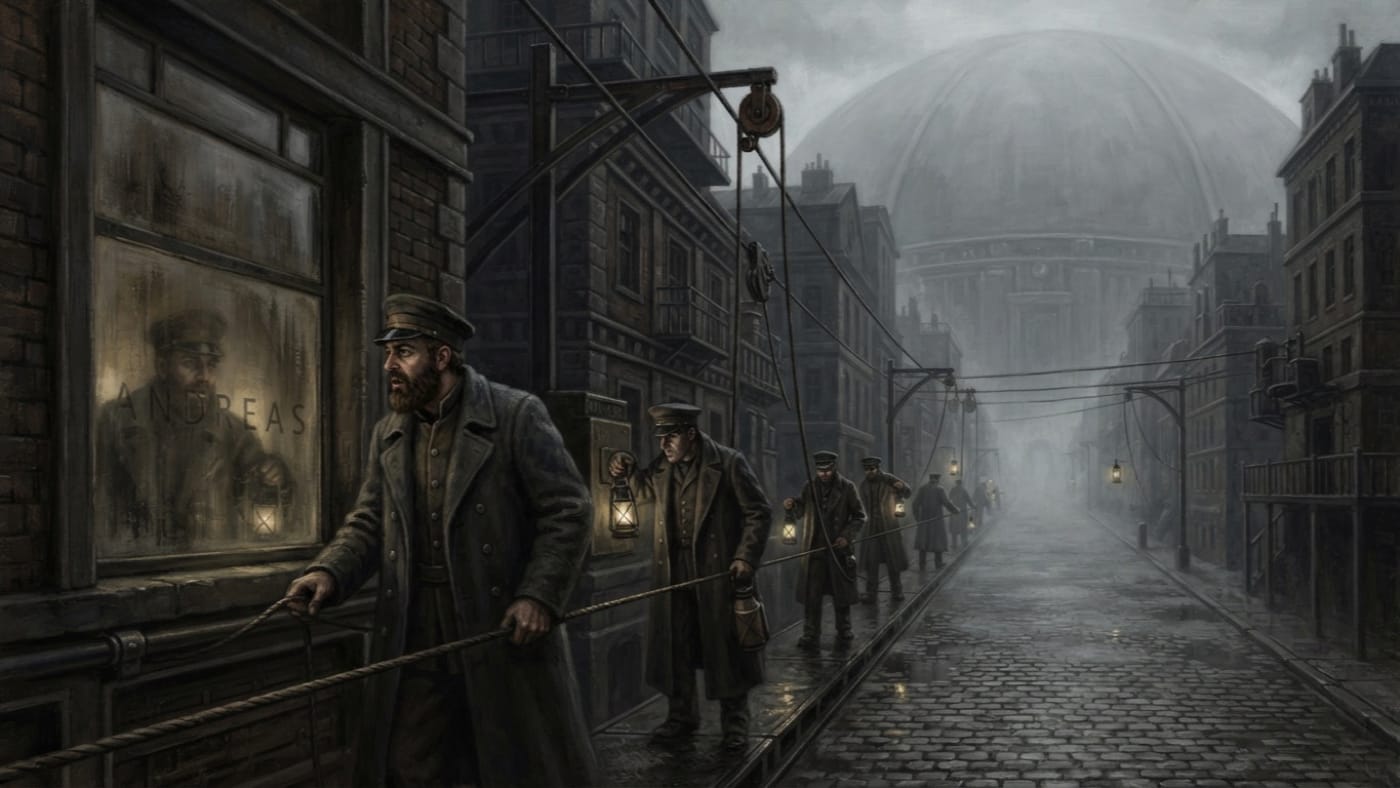
The surviving account is short. A Silence Dome fell along Processional Road. Rope-road crews were working beneath it, and they lit memorial lamps to keep their direction. The lamps were reflected in glass, and the reflections spelled names. Each man read his own. The men walked into the pall, and none returned.
My survey of the Domes records that sequence, and my survey of the Hush Lofts repeats it. Two of my own articles agreeing with each other is gratifying. It still amounts to one account told twice, and I will not dress it up as two witnesses. The city through which Processional Road ran is unrecorded. So are the size of the crew, the men's names, their employer, the season and the hour. Any clerk who wishes to supply these details may also supply his own name on the confession form.
The evidence supports a narrow question: what the men saw, and what they did. Why they did it is a larger question, and no department owns the answer.
#On Lanterns and Names
The rope is the road. On the high walks a man keeps one hand on the cord, and the cord tells him where the next man is, where the anchor is and where the drop is. Rope-road crews splice by hand under lamps that burn, as the saying goes, for their own funerals. On Processional Road the lamps were memorial lamps, kindled for the dead and pressed into service as markers of direction. I can tell you they were memorial lamps. I cannot tell you whom they memorialised, and I decline to put a widow at the end of every wick to make the reader comfortable.
The account says glass and nothing more. It does not tell me whether this was a window, a lamp-chimney, a reliquary case or a shopfront. Lamp-light struck it and came back. In the reflection, strokes of light became letters, and the letters formed a name.
Each man saw his own name. On that point the account is exact, and it is exact on nothing else nearby. It does not record whether any man saw another man's name, how long the men stood looking, or whether they hesitated. It records the next act. They walked into the pall.
Under a Dome nobody could have called them back. A shout dies at the teeth. If any foreman on Processional Road tried to stop his crew with his voice, he was praying with his mouth shut and calling it command.
None returned. The account ends there, and the Ledger ends with it.
"None returned" is a report of absence, and an absence cannot certify a death. No recovered bodies are recorded. No search party is recorded, and no later sighting. Nothing shows possession, removal elsewhere, sacrifice or any other ending a pamphleteer might sell at a penny a sheet. Knowing your own name when you see it proves no theory of true names, souls or compulsion. The resemblance to a summons is strong, and I feel it as keenly as anyone. A resemblance remains a resemblance, and the Bureau does not put feelings under seal.
#On the Failed Medium
A Dome is an acoustic null, filed among the Wound-Sites and held in the custody of the Bureau of Orison. Inside one, every audible instrument of order fails: bell, bugle, sermon and the sergeant's bark. What remains is anything that can be seen or felt. Dome procedure in every sector relies on hands, rope-tugs, chalk, shuttered lamps and mirror glints. A crew under a Dome survives by reading light and touch, because nothing else reaches it.
That is why the incident matters to procedure. The men on Processional Road were doing what Dome discipline required. They lit lamps for direction and they watched for light. When light gave them something to read, they had already been trained to treat it as an instruction.
Here a careful officer must separate two things. A reflection can carry legible information. An order needs an issuer, a lexicon and a seal. A Silence Dome Pass lists the signal lexicon its bearer may use. I have read a good many of those lists, and none of them includes the bearer's own name written in a window. Whatever spelled those names had no lexicon, no seal and no rank, and men still followed it.
Earlier public summaries described Dome failures as morale deficiencies among affected troops.
The existing field correction stands and applies here. Audible command cannot cross a failed medium. A crew that walks toward a lit word under a Dome has not shown weak morale. It has read the only medium left to it.
The Bureau of Engineering has its own views on what a Dome does to air, and so does Doctrine. Neither view names a culprit for Processional Road. I will not borrow a general theory of Domes and stamp it on a single night of which I know five facts.
#On Glass and Precaution
Orison's field advisory on reflective hazards is short enough to memorise and dull enough to ignore. Hood the lantern. Cover the reliquary glass. Dull the buckle. Do not read names in a reflection. The advisory exists because of the account examined here. Its existence proves the Bureau was frightened. It proves nothing about what frightened the Bureau.
Each measure deals with a surface. A hood keeps a lamp's light low and pointed, so that it shows a hand-signal without spilling onto every pane in the street. A cover over reliquary glass removes the most sanctified mirror a soldier carries. A dulled buckle is one fewer bright thing on a man's own body. None of this is said to banish anything. It reduces the number of places where light can come back carrying words.
The caution applies with special force in the Hush Lofts. These are upper rooms and attics where occupants who cannot trust their voices rely on their hands, and hands are useless in the dark. Some light has to be admitted. The Circle of Mute Radiance, whose vocabulary gave the lofts their name, issues its commands by hand-code and mirror-shard flash. Its headquarters at the Hush Loft keeps its shrine candle barely lit. A loft therefore has to manage a narrow margin. With too little light, an order is lost between two people. With too much, the window tells the street that someone is awake. With a carelessly angled shard, the occupants may read something they never sent.
That last risk is the one the advisory addresses in the lofts. The application concerns lofts as a category. It places no member of the Circle on Processional Road, and it assumes an active Dome in no particular attic. Rooms named for hush are not necessarily rooms where sound has died.
I cannot promise that a hooded lamp would have saved the crew on Processional Road. Nobody can promise it, and the advisory does not try. It removes a surface that once delivered a name, and the Bureau has always had to buy safety one surface at a time.
#On the Present Use of the Account
The compiler of A.S. 201 may keep the following. A Dome fell on Processional Road. Rope-road crews lit memorial lamps for direction. Glass reflected those lamps as names, and each man saw his own. The men walked into the pall and none returned. Orison's advisory on reflective surfaces followed, and it now governs any setting under Dome conditions where people signal by sight, the Hush Lofts included.
The compiler may not keep a year, a city, a count of the dead, a list of names, a lamp code, a culprit or a fate. The incident must also be kept apart from two neighbours that a lazy clerk would merge with it. The Silence Siege of Kiev is a separate horror with its own file. The Quarter of Widow's Light is a separate place with its own lamps and its own stories. A shared vocabulary of widows and lanterns does not make them the same file.
The tract is filed. The road is named. The men are not.