

#On the Survey and Its Ground
This is a survey of the Quarter of Widow's Light as it stands in A.S. 201. It covers what can presently be seen, counted and attributed, and nothing older. I have no founding charter to give you, because no one has produced one. The Quarter is a trench-support district of Bastion-Constantinople, the southern anchor of the Sagittal Line. It lies just behind the Rope Roads and faces the Ravelin of Sorrow, the fifth of the six outer works. Its people store, count, sew, light and send. Its lamps are memorial lamps, and its labour is the labour of supply. The Synod has found it convenient that these are the same lamps.
Two anchors fix it, and I will not claim more. On one side hang the ropes and pulleys that feed the front across mud that eats boots. On the other stands Sorrow, a ravelin that faces this Quarter and also keeps watch on Chamber 7. This survey says nothing of streets, acreage, boundary stones or census, because the Ledger says nothing of them, and I will not draw a map from a mood.
#On the Warehouses and the Women Who Count
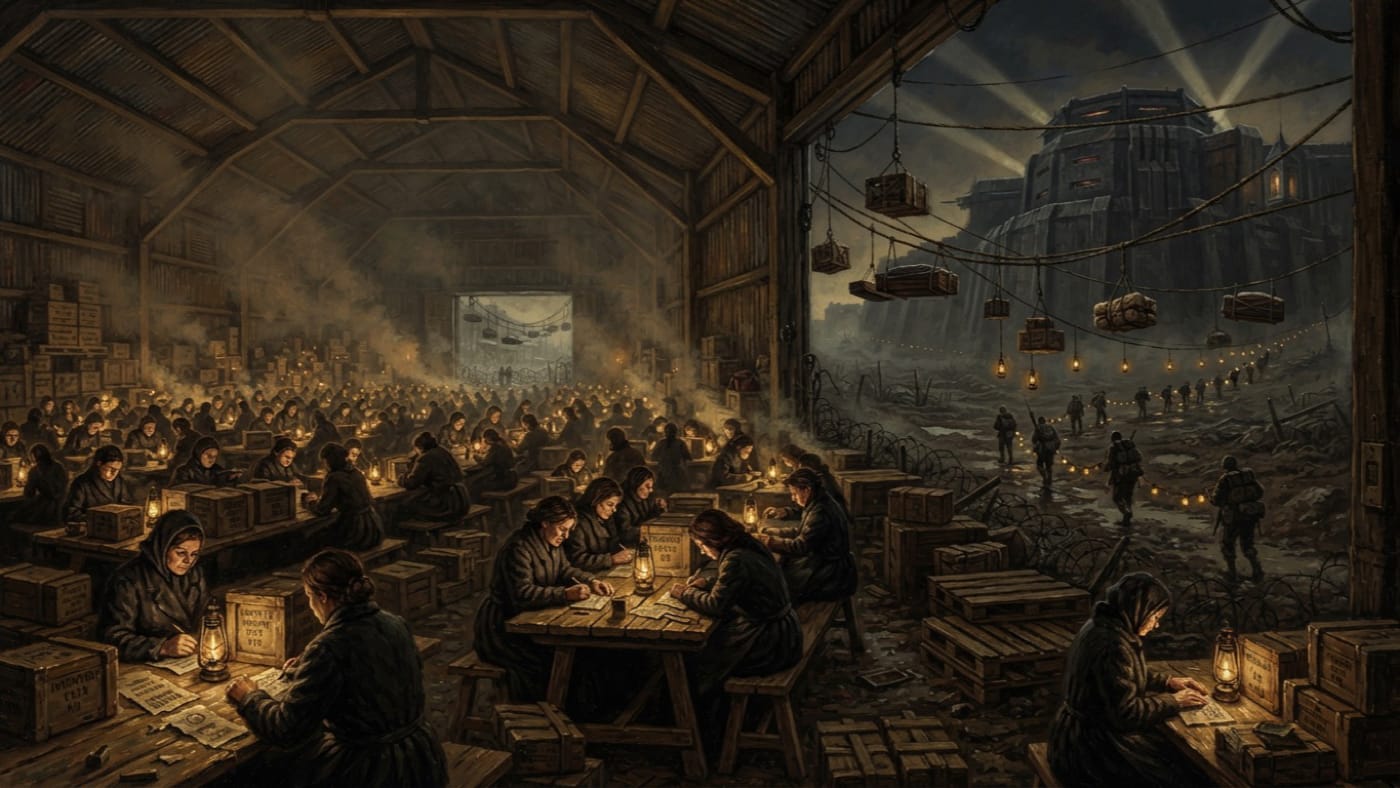
The warehouses are kept in permanent dusk. Oil-smoke sits under the rafters, in the sacking and in the hair. The floor is crowded with pallets. The pallets move in shifts, and the shifts are measured by lamps.
Widows are drafted here after their husbands fall. Each one receives a lamp inscribed with her husband's name. She keeps it burning while she counts crates or sews sacks, and when it gutters her shift is over. I record this plainly because the practice is plain. A woman sits at a trestle with a tally board and a needle. Beside her elbow, in brass and glass, is the name of the man the war took, lit by oil her own tithe helped to buy.
She never loses sight of the name. Perhaps that was the design, or perhaps an accident that the Bastion allowed to harden into one. She counts by its light and sews by its light, and when she looks up from a miscount she looks at him.
Each pallet carries crate numbers and, beside them, funerary sigils. Grain leaves the Quarter marked both as grain and as mourning. Salt goes out under a number and a sign for the dead. The clerks of the Bureau of Records can read both marks. The women who stamp them no longer need to.
Older accounts add that a faltering lamp could end more than a shift. I have searched for the ordinance. I have found the sentence repeated many times and the ordinance nowhere, and I record both facts without choosing between them. Constantinople has always preferred a threat that no one signed.
#On the Way to the Ropes
What the Quarter stores, the Rope Roads carry. Ration crates, coffins, reliquary chests and barrels of salt pork hang from the same ropes and ride the same iron pulleys above the mud of No Man's Land. Bread and the dead travel on one manifest. The soldiers ask which load is heavier. The Bureau of Tithes asks only that both be stamped.
Night supply runs leave by lamp. A squad moves as far as the next pool of memorial light, halts there, and goes on to the next. The bells of the Bastion govern the fortress, its kitchens and its cannonades. At the edge of the ropes the working measure is the distance between two lamps, and a squad that outruns its lamp has outrun its instructions.
The Quarter also supplies lamps to the rope crews. Long lines of lanterns are strung beneath the ropes, so that a man who crawls out to splice a frayed line does it under a funeral flame. The crews say every Rope Road is paved with widows before it is paved with crates. Doctrine calls the joke heresy. Records files it as probable truth.
This is supply, not sovereignty. The Quarter lights the ropes. It does not own them, string them, or answer for every pulley between the bastions. Anyone who wishes to know who does may consult the appropriate offices, and enjoy the consultation.
#On the Tithe That Fills the Lamps
The lamps burn oil, and someone pays for the oil. Widow tithe supports it. That is the arithmetic of the Quarter. A woman whose husband has been entered among the fallen pays toward the flame that bears his name, and then works by it. The Bureau of Tithes calls this devotion sustained. I call it devotion invoiced. The Bureau has never disputed my description, only my tone.
I give no rate. I can certify none that has been published, and a guessed figure is one some clerk will later try to collect.
Descriptions of the Quarter have said its lamps burn oil rendered from widows' tithe as "a mixture of fat, tears, and ash," and the Bastion's own list of the ravelins speaks of oil "distilled from tears."
Tears do not burn. The survey of the Ravelin of Sorrow says so with admirable bluntness. The chapel's oil is bought with widow-tithe remittance, made up with Pilgrimage candles and scented with ash-rose from the Ash Gardens. The tears reach the lamp through the account book, and never through the wick.
That chapel deserves its own article and gets one sentence here. The Chapel of Widows' Light stands inside the inward shoulder of Sorrow and keeps its own lamps, its own ribbons and its own quarrels, while the Quarter is a district of warehouses that the ravelin faces. Petra Valenne commands Sorrow. Nothing in the Ledger makes her governor of the Quarter, and I would not be the one to suggest it to her.
The Widows' Syndicate is a third thing again: a consortium of war-widows that keeps lending-houses, relief offices and unofficial archives. It shares a vocabulary with the Quarter, because the city has only so many words for the women left behind. A shared vocabulary does not make a shared office. I find no record that the Syndicate collects this tithe, employs these women or keeps these lamps.
#On What the Lamps Are Said to Say
The reports are many and their filing contradicts itself. I give them as they were filed.
When the wind runs sharp, the lamps are said to whisper the names of the dead. Columns marching past have reportedly halted and answered a muster that no officer called, as if the glass itself had read the roll. The same reports say some marchers would not move again, convinced the lamp had confirmed their deaths before the clerk could. Soldiers passing the warehouses at night speak of prayers rising inside, in more voices than there are women at the trestles.
The Bastion's pamphlets call this fatigue-induced delusion, a diagnosis issued most freely to officers. Doctrine has dismissed the whispers as hysteria in one hand and, in another, welcomed them as the saints guiding the weary. Purity calls them heresy. Records holds transcripts that it says named officers before their deaths, and its redacted line classifies the matter as a statistical anomaly not to be discussed. No one has shown me a transcript I could set beside a death certificate and certify. I have been shown the folder. It is thick.
Then there is the glass. Lamps in the Quarter are reported to shatter for no cause. The shards are said to cut deep and the blood to clot into letters that spell names, often of men not yet dead. The account is repeated in the Codex survey of No Man's Land, which sets the two verdicts side by side. Doctrine says accidents. Records says premonitions. That entry calls both correct, which is the Bastion's oldest way of ending an argument. An accident and a premonition can share a folder, but not a cause, and no office has yet shown me the cause.
Nothing here is proven. Names in blood do not establish which man will die, by whose hand or when, and a halted column does not establish who called it. This survey records the reports, the classifications and the distance between them, and leaves that distance unbridged.
#On the Present Condition
As surveyed in A.S. 201, the Quarter does what it has done for as long as anyone has bothered to write it down. Crates are counted and sacks are sewn. Pallets leave under number and sigil. Lamps are issued, inscribed, filled from the widows' tithe and strung beneath the ropes. Squads go out at night from one pool of light to the next, and Sorrow faces them while they go.
The whispers are still reported, and the glass is still said to break. Doctrine and Records still disagree in writing, which is how the Bastion keeps a question open without having to answer it.
A woman finishes her count when her lamp gutters, and the name on the glass goes out with the flame. When she comes back, the lamp is filled again, and she has paid for the oil.