

#On the High Routes
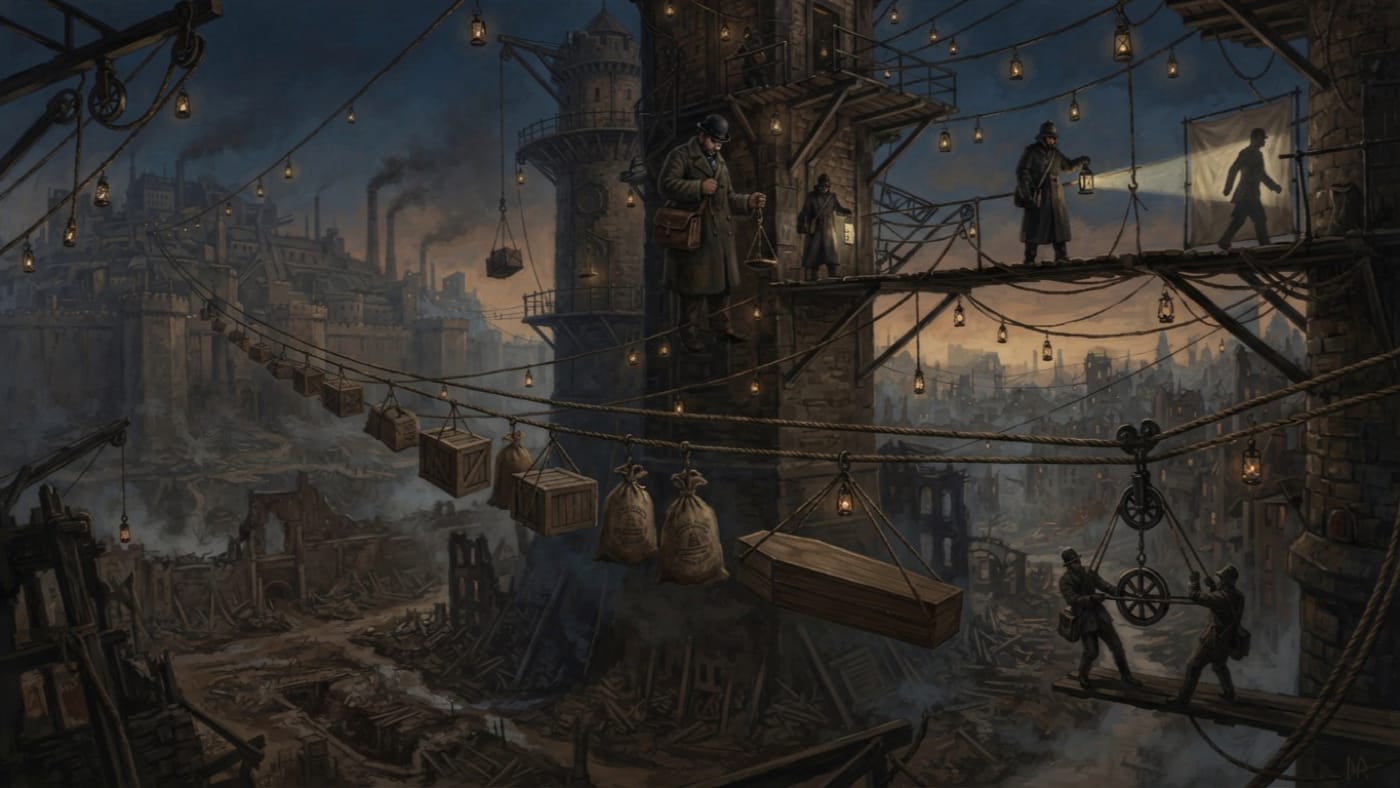
A Rope Road is any route the Church has persuaded to hang. The name covers the elevated cargo lines strung on rope and iron pulleys over mud, trench, canal, courtyard and bastion gorge. It also covers the pulley bridges and bridge-cords of the bastion towns, the stacked walks laid plank over plank above streets too crowded to use, the inspection gantries, and the customs lanes, where a clerk weighs a parcel in mid-air and tries not to look down.
Soldiers speak of the Rope Roads as one thing, the way they speak of the war as one thing. The Spine runs from Bastion-Königsberg on the Baltic to Bastion-Constantinople at the Bosphorus, and along it hang many such systems. Some are local and some connect one sector to the next. Each is rigged to the ground it crosses and to the needs of whoever rigged it. No single span runs the length of the Line, and no survey of record joins every bastion to every other by cord. At Bastion-Irongate the account lists the mountain gate, the rail spur and the convoy tunnel, and then admits a rare rope road over the ridge that runs only in season.
The class divides by what it carries. Freight rides the sling and the pulley, and people use the walks. The division holds until a wounded man is lashed into a sling. From then on he is freight, and the ledger enters him as freight.
#On What the Ropes Carry
Coffins ride beside ration crates and reliquary chests beside barrels of salt pork. Bread goes up the line, the dead come back, and quite often both hang from the same cord in the same hour. The crews have a question about it that the Bureaus have never answered: which weighs more, the dead or the bread?
Men travel too. The wounded are lashed down like cargo. Conscripts are strapped under tarpaulin and told not to scream, because screaming upsets the pulley rhythm, and a crew that loses its rhythm can lose its load. Some parcels are illicit and some are official. A few official ones are worse than the illicit kind, and some passengers have paid a good deal not to be seen paying.
The Line depends on all of this in the plainest way. The repair manuals put it in one sentence: if a Rope Road fails, an entire trench starves. In the towns, the high walks keep a bastion working after curfew, through flood, under shelling, and in the daily jams of a civilisation that has mistaken the queue for a sacrament. A pulley bridge moves bodies faster than any street.
Lesser trades use the same roads. Smugglers on the Bosphorus keep rope-road drop points next to their crypt-harbors and customs piers. In those waters, "reassignment" to the rope-roads is named as a punishment alongside immurement and drowning "accidents." Tavern runners in curfew fog work the underlevels beneath the walks, where the planks above keep off the rain and some of the scrutiny.
#On Pulling and Repair
Men pull unevenly. One heaves early, another late, the iron wheel stutters, and a coffin bound for the rear swings into a crate bound for the front. Above a trench, a stutter like that ends in a fall. The Bureau of Orison and Song has codified Rope Road Hymnals, chants shouted in time with the pulleys, so the crews pull together.
Crews report that the pulleys sometimes sing back. I have read accounts in which a rope "refused" to lower until it was addressed with the correct verse. Soldiers on certain sectors say the roads groan all night like a choir. Engineering personnel deny all of it, with the tired dignity of men who have heard it themselves. I record the reports and the denial and pass judgement on neither.
The repair literature treats the cordage as consecrated. It describes the strands as woven with ash, salt and bell-hours, blessed three times, knotted with catechism, and checked for tension against the relic-bones of saints. I give this as the devotional record of maintenance. Anyone who reads it as a recipe will meet the ground sooner than the Bureau intends.
Bombardment frays the lines, ash-storms snap them and ordinary wear eats them. When that happens, a crew crawls out along the sag and splices the break by hand. The Quarter of Widow's Light supplies the lamps for this work, long rows of lanterns strung beneath the ropes, so that a man repairing a line does it under a funeral flame. The Quarter supplies lamps and nothing more. It does not run the roads. The crews say every Rope Road is paved with widows before it is paved with crates. Doctrine calls that heresy, and Records files it as probable truth.
On sectors where Pale Chanters are reported, the hymnal is set aside. Repair crews pack their ears with reliquary wax, keep their eyes on the rope and talk only in tugs and gestures, because one forgotten knot drops a whole pallet into the trench. The Bureau sings to its crews on some nights and seals their ears on others. They are different nights and often different crews, and the arrangement survives on that fact.
#On Crossings Recorded
A rope-road also gives a view. From a pulley bridge a man can see who crosses between wards after curfew, and whose bundle is heavier on the way out than on the way in. He can see which widow visits which clerk, which priest avoids which checkpoint, and which Warden carries a box that should bear a seal and does not. The Church built inspection gantries and customs lanes into the high walks to watch parcels. They proved just as good for watching people.
Within the Lantern Brotherhood, the Circle of Rope-Road Lanterns claims these high walks as its jurisdiction. It works them with rope knives, pulley keys, grapnels, shutter-lanterns and sling-cord evidence bags. Its patrols go in pairs, followed by a Spark who watches behind them and never looks down. The pair angles its shutter-lanterns to throw a suspect's outline onto a wall, a cargo net or a bridge plank. In that outline a bottle becomes a shape and a folded letter becomes a rectangle. A chalk hook-arrow on a post means watch from above. Few citizens can read it, and the ones who can tend to change their route.
Pulley Station Hark is officially a maintenance tower and bridge-inspection post. It has a locked upper platform, and on that platform is a chalk wall that records who crossed, when, with whom, and what they carried. The wall is wiped at dawn. Before it is wiped, selected crossings are turned into anonymous tips for the Wardens, and others into private demands for payment. I give the station no city and no builder because the record supplies neither, and no authority over the wider network because it holds none.
The Bureaus disagree about the arrangement. The Bureau of Shadows approves, because high places collect secrets without any new construction. The Bureau of Purity objects that blackmail competes with confession. The Bureau of Tithes likes the revenue and dislikes the leakage, and has written memoranda that hold both opinions in a single paragraph.
#On Falls and Their Accounts
The danger is real before anyone helps it along. Lines snap in wind. Pulleys shear under weight. More than once a whole company has gone into the mire beneath a resupply line, and the official records call these events "transport mishaps." The Tithes Bureau has ruled that rope casualties are not to be logged as losses. They are entered as "contributions to vertical sanctification."
The Circle keeps its own hours on top of the ordinary hazards. At midnight comes what its schedule calls the accident window: selective drops and selective rescues. A sling-crate of contraband falls where the Wardens will find it. A courier stumbles into a net and stays there long enough for his satchel to be searched and resealed.
The Circle's other register is the Fall List, a hidden roster of people helped off the rope-roads on a patron's order. The impolite name for it is murder for patronage. If one widow ever obtained that list, the Wardens would erase the Circle rather than let the city learn who supplies its public order. No widow has obtained it.
Falls from the rope-roads during curfew are recorded as transport mishaps, the rope having failed.
Corrected. Falls from the rope-roads during curfew are recorded as transport mishaps. Some of the ropes failed. The ledger has only one column.
The official position stands as written: reports of intentional falls remain unverified by recoverable witnesses. A fall from a height leaves very few witnesses who can be recovered, which is why it is chosen.
#On the Present Use
This survey describes the Rope Roads as they stand in A.S. 201. They still feed the bastions and keep the towns moving after curfew. They still carry the dead and the bread on the same cord. Crews still crawl out along them to splice by hand, under lamps that burn for their own funerals. The Spine has no other route that moves freight as quickly over ground that cannot be crossed on foot. That is the reason the roads have outlasted every complaint against them.
The Circle of Rope-Road Lanterns remains under conditional toleration, with quarterly review of its pulley-key custody, its accident ledgers and its use of chalk. Its claim over the high walks is a claim to police them. It gives the Circle no ownership of the cordage, no credit for building it, and no running of every pulley from the Baltic to the Bosphorus. This survey found no single office that administers all the Rope Roads.