

#On the Observance
"Storms have signatures." — Saffron proverb
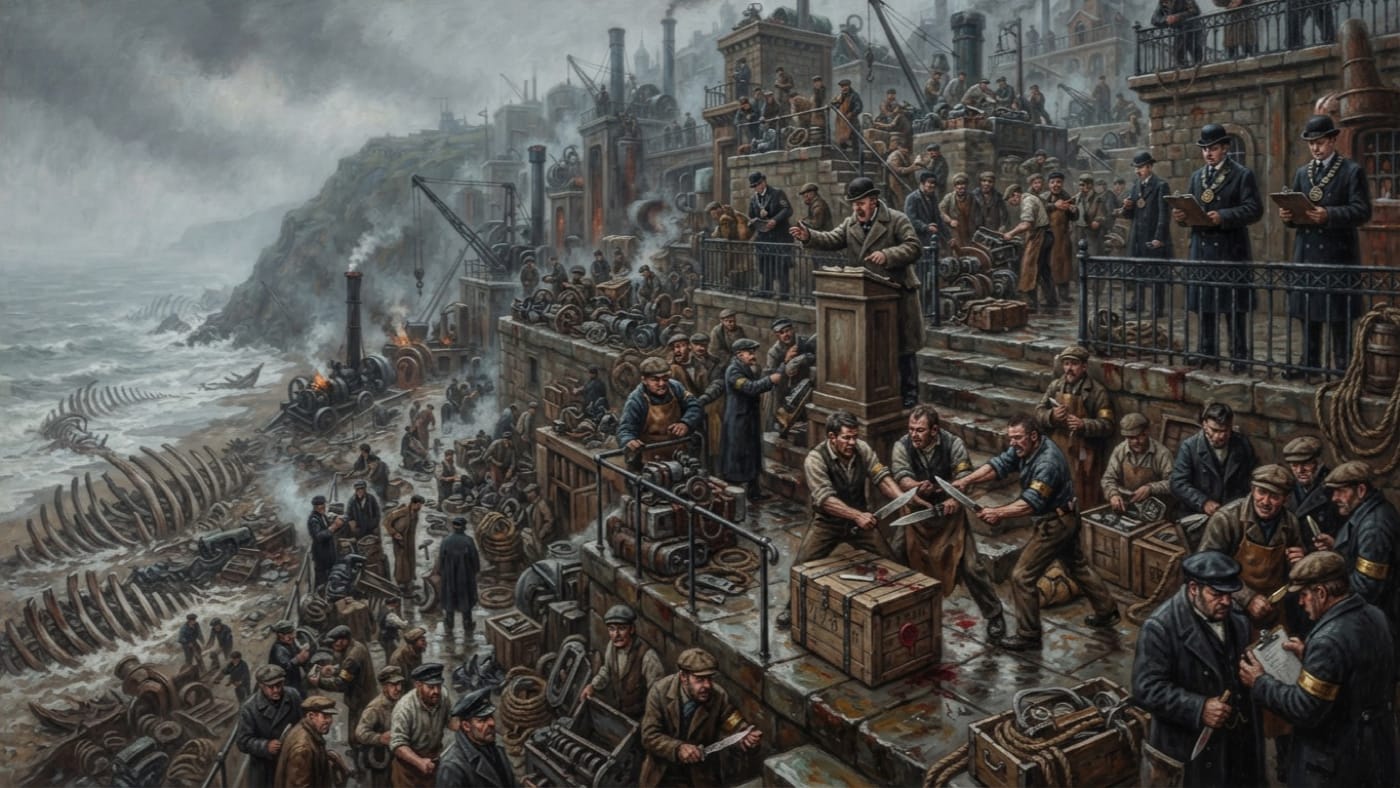
Of the festivals Saffron Bastion permits itself, Wreck-Tithe Day is the only one with an honest name. Saffron Flag Week puts its purity raids in drill order and bunting. Wreck-Tithe Day doesn't bother with costume. Salvage comes up the Wreckmarket steps, the lots are called, the claims are read aloud, and when two parties hold paper on the same crate the dispute goes to the knives.
That is everything the Coastal Registry can certify. Wreck-Tithe Day is a major festival of the port. It consists of salvage auctions. Knives come out over claims. I can cite no approved calendar that fixes the day, no founding instrument, no patron and no first observance. The Bureau of Records receives the dues the day produces and holds nothing on where it came from. The salvagers have never needed a calendar, because everyone on the beach knows when it falls.
#On the Auction Steps
The Wreckmarket sits low on the headland. It is built as stepped stone platforms above the wreck beaches, where the hulls lie on the shingle like the ribs of something the sea has finished eating. On any ordinary day the auctions run at midday, after the seals are stamped at the Third Quay Sealhouse and around the time the Insurance Courts open their hearings. Wreck-Tithe Day uses the same steps, the same auctioneers and the same goods. The only difference is the knives.
The district smells of rust, citrus peel and cheap rum. The citrus is there to cover the rot, and the locals call that cover fishmask. Everything on the platforms is wet. There is salvage metal stripped from hulls. There is sealed cargo whose seals have outlived their owners. There are fittings, chain and crates, and, according to the salvagers, a great many objects that are worth more than they appear. Buyers come down from the harbor-master class: chandlers, contractors, captains short a cargo. Fences come up from below, and nobody asks which direction they came from.
The papers matter more than the goods. A Saffron salvage claim is presented in oilcloth, because wet paper is worthless here and the phrase also means a bribe. A respectable buyer shows dry hands. Payment goes in coin, salvage tokens or salvage coins stamped with a quay number. I would set down the exchange rates if the Wreckmarket would admit to having any.
#On the Claims
The Gilt-Knives are the Wreckmarket Salvagers, a cartel with divers, boats and fences. Their territory is the Wreckmarket and the wreck beaches. They call their work salvage recovery, and the Quay Chapterhouse is content to file it under that heading. They control the auction schedules. In a market where a lot loses value every hour it sits in brine, deciding when a crate is called matters about as much as deciding who owns it.
Their real purpose is the "sainted" wreck. Some hulls are held under that designation, and competitors are kept off them. The Registry knows what the designation does. It does not know how a wreck gets it. I can find no canonization docket, no reliquary inventory and no bishop's signature. All the designation demonstrably achieves is the exclusion of competitors. In a port where everything else can be bought, including the seal on your cargo and the pass in your pocket, an unchallenged salvage claim on a sainted wreck is one of the two things that cannot. The other is a clean quarantine release during a fever spike, and that tells you which things Saffron really holds holy.
The cartel uses three methods. It uses violence, which needs no gloss. It forges claims, which is why the claims have to be read aloud. It stages wrecks, and this the Registry may record only as a stated method of the cartel. It is not a finding against any particular hull, lot or festival. When a forged claim meets a genuine one on the steps, and a third claimant has quietly bought the diver who found the crate, the auctioneer has no procedure to follow. The festival supplies one.
The Bureau of War does not intervene, because the Gilt-Knives pay their dues on time. No exemption has been filed, and none has been needed. A tribunal would want testimony. The steps take whatever the steps are given.
ERRATUM — Coastal Registry: A previous entry on the Gilt-Knives described Wreck-Tithe Day as the occasion "when the season's disputed claims come to the auction steps together." The Registry has found no instrument that consolidates salvage claims by season or sends them to a single hearing. The phrase is withdrawn. The disputed claims remain disputed, and nobody has gathered them anywhere.
#On the Tithe and the Writs
The name promises a tenth, but a name is not a legal instrument. The salvage tithe is one of the port's established revenues. It sits in the ledgers beside the salt dues, the berth fees, the pilgrim intake fees, the confession tithes and the storm levy the Quay Chapterhouse imposes in bad seasons. The Registry records that it is received. It does not record the rate, the way it is assessed, the clerk who collects it or the office that keeps it. Whether the day takes its name from the tithe, or the tithe was simply the one thing everyone could agree on, is a question I leave to whoever survives the next one.
The money doesn't end on the steps. Down the hill, the Insurance Courts issue writs, liens and arbitrations, and among their instruments is the salvage-loss indemnity. That writ compensates the owner of lost cargo at a rate the Courts set themselves. So a crate brought up the Wreckmarket steps may already be a loss on someone's indemnity, a lien on someone's wages and a forged claim in someone's oilcloth, all before the auctioneer opens his mouth. The Courts have no need to come down to the beach, because their paper is already there.
Readers trained in Strasbourg tend to assume that a holiday of open knife-work must suspend the law. It doesn't. The Courts' storm exceptions suspend civil law only during declared emergencies, and the festival is not one. Every statute in Saffron stays in force while the blades are out: the seals, the dues, the liens, the curfew chains waiting for evening. Civil law is fully in effect on the steps, and the knives are drawn anyway.
#On Those Who Bring It Up
The salvage does not climb out of the sea by itself. Saffron's salvage divers live in Low Nets, under the terraces and above the tide culverts. They work the under-wall at night and the beaches by day. By local reputation they are short of teeth and tell the truth only underwater. The Gilt-Knives employ divers. So does whoever outbids the Gilt-Knives for a single afternoon. Waterfront labor at Saffron belongs to whoever pays for it this tide.
The Ropehand Compact, the Dock Union of the Low Nets, works the same waterfront and draws on the same families. It is a separate organization. Sharing workers is not sharing a command, and the Registry has no evidence that the Compact and the cartel answer to one hand. Anyone who claims otherwise should bring documents in oilcloth.
Much of what reaches the steps comes from the Sainted Wreckfield, two or three hours out by skiff. That water yields salvage, rumors of relics, wars over claims and arguments with the Quarantine Prefecture over holds on crews and cargo. Divers there report demon-lures, undertow and missing time. A wreck there is said to have rung bells underwater. That report is attributed and has not been authenticated, and the auditor sent to look into it has not come back. None of it lowers the bidding. A crate rumored to be a relic sells for more than a crate known to be a crate.
Diver's statement on the condition of the recovered lot ████████████████ "it was dry inside, all of it, and the seal was ███████████" ██████████ statement closed at the diver's request. The diver was not available for a second statement.
#On the Present Condition
Wreck-Tithe Day goes on, as the port's major festivals do, with no founding text and no plans to stop. The steps are still stone. The beaches are still full of ribs. The claims are still read aloud in front of men who can't read them. Canon-Marshal Sable keeps her back to the water. Prefect Greaves keeps his holds. Canon-Inquisitor Silex Marrow is expected in Saffron with authority to audit the Insurance Courts' pre-signed exceptions. His commission says nothing about the Wreckmarket, the bid sheets or the knives, and I know of no addendum.
The lots will be called in their order, whatever that order is and whoever wrote it. Someone will present a dry claim in oilcloth, someone else will present a drier one, and the auctioneer will step back from the platform edge.
The sea pays what it owes. On Wreck-Tithe Day it pays in public.