
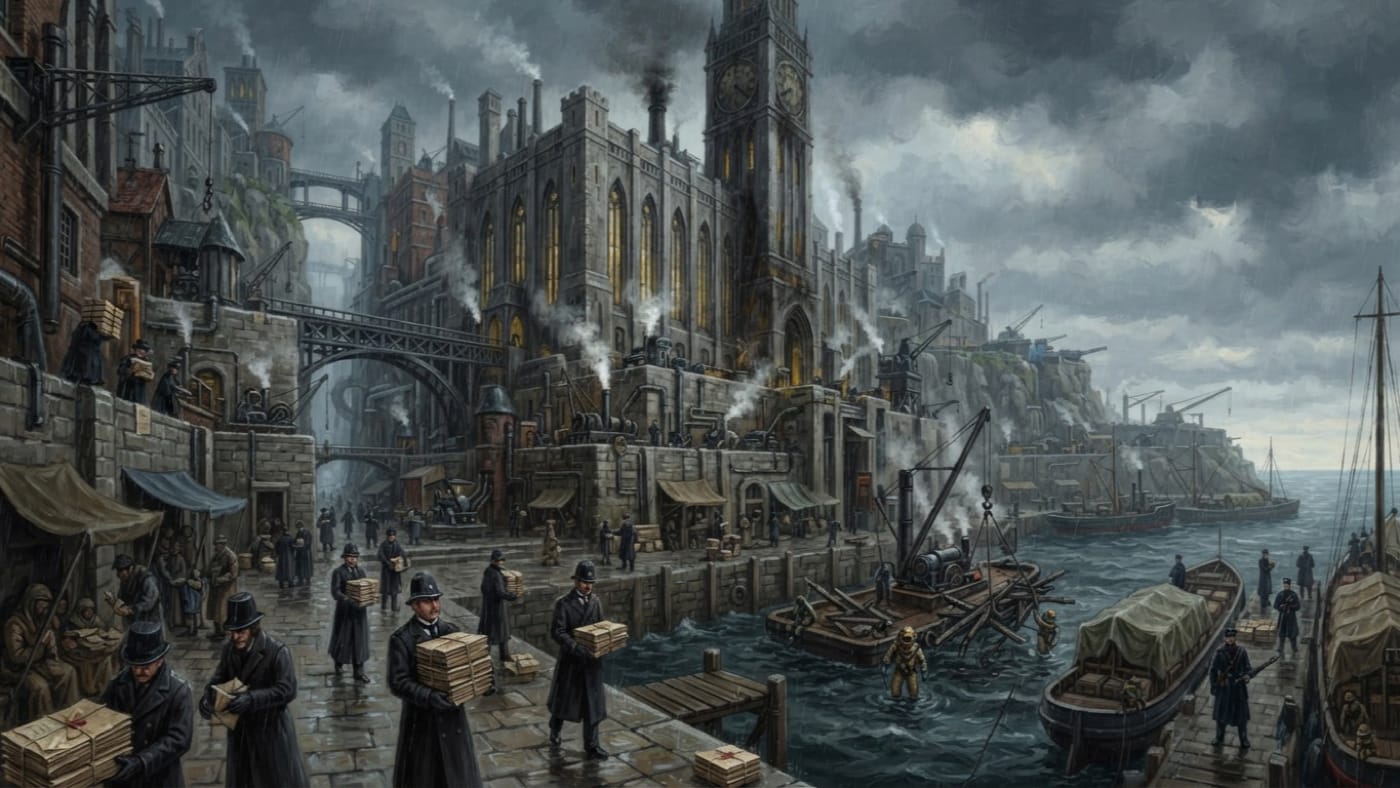
#On the Courts and Their Seat
"Storms have signatures." — Saffron proverb
A lien notice at Saffron is a single sheet, folded twice and sealed in brown wax. A scribe in black gloves delivers it and keeps the gloves on while the debtor makes a mark. The gloves are uniform, though the habit is older than the uniform. Paper that will outlive the person it names should not carry that person's sweat.
The notices come from the Insurance Courts, a district of stone chambers and parchment vaults on the terraces of Saffron Bastion. Most of them come from the Insurance Hall of Exceptions. Hearings are held at midday, after the seals are stamped and while the salvage auctions are still shouting. The Hall smells of parchment, incense, wax and salt-damp masonry, and under those, faintly, of old blood. Nobody is executed there. The smell is blamed on the vaults.
In ordinary times the Courts hear civil matters. Health and doctrine go to the Quarantine Tribunal. Canon-Marshal Veyra Sable holds the berths and the guns. Prefect Halden Greaves holds the passes and the holds. The Quay Chapterhouse holds the seals and the manifests. The Courts own the claims. Writ-Lector Odrin Vale presides over them. He signs in an ink that smells of iodine, and he smiles when storms arrive. The Bureau's file on him contains nothing else worth sealing.
#On Recovery and Establishment
The Adriatic sinks ships. This is the first fact about the Courts, and their critics like it least, because it is true.
A sunk vessel leaves behind an owner and a creditor. It leaves the crew's widows, the divers on the wreck beaches and the Chapterhouse's dues clerks. Each of them arrives with papers, and every paper contradicts the next. Since the Brine Fever Winter of A.S. 112, the Quarantine Prefecture had governed Saffron's bodies. Nobody yet governed what the sea took from those bodies. Meanwhile convoys bound for the Line's lower theaters waited at anchor for quarrels about rope to end.
The published Saffron entry records that in A.S. 134 (1844 CE) storms destroyed eleven merchant vessels in nine days, and that the Insurance Courts followed. The bastion's own records say only that the Courts were established to "stabilize recovery." Both accounts are accurate. Neither names a founder. I have no charter to cite, and I decline to forge one.
Recovery was stabilized. Someone had to decide whose rope it was. The Courts decided and charged for deciding. Within a generation they had found that the charge was the business.
#On the Four Writs
The Courts issue four instruments. Merchants confuse them. The Courts never do.
The storm-damage assessment settles liability after a maritime catastrophe: whose hull, whose negligence, whose cargo and whose fault. It is the foundation instrument. Every other writ rests on its findings.
The salvage-loss indemnity compensates the owners of destroyed cargo at rates the Courts set. The Courts set the rate after the assessment has assigned the fault, and the same chamber does both. An owner who objects may petition. The Courts hear the petition.
The quarantine-hold compensation repays merchants for losses suffered while the Prefecture detains their crews, goods or persons. Here the Courts sit downstream of Greaves. Every hold he signs on the Causeway eventually becomes a claim on Vale's docket.
The storm exception suspends Saffron's civil law during a declared emergency. It allows property to be redistributed, labor to be conscripted and claims to be judged without appeal. It is treated below, at the length it has earned.
All four writs are transferable. A writ is a debt with a seal on it, and debts change hands. Insurance writs circulate beside coin and the port's ordinary tender. Men who can afford to wait buy them at a discount, and men who know the docket redeem them in full. A widow paid by writ may sell it that afternoon to a chandler, who may use it to clear his oil arrears. By evening it may sit in the strongbox of someone who never saw the wreck.
The lien is the other side of the writ. An insurance lien attaches to what debtors own and to what they will earn. A dock laborer under lien works the quays for wages already spent in the Hall. Saffron calls this a "storm recovery adjustment."
Then there are the futures. The Courts sell disaster exception futures, which are tradable writs against storms that have not happened yet. The Courts call the practice "actuarial prayer": a pious estimate of what Providence intends for the coast. Doctrine has observed that a writ on an unformed storm implies foreknowledge, and foreknowledge belongs to the Creator. The Bureau of Doctrine has not ruled. The futures keep trading while it deliberates.
#On the Exception and the Held
"Writs float better than bodies." — Saffron proverb
The Courts have wide discretion over what counts as a storm. Wind is evidence. So is a falling barometer, a harbor bell rung out of sequence, or a pier that has lost men in the night. When the Hall declares a storm, the exception writ issues. For as long as it runs, the Insurance Courts are the sole legal authority over civil matters in the bastion. Sable keeps her guns, Greaves keeps his yards and the Quarantine Tribunal keeps its doctrine. Everything that can be owned, owed or contracted passes to Vale's desk.
The paperwork then runs in order. Liens are executed. The negotiated protections of the Ropehand Compact lapse, because a labor agreement is a civil contract and civil contracts are suspended. Housing in Low Nets is reassessed as storm debris. Its occupants are reclassified as emergency labor and sent to clear the debris that was their roofs until the morning's writ. There is no appeal. The exception ends when the Courts declare the storm over.
The storm passes. The writs remain. Property redistributed under an exception stays redistributed. Executed liens stay executed. The labor rolls drawn up during the emergency go into the files, and the next exception uses them.
Quarantine is what makes all of this enforceable. Anyone saffroned on the Causeway loses legal standing for the length of the hold. A held man cannot trade, petition, own, testify or leave. The Prefecture manages his property in trust and may conscript him for sanitary labor. Suppose his house falls under an exception. He cannot contest the assessment, because he cannot petition. He cannot sell his indemnity before the lien takes it, because he cannot trade. He cannot speak for a neighbor, because he cannot testify. While the Courts rule on his property, the Prefecture holds it in trust. He walks out of the yards with a dry-pass, a lien and no house.
The Courts and the Prefecture quarrel, and they mean it. Greaves wants stricter lockdowns. The Courts want looser rules, since a loose port has more incidents and incidents bring fees. Each side profits from the other's preference. The quarrel has never yet held up the paperwork.
#On Disasters Prepared in Advance
"Where storms are authored." — the underworld's name for Saffron
In A.S. 199 (1909 CE) the Quay Chapterhouse audited the Courts and found storm exception writs already signed. Each was dated three to nine days before the storm it named. That much is documented: the audit, the papers and the dates.
The papers prove less than Low Nets says they do. A pre-signed exception proves that the Hall expected storms and prepared for them. The Courts call that prudence. The Chapterhouse, on finding the writs, used a less printable word. The papers prove that a writ existed before its weather. They do not show that Vale foresees the weather or makes it. The Bureau of Doctrine has not yet decided whether the presumption of foreknowledge is fraud, insolence or heresy.
ERRATUM — A.S. 200, Bureau of Doctrine Coastal Registry, File 7-C-441: Earlier editions described the Insurance Courts' storm exceptions as "a measured and proportionate response to maritime emergency." That description is withdrawn following the discovery of pre-signed exception writs dated before the storms they referenced. The Bureau's revised description is "administratively irregular." The Bureau of Records has filed both versions.
The street goes further. Its account, which I record as street-truth and nothing firmer, says the Courts write disasters in advance and pay the Lanternline Chandlers' Lodge to make them plausible. The Lodge controls the harbor's oil and its approved lantern patterns. A disaster needs a cause the Courts can certify, and the Lodge controls the lights. Low Nets has done that sum without a seal.
The Saffron entry has already disclosed the rest, and the Bureau does not unsay what it has sealed. Selected lantern patterns draw the demon-lures to particular piers. Deaths in Low Nets are filed as marine incidents. Exception writs on those incidents pay for the Prefecture's operations, and the Prefecture's holds supply the labor that replaces the dead. The Courts sit in the middle of this cycle and turn the night's losses into the morning's revenue. In their own language, the cycle is actuarially sound.
Others take their share. The Gilt-Knives profit from salvage, forged claims and staged wrecks. They also profit from the exclusive access a "sainted" wreck confers, and every writ that classifies a wreck decides who may dive it. The gun captain of Cliff Battery Twelve is on the Courts' payroll. The payment is documented. No particular shot it bought is documented. The Brine Choir sings under the piers and claims its hymns can calm storms. The Courts have never said whether a calmed storm reduces a claim, and the hymns' power remains unresolved.
The Compact answered in A.S. 200 with three slow strikes. None succeeded. Union protections are civil contracts, and the Hall can suspend civil contracts.
#On the Present Condition
In A.S. 201, Writ-Lector Vale remains in office. The Hall sits at midday. The writs circulate, the liens attach, and the futures trade against storms that have not formed. The scribes still wear black gloves.
Canon-Inquisitor Silex Marrow has authority to audit the pre-signed exceptions and examine the Lanternline pattern books. Marrow is expected in Saffron by the Feast of the Sealed Harbour. The audit is pending. No finding has been entered, no officer removed and no writ voided. An auditor who compares dates will find the Hall's newer papers in excellent order. The older papers are what the audit is for.