


#On His Station
Writ-Lector Odrin Vale is the presiding officer of the Insurance Courts of Saffron Bastion. This dossier is a documentary survey of the man as he stands in A.S. 201, which merchants and foreigners call 1911. I enter that year at the head of the file because it is the only year here that belongs to the surveyor and not to the subject. The papers I have been allowed to read do not give his birth, his age, his schooling, his ordination if he had one, the morning he first sat in the Hall of Exceptions, or the name of the man whose chair he took. I will not forge any of them. A survey describes what the record holds. This record holds an office, a desk, a great many dated instruments, and a man who has outlasted his own scandal.
The office is narrow on paper and wide in its effects. Saffron's fear is divided among three tenants. Canon-Marshal Veyra Sable holds the berths and the guns, so she can starve a convoy. Prefect Halden Greaves of the Quarantine Prefecture holds the dry-pass, so he can erase a person and keep the body. Vale holds the disaster writ. What he trades in is ruin by paper. Every shipper, salvor, widow and ropehand in the port knows that a loss is not over when the water goes down, and that its final shape will be settled at his tribunal.
He commands no gun. He signs no quarantine hold. He seals no manifest, because the Quay Chapterhouse keeps that wax and guards it like a dowry. What reaches his chambers is the aftermath of other men's authority, already counted and waiting for a price.
Every coastal source that names him repeats two particulars. He smiles when storms arrive. His ink, and his scribes' ink, smells of iodine. No Rites file, no physician and no street rumour has explained either one, and the rumours are worthless. I record both details the way a garrison clerk records a scar on a deserter's description, as marks of identification, and I attach no theology to either.
His composure is the third thing the sources agree on, and the only one I have watched for myself. During my pastoral inspection of the southern coastal installations in A.S. 197, I asked the three tenants of Saffron what the waterline voices want. Greaves said bodies. Sable told me not to look at the water. Vale smiled and said, "Claims." I have given that exchange elsewhere and I add nothing to it here. It remains the most candid job description I have ever heard from a coastal official, and he needed one word for it.
#On the Authority of His Writ
The Insurance Courts were established in A.S. 134, after storms destroyed eleven merchant vessels in nine days. Their stated purpose was to stabilise recovery. That is the date of an institution, and the Bureau's habit of folding history into whichever face is currently famous will not make Vale its founder. The files I have been shown contain no charter text and name no founder. The Courts appear in the record already robed and already hearing claims. Vale appears later and presides now. The gap between those two facts is a matter for Records, and Records has not filled it.
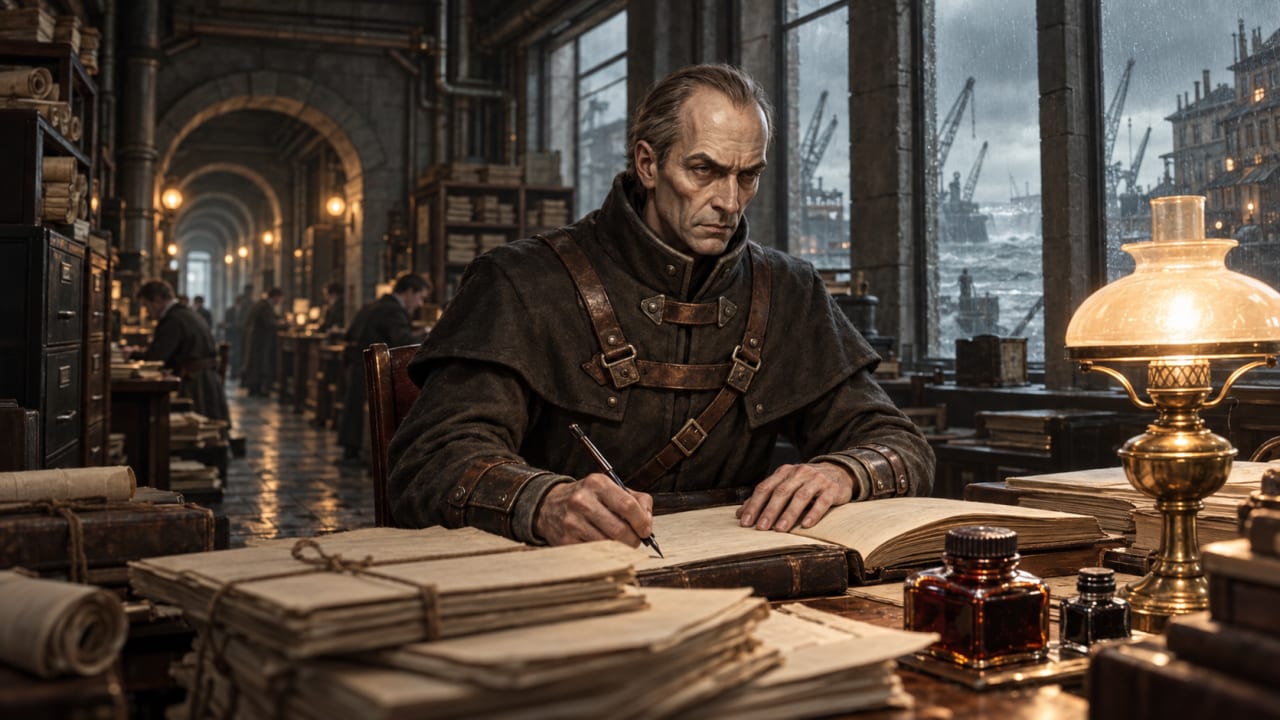
Before A.S. 134 Saffron settled its losses as fishing towns always have. The first crew to reach a wreck salvaged it. Spoiled cargo was argued over in taverns until somebody produced a gaff-hook. A household that lost its earner was ruined with no documents at all. The port had already been designated a fortification in A.S. 72, under offices that later took Synodal names, and in A.S. 112 the Brine Fever Winter gave it a Prefecture. None of that required a court of claims. What required one was a pilgrim port that lost hulls, rope, berths and men every season, and merchants who stopped sailing where their losses could not be recovered.
The need was real, and the office survives on it. A shipper whose consignment rots under a Prefecture hold needs a tribunal that will price the rot. A salvor and an owner fighting over one hull need an arbiter with a seal, and a widow needs her husband's wage converted into something a baker will accept. Saffron would have burned a court that did nothing but rob. It keeps a court that robs and also pays. That distinction has done more to keep Vale in his chair than any patron I could name, and I can name none.
Jurisdiction in Saffron is divided by subject, and Vale's subject is the ledger. The Quarantine Tribunal judges lungs and doctrine. Harbor Marshal Command keeps the berths, the provosts and the cliff guns. The Prefecture keeps the yards and the passes. The Quay Chapterhouse keeps the seals. The Insurance Courts hear claims, arbitrate salvage, issue disaster writs and attach liens. The Courts' own register excludes health, doctrine and battery command from their remit, and I quote that exclusion because the port's gossip forgets it every time a storm makes the Writ-Lector look omnipotent.
The title establishes less than people assume. The coastal sources speak of Writ-Lectors in the plural. Vale is the one the port names and the one who presides. No source gives him any rank beyond the title, and I award him none.
His power is easiest to describe by the paper that crosses his threshold. Shippers' loss declarations come in, along with salvage returns, carriers' disputes and merchants' petitions for compensation after detention. Households bring claims for men the sea has kept. All of it enters the Hall of Exceptions at midday, after the morning's seals are stamped and before the salvage auctions begin. Writs go out. His authority is the authority of the last signature in a chain. The berth was refused, the hold was declared and the lamp failed under other men's hands, but what any of it cost, and who owes that cost, is decided at his desk.
#On Compensation, Indemnity and the Lien
The Courts issue four kinds of writ, and Vale presides over all four.
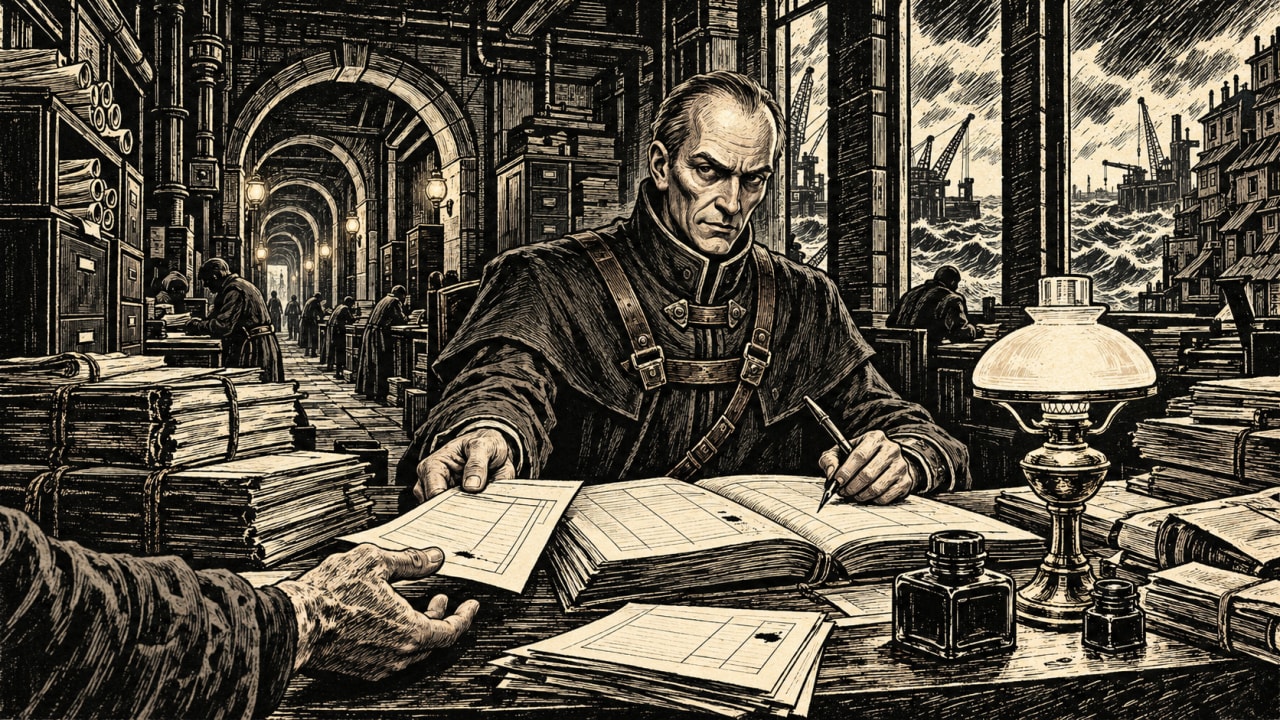
A storm-damage assessment establishes liability after a maritime catastrophe. It decides whose negligence, whose contract or whose weather is to blame, and that decision governs every later payment. A salvage-loss indemnity compensates the owners of destroyed cargo at rates the Courts determine. A quarantine-hold compensation reimburses merchants for losses suffered while the Prefecture detained their goods or crews. The heading names the merchant and not the person held, and readers who expect otherwise have confused mercy with commerce. The fourth kind, the storm exception, is the instrument that made Vale notorious, and I keep it for the next section.
These writs become a market because they can be transferred. A writ promises payment, but it does not promise payment soon. A household that cannot wait for the Courts to settle can sell its writ at a discount to a buyer who can, and Saffron has no shortage of such buyers. The widow gets bread this week at a fraction of the award. The buyer collects the full award whenever the Courts pay. Writs circulate through the port alongside coin, berth chits, ration tokens and salvage tokens, and their value is said to rise and fall with the barometer. Among the things that count as wealth in Saffron, after clean lungs and dry bedding, the local survey lists a name recognised by the Writ-Lectors.
On top of the transferable writ the port has built a trade in insurance-writ futures: wagers on disasters that have not yet happened. The Courts call this "actuarial prayer," and I give the phrase as their own. It describes an administrative habit. It proves no prophecy. Low Nets calls the same practice praying for weather, a name I find more accurate.
The lien is the Courts' second sacrament, and it goes further than the writ because it reaches into time. A household whose roof was repaired against expected compensation, a debtor whose creditor bought his writ, a carrier ordered to bear a loss: any of them can find a lien attached to their future wages. The dock name for the seizure is "storm recovery adjustment." The dock name for the Hall's practice of settling matters by lien is execution, and the docks have not been corrected.
The consequences fall unevenly, and the unevenness is how the office works. A shipper with capital can wait for his indemnity, contest the assessment and hire a scribe who knows which clauses the Hall prefers. A salvor with a sainted wreck under his control can turn one disaster into three claims. A household in Low Nets can do none of this. It receives the writ, sells the writ and keeps the lien, so the paper stays with the family after the money has gone.
Saffron has a proverb that writs float better than bodies. It tends to come up at the domestic occasion the port has made its own: a compensation writ arrives for a man no one has found, and his family has to decide whether to eat or to mourn. Some of the widows paid by writ now pray for storms. I would condemn them more readily if I had ever been hungry in Saffron.
#On Exceptions Prepared Before the Weather
The storm exception is an emergency instrument, and its breadth is the reason the port fears it. When a storm is declared, and the Courts have wide discretion over what counts as a storm, an exception suspends the ordinary civil law of Saffron for the length of the crisis. Contracts are set aside. Claims are rearranged while the water is still in the streets. Property liens are executed. Labour is conscripted for emergency work. Protections the Dock Union negotiated over years disappear in an afternoon. Low Nets households learn that their dwellings have been reassessed as storm debris and that they themselves have been reclassified as emergency labour. The storm passes, and the writs stay in force.
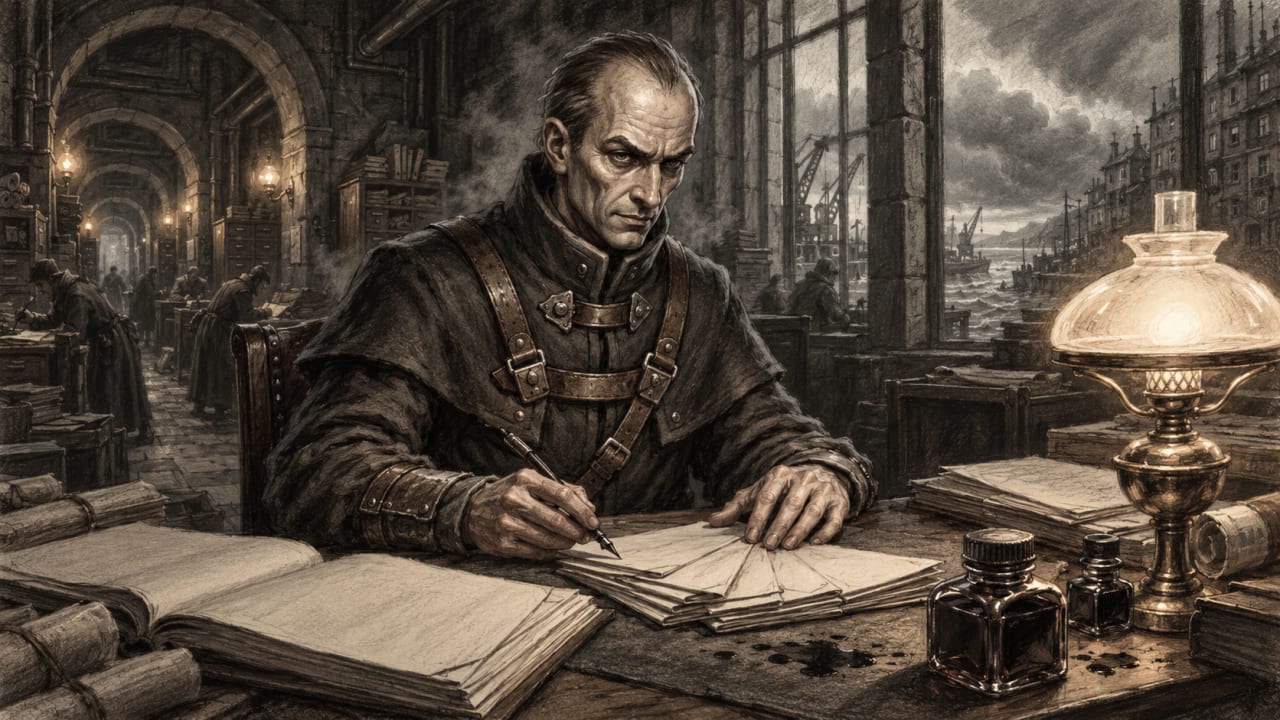
The Saffron survey says that under a declared exception the Courts become the sole legal authority in the bastion. I accept this for civil law and reject it for everything beyond civil law. During an exception the Prefecture still holds its yards, Harbor Marshal Command still mans its batteries, and the Bureaus still keep doctrine. An exception strips the citizen of his protections. It does not give the Writ-Lector Sable's guns or Greaves's gates, any more than a bankruptcy gives the creditor command of the garrison. Vale's office can finance a consequence and make it lawful without commanding the hands that carry it out.
Exceptions issue from the Insurance Hall of Exceptions, a set of stone chambers and parchment vaults where incense burns against the smell of wet petitioners. The cabinets hold templates. Taken alone, that is no sin. A prepared form saves time in an emergency, and every competent registry keeps blank burial certificates, blank fever notices and blank requisitions for lye. A port that loses ships every winter would be negligent if it had no exception form drafted in advance. The A.S. 199 discovery is a matter of the dates on the forms. Preparation was never the charge.
In A.S. 199 the Quay Chapterhouse began an audit and regretted it almost at once. The audit found pre-signed exception templates, associated with Vale's office, that carried dates three to nine days earlier than the storms they referred to. A blank form waits for its emergency. These forms had their emergencies written in already: an exception dated before its storm, signed before its storm, and referring to a storm that then arrived on schedule. A.S. 199 is the year of the finding. The surviving summaries do not say that every storm in question fell in that year, and I will not shorten the interval to make a tidier sentence.
Coastal Registry entries described the Insurance Courts' storm exceptions as "a measured and proportionate response to maritime emergency."
Withdrawn, A.S. 200, Bureau of Doctrine Coastal Registry, File 7-C-441, following the A.S. 199 discovery of pre-signed exception writs dated three to nine days before the storms they referenced. Revised characterization: "administratively irregular." The Writ-Lector's office was not included in the correction.
That phrase is the Bureau of Doctrine's whole published judgement. It brought no criminal charge, no deposition and no verdict. The discovery set off a run of memoranda between the Quay Chapterhouse and Strasbourg, and those memoranda are still settling like ash after a fire. Vale's own recorded response was a smile, which I enter here as testimony.
The record establishes a sequence and a gap. It does not establish how the gap came about. A clerk may have back-dated forms to a fixed schedule and later corrected nothing. Someone may have forecast the weather with uncomfortable accuracy and claimed the profit in advance. Someone may have arranged for disasters to fit the forms. The forms may hide an explanation that nobody with a seal has yet offered. Each reading is attractive to someone in Saffron, and the paper supports none of them over the others. The finding leaves us with an instrument of the Courts that existed before its cause did. Whoever explains the three to nine days will have to explain them in the order in which the documents were made, and that order has already been laid out on the table.
#On Lamps, Holds and Predictable Loss
The Courts do not need to arrange disasters to profit from them. They profit most from a coastal machine that produces disasters in the right order, and the order runs through other offices.
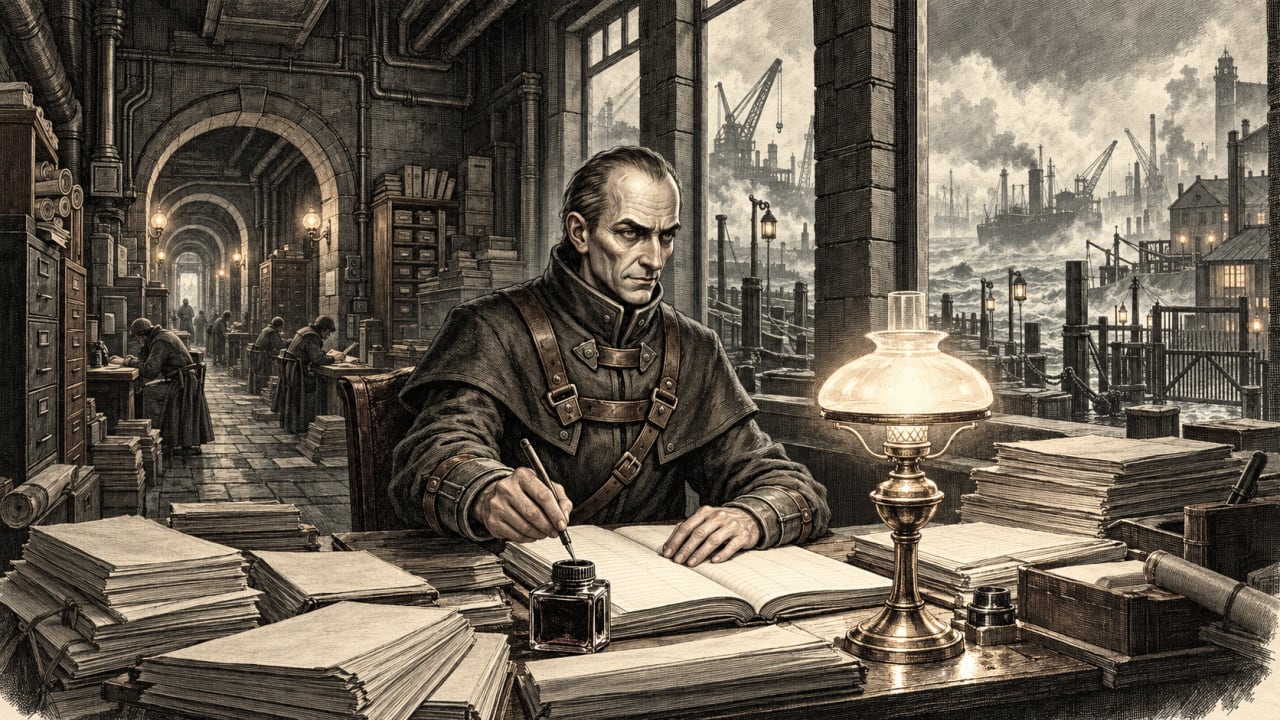
It begins with the Demon-Lure lanes, where licensed lamps, broken salt lines, false registry numbers and ranged guns draw the waterline voices into controlled kill-strips. When a lure lane draws more than it was meant to, the Prefecture classifies the losses as marine incidents. Marine incidents become claims. Exception writs finance quarantine operations. Quarantine holds supply the replacement labour for the dead. Salvage, liens and repair contracts follow in good order. My own entry on the lures says the Insurance Courts prefer predictable bites, because a lure lane worked under controlled conditions produces its paperwork in advance and an accident produces the same paperwork late and with more screaming. In that entry I wrote that Vale, who smiles when storms hit, smiles also when the lanterns are cleaned. I stand by it as observation. It is not evidence that he commands the lamps.
The lamps belong to the Lanternline Chandlers' Lodge, and pressure between the Lodge and the Courts runs both ways. The Courts can squeeze the Lodge by delaying payment. The Lodge can answer with oil shortages, glass shortages and two nights of chosen gloom that teach the harbour what an unpaid chandler costs. Lantern shortages have coincided with writs that needed fog. The street says the Courts pay the chandlers to make prewritten disasters plausible. The local survey files that claim as street truth, half true by its own estimate, and the Courts' own entry repeats the classification. I file it the same way. No source I may cite shows Vale ordering a particular shutter change, a particular dark pier or a particular failed wick. The Lodge sells darkness by the hour, and the Courts are among its customers, but the invoices are not in the file I hold.
COASTAL REGISTRY INTERNAL CROSS-LINK — LOW NETS / A.S. 198 Pattern shift authorised by ████████████. Recorded civilian loss: marine incident, tide surge. Replacement labor drawn from: Quarantine Hold Yard C. Insurance recovery: storm exception pre-dated by █ days.
The guns are a separate matter with a separate paper trail. The captain of Cliff Battery Twelve is paid by the Insurance Courts. The Harbor Marshal knows this, tolerates it and keeps a note of it in a sealed file for future use. The record shows the money. It does not show that any particular discharge was bought or any particular silence purchased, and it gives Vale no command over the battery. Sable commands Battery Twelve. The Courts have a captain who takes their money, which a defence advocate would call an unfortunate friendship and an auditor would call a line in a ledger.
Two episodes are often merged by people who prefer one story to two. During Lantern Compliance Action 44-K in A.S. 198, in Low Nets, an Insurance Court observer stood inside a marked firing line and delayed the battery's discharge. The extract does not say who sent him or why he stood where he did. During the South-Pier Incident of A.S. 199, Battery Twelve could not depress its guns far enough to bear on the water beneath the boards. The first episode was a man in the wrong place. The second was a limit of the guns. They are a year apart and involve the same battery, and nothing in the record connects them. Readers who connect them anyway are writing their own dossiers and should sign them.
#On the Choir and the South-Pier Account
The Brine Choir is the one party on the waterline whose usefulness costs the Courts money. Its illegal services beneath the piers, held at tide-hours, with hummed names and counter-patterns sung into the gaps between the Lodge's shutters, sometimes quiet the water that the lure lanes disturb. When that happens, fewer men are lost. When fewer men are lost, fewer claims are filed. In my entry on the Choir I wrote that it hears storms before the Courts have finished dating them, and that the Prefecture uses it through denial: a patrol thinned, a pier gate left unbarred, a saffroned widow taken out of a holding yard and returned three nights later with salt-white lips and the name of a missing diver. Greaves records no exchange. Sable records no instruction. Vale records a lower claims estimate.
That entry in the ledger is the whole of the evidence. A lower estimate after a night when the Choir was allowed to work shows that the Choir's interventions reduce the losses the Courts price. It shows no commission, no fee, no patronage and no promise of immunity. Why an office that lives on loss tolerates a congregation that reduces loss is a question the record raises and does not answer. One reading says that a predictable smaller loss is worth more to a tribunal than an unpredictable larger one. Another says that reduced exposure is simply reduced exposure, and that a Writ-Lector, like any other clerk, prefers a column that balances. I offer both and endorse neither. The Choir's rumoured plan for a mass lure-calling, which its cantors deny in three voices slightly out of phase, is said to sound to the Courts like future exception business. That too is an attributed hearing and not a recorded plan.
The South-Pier Incident of A.S. 199 is told consistently across the sources, and I give the agreed sequence once. A sanctioned lureline failed after two lamps guttered. The false registry number used as bait was answered in the voice of the dead man who had once held it. The water rose beneath the boards. Battery Twelve could not depress its guns. The Choir, gathered illegally under the gutting racks, sang three tide phrases. The water went down. Six men survived. Four singers were arrested. Two singers disappeared while in quarantine custody. The cantor's name has been withheld by the Choir and misfiled by Purity as three separate women, and I have no wish to make it a fourth entry.
The official account of the A.S. 199 South-Pier Incident credited the survival of six men to "corrected lantern pressure."
Amended under sealed addendum, A.S. 200. Brine Choir participation is confirmed. Survival counts used in subsequent loss estimates are to be read accordingly. The arrests stand. Custody responsibility for the two singers who disappeared during quarantine remains unassigned in the addendum.
No source I have consulted places Vale on the pier that night. None shows his signature on the arrests or on any order touching the two who vanished. The custody belonged to the Prefecture, and the yard sheet that moved the missing singers out of ordinary count uses Prefecture phrasing. The under-pier account says the Choir did not save six men at all but paid the water with something else, and that the two missing singers can be heard on certain calm afternoons beneath Pier Six. I report that account as the Choir's own story and draw no conclusion about the fate of the singers.
#On Those Who Carry the Claim
The Bureau of Records counted fourteen thousand three hundred occupants in Low Nets in its census of A.S. 200, in structures the Bureau of Engineering classes as sub-habitable. A prior memorandum had counted nine thousand in adequate housing. The difference was attributed to seasonal flux. These are the people the Courts' paper eventually reaches, and they reach the Courts as claimants, as labour and as witnesses.
The following is the shape of the procedure, not a case from any docket. A ropehand is lost in a marine incident and his body is not recovered. His household files a claim and receives a compensation writ for a man nobody has buried. The household cannot wait for payment and sells the writ at a discount to a buyer in the Courts district. The roof that leaked through the same storm was repaired against the expected compensation, so a lien now sits on the eldest son's future wages. If the son works the piers, he works them on terms set by the storm exception that rearranged the union's protections while his father was still in the water. If the son coughs in the wrong week, the Prefecture may hold him. While he is held he cannot testify, petition or accuse an officer except through Prefecture channels. He can still appear on a compensation list, a labour roster and a lien schedule at once, and he is not available to contradict any of them.
The Courts did not invent the quarantine hold. They have learned to read its calendar. A witness who is held for the length of a hearing need not be bribed, threatened or drowned, because the form has already silenced him with a doctor's blessing.
Resistance exists and the Courts price it too. The Ropehand Compact answers with the slow strike: berths unloaded at half pace and rope coiled with deliberate carelessness. Three slow strikes in A.S. 200 won no concessions. The Quay Chapterhouse answered them with quarantine labour drafts that conscripted the strikers' families. A storm exception declared during a strike suspends the very protections the strike is meant to defend. Some members of the Compact also sing beneath the piers. That overlap of persons shows that men can belong to two things at once, and it does not show any treaty between the two institutions.
The Gilt-Knives stand at the other end of the claim. The salvage cartel controls the Wreckmarket's schedules, locks competitors out of "sainted" wrecks and, according to the port survey, stages wrecks and forges claims. A hull lost under an exception produces an indemnity for its owner, a lien for its creditor and a salvage claim for whoever reaches it first. The cartel's interests and the Courts' interests meet in every such hull. No compact between Vale's tribunal and the cartel has ever been produced, and I have no meeting, payment schedule or shared command to report. Two parties that profit from the same disaster can each act alone and still be paid by the same wreck.
#On the Pending Comparison
Canon-Inquisitor Silex Marrow of the Bureau of Purity holds authority to audit the Insurance Courts' pre-signed exceptions, to subpoena their writs, to interrogate the Lanternline pattern books and to examine the quarantine holds used during compliance actions. He is expected in Saffron and has delivered no verdict.
His method is sequence. Other inquisitors ask whether a man sinned. Marrow asks which lamp moved, which hold opened, which claim was paid, and in what order. His preparatory abstract names five sets of records for comparison: the Lodge's oil-loss ledgers, the Courts' storm exceptions, the movements through Quarantine Hold Yard C, the vacancies in Low Nets housing, and the depression logs of Battery Twelve. The same abstract instructs him to reject "storm" wherever the writ predates the cloud.
That instruction explains why Vale's office is more exposed than its neighbours. The Prefecture can describe a hold as sanitary necessity and leave the description vague enough to survive. The Lodge can describe a pattern change as harbour safety, and nobody but a chandler can read the pattern. A writ cannot hide behind expertise. Its whole value lies in its date, and the date is written at the top in iodine ink for any literate auditor to set beside a storm report. The Courts built their authority on documents that state exactly when they were made.
Saffron has prepared its usual welcome: decoy forgeries, Lanternline apprentices fattened for sacrifice, Quarantine nurses ready to confess to humane excess, and Insurance clerks coached to weep and call fraud a misunderstanding. Sable will offer discipline and Greaves will offer public health. Vale will offer papers. He has always had papers, and an official who hands over his documents willingly has either nothing to hide or a very great deal already filed in the right order. The audit exists to tell those two apart.
Marrow's separate warrant at the Archivolt Causeyworks shares an inquisitor with the Saffron audit and nothing else that I can show. The suggestion that water and stone are joined in one conspiracy with the Writ-Lector at its centre has no document behind it, and I am not going to supply one.
For the sake of completeness I record my own part. When I was asked to prepare a briefing for the audit, I prepared two, one for Marrow and one for Vale, and they do not contain the same information. I entered that admission in the Saffron survey and I repeat it here, because a dossier that leaves out its author's interests is a dishonest dossier. Two documents with different contents prove that I chose what each man would know. They prove no treaty, no immunity and no private history between the Writ-Lector and myself. What each document contains is my business, and the Bureau's if it asks.
#On His Present Condition
As of A.S. 201 Writ-Lector Odrin Vale remains in office. The Hall of Exceptions hears claims at midday, after the seals and before the salvage auctions. Writs are issued. Liens are attached. The A.S. 199 discovery stands as recorded, and the A.S. 200 correction stands as published. Doctrine's judgement is still "administratively irregular" and the matter is still described as civil. Vale has not been removed, suspended or arrested. Marrow's audit is pending and no verdict has been issued. His scribes still carry ink that smells of iodine, and the weather still comes in from the Adriatic.