

#On the Division as Compiled in A.S. 201
This dossier was compiled for the Codex in A.S. 201, 1911 CE. That year dates the compilation and nothing else. It is not the year the division was founded, inspected or condemned, and readers who copy it into a muster heading will be corrected in red.
The 14th Prefectural Division was a formation of the Rationalist Second Army in the service of the Rationalist Republic. On 1 November A.S. 45, 1755 CE, it held one flank of that army at the Battle of the Iron Plains. The 7th held the centre and the 12th held the far flank. The formation's rules came from Vienna. That covers its documented life. The sources consulted for this compilation give it no commander, no founding, no strength of its own, no banner and no named man. The Ledger will not supply any of these for the sake of a fuller page. A forged roll is still a forgery, however well it is written.
#On Its Place in the Second Army
The Second Army marched east on orders from the Council of Nine in Vienna. It was to investigate disturbances reported by refugees and to suppress any organised resistance it found. These orders were issued to the army. No surviving instruction is addressed to the 14th, and none is needed, because a prefectural division went where its army was sent and stood where its army's deployment placed it.
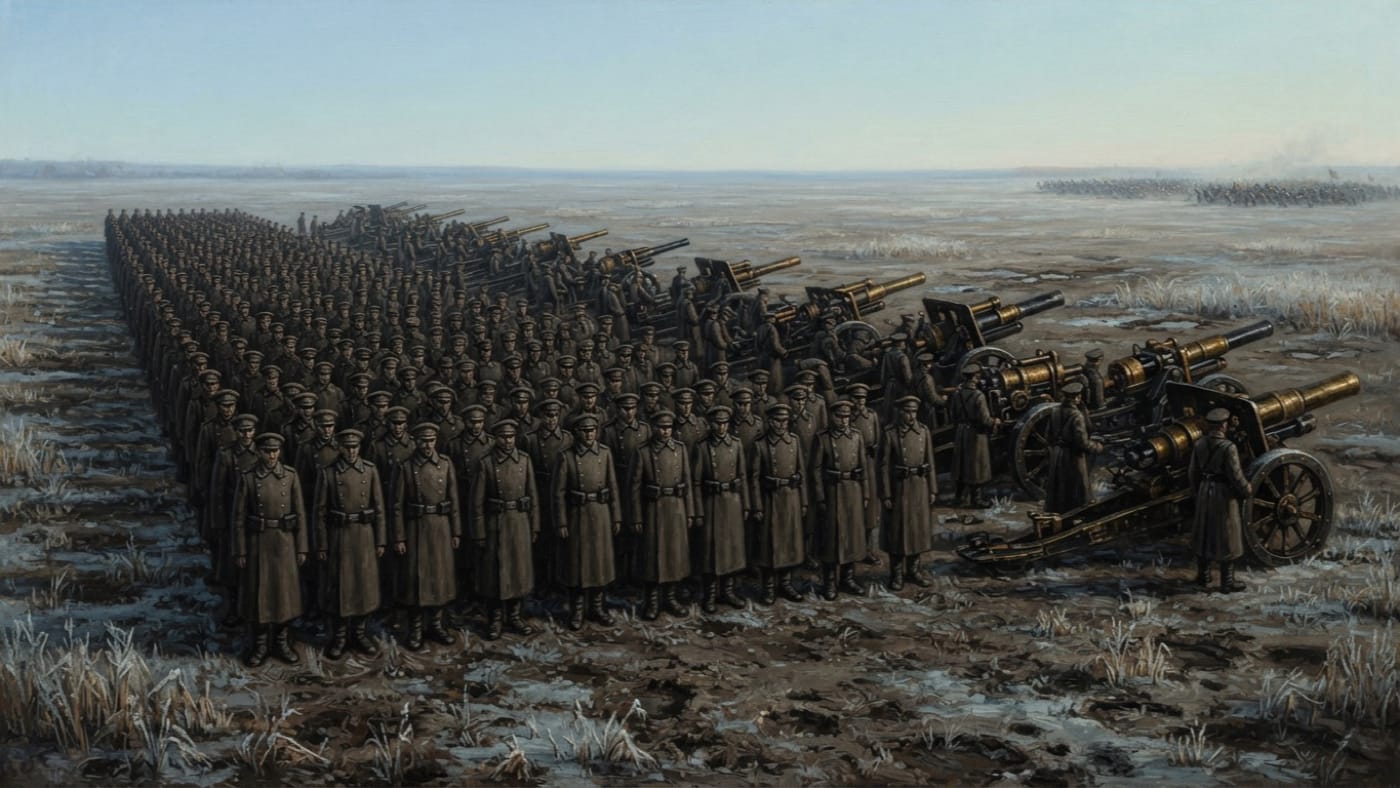
At the Iron Plains the army placed three divisions abreast. The 7th was in the centre under Colonel Kreszner. The 12th dressed one flank and the 14th dressed the other. The accounts say "opposite" and nothing more. The consulted sources do not say whether the 14th stood on the left or the right, the north or the south. A compiler who picks one has drawn a map, not found one.
The combined force is recorded as about twelve thousand effectives with sixty-four clockwork guns behind the line. Those figures describe the army. Dividing them by three produces four thousand men and twenty-one and a third guns. That fraction of a gun should embarrass anyone who wants the 14th's establishment from arithmetic. The batteries were army ordnance under army control, and no source assigns any of them to the 14th's front.
#On the Viennese Rules
The Academy at Vienna gave the Republic its preferred geometry of war, and its own published account states that the 7th, 12th and 14th deployed by that geometry. It had five requirements: regulation distance between bodies of men, the artillery echeloned cleanly behind the infantry, a centre that held, flanks kept in balance, and officers trained to angle everything correctly.
Each rule answered a real danger. Regulation interval stops one volley from tearing through two companies at once, and keeps a frightened regiment from crowding against its neighbour until neither can load. Echeloned guns fire over friendly heads at an enemy that has shown itself. A held centre is the army's spine. Balanced flanks protect that spine, because a flank exists to stop the enemy going around it. Cavalry hunts flanks, and so do encircling columns and every general who has studied a map of Cannae. The Academy taught that a centre holds only while both its flanks hold. On 1 November the 14th was half of that guarantee.
Whether every officer of the 14th had sat in Vienna's lecture halls, the record does not say. Rules travel farther than graduates do. A regulation printed in Vienna could be enforced by a sergeant who had never seen the city, and Rationalist sergeants enforced regulations with the fervour other men keep for relics.
The drill was competent, and that is the uncomfortable point. All five rules assumed an enemy that occupied ground. They assumed the danger would come across the field toward the line, from the front or the side, at a speed that could be measured. A flank built against envelopment answers a horizontal question. Nothing in Vienna's manual expected the question to come from directly above.
#On the Morning of 1 November
The field lay east of the Danube and south of Debrecen, in what the Republic called the Prefectural District of Pannonia. It was farmland, flat and open, with frozen mud and wheat stubble underfoot, the kind of ground artillery officers like and infantry officers trust. The army had been marching east for nine days. That morning scouts from the 7th reported a large enemy concentration on the eastern horizon. The three divisions deployed, and the 14th took its place.
Fire then fell from a cloudless sky.
The accounts describe columns of white heat, with no barrel, charge or crew behind them. Where a column struck, the frozen ground softened, ran and closed again as slag. The Church's account names the cause as Maldrake, Sin-General of Wrath. The date is also the date of the Sundering, and Doctrine does not regard that as an accident of scheduling. Why the Creator allowed that fire on that field is a question Doctrine answers faster than the evidence does. The Ledger records the fire and its effects. It leaves the rest under attribution.
The 14th stood inside that catastrophe. No consulted source gives it a separate manoeuvre, a last order, a route of flight or a sequence of destruction. Any line written about the 14th's final minutes would be fiction in a dead man's coat. The record supports this much: the Second Army was destroyed as an operational force on that field, and fourteen survivors are reported for the battle as a whole.
An earlier edition of the Iron Plains entry attributed the fire to "demonic artillery of unknown provenance."
That battle account has itself withdrawn the phrase. Artillery requires a battery, a position and a gunner choosing his range, and none of these was found. The correction is repeated here because the 14th stood under the fire it concerns. A flank cannot be honestly described while the old error about what fell on it is left standing.
#On What the Associated Records Preserve
Memory of the Iron Plains is shared out unevenly. The 7th has Kreszner and his last recorded order: "Formation holds. Advance at regulation pace." The 12th has Private Kessler, whose testimony is sealed apart from the rest because of what he said the fire did. The 14th has its numeral and its place in the line.
That is still evidence. Deployment is a fact of record. A division that appears in the order of battle, the army's composition and the Academy's own admission of its doctrine is identified as firmly as any unit with a colonel's portrait. It is identified more modestly, which is a different thing.
The consulted sources give no testimony from the 14th. That does not prove that none of its men lived or that its papers never existed. The restricted Iron Plains testimony concerns the battle, and nothing supplied to this compilation names any witness as a man of the 14th. The Republic's filing was poor, the fire was thorough, and seizures came later. Any of these may explain the gap, and none of them is entered here as the explanation.
The deployment diagrams outlived the deployment. In the Academy's published account they are kept as instruction, a perfect formation drawn for the purpose of explaining its perfect failure. The War College teaches that failure through the 7th and Kreszner. An honest diagram of three divisions abreast still has to draw the 14th, in its block of measured interval, holding a flank against an envelopment that never came.
#On the Present Holding
As of this compilation in A.S. 201, 1911 CE, the 14th Prefectural Division is entered in the Ledger as a flank formation of the Rationalist Second Army, deployed under Viennese rules at the Iron Plains on 1 November A.S. 45 beside the 7th and the 12th. The army it belonged to did not leave that field as a fighting force, and the consulted record has no later entry for the 14th taking the field.
No new classification is issued for it here and no old one is recited. The division keeps the standing it actually has: condemned with the instrument it served, and recorded accurately on the evidence that survives.