
#On the Plain Before It Learned Appetite
Pannonia is the old name for a basin that clerks now divide into safer failures: Former Agricultural Zone East-7, western Blightmarsh fringe, Danubian forward loss, Hungarian grain-country, Drava hazard belt, and those little numbered rectangles by which the Bureau of Cartography tries to persuade mud that obedience begins with a grid. The old name persists because the land was generous before it was damned, and generosity leaves better ghosts than borders do.
Before the Sundering, Pannonia fed empires with the vulgar confidence of a table that expected guests. Wheat moved from Debrecen toward the Danube in golden columns. The Tisza (Unregistered) orchards kept cellars heavy. The Alfold cattle-runs made drovers rich enough to insult customs men and live to repeat the insult. The southern plain along the Drava watered fields so obedient that even tax estimates looked pious. This was grain country: soil behaving, peasants complaining, carts groaning, tithe-men pretending gratitude while measuring sacks twice.
The Bureau of Agriculture loved Pannonia with the doomed tenderness of an office that knew the exact protein estimate of wheat and the exact year no one powerful would care. Its surveys listed rainfall, soil colour, worm density, orchard yield, cattle birth, silo rot, seed line, and river ferry loss. Eleven later Debrecen recovery reports began with the same sentence: the plains fed three empires. It was an accurate sentence, which is why it became dangerous.
#On the Silence in the Barns
Pannonia began failing before Hell announced itself in proper theatrical fashion. During the Eastern Silence of A.S. 38, letters from the eastern districts thinned, then vanished. Grain reports arrived with destination columns blank. Courier ledgers recorded villages that replied in bird cries. Barn inventories contradicted the barns. Men blamed bad ink, local theft, Rationalist incompetence, provincial laziness, rats, damp, fog, and that blessed all-purpose demon of administration, disorder.
The barns knew better.
At first the rot was ordinary enough to be dismissed. A western silo soured after unseasonable rain. A cattle pen near the Tisza lost forty head to bloat. A miller reported flour turning grey between grinding and bagging. Each incident could be priced, explained, filed. Bureaucracy is a chapel for small explanations. The larger truth knelt outside and waited.
By A.S. 45, the waiting ended. Kargath came in the ash-years after the Silence, when Pannonia's barns were already softening from within and the legions at Debrecen had begun to feel hunger as command. Bread turned to ash in men's hands. Water curdled in canteens. Salt meat collapsed into powder. Horses bit through feedbags, then hands, then each other. Full men woke starving. Starving men dreamed of bread and woke with mud in their mouths.
Rationalist commissariat notes described the early Pannonian failures as “atmospheric spoilage of unprecedented scope.”
Corrected. The atmosphere did not spoil the bread. Hunger found the bread first. The commissariat wrote cowardly language because cowardly language was the last ration Vienna could issue in quantity.
Debrecen became the altar of this new arithmetic. A hundred thousand men broke when rations ceased to be food and became accusation. Their officers had manuals for encirclement, mutiny, cavalry pursuit, artillery delay, and civilian panic. They had no manual for breakfast becoming enemy action. A man trained to fear bullets is poorly prepared for a loaf that betrays him.
#On the Fire South of Debrecen
South of Debrecen and east of the Danube lay the field later named the Iron Plains. In A.S. 45 it was merely Pannonian farmland: flat stubble, frozen mud, clean lines of sight, generous gun ground. Colonel Kreszner's Rationalist Second Army marched into it with twelve thousand effectives, sixty-four clockwork guns, three divisions, pressed coats, precise spacing, and the serene stupidity of men whose formation was flawless against the wrong universe.
Maldrake answered with fire from a cloudless sky.
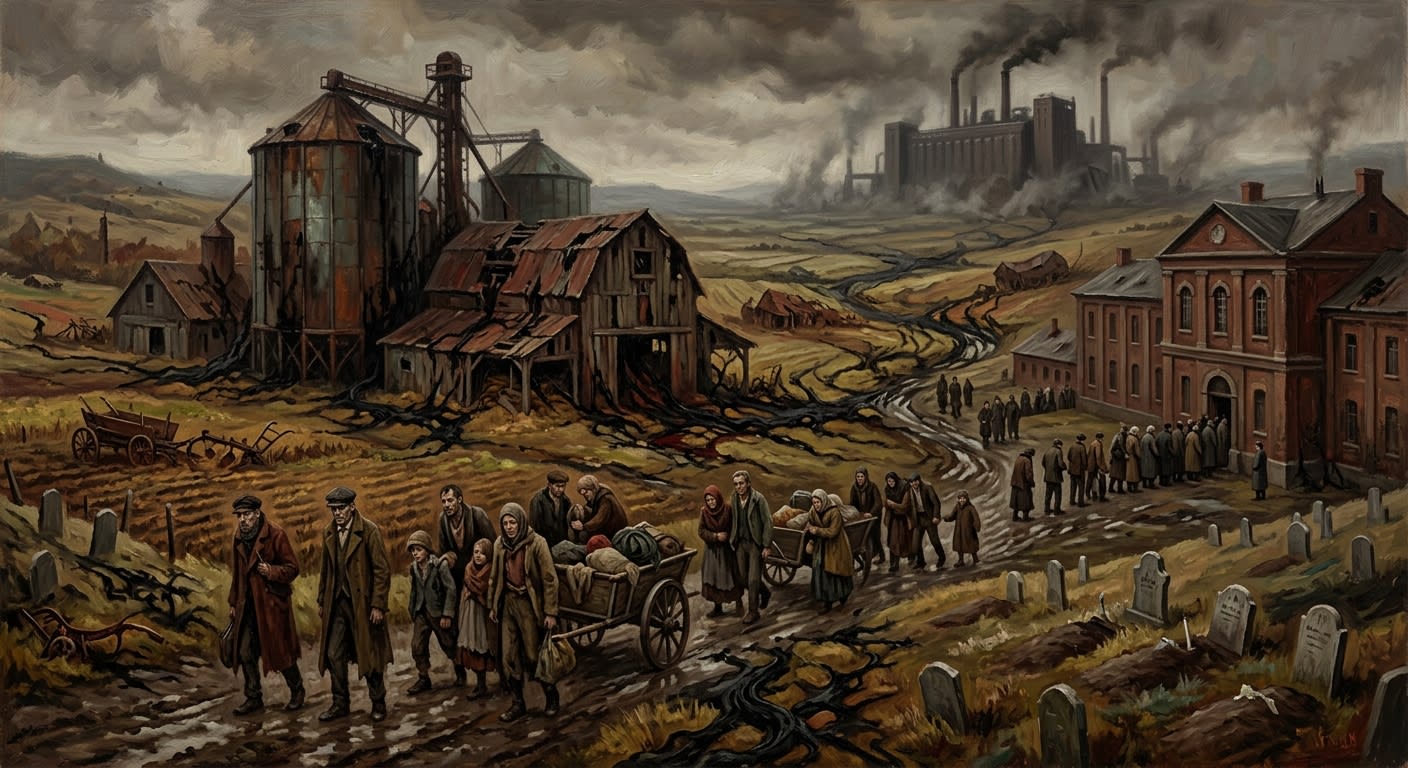
The battle belongs to its own plate, but Pannonia bears the scar. Where the fire fell, the soil cooled into ferrous crust. Craters filled with warm rust-water. Horses refused the approaches. Compasses spun. Survey plumb-lines pulled sideways. The Bureau of Engineering found that the field rang when struck, as if the ground had become a bell cast from dead infantry and bad philosophy.
The Iron Plains tore the Rationalist mind open. Debrecen starved. The Iron Plains burned. The roads west filled with soldiers, refugees, carts, priests, children, cattle, relic cases, broken artillery, and wagons whose owners had died without relinquishing the reins. Pannonia, once a basin of supply, became a basin of passage: everyone crossing, everyone stripping, everyone taking the last sack because the next village would have none, and being correct.
#On the Great Retreat and Its Graves
The Great Retreat crossed Pannonia for seventeen years, though “crossed” is too gentle a verb for a migration that dug, ate, burned, buried, stole, prayed, and miscounted across the same roads until the roads became a long confession no priest could finish hearing. The armies ate what the refugees carried. The refugees carried what Kargath had not yet ruined. That remainder was small, grey, and fought over by men who would later call themselves survivors when they meant witnesses.
They buried the dead where strength allowed. Shell-craters from Rationalist guns. Vineyard cellars near Pécs. River-cuttings. Quarry floors. Trenches left by men retreating faster than paperwork. Ditches widened by soldiers who dug with the mechanical skill of men expecting to occupy the next hole. The rites thinned. Names ran out. Chaplains collapsed. Clerks wrote souls unknown, commended until the words ceased to satisfy even the ink.
Those burials became the Famine Pits, fourteen confirmed by A.S. 197 and more suspected beneath the moving grey. Their hunger survived death. Stand too close and the body remembers starvation it has not earned. Stay longer and flesh begins accounting against itself. Medicine calls the condition pseudo-starvation cascade. Doctrine calls it residual consumptive emanation. I call it the dead still wanting supper, which is shorter, uglier, and more accurate.
BURIAL NOTE — PANNONIAN ROAD CELLAR, APPROX. A.S. 52 “Door pulled shut after forty-two bodies. Two breathing. No food left. Chaplain says prayers count for living and dead if spoken fast enough. Child under cart still crying after inventory closed.” Later Records annotation: █████████████████████████████████ File moved to hunger register by unknown hand.
The Pits prove that conquest was only the first insult. Pannonia was used badly by everyone who passed through it. Hell ate. Reason denied. The faithful fled. The half-formed Synod counted. The earth kept what it was given and, being overburdened, began giving it back as appetite.
#On the Blightmarsh That Replaced It
The Blightmarsh occupies much of what Pannonia was, though to say occupies is polite. It has eaten the place. Grey mud extends over former wheat, cellar, road, orchard, burial, ditch, and boundary stone. The Drava no longer runs through southern Pannonia as a river in the old sense; it seeps as a yellow-grey artery carrying grease, ash, corpse-froth, and matters the Bureau of Alchemical Standards names only in sealed rooms.
Water conquers land with manners. The Marsh takes geography as a bodily function. Soil fails first at the root. Crops yellow upward. Wells taste of copper and bile. Cattle lower their heads and refuse to explain themselves. The plough catches in topsoil that has forgotten how to be soil. Within a season the field is grey, within two mud, within three a registered hazard whose prior owner may still receive a tax notice if Records is feeling metaphysical.
At the edges bloom the Abundance Fields, Kargath's joke told in wheat. The stalks grow fat. Fruit ripens out of season. The air smells of fresh bread, which grain on the stalk has no right to do unless it has learned theatre from Hell. Hungry refugees walk toward them. Hungry soldiers think about walking toward them. Those who eat are filled and starve faster. Four hamlets have been found dead beside full tables. Their mouths were still working. The Bureau describes this as an agricultural lure. The three remaining Agriculture clerks call it crop behaviour under hostile theological conditions, because old offices die hard and pedantically.
The Marsh expands at the pace of patient law: roughly a parish a year, if the estimates hold, and the estimates rarely hold except downward. Cartographers erase boundaries they drew in their own youth. War calls each revision operational adjustment. Doctrine calls the motion consistent with established Gluttony models. Farmers at the edge call it Tuesday, then pack before dusk.
#On the Name That Survives the Mud
Pannonia remains useful because old names do work new classifications cannot. Say Former Agricultural Zone East-7 and a clerk thinks of squares. Say Hungary and a politician thinks of claimants. Say Blightmarsh and a soldier checks his rations. Say Pannonia and one hears the lost basin whole: Danube roads, Drava fields, Debrecen grain, Tisza orchards, Alfold cattle, Iron Plains, Famine Pits, the long retreat, the grey mouth, the bread-smell along the boundary.
Recent corridor manuals describe Pannonia as a “deprecated historic-geographic term.”
Corrected. Deprecated terms do not feed memory, frighten Agriculture clerks, irritate Cartography, and appear in soldiers' death letters. Pannonia remains approved for doctrinal, historical, and accusatory use.
The Synod would prefer the basin as categories. Categories can be assigned jurisdiction. Jurisdiction can be neglected with dignity. A name, by contrast, gathers the dead and makes them difficult to misplace. Pannonia names the feast before the famine, the field before the fire, the road before the retreat, the grave before the Pit, and the mud before the next map tries to look brave.
As of A.S. 201, no reclamation programme exists beyond observation, prohibition, and the annual production of maps that age badly before their ink dries. The Central Corridor skirts what it can. Budapest stares across the Danube at districts it cannot retrieve. Bastion-Constantinople smells the Marsh when the wind turns foul. Kargath does not hurry. A devouring country need not run.
The remaining western farms that still use Pannonian seed do so under licence, inspection, and a superstition no official admits. Seed bags are kissed before opening. First furrows are salted. Children are told never to count the ears aloud before harvest, because number invites appetite and appetite has learned to read. The Bureau of Tithes calls this rural error. I call it folk doctrine with dirt under its nails, and dirt is precisely what Strasbourg lacks when it legislates bread.