
#On the Army Reason Sent East
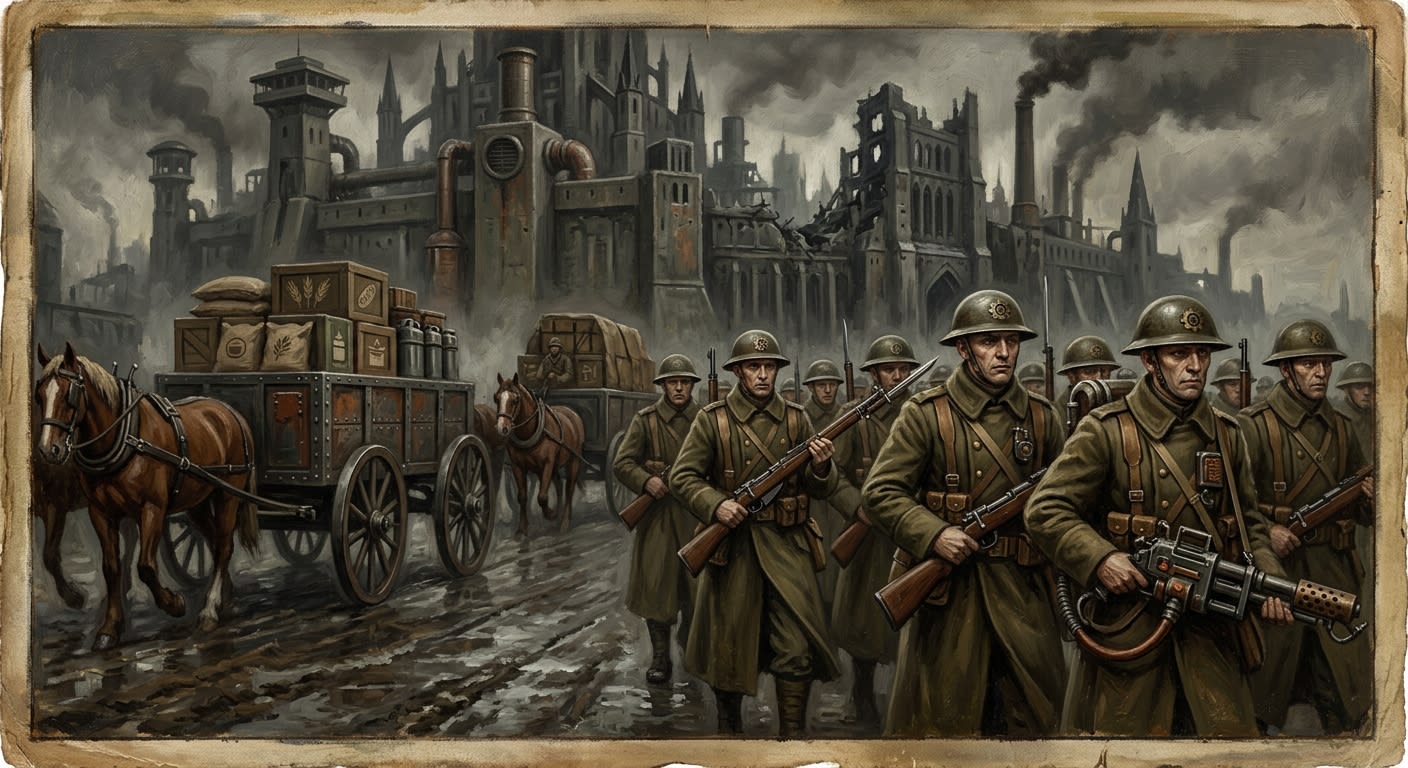
The Rationalist Second Army was the cleanest military instrument the Rationalist Republic sent into the Sundering and one of the first instruments to discover that clean steel makes a fine offering when the altar has teeth. It marched east in A.S. 45 under Council orders to ascertain disturbances, restore prefectural order, and suppress any organised resistance incompatible with the Concordats of Governance. Observe the verbs. Ascertain. Restore. Suppress. All three arrived with polished boots. None returned in usable condition.
Its two canonical wounds are Debrecen and the Iron Plains. At Debrecen, its supply certainty was eaten by Kargath. At the Iron Plains, its formation certainty was burned by Maldrake. Hunger broke one doctrine. Fire broke the other. The surviving files smell of lamp oil, rust, horse sweat, and the peculiar odour of a defeated theory attempting to remain grammatical.
The Army was not a mob, levy, panic-column, dynastic remnant, or provincial militia with banners stitched by widows and officers chosen for ancestry. It was a modern Rationalist force: drilled, supplied, indexed, equipped, numerate, obedient, and sacramentally vacant. Its regiments carried orders instead of saints. Its artillery carried spring mechanisms instead of blessings. Its officers carried confidence as if confidence were ammunition. The first two can be issued. The third explodes in the hand.
#On Its Composition and Mechanical Vanity
The Second Army was built according to the Republic's favourite superstition: that men become reliable when arranged into numbers. Its divisions were prefectural in name and in spirit. Each soldier belonged first to the Republic's arithmetic, then to his company, then to his stomach, and only accidentally to the Creator, family, memory, or fear. The order of possession mattered. The Republic had spent forty-five years moving the soul lower on every form.
The 7th Prefectural Division held the centre at the Iron Plains under Colonel Kreszner. The 12th and 14th dressed the flanks. Cavalry officers such as Captain Elias Mürren screened roads, carried messages, and enjoyed the mounted delusion that height confers mastery over mud. Sixty-four clockwork guns supported the line: brass-barrelled, spring-loaded, trained by the school of Lucien Artois, four rounds per minute in the best weather and zero prayers in every weather.
Its supply tables were admired by men who should have feared admiration. The Debrecen operation carried siege assumptions for six months: flour, salted meat, oats, cartridge paper, medical spirits, field coppers, horse feed, spare springs, boot leather, disinfectant, and enough confidence to choke a ration clerk. Every crate bore prefectural marks. Every wagon carried manifest copies. Every officer knew the day on which hunger was expected to become a difficulty. Kargath adjusted the schedule.
Their doctors catalogued wounds. Their engineers catalogued roads. Their officers catalogued enemy capacity according to prior wars against mortal opponents, civic rebels, religious holdouts, and men who kindly remained subject to ballistics. The Army's fault was not slovenliness. Slovenly armies die with less irony. The Second Army was tidy enough for Providence to use as a lesson plate.
#On the March Toward Collapse
The Army entered the eastern theatre as the Sundering opened and the old maps began lying aloud. Refugees arrived speaking of moving forests, blackened churches, fog with intention, villages that replied in wrong handwriting, and food stores that had gone quiet before vanishing. Rationalist command classified the reports as hysteria, regional superstition, communication failure, sabotage, peasant exaggeration, and disturbances. Classification is a warm coat until weather acquires claws.
The Council of Nine ordered investigation and suppression. The Second Army marched with all the procedural calm of men arriving to discipline a riot. Its columns moved through Pannonia where the wheat stubble still looked like wheat stubble, the wells still pretended to be wells, and the roads still lay obediently on the surface of the world. Soldiers joked. Gunners inspected springs. Cavalrymen checked girths. Commissariat clerks argued over sacks. War, at this stage, remained recognisable enough to flatter them.
Debrecen was the first great correction. The city and its surrounding provision radius entered Kargath's appetite: forty-two thousand souls, grain stores, cattle-runs, warehouse dust, field promise, salt meat, confidence, and any rational hope that supply could be made sovereign by manifest. Mürren's deposition records that warehouses went quiet before they emptied. The phrase is obscene because it is precise. A warehouse makes noise even when unvisited. Rats minister there. Wood complains. Sacks settle. Clerks curse. At Debrecen, silence passed through the storage district like an inspector with authority.
Then the food vanished.
#On Debrecen and the Failure of Rations
By dawn, the Army's bread had become memory. Water curdled in canteens. Salt meat collapsed into grey powder. Horses screamed at feedbags, bit through leather, then bit the hands that tried to calm them. The commissariat called it spoilage because commissariats prefer small nouns when large ones stand at the door. Officers called it sabotage because sabotage leaves someone punishable. Men called it hunger. Soldiers, possessing bodies, often reach doctrine first.
Rank survived only where ammunition guarded it. By noon, men gnawed leather. By evening, they gnawed saddle soap, reins, cartridge paper, sleeve cuffs, and devotional scraps stolen earlier from peasants as jokes. Jokes have a short shelf life under famine. Mürren ate his horse Ardent, then his adjutant's horse Celandine, then witnessed or accepted the sorcerous provender that the Sealed Testimonies now keep under Purity restraint. The visible phrase remains: It offered itself to us, and we ate, and the eating did not stop.
DEBRECEN RETREAT — SECOND ARMY WITNESS CROSS-NOTE Recovered group: seventeen. Alive after seven days: three. Observed abnormalities: stomach distension beyond anatomy; teeth reshaping; repeated requests for “what offered itself.” Command residue: ration ledgers found balanced, wagons empty, seals unbroken. Classification: sorcerous provender / involuntary heresy.
The Army retreated without admitting retreat. Rationalist language preferred manoeuvre, withdrawal, consolidation, westward reorientation, and emergency ration correction. The men preferred running. They ran from empty wagons and from fields that smelled of bread where no bread grew. Some carried sacks because empty sacks feel like hope to a starving man. Some cut open dead horses and found the stomachs full of ash. Some prayed, badly and late. The Bureau makes no mockery of that. Late prayer is still evidence.
Early Synodal sermons described Debrecen as punishment upon the Rationalists alone.
Amended for sober instruction. The hunger consumed soldiers, camp followers, local civilians, prisoners, horses, cattle, and whatever poor souls happened to stand inside the appetite's radius. Providence may instruct through catastrophe. Catastrophe is rarely tidy enough for parish rhetoric.
Debrecen did not merely defeat supply. It humiliated the assumption that logistics belonged to man. The Second Army had planned for shortage, spoilage, theft, delay, mud, disease, enemy cavalry, and defective wagons. It had not planned for a Sin-General whose dominion could make plenty withdraw from matter. A ration table cannot argue with an empty sack that still bears its seal.
#On the Iron Plains and the Failure of Formation
The survivors of hunger met the lesson of fire. At the Iron Plains, east of the Danube and south of Debrecen, the Second Army deployed as it had been trained to deploy. Three divisions abreast. The 7th in the centre. The 12th and 14th on the flanks. Batteries unlimbered behind the line. Officers' sabres at prescribed angle. Boots in frozen mud. Guns aligned. Coats pressed by men whose profession had not yet learned to wrinkle before the supernatural.
Scouts reported a large enemy concentration. The report remains a jewel of inadequate truth. The enemy did not form ranks, present banners, signal movement, or offer any target for the clockwork guns. It did not need to share war's manners. Fire fell from a cloudless sky.
The first columns turned soil to slag. The second found artillery. The third moved from left to right with a clerkly sequence recorded by four survivors and disliked by every official who prefers Hell to behave like a beast rather than an office. Brass softened. Springs fused. Horses folded into steam and bone. Men sank into ground that had been farmland a breath earlier. Kreszner gave his last order between terror and uselessness: Formation holds. Advance at regulation pace.
The order has become famous because it is perfect. Perfectly brave, perfectly useless, perfectly Rationalist. Kreszner's life had trained him to preserve formation under stress. The world changed the meaning of stress without notifying his academy. Formation held. The fire did not care. Advance continued. The ground received them.
Fourteen men survived. They ran in the direction that was not fire. Some bodies collapsed far west, still facing away. Private Kessler heard singing. Others described warmth before annihilation, which remains one of the crueler details: the fire came with hearth-manners until it touched flesh. Maldrake's wrath did not rage like a tavern brawler. It filed destruction across the line.
#On Survivors, Silences, and Official Use
The Second Army survives chiefly as paper under restraint. The Iron Plains volume holds fourteen testimonies in the first silence of the Vault of Silences. The Mürren deposition smells of lamp oil and, when warmed by careless hands, reports chewing sounds no office enjoys acknowledging. Colonel Kreszner's last order is copied by officer candidates. Captain Mürren's line is read by no one after supper unless the reader is either brave, stupid, or employed by Doctrine, which contains both prior conditions in superior arrangement.
The Sealed Testimonies preserve three useful facts from the Iron Plains: the fire fell without warning, consumed without discrimination, and ceased when nothing remained to consume. Seventeen inconvenient facts remain sealed. This is not evasion. It is dosage. Truth, administered all at once, can kill the patient or improve him beyond obedience.
War College teaches the Second Army as necessary failure. The cadet learns that courage without metaphysics becomes posture; formation without prayer becomes geometry offered to fire; supply without sacrament becomes an invitation to hunger; artillery without blessing becomes brass awaiting correction. Then he learns spacing, powder care, and the Ordained Repeater mechanism stolen from Rationalist design, because hypocrisy is merely continuity blessed by the winning office.
A.S. 95 War instruction named the Second Army “the army that proved Reason useless.”
Corrected. Reason is useful as servant. The Second Army proved Reason suicidal as sovereign. The distinction keeps bridges standing, guns firing, wounds boiled, ledgers legible, and clever boys from founding republics before breakfast.
The Bureau of Doctrine keeps the Army's corporate guilt distinct from the pity owed to individual men. Many were heretics. Many were conscripts of heretical administration. Many died hungry, burning, afraid, and unexpectedly honest before the end. The Ledger can hold all of this without softening. Mercy is not acquittal. Condemnation is not amnesia.
#On the Remains of a Properly Destroyed Army
The Second Army left few remains suitable for monuments. Debrecen kept hunger. The Iron Plains kept iron. Bratislava received runners whose hearts failed after escape had already become impossible. The Ossuary Gate of Debrecen now watches the approach where the dead revise brands and the marsh remembers streets. The Blightmarsh covers what Kargath ate and opens old road plans when it hungers for proof. The Iron Plains crust expands by measures Engineering no longer enjoys publishing.
A vulgar chronicler would end with pity. I shall do better. The Second Army was the Republic in uniform: intelligent, disciplined, arrogant, efficient, spiritually naked, and late to every essential fact. It marched east to correct disturbance and became disturbance's evidence. It brought clockwork guns to Wrath and ration ledgers to Hunger. It discovered that Hell can read a field manual, ignore it, and still kill everyone standing at regulation distance.
The Synod learned from the Army, stole from it, condemned it, blessed its mechanisms, sealed its testimonies, and used its dead to instruct better men. This is not contradiction. This is victory with an archive.