

#On the Division at the Centre
The 7th Prefectural Division held the centre of the Rationalist Second Army on 1 November A.S. 45. That was the morning the Rationalist Republic brought its finest geometry to the Iron Plains, and the sky did not trouble to mark it. The 12th and the 14th dressed the flanks on either side. Colonel Kreszner commanded the centre. Its light company filed the dawn report. Its ranks received the fire, and its colonel's last order outlived every one of them who fell.
That is nearly all the Ledger can swear to, and I prefer an honest skeleton to a rouged corpse. The Synod holds no founding year for the 7th, no recruitment district, no establishment strength, no motto, colours or standard. Prefectural was a Republican designation. The files do not show that any prefecture raised the division, paid it or commanded it. Its orders came from Vienna, like everyone's.
#On Its Drill and Its Scouts
The 7th fought by the doctrine of the Academy at Vienna: regulation interval, balanced deployment, centre held, flanks dressed, and batteries placed behind the line for enemies with bodies, horses and motives. Kreszner did not write that doctrine, and no surviving file seats him on an Academy bench. He kept it the way a sacristan keeps a lamp, with the smug devotion of a man who has never seen one go out. His recorded habits were small and exact: cartridge discipline, dry powder, ration arithmetic, and boots dressed in a line straight enough to rule ink against. A division learns its colonel the way a choir learns its precentor's pitch.
The army around the 7th fielded about twelve thousand effectives and sixty-four clockwork guns in the line of Lucien Artois. Those are army figures. The files do not say how many of the twelve thousand wore the 7th's number, or how many guns stood behind its stretch of the line. I will not carve a dead army into thirds to please a quartermaster.
The army marched east for nine days under orders from the Council of Nine: ascertain the disturbances reported by refugees, and suppress any organised resistance incompatible with the Concordats of Governance. Nobody recorded the division's own road within that march. Sermons will sometimes describe it anyway. The sermons are lying.
At dawn on the first of November, scouts of the 7th's light company reported a large enemy concentration on the eastern horizon. The file classified it as enemy concentration (irregular). This is the clearest thing the division ever said in its own voice, and it said precisely what its forms allowed. Light companies are trained to count men, mounts, guns and cookfires. They had a column for every one of those, and none for what was coming.
#On the Centre Under Fire
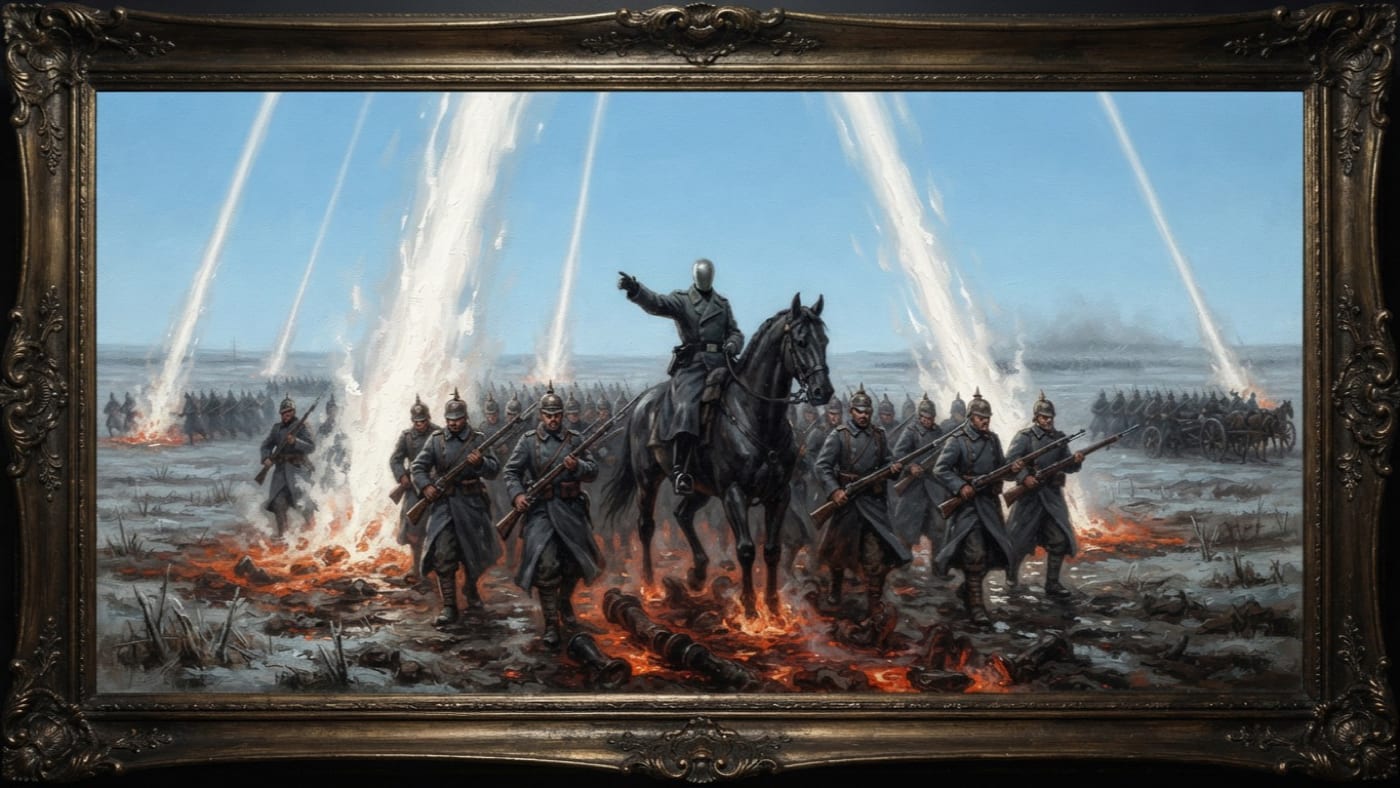
The recorded description puts the field east of the Danube and south of Debrecen, in the Hungarian plain the Republic administered as Pannonia. It was frozen stubble and mud, flat enough to flatter artillery and open enough to persuade officers that sight was knowledge. The 7th took the centre at regulation spacing. The flanks dressed on it, as flanks dress on a centre. The batteries unlimbered behind. Sabres came up at the prescribed angle. The east sent back no ranks, drums, banners, cavalry or smoke, and no gun anyone could see.
Fire fell from a cloudless sky.
It came down in columns of white heat. Where a column struck, the ground softened, then ran, and took whatever stood on it: boots, gun carriages, horses, men. Four survivors later testified that the fire moved with direction, left to right across the formation, pausing at the batteries and then resuming. Brass softened. Springs fused. A centre exists to be the fixed point the rest of the line can dress on, so the centre stood. That was its whole purpose, and the ground beneath it was turning to liquid.
Whatever the Second Army had suffered from hunger earlier in that eastern season is filed under Debrecen and Kargath, and it was a different horror with its own clerks. The Iron Plains belonged to fire.
Somewhere between the first terror and the last uselessness, the 7th received its colonel's final recorded order:
Formation holds. Advance at regulation pace.
Survivors testified that the centre went on moving after the fire had taken its front. I report that as testimony. No witness saw the whole line, and I will not pretend to have stood behind every man of it with a slate. Some of the 7th surely obeyed. Some surely could not. Some may have run, and the file is too charred to tell me who.
SURVIVOR TESTIMONY CROSS-NOTE: IRON PLAINS Witness designation: 12-P/UNHARMONISED Statement: "The centre kept moving after the fire took its front rank. Their colonel was still upright. He had no face. He gave the order anyway, or the order gave him." Further line sealed under Ninth Ratification.
That may have been Kreszner. It may have been something standing where Kreszner had stood. The witness could not say, and Doctrine declines to say on the witness's behalf. Kreszner was killed in action. No confirmed body was ever recovered. The 7th ceased to exist as a formation that morning. The Ledger records no divisional count of its dead, and I will not invent one.
#On the Charge of Incompetence
The Bureau of War enjoys blaming dead officers, as dead officers rarely file objections. For a season its instructors made the 7th's deployment the villain, because a villain with epaulettes can be corrected with a pointer. A cloudless sky cannot.
A War College plate formerly described Kreszner as "the incompetent commander whose textbook deployment doomed the Second Army."
Corrected. The deployment was sound by every military science available to the Republic. The textbook failed because the field had stopped submitting to textbooks. The fault belongs to the textbook's sovereign, not its pupil.
The Church can afford to say this plainly. The 7th's intervals were correct, its centre was correctly placed, and its scouts reported promptly in correct language. All of this is the indictment. The Republic had spent forty-five years teaching men that the world would answer to measurement, and it sent them into the Sundering still holding that belief, with their coats pressed. Doctrine reads the Iron Plains as the Creator's judgment on a sovereignty that put procedure above Him. That reading belongs to Doctrine. The testimony records fire, sequence and death. It does not record the hand behind them, and it does not prove that a chaplain at the centre would have kept one boot out of the slag.
The 7th did not know what it faced. Nobody in the Republic did. The Bureau of War entered the name Maldrake in the file in A.S. 92, forty-seven years after the field went quiet. The correction was made in a warm room by men who had read the ending first. That makes it no less true. It does make it unfair to quote the A.S. 92 file as if the light company had read it at dawn.
#On What Remained in Instruction
Fourteen men survived the Iron Plains out of the whole Second Army. Their accounts are held under restriction in the first silence of the Vault of Silences, under the classification the Codex catalogues as Sealed Testimonies. Private Kessler, whose testimony is held apart from the rest, stood with the 12th on a flank. He did not stand with the 7th. In what I have read, no named survivor can be assigned to the centre. The 7th left no witness of its own on the record. It survives in the accounts of men who watched it from a neighbouring formation, and in the voice of an officer it could not save.
The division's afterlife is therefore made of paper. It lives in deployment diagrams in which the centre is always drawn correctly, a dawn report with the word irregular in it, and one order of eight words.
The War College spends that order carefully. In their third week, officer candidates copy Formation holds. Advance at regulation pace. by hand beneath a brass lamp. Beside the lectern, an instructor strikes a flake taken from the Iron Plains. The College records that the flake rings softly if the handwriting is poor. Engineering has an explanation, War has a denial, and I have no need of either. Candidates who add a flourish recopy under a cold lamp. Candidates who show admiration recopy after reading the casualty roll. The 7th is taught as neither fool nor martyr. It is taught as the best drill an unbelieving state could buy, standing correctly at the exact place where correctness stopped meaning anything.