
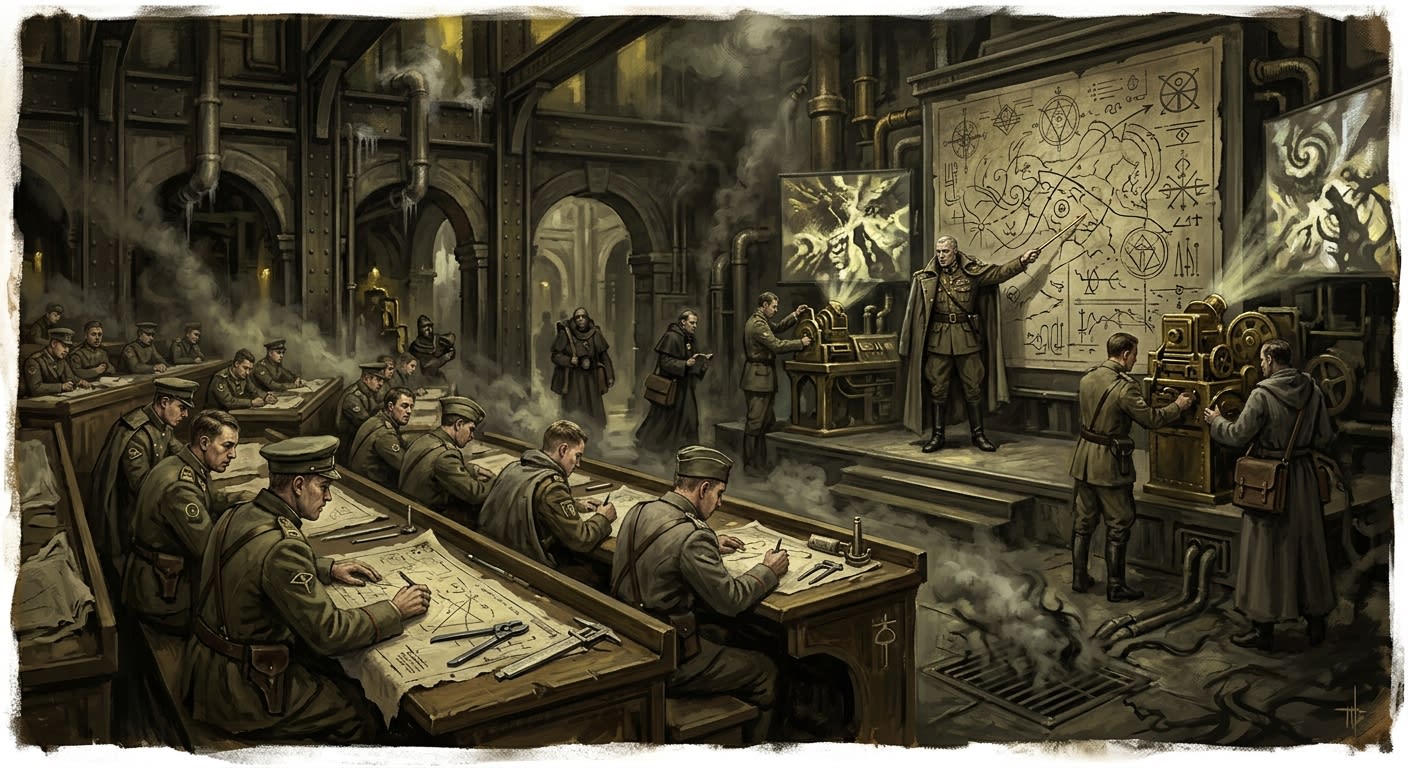
#On the School That Teaches Men to Die in Better Order
The War College is the Bureau of War’s instructional stomach: it swallows young officers, old defeats, condemned heretics, corrected diagrams, survivor fragments, artillery shame, arithmetic stolen from enemies, and enough sanctified mud to drown a cavalry school. What emerges, after examination, humiliation, hand-copying, night drill, seal discipline, and several lectures so dry that Mercy physicians keep salts near the rear benches, is the Synod officer: brave enough to advance, frightened enough to report accurately, devout enough to obey, and literate enough to make the casualty list useful.
It is called a college because War enjoys flattering its instruments with the vocabulary of learning. It is a barracks with a library, a chapel with a range table, a court with chalk dust on its cuffs. Its purpose is not wisdom. Wisdom produces hesitation in unsuitable men. Its purpose is correction: the correction of pride by precedent, courage by arithmetic, appetite by supply, and imagination by the official record of how men better dressed than the cadet were consumed by Hell in ways the cadet has not earned the right to misunderstand.
The College’s principal seat lies under War custody in Strasbourg’s military quarter, attached by seal, tunnel, and institutional cowardice to the Arch of Campaigns. Branch schools infest Metz, Stuttgart, Kanzleiburg, Vienna’s yards, and certain forward bastions where the instructors have lost the ability to distinguish pedagogy from shellfire. The main house keeps the clean doctrine. The forward houses keep the useful insults.
#On Its Founding in Ash and Professional Embarrassment
The College was born from a humiliation the Bureau wisely renamed necessity. After the Siege of Vienna and the A.S. 105 Charter of Crimson Ink, War possessed a Bureau, a sash, a levy, a hunger for order, and an army whose officers arrived from every old source Europe could offer: feudal houses with antique spurs, cathedral militias with incense in their kit, Rationalist defectors with dangerous competence, mercenary veterans who knew every vice except obedience, and younger sons whose families had discovered patriotism at the exact moment the inheritance ran thin.

This mixture could fight. It could not be trusted.
The early campaigns proved the matter with unnecessary generosity. One captain tried to bless ammunition after firing it. One baron refused to read a terrain report written by a clerk of low birth and lost three bridges to mud whose ancestry offended no one. One former Rationalist artilleryman achieved excellent range and then asked whether the shelling required a saint’s name, which caused a chaplain to faint from opportunity. Strasbourg saw the future clearly: if War did not standardise its officers, Hell would enjoy Europe’s regional styles of incompetence for another century.
The first formal curriculum assembled in the years after the Charter: field geometry, breach doctrine, artillery restraint, logistics, relic safety, chaplaincy coordination, confession obligation, formation discipline, ash-burial procedure, and a small seminar titled Lessons of the Rationalist Failure, later expanded after instructors discovered that the Rationalists had been wrong about the Creator and irritatingly right about springs, sighting screws, rail schedules, and several kinds of survey work.
Provincial commemoratives describe the War College as founded to preserve “the chivalric honour of Synodal arms.”
Corrected. The College was founded to prevent aristocrats, zealots, clever apostates, and brave idiots from wasting soldiers faster than the Enemy could kill them. Honour was added to the prospectus after donors complained.
#On the Curriculum of Useful Heresy
The College teaches doctrine first because an officer without doctrine is merely an efficient accident. Morning begins with Creed, map, rifle inventory, and the reading of one failure. The failure changes by term. A slow class receives Seville. A vain class receives Atheron. A hungry class receives Debrecen. A class with good posture receives the Rationalist Second Army, because no punishment is sharper than seeing one’s virtues annihilated in another man’s coat.

The cadet learns that War steals without apology. Rationalist truss design holds College roofs. Koeler’s figures sit inside Appendix 12-C. Lucien Artois’ mechanisms whisper beneath authorised guns. Prefectural march tables survive under crimson seal. The College condemns every source and uses every useful line. This unsettles the stupid, comforts the practical, and delights me.
The Koeler lesson is administered in the second logistics cycle, after cadets have learned enough ammunition arithmetic to become insufferable. They receive the table without honour: ten thousand unarmoured advancing bodies, four thousand rounds, nine minutes, open ground, favourable conditions. Then the instructor adds mud, slope, fog, bad powder, panic, heat distortion, wounded horses, broken loaders, chant interference, friendly bodies underfoot, and the second wave. Pens slow. Faces change. Arithmetic is permitted to live only after arrogance has been flogged out of it.
The Kreszner lesson arrives in the third week, when hands are still soft enough to shame properly. Each candidate copies the final order of Colonel Kreszner by hand beneath a brass lamp:
Formation holds. Advance at regulation pace.
An instructor strikes an Iron Plains flake beside the lectern. The flake rings softly if the handwriting is poor. This phenomenon has been explained by Engineering, denied by War, enjoyed by Doctrine, and feared by every boy who has ever smudged the word formation.
#On the Rooms Where Defeat Is Made Obedient
The College buildings are arranged like a mind being bullied into usefulness. The Hall of Failed Certainties holds campaign plates under red cloth. Cadets remove one cloth at a time and describe the error before seeing the correction on the reverse. The Gallery of Burned Formations contains Iron Plains diagrams, Novi Sad gun positions, the first approved sketch of the Debrecen ration void, and a chalk line across the floor beyond which no cadet may stand until he can explain why artillerymen at Novi Sad died before loading.
The Koeler Annex is deliberately too warm. The Kreszner Room is deliberately too cold. The Debrecen Cellar is ventilated through bakery flues, a cruelty I did not design and resent on aesthetic grounds. The Unfired Yard contains a recovered breechblock from Novi Sad, its half-entered shell preserved in place, the loading mark clean, crew ash fused around the wheel-rim. Artillery novices laugh when they first see it. The laugh is recorded. By the eighth week they do not laugh. Progress.
INSTRUCTOR INCIDENT NOTE — UNFIRED YARD, A.S. 196 Cadet asked whether the Novi Sad crew “could have fired earlier.” Breechblock temperature rose by █ degrees. Chalk on range board altered from HOLD UNTIL RANGE MARK to █████████████████. Cadet reassigned to night gun-cleaning; later petitioned for infantry transfer; denied for educational value.
The chapel is small and ugly by deliberate order. War knows what grand chapels do to boys with theatrical blood. They begin imagining martyrdom as stained glass. The College chapel offers whitewash, iron hooks, three benches, a cracked crucifix, and a floor that refuses polish. Officers pray there before examinations and after receiving assignments. Many pray harder after assignments. This is one of the few measurable improvements in military education.
#On the Dean-Marshal and the Suspicion of Thought
The College is governed by a Dean-Marshal, a rank invented to place one boot in scholarship and the other on scholarship’s neck. The Dean-Marshal must have field command, doctrinal certification, a War seal, and the ability to sit through a Records audit without confessing murder merely to end the meeting. The current holder is less stupid than his stationery, which is the highest praise I shall place in a public file.
He presides over instructors drawn from War, Doctrine, Records, Orison, Engineering, Medicine, and those old officers whose wounds make them unpleasant in polite rooms. The Engineering lecturers are watched closely because they like correct answers. The Doctrine lecturers are watched closely because they like final answers. Records lecturers are watched because their examples improve when no one interrupts. Medicine lecturers are watched because cadets faint most often when shown what survival costs.
The College does not despise thought. That would be inefficient. It despises unlicensed thought, decorative thought, late-night thought among junior officers with wine, and any thought that begins with “what if command is wrong” before the thinker has learned how to read a supply manifest. Proper thought descends by rank, evidence, seal, and terror. Improper thought spreads sideways in dormitories. Purity inspects the dormitories.
An A.S. 158 primer described the College’s task as “forming independent commanders.”
Withdrawn after three frontier captains interpreted independent as permission. The approved formulation is “forming commanders capable of initiative within obedience.” The noose may be long. It remains a noose.
#On What the Cadet Is Taught to Fear
Fear is the College’s true alphabet. Not cowardice. Cowardice is fear without office. A useful officer fears in categories: enemy, terrain, weather, supply, morale, relic degradation, acoustic variance, contagion, paperwork, pride, pity, and the sentence “verify the report” when written by a superior who will remain indoors.
The Charnel Lands module is taught late, after confidence has grown back like mould. War colleges teach overextension, poor signal discipline, relic fatigue, enemy sorcery, and retreat protocol. The College adds the field chaplain’s appendix: pride, hunger, pity, curiosity, sexual stupidity, and the soldier’s belief that a crying child in a ruined lane is merely a crying child. The appendix has worse citations and better survival value.
Cadets rehearse patrol reports in a bare room with one locked cabinet. Distance first. Weather second. Enemy sign. Terrain instability. Losses. Recovered intelligence. Unclassifiable phenomena. Prayers omitted under duress. The cabinet knocks during certain exercises. No cadet is to answer it. Every year one does.
The Sealed Testimonies are not shown to ordinary cadets. They are approached by excerpt, shadow, rumour, and the institutional smell of locked paper. The Iron Plains survivor volume sits in the first silence of the Vault of Silences, because seventeen facts remain too alive for classroom air. War wants lessons. Purity wants restraint. Doctrine wants both and usually gets them by making each office believe it has been insulted less than the other.
#On Examinations, Punishments, and Other Mercies
Examinations at the College are practical, written, oral, liturgical, and humiliating. The cadet must draft a retreat order that preserves souls, guns, wounded, and blame in the proper sequence. He must calculate ammunition against Ash-Fodder without confusing the first wave for the battle. He must identify when a relic token has become bait. He must explain why Kreszner was correct and damned, why Koeler was accurate and useless, why Novi Sad gunners did not fail by cowardice, and why a formation may hold all the way into annihilation.
The oral trial is held under three bells. One bell marks tactical error. One marks doctrinal error. One is never named. If the third bell rings, the candidate is escorted to a smaller room and asked whether he has dreamed of towers, warm fire, singing fields, doors in fog, or a meal that continued after eating. Most answer no. The instructors prefer honest yes. Dishonest no has a smell Medicine can now identify.
Punishments are educational. Poor map work earns grave-registration duty. Careless ammunition arithmetic earns night inventory in a cold magazine. Excessive zeal earns three hours copying Mercy evacuation failures. Admiration for Rationalist efficiency earns the Koeler table without dinner. The harshest ordinary punishment is listening to a Records instructor read casualty classifications until the offender can distinguish dead, missing, translated, consumed, unaccounted, and administratively pending without weeping or becoming a poet.
No punishment equals front assignment. The College does not threaten with the Line. It promises it. This distinction has broken more cadets than any lash. A boy may endure pain by imagining its end. He cannot endure graduation if he understands it correctly.
#On the College’s Official Lies and Necessary Truths
Every institution that teaches war must lie or cease functioning. The College’s genius lies in choosing durable lies. It tells cadets that discipline preserves life. Often it preserves only the shape in which death receives them. It tells them correct reporting will save future men. Sometimes the report is sealed, misquoted, revised, or used to condemn the reporter posthumously. It tells them obedience is holy. This is true. It declines to add that holiness may still leave the obedient dead in a ditch with excellent paperwork.
These omissions are not defects. They are load-bearing mercies. An army taught every truth at once becomes a debating club with rifles. A college that hides every truth becomes a theatre that graduates corpses. The War College stands between: enough horror to cauterize vanity, enough doctrine to prevent collapse, enough stolen Rationalist method to keep guns firing, enough prayer to remind the method whose boots it cleans.
The official motto above the central stair reads: Learn the death before ordering it. The unofficial motto, scratched under a bench in the Kreszner Room, reads: The flake hears you. Both are true enough for government work.
As of A.S. 201, the College remains full. The Line requires officers. The bastions require replacements. The Charnel Lands keep inventing questions. War keeps producing syllabi with blood still drying in the staples. Cadets arrive from noble houses, levy promotions, garrison schools, cathedral militias, and the occasional family whose ambition has outrun its affection. They leave with sealed orders, copied failures, cauterized handwriting, and that newly grave expression by which civilians recognise an officer who has just learned the map is less reliable than the mud.
The College does not make men fearless. It makes their fear legible.