
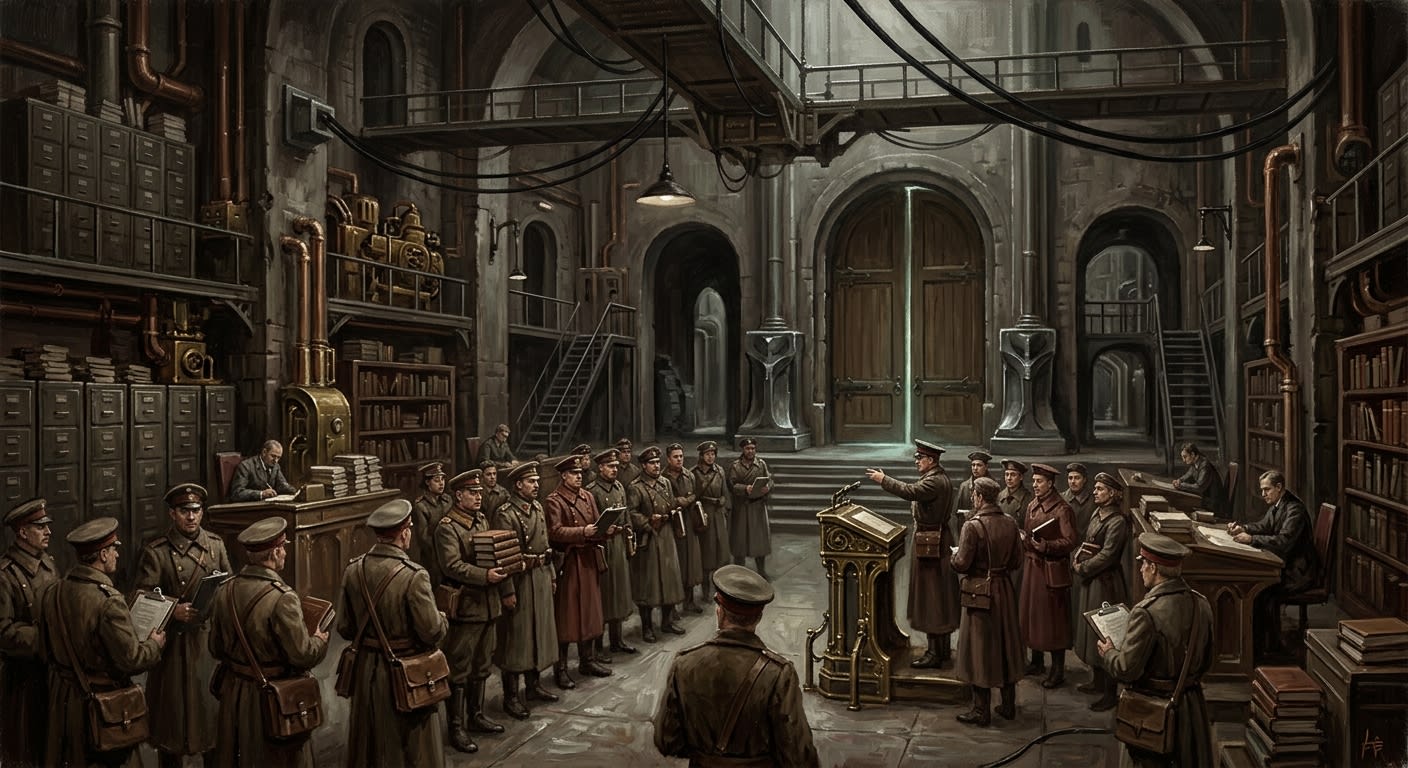
#On the School That Teaches Questions to Kneel
The Academy of Strasbourg stands inside the capital because the Synod requires educated servants and distrusts every educated man until his spine has learned liturgy. It trains theologians, lawyers, notaries, surveyors of doctrine, licensed scholars, bell-commentators, minor canonists, record-sifters, and the occasional actual thinker, whom Purity watches with the expression of a butcher studying a clever pig. It is called an academy for historical reasons and disciplinary convenience. No one in Strasbourg says the word without tasting ash.
The Academy occupies a cluster of lecture rooms, library courts, cloister walks, dormitories, examination cells, and reading galleries between the University quarter and the administrative heart. From some windows one sees the Cathedral spires. From others, the northern arcade of the Silent Colonnade shows its pale back and refuses arithmetic. Students are instructed not to count the arches. Students count them. Students are young, vain, and in need of correction. This is why schools exist.
#On Its Founding and Necessary Hypocrisy
The Academy descends from older Strasbourg jurist halls and Rationalist lecture rooms inherited after the fall, scrubbed, re-consecrated, licensed, and never entirely trusted. By A.S. 90, after the Concordat of Strasbourg fixed the city as doctrinal centre, the Synod had learned that zeal alone does not file a province. It needed clerks who could read a disputed tithe roll, priests who could argue a heresy to death, engineers who could understand forbidden diagrams, and archivists who could recognise a lie written in excellent Latin.
So the Synod kept a school.
Early Purity circulars described the Academy of Strasbourg as a temporary concession to administrative need.
Clarified. Temporary concessions that acquire stone walls, kitchens, endowed chairs, examination robes, and alumni in seven Bureaus are institutions. Purity has known this for a century and resents nouns it cannot burn.
The hypocrisy is holy because it is supervised. The old Academies made knowledge sovereign. Strasbourg makes knowledge kneel, signs its licence, binds its wrists, and sends it to work under escort.
#On Curriculum
The first year breaks confidence. Students arrive fluent in parish cleverness, provincial ambition, tavern metaphysics, and that vile little smirk by which the half-educated announce themselves before breakfast. They are given canon law, liturgical chronology, heresy taxonomy, bell-sequence interpretation, rhetoric, accounts, records discipline, elementary demonology, oath structure, and three kinds of silence. By winter most have stopped smiling. By spring the good ones have begun taking notes in margins instead of speaking.
Examinations are oral, written, procedural, and architectural. A student may be asked to distinguish schism from error, error from stupidity, stupidity from provincial custom, and provincial custom from a chargeable offence. He may be given two contradictory parish registers and told to produce one widow. He may be placed before a sealed door and instructed to state name, office, purpose, and answer, with no context volunteered. The failures speak too much. The best failures become poets, which is why we watch poets.
#On the Silent Colonnade Note
The Academy’s most famous embarrassment is the A.S. 187 seminar note that called the Silent Colonnade “local folklore of no administrative consequence.” The lecturer, whose name remains sealed by mercy or ridicule, delivered this conclusion after three Wednesdays of student counting. The following week the seminar room acquired an extra north door. The attendance register listed the lecturer absent from his own birth. The note was withdrawn.
ACADEMY INCIDENT FILE — A.S. 187 Room: Seminar Three, North Walk. Subject: Colonnade folklore note. Observed change: additional door in north wall; handle lower than regulation; lintel unmarked. Register anomaly: lecturer absent from birth, baptism, appointment, and lunch. Disposition: door sealed; seminar discontinued; students reassigned to harmless arithmetic.
This episode improved the Academy. Nothing disciplines scholars like architecture correcting them in public. Since A.S. 188, the first rule of the Strasbourg methods course has been carved above the lectern: WHAT THE CITY REFUSES TO COUNT, DO NOT REDUCE TO FOLKLORE. A superb sentence. I would have made it sharper, but the stone was already paid for.
#On Scholars Under Suspicion
A proper Strasbourg scholar is a contradiction strapped to a desk. He must know enough to read the enemy, enough to use the enemy’s tools, enough to see where Doctrine has revised itself, and enough to keep his damned mouth shut when Revision wears yesterday’s seal. Records wants his accuracy. Doctrine wants his obedience. Purity wants his confession in advance. Bells wants his ear. Shadows wants him to deny ever having been approached.
The library is divided into public stacks, restricted stacks, Secret Stacks, and rooms whose door plates contain no words but make librarians pale. Students boast of entering the second. Graduates lie about the third. No one boasts of the fourth. The Library of Saint Origen supplies many of its tutors, and in return the Academy supplies the library with interns, copyists, indexers, and young fools who learn, after one month underground, that books can stare back.
A foreign visitor’s account claims the Academy of Strasbourg preserves “free inquiry within doctrinal bounds.”
Corrected. Free inquiry within doctrinal bounds is like free swimming in a baptismal font with a Lictor holding one ankle. The phrase is foreign, optimistic, and damp.
#On Present Use
As of A.S. 201, the Academy remains active, useful, resented, and indispensable. Its graduates staff tribunals, parish courts, Bureau desks, archives, licensing offices, chant commissions, oath panels, doctrinal missions, and three departments that officially do not recruit. Its failures become provincial schoolmasters, minor pamphleteers, nervous priests, smug tavern atheists, or very quiet clerks in rooms without windows.
The Academy is dangerous because thought is dangerous. The Synod’s genius lies in refusing both peasant ignorance and Rationalist permission. We teach the mind to sharpen itself on authorised stone. We keep the blade. We count the fingers after use.