
#On the Stone That Pretends to Be Heaven
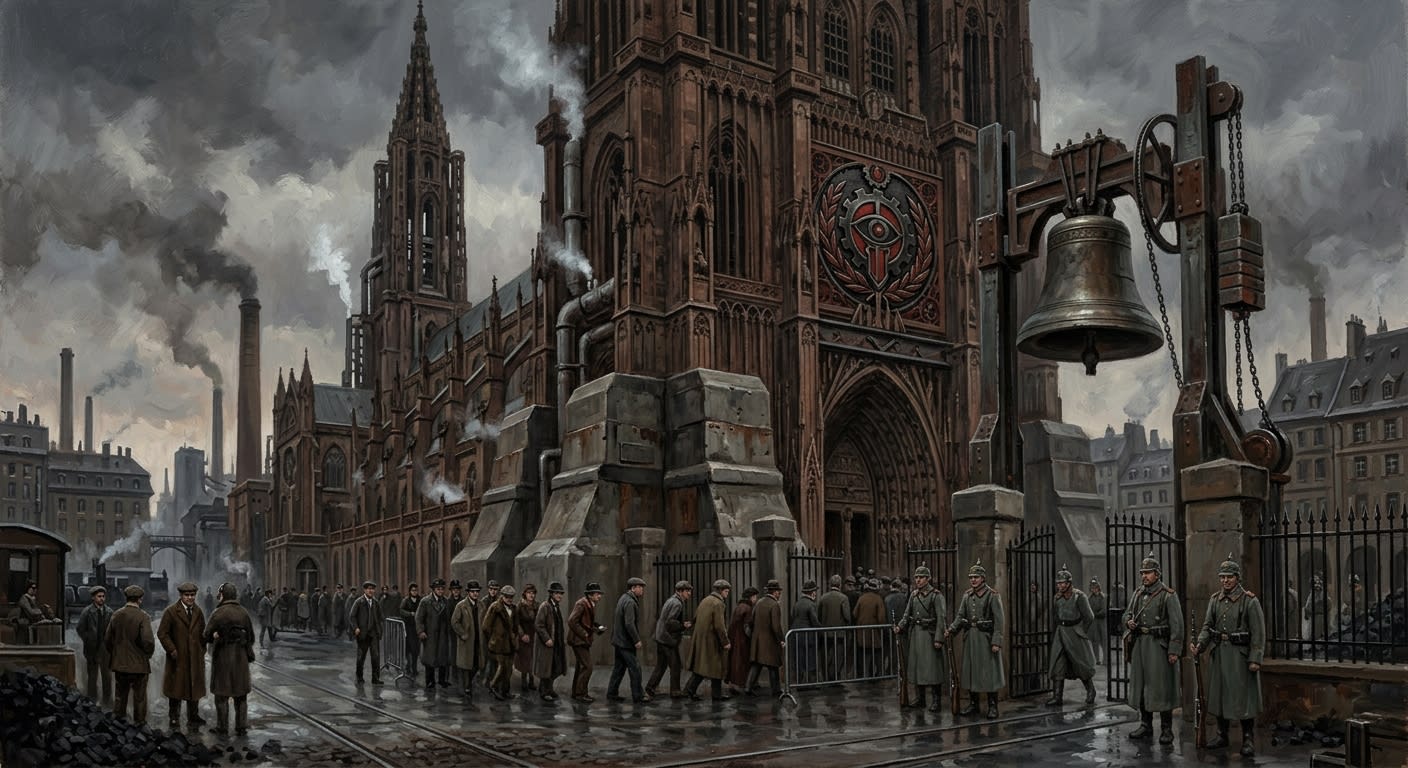
Strasbourg Cathedral is the largest argument in the western heartlands, and the only one whose buttresses have outlived every man who tried to refute it.
The common guidebooks call it the Cathedral of All Saints and Settled Accounts. The Bureau of Records calls the older choir the Basilica of the Ledgered Saints. The Bureau of Bells calls the northeast tower its headquarters and pretends the rest of the building is an acoustic support structure. The Bureau of Relics calls the sub-vaults a custody environment. The Bureau of Masks and Seals calls the eastern cloister the Sigillary. The faithful call it home, refuge, judgment, miracle, roof, threat, or simply the Cathedral, because ordinary people possess the mercy of imprecision and are punished for it only on feast days.
All names are correct. This is the advantage of being enormous.
The Cathedral stands at the western face of the Sanctum Mile, in Strasbourg, where the clean street begins its white procession through Bureau houses, courts, prisons, and the various civic refinements by which power learns to wear marble. It is the first thing the foreign envoy sees if the envoy has been routed properly, the last thing the condemned sees if Purity has been theatrical, and the thing every citizen hears, whether he looks at it or not. Its bells travel farther than its shadow. Its shadow, in certain months, is sufficient.
The Cathedral is built upon Rationalist stone. This fact is true, embarrassing, and useful in precisely that order. Before the Synod's elevation, Strasbourg had courts, merchant halls, measuring houses, and all the dry little temples of commerce by which godless men persuade themselves that arithmetic can substitute for grace. The early Confessors did not raze those foundations. They consecrated them, occupied them, buried them under saints, and then wrote pamphlets implying they had never existed. The modern Cathedral rests upon the enemy's work and calls the arrangement victory.
That is sound theology. The Enemy supplies stone. Doctrine supplies meaning. Records supplies the correction.
#On the Pre-Synodal Foundations
The first church on the site was merely large. That is the cruelty of beginnings: they never know what later vanity will require of them.
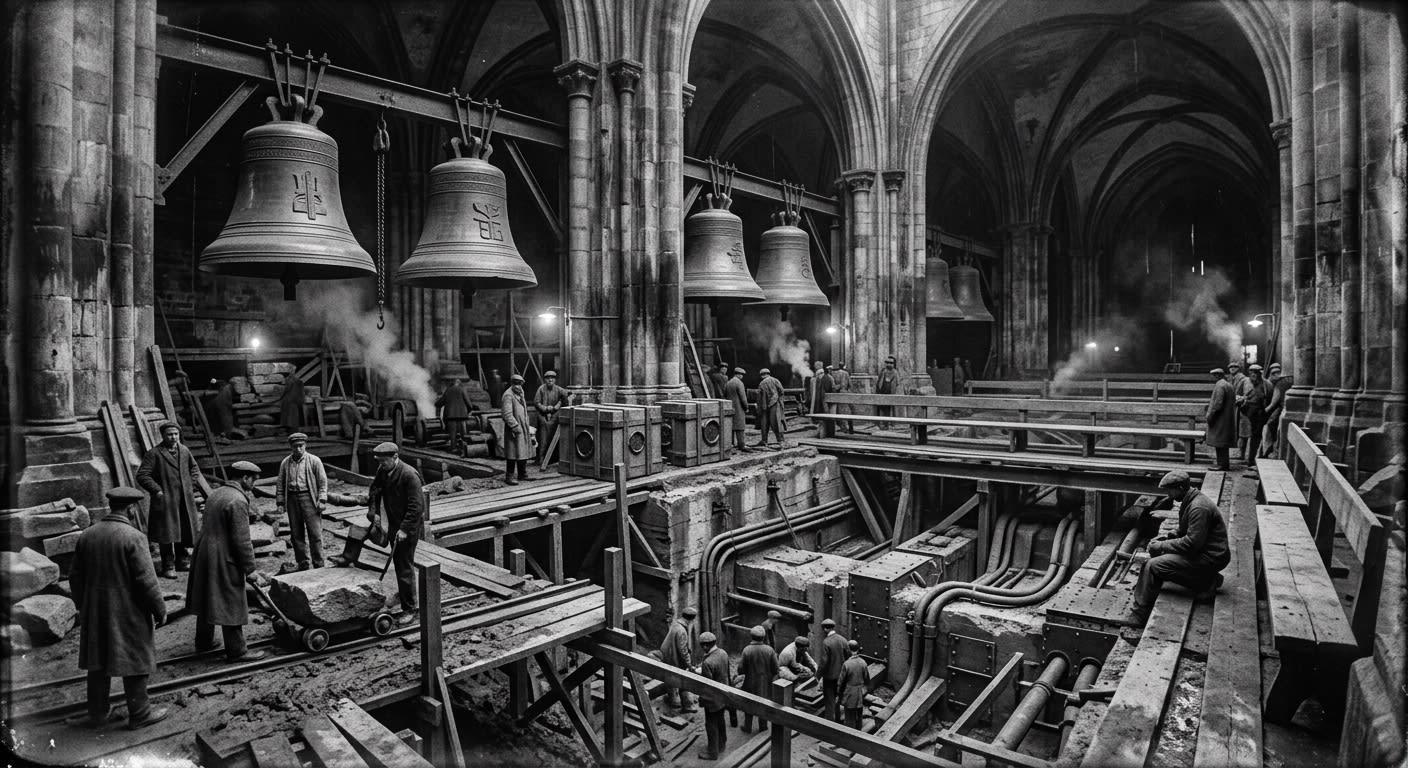
Strasbourg's old river merchants had already made the ground stable. Their warehouses pressed close to the precinct, their courts sat square over older paving, their drainage channels ran with the confidence of men who thought water was a civil matter and not, as later centuries have proved, a theological collaborator. When the First Confessors chose Strasbourg as the seat of united doctrine in A.S. 0, they chose it because it was defensible, boring, central, and already equipped with walls built by people they despised.
The Cathedral grew from that practical insult. The choir expanded first, then the nave, then the western face, then chapels grafted to chapels until the building developed the holy asymmetry of an institution receiving too many mandates from men with seal rings. The original merchant court under the south pier was filled with lime, ash, and fragments of confiscated Rationalist measuring rods. Pilgrims are told this represents triumph over Reason. Masons call it a cheap aggregate. Both readings hold weight.
Earlier catechism plates described the Cathedral site as “virgin ground raised by pure confession.”
Corrected. The ground was Rationalist, commercial, and excellently drained. The Synod did not create the foundations. It improved their loyalty.
By the first century of the Synodal calendar, the church had ceased being a church in the ordinary sense. It became meeting hall, court, treasury, archive porch, oath chamber, processional theatre, and the weather under which all Bureau architecture learned to stand. Every Bureau wanted proximity. Records wanted sub-vaults near the altar. Purity wanted doors leading away from public sight. Bells wanted height. Relics wanted depth. Masks and Seals wanted stone thick enough to distrust sound. Doctrine wanted everything visible enough to awe and complicated enough to require interpretation.
The building obliged. Great buildings often do. They begin as shelter and end as accomplices.
#On the Concordat Nave
The nave is where Europe became administratively smaller.
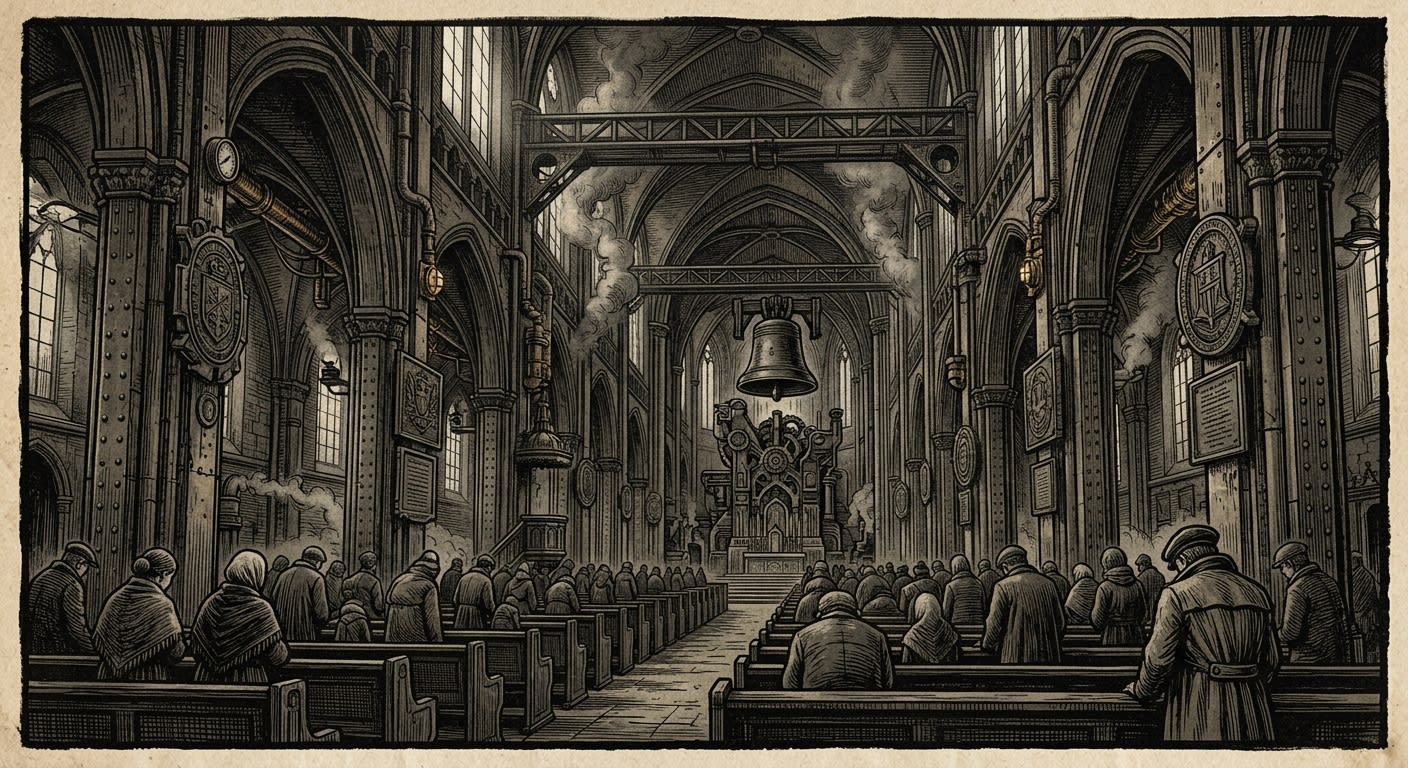
In A.S. 90, the Concordat of Strasbourg was signed beneath its vaults, on black Rhenish oak that served as both altar and treaty furniture. France, Iberia, and the Rhineland pressed their seals into one wax. Hierarch Augustinus and Cardinal Kratz were already dead; their presence in commemorative paintings credits earlier work, not attendance. The Bureau of Records preserved the table, the used blotting cloth, and several inconvenient marginal memoranda later reclassified as devotional texture.
The public painting shows bishops gathered in luminous obedience beneath banners held motionless by Providence. The private maintenance rolls note scaffold repairs, wax stains, crowd damage to three choir stalls, and fourteen cases of deafness after the proclamation bells began their three-day assault on civic glass. History loves banners. Buildings remember invoices.
The nave's proportions were later canonised as “concordant measure,” a phrase by which the Bureau of Engineering means the roof has not fallen and the Bureau of Doctrine means the Creator approves the acoustics. Every high ratification since has borrowed its geometry: three seal desks beneath the crossing, one central ink, banners hung at angles prescribed by Heraldry, Bell-Masters positioned where their faces can be seen by the Archons but not by the petitioning crowd. The Cathedral does not merely host authority. It teaches authority where to stand.
The Hall of Confessions down the Mile exists for ordinary Synodal sessions. The Cathedral is reserved for acts that wish to become memory before the ink dries: Bureau charters, saint ratifications, treaty humiliations, posthumous condemnations of persons too dead to object, and those elegant public reconciliations where two offices that have hated one another for a generation embrace beneath a reliquary and resume sabotage by supper.
The nave floor contains small bronze discs set between the stones. Pilgrims think they mark holy positions. Clerks know they mark processional sight-lines, banner alignments, speaking stations, guard intervals, and the optimal locations from which a Confessarius may hear six conversations while appearing to admire vaulting. Holiness is often a matter of standing on the right metal circle.
#On the Bell Tower
The Bell Tower of Strasbourg Cathedral is nine floors of bronze, rope, parchment, tuning forks, sweat, superstition, and the sort of professional irritability only musicians and artillery officers achieve.
The Bureau of Bells occupies it as headquarters, having been constituted in A.S. 52 after the Miracle of Cologne and ratified under the Concordat settlement. Its officers speak of the Tower as if they discovered height. Master-Carillonist Aldo Venn commands from the upper rooms, where the windows glow amber at dusk and the rope channels descend through the stone like veins in a saint's arm. He speaks in rhythms. This is not poetry. It is a warning label.
The Cathedral bells do not merely mark time. They ration grief, open confession, close markets, summon levies, divide festivals, halt processions, begin executions, delay executions, announce fasts, erase sleep, and occasionally communicate with offices that deny receiving sound. The citizen says, “the hour has rung.” The Bureau says, “the hour has been enacted.” The difference explains the whole Synod and several migraines.
The Bell Codex rests under custody in the Tower, waxed, chained, guarded, and amended by local addenda whose authority is as absolute as it is mutually hostile. Copies travel to timing houses across the Dominion. The Cathedral copy remains the exemplar because Strasbourg, in its usual modesty, has mistaken possession for ontology. A peal written here becomes law in Brest, Shipka, Constantinople, and several villages whose inhabitants have never seen the Rhine but know when to kneel because bronze from Strasbourg has told them.
Below the main carillon hangs the small bell the people call the Heresy Bell, officially Bell 7-C Auxiliary. Its legend says it tolls when a soul strays. Its schedule says something duller and more useful: irregular enough to seem watchful, regular enough to save labour. The rope does not know heresy. The dread does.
During storms, the Tower sometimes rings before command. Bells denies this. Engineering blames contraction. Doctrine blames improper listening. I blame the Cathedral, which has spent two centuries absorbing Europe's oaths and may be forgiven a little involuntary speech.
#On Confession Benches and the Ears That Sit There
The confession benches of Strasbourg Cathedral are among the most crowded, polished, overheard pieces of furniture in Europe.
Citizens come to confess because the Cathedral's receipts carry weight. A parish receipt feeds ordinary bureaucracy. A Cathedral receipt travels like a nobleman's carriage: waved through, admired, resented, stamped twice, and questioned only by men who enjoy danger. Pilgrims queue along the west aisle before feast days, clutching sin lists, tithe slips, old absolutions, petitions, infant shoes, disputed vows, and the quiet terror that their confession may be too small for such a large room.
Priests hear the sacrament. Clerks process the receipt. Confessarii sit near the doors, the benches, the sacristy wall, and the candle racks, hearing nothing protected and everything useful. The seal of confession is inviolate. The nervous rehearsal before confession is not. The relieved whisper after confession is not. The argument between husband and wife over whether to mention the hidden coin jar is not. The bench hears. The bench files through human hands.
The Sacerdotal Ear is not acknowledged. The Bureau of Shadows is not acknowledged. The cathedral chapter has never received instructions regarding plainclothes listeners in holy precincts. The absence of instructions has been implemented with admirable discipline. Ushers know which benches not to polish during certain hours. Candle boys learn which old men are never to be asked to move. A woman with a rosary has sat beneath the Saint Isidore niche for eleven years and has aged by no more than four of them. Her name appears on no parish labour roll. Her handwriting appears nowhere I may cite.
CATHEDRAL CLOSE OBSERVATION NOTE — UNDATED Bench row west of Confession Door Three. Observed seated persons: ███████ Persons listed on duty rota: █ Persons known to cathedral chapter: ███ Acoustic range under normal whisper: ██████████████████ Recommendation: leave arrangement undisturbed; polish around the bench.
The Cathedral's greatness protects and exposes. A whisper vanishes upward into vaulting. It also travels sideways along stone seams cut by men who understood sound better than mercy. A penitent who lowers his voice may reach the Creator and three clerks. This is efficient. Strasbourg admires efficiency when it can be dressed as reverence.
#On the Depths Beneath the Close
The Cathedral climbs, and so every fool looks upward. The better horror descends.
Beneath the Cathedral Close lies the Vault of Sacred Custody, headquarters and stomach of the Bureau of Relics. Visitors may descend seventeen steps to the Reception Hall and there admire reliquaries displayed at a distance calculated to produce devotion without liability. Below that begin the iron-sealed caskets, lead-lined cabinets, rotation stock, Ward-safe bones, Contaminant holdings, and corridors whose numbering system performs clarity while strangling it in the cradle.
The Vault acquired its present authority after the First Ratification of A.S. 92, when Relics made operational its most cheerful axiom: a relic authenticated is a relic made holy; a relic unauthenticated is kindling. The Cathedral became the place where bones are kept, graded, armed, and made useful. Finger-bones for trench chapels. Tooth-caskets for travelling priests. Ash phials for hospitals. Chains that hum when Bell-Masters are absent. Lamps that resent darkness with measurable discipline. The dead, properly housed, are an infrastructure.
The eastern cloister houses the Sigillary, three levels down into the old foundations, where die-cutters manufacture the stamps without which reality remains draft. There the master counter-seal impressions sleep beneath cloth and guard. There seal-dies are weighed, tested, retired, melted, recast, and indexed. There wax-masters die occupationally, which is how one knows their work mattered and no superior intends to discuss compensation.
The Cathedral's depths form a theology of authentication. Above: bells tell the city when time exists. At ground: confession tells the citizen whether sin has been received. Below: Relics decides whether bone is sanctity, Masks and Seals decides whether paper is law, and older corridors decide nothing publicly while continuing, by every practical measure, to decide.
A charitable guide once described the Cathedral sub-vaults as “devotional storage.”
Corrected. Storage is where one places surplus chairs. The Cathedral sub-vaults contain custody, classification, authentication, silence, and several objects that knock from inside cabinets whose labels have been rewritten too often to inspire confidence.
The fourth direction remains sealed. Engineering's instruments declined to function beyond it. Relics has no comment. Doctrine has approved both the lack of comment and the seal. I have stood near that lower air once, during an authorised inspection conducted at such speed that even my vanity had no time to admire itself. I heard no sound. The silence had excellent handwriting.
#On the Close and Its Neighbours
The Cathedral does not stand alone. Nothing powerful in Strasbourg does. Solitude is for saints, prisoners, and clerks about to be blamed.
To the north, the Silent Colonnade forms the fourth side of the Cloister precinct, an arcade of unmarked doors, inconsistent arch counts, and consequences that arrive without paperwork. On clear mornings, from certain upper windows, one may see its pale run of stone lying at the edge of the Cathedral's authority like a correction no one has signed. Bells reach it as dry taps. Footsteps soften there. Men enter for adjustments and return having never applied, or do not return, or return with the sort of altered paperwork that makes Records clerks sit very still.
To the east, the Sigillary breathes tallow and metal. To the southwest, the Tower of the Quill watches with the Bureau of Doctrine's usual architectural self-regard. The Cloister of Concord joins, frames, and thickens the whole precinct into a bureaucratic organ. The Sanctum Mile begins at the Cathedral's western face and carries the eye toward Purity's black stone, the Hall of Confessions, the Prison of Questions, and the administrative courts where men discover that a petition has weight only after the state places a hand on the scale.
This proximity is not accidental. The Synod learned early that power wastes force when offices scatter. Put bell, seal, relic, doctrine, confession, prison, court, and unmarked door within one walk, and authority becomes weather. A citizen crossing the precinct passes through sound, law, bone, secrecy, correction, and marble before he has found the kiosk. By the time he reaches a clerk, he has already been governed.
The Cathedral Close is less a district than an arrangement of pressures. Every facade has a sight-line. Every sight-line has a watcher. Every watcher has a superior who denies watching. Processions move according to routes that appear ceremonial and function as rehearsals for custody. Foreign envoys admire the order. Citizens understand the warning. Pilgrims understand just enough to buy candles.
#On Pilgrims, Candles, and the Price of Looking Up
The pilgrim enters by the western porch and becomes smaller in the approved manner.
This is the first labour of Cathedral architecture: reduction. A person arriving from Liège, Rouen, Candlewick, Marseille, or one of those Alsatian villages where every family owns three saints and no complete teeth, carries private sorrows large enough to fill a cottage. Under the nave vault those sorrows are forced to kneel. The ceiling rises; the body shrinks; the petition acquires better handwriting. The Bureau calls this elevation of the soul. I call it civic perspective enforced by stone.
At first bell, the west doors open to controlled mercy. Pilgrims pass through rope lanes in groups of forty, each group tagged by parish, route, and fee status. Candle tokens are checked before wax is issued. Wax is checked before lighting. Lighting is supervised by a Candle Marshal who has memorised seventeen classes of illicit flame and can smell black-market absolution oil from a distance that suggests either training or witchcraft. The candle stands nearest the south transept are reserved for verified military dead. The north transept receives uncertain dead, delayed dead, and those persons whose death has been filed but not yet accepted by Records. The difference matters. Ask any widow who has prayed at the wrong iron rail and been corrected by a boy with a ledger.
The Cathedral sells remembrance in increments: taper, vigil candle, ribbon candle, named flame, extended flame, feast flame, and the exquisite Archival Flame, in which a clerk records the petitioner's name beside the flame's burn-time and forwards a quarterly extract to Records, Tithes, and whichever mercy office profits from sorrow that can be counted. The poor buy tapers. The rich buy duration. The wise buy nothing near a clerk.
Foreign envoys are given a different route. They enter after the pilgrim crush has been thinned, escorted beneath the great vault, halted before the Concordat pavement, and invited to look up. Every envoy looks up. The Cathedral was designed to make refusal feel rude. While the envoy admires height, the escort recites numbers: nave capacity, bell radius, relic count, seal-die archive, annual candle revenue, known miracle reports, verified miracle reports, miracle reports withdrawn after family correction. The envoy hears sanctity. The escort reports whether the envoy flinched at “family correction.”
Children experience the Cathedral most honestly. They stare at the glass, not the altar; at the gargoyles, not the doctrinal panels; at the rope holes, not the priest. They understand that the building is alive before their parents have finished explaining how dead stone proves living faith. Some cry when the first full peal passes through the nave. The parents apologise. They should not. The child has heard correctly.
During winter fasts, frost gathers on the inner west hinges though no wind enters there. During the Feast of Buried Names, the candle smoke travels east regardless of draught. During Concordat week, the bronze floor discs warm underfoot before the bells begin. These are harmless observations. The Bureau has collected them for one hundred and nine years under harmless headings. Harmless things require many cabinets.
A.S. 188 Pilgrimage Office pamphlets described Cathedral access as “free to all faithful persons.”
Corrected. Entry is free. Movement, candles, petitions, viewing proximity, name-recitation, bench use, relic-glimpse scheduling, and grief beyond the allotted interval remain subject to ordinary devotional charges.
By dusk, the pilgrim leaves with neck sore, purse lighter, receipt folded, and soul adjusted toward obedience. This is not fraud. Fraud promises what it cannot deliver. The Cathedral delivers exactly what it promises: scale, sound, paperwork, and the sensation of having stood beneath something too large to sue.
#On Fire, Bells, and Funeral Routes
A building that lives long enough accumulates disasters the way a lawyer accumulates clauses.
The Cathedral has burned in minor ways, cracked in private ways, flooded through seams that maps omit, and lost enough altar silver to support three respectable black markets. Most incidents are filed by the office whose embarrassment is smallest. Bell fractures go to Bells. Wax fires go to Masks and Seals. Relic odours go to Relics unless the odour speaks, in which case several offices suddenly develop urgent conflicts of jurisdiction.
The Night of Two Bells in A.S. 129 remains the Cathedral-quarter disaster with the politest public face. Saint Erasmus and the Cathedral of the Perpetual Writ tolled together during a funeral route, splitting eight hundred mourners into three obedient streams. One group moved by sound into an unrailed dark canal. Nineteen died. The Route-Timing Concordat followed, imposing two-bell clearance on funerals, levy transfers, relic processions, ration releases, penitent marches, and evacuations. Strasbourg turned drowned mourners into route law with its customary speed.
There are older Cathedral stories: a choir stall that sang during Holy Week with no boy assigned to it; a bell rope found wet with river water during drought; a sealed east chapel whose candles burn down only when a false relic enters the Close; a stair under the north transept that appears only after midnight and leads to the same landing, but with one fewer name in the visitor book. Folklore, the Bureau says. Folklore is the word bureaucracy uses for reports whose staffing implications are undesirable.
The Cathedral survives because survival is its most persuasive doctrine. Scaffolds rise, masons vanish, bells are recast, cracks are renamed, side chapels are closed for “restorative silence,” and the nave opens by morning. A capital cannot afford a wounded Cathedral. Strasbourg maintains an unwounded Cathedral by correcting its wounds before the public learns which stone bled.
#On the Present Condition
As of A.S. 201, Strasbourg Cathedral remains the tallest structure in the capital, the loudest legal object west of the Sagittal Line, the most visited sacred site under Synodal custody, and the most densely occupied piece of stonework in Europe. It houses worship, timing, ratification, confession, surveillance, authentication, relic custody, seal manufacture, and enough unlisted corridors to make a cartographer reconsider drink.
The nave holds ten thousand. The Bell Tower commands the hours of half a continent. The confession benches hear more than penitence. The Vault digests sanctity into deployable stock. The Sigillary makes law bite. The Close feeds the Sanctum Mile. The Silent Colonnade waits nearby with its unmarked doors and the admirable restraint of a predator that has already eaten.
The Cathedral is holy. Let no tedious sceptic mistake my irreverence for denial. Holiness is not softness. Holiness is pressure applied from above and below until the soul takes the approved shape. Strasbourg Cathedral presses beautifully.
At dawn, the first bell moves through the tower stone, down the nave, into the confession benches, through the eastern cloister, across the Vault seals, under the Silent Colonnade's dry arches, and out over Strasbourg's roofs. The city wakes because bronze has instructed it to wake. The Cathedral darkens behind its own sound.
The Creator may dwell there. The Bureaus have signed the lease.