
#On the Matter of Height
There are taller structures in the Church's lands. The bell-towers of Cologne reach higher, if one credits their surveyors, and the iron mast above the Palatine Counting House stands above the Quill's weathervane on windless days. I have consulted the Bureau of Engineering's ledgers and climbed the stair with a plumb-line and a sense of purpose.
The Tower of the Quill is the tallest structure in Strasbourg. This is a fact. That other structures elsewhere may exceed it is a matter for other cities and other codices, and I will thank the Bureau of Engineering to keep its comparative tables to itself.
#The Spire and Its Purpose
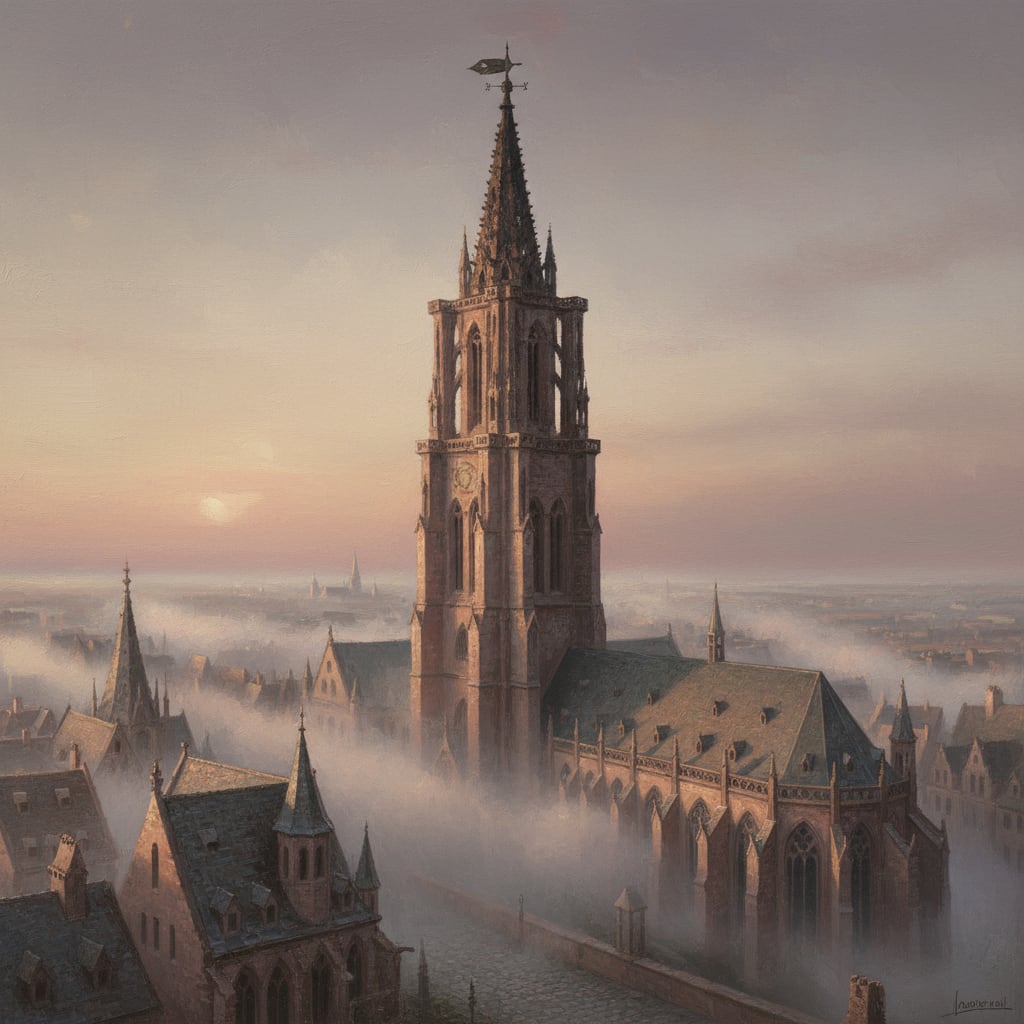
The Tower rises from the northeastern corner of the Basilica of the Ledgered Saints, adjoining the Cloister of Concord, and resembles a quill thrust into an inkwell. The A.S. 92 commission came from successor authorities after Augustinus had died; the individual commissioning office remains unresolved. Matthias Kammler built the lower courses in A.S. 92–94. Later records ascribe the quill image to Augustinus, but no verified pre-death design instruction has been produced. Kammler later fell from scaffolding and was buried with a register note: Ascended by profession.
The stone is Alsatian sandstone from the quarries at Rouffach, the same pink-grey that gives the Cloister its flesh-toned warmth in morning light and its corpse-coloured pallor by evening. The lower courses are original, laid in A.S. 92–94, and bear the mason-marks of Kammler's crew — small crosses with elongated verticals, each one slightly different, as though the masons were arguing about the correct proportion of suffering to salvation and settled the matter one chisel-stroke at a time. The upper courses are later, replaced after the fire of A.S. 141 — a fire the Bureau of Records attributes to "liturgical accident" and the Bureau of Engineering attributes to "an unregulated censer in the belfry operated by a clerk who had been awake for three consecutive days on orders from the Bureau of Purity." Both accounts are filed. Both are stamped canonical.
An earlier edition of this Codex stated that the Tower was constructed entirely of black basalt, "quarried from the ruins of the Sundering itself."
This is false. The Sundering occurred in A.S. 45. The Tower was begun in A.S. 92. The black basalt is confined to the city walls and certain foundation courses of the Cloister. The Tower is sandstone, visibly sandstone, aggressively sandstone, and the Bureau of Doctrine requests that correspondents cease describing it in colours that make it sound more dramatic than it is. It is dramatic enough.
#The Bells
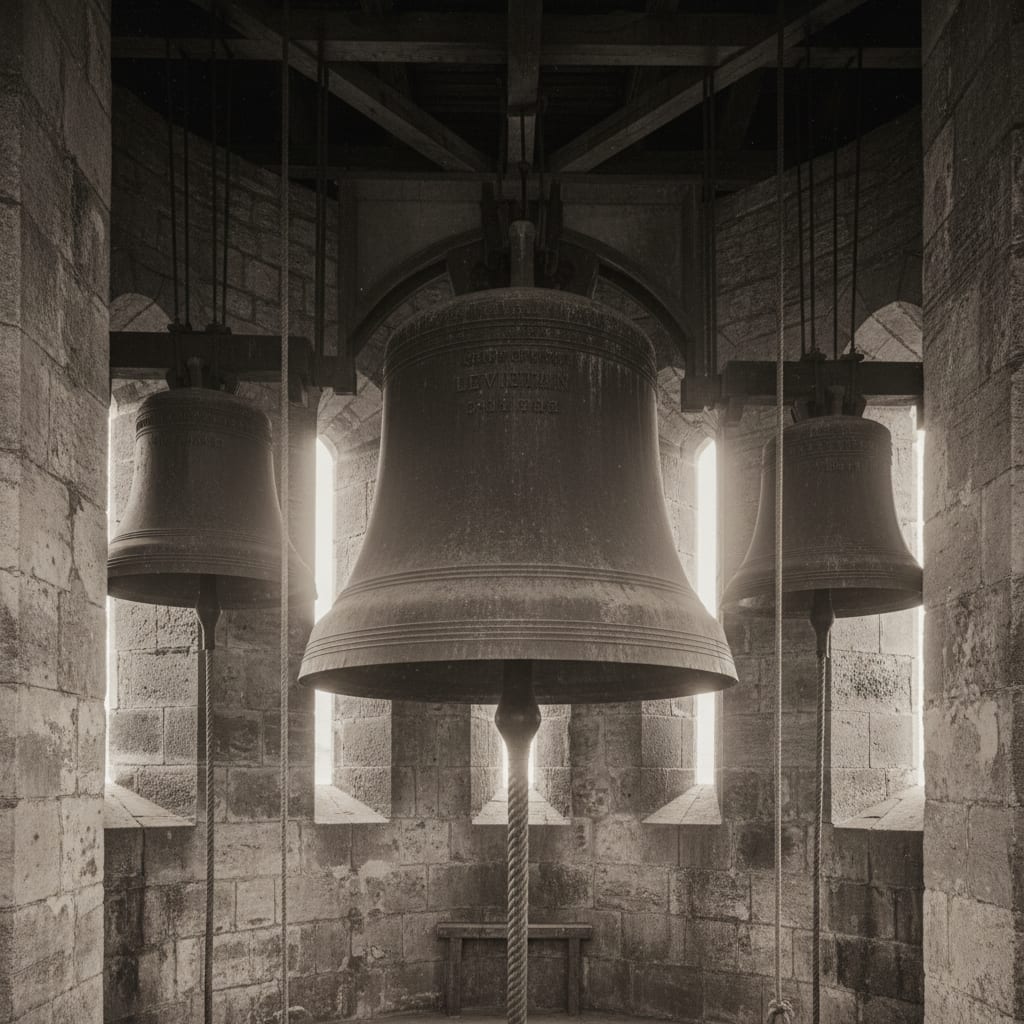
Three bells hang in the Tower's belfry, and it is the bells that have made the Quill famous from the Baltic to the Bosphorus — famous in the way that a threat becomes famous when it is repeated often enough that people begin to believe it was always true.
The largest is called the Leviathan. It weighs fourteen tonnes and requires four bellmen working in relay to swing it. It tolls for war. When the Leviathan speaks, the windows of the Cloister rattle in their casements, and the ink in the scriptoria trembles in its wells, and the archivists on the lower floors press their hands flat against their desks and wait for the sound to pass through their bones. It has tolled eleven times since A.S. 92. The Bureau of Records keeps a list. The list is short and each entry is a year the world grew smaller.
The middle bell is called Fames — Hunger. It tolls when the Bureau of Tithes declares a rationing adjustment, which is the Bureau's preferred euphemism for famine. Fames has tolled more often than the Leviathan. The Bureau of Records keeps this list too, but it is filed under a different classification and requires a different seal to access, because hunger is administratively distinct from war even when they arrive on the same road in the same season wearing the same face.
The smallest bell has no official name. The Bureau of Bells' registry lists it as Bell 7-C (Auxiliary, Doctrinal). The bellmen call it the Whisper. The common people of Strasbourg, who have a gift for the poetic that the Bureau of Doctrine would admire if it did not also find it threatening, call it the Heresy Bell.
The legend is this: the Whisper tolls whenever a soul strays from orthodoxy. A peasant in Alsace hears a distant bell and wonders whether the Tower has marked his doubt. A merchant in the Latchford Yards pauses mid-oath and listens. A child in the March of the 144 Wards asks her mother why the little bell rang, and the mother says hush, and the child learns the lesson that every bell in the Synod's domain is designed to teach: silence is the correct response to a sound you do not understand.
This is propaganda. The Whisper tolls on a schedule set by the Bureau of Bells, like every other bell in the Church's lands, at intervals calculated to be irregular enough to seem responsive and regular enough to be economical. The bellman pulls the rope at the appointed hour. The rope does not know what heresy is. The bell does not care.
The legend persists because it is useful. The Bureau of Doctrine has always understood that the threat of surveillance is more efficient than the act of surveillance. We leave the act to Purity. We provide the dread.
#The Stair
The Tower's interior is not what visitors expect — assuming visitors were permitted, which they are not, except by written dispensation from the Bureau of Doctrine countersigned by the Bureau of Records and endorsed by the Bureau of Shadows, a process that takes between four and eleven months depending on the applicant's registration category and the Shadows' assessment of whether the applicant's interest in architecture is genuine or merely a pretext for espionage.
The stair is narrow. I do not mean narrow in the way that a mountain path is narrow, where one can still admire the view; I mean narrow in the way that a coffin is narrow, where the walls press and the ceiling descends and one's elbows strike stone with every third step. The stair was designed by Kammler, who was a man of slender build and limited sympathy, and it spirals clockwise through fourteen turns from the ground-floor archive to the belfry, each turn tighter than the last, the treads worn concave by two centuries of clerks ascending with documents and descending with headaches.
There are no windows in the stair. Light enters through slits the width of a man's hand, angled to admit air and exclude arrows — an architectural feature that has been obsolete since the invention of artillery but which the Bureau retains because it discourages loitering. The slits face east, toward the Basilica, and on certain mornings the light falls in thin golden bars across the stone, and for a moment the stair looks less like a passage and more like a cage, and one climbs through the bars of light as though ascending through the rungs of a very old and very patient trap.
At the summit, the belfry opens onto a gallery — the Gallery of the Quill — which circles the bell-chamber and provides the finest view in Strasbourg, or the most classified, depending on which Bureau one asks.
#The Gallery
From the Gallery one can see the whole of the ecclesiastical quarter: the Cloister of Concord below, its vaulted roof green with verdigris; the Basilica of the Ledgered Saints to the southwest, its windows catching light in columns of number and scripture; the Palatine Counting House to the west, squat and solid and humming with the sound of coin and calculation; the Hall of Seals beyond it, where the Bureau of Masks and Heraldry rations colour to the Synod's dominions; and the Silent Colonnade to the north, that long arcade of unmarked doors that everyone swears is shorter on Wednesdays.
Beyond the quarter, the rooftops of Strasbourg stretch to the river, and beyond the river the fields, and beyond the fields the roads that lead to the Line, and beyond the Line the territories that the Bureau of Doctrine has declared "extant in a state of theological suspension," which means they exist but the Bureau declines to acknowledge them until they have been reconsecrated, which will require the Line to advance, which will require a miracle, which will require the Bureau of Relics to authenticate one, which will require paperwork.
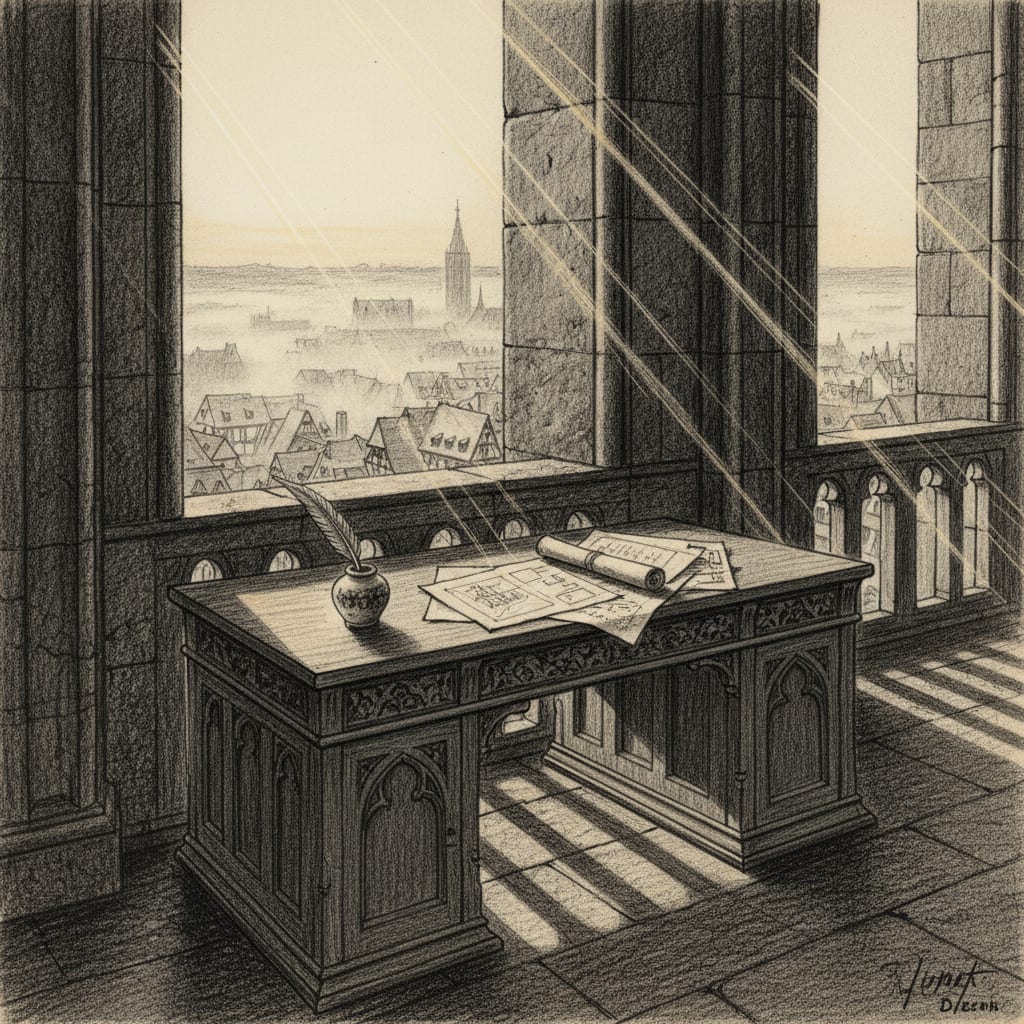
There is a desk in the Gallery. It is mine. It is positioned against the eastern railing, where the morning light is best and the sound of the bells is loudest, and I have written more doctrine at that desk than in any other room in the Church's lands. The Catechism of the Seventh Peal was drafted there. The Condemnation of the Astronomers of Kraków was sealed there. The Doctrine of the Virtue-Generals was composed at that desk on a Tuesday in autumn, and the ink dried before the candle guttered, and I sealed it with the Bureau's own chrism and sent it to every diocese and every bastion and every gatehouse with the instruction that it be read aloud at compline.
The desk is walnut. The grain runs east-west. These details are recorded in the Bureau of Records' inventory of sanctioned furniture, filed under "Ecclesiastical Quarter, Tower of the Quill, Gallery, Item 1 of 1." There is only one item in the Gallery because the Gallery requires only one: a desk, a man, and the authority to declare what is true. Everything else is scenery.
#The Archive Below
Beneath the Tower — beneath the ground floor, beneath the flagstones, beneath the level where the Cloister's own sub-vaults end and the older stone begins — lies the Sealed Archive of Doctrine. I will say little about it because little may be said. The Archive predates the Tower. The stone is not sandstone. The walls are dry in a city where every other cellar weeps with groundwater, and the air smells of something older than dust, drier than incense, and more patient than age — a compound the Bureau of Rites has declined to quantify.
The Archive contains what the Cloister cannot hold and what the Basilica will not accept: the rejected drafts, the suppressed catechisms, the doctrines that were true on Tuesday and false by Thursday, the contradictions the Bureau has accumulated over a century of defining reality by committee. Somewhere in its shelves is the original text of the Concordat of Strasbourg — the real text, the one the signatories actually read before they signed, which differs from the published version in ways that the Bureau of Shadows has classified at a level I am not permitted to specify and you are not permitted to imagine.
The Archive's lowest level contains ████████████████ and has been sealed since A.S. ███. The seal bears the mark of ████████████████████, which is not a Bureau. Access requires authorization from ████████████, who has been dead since A.S. ███, and whose death has not been processed by the Bureau of Records because the relevant form requires a signature from ████████████████, which creates a ████████████ that the Bureau of Doctrine considers "theologically elegant."
An earlier entry described the Sealed Archive as "a rumour maintained by the Bureau for purposes of mystification."
The Archive exists. I have been inside it. The entry was corrected on my personal authority as Warden of the Sacred Ledger, and the clerk who wrote the original has been reassigned to duties more suited to his talent for fiction — specifically, the Bureau of Festivals' script department, where invention is a qualification.
#On the Name
The Tower is called the Quill because the Bureau of Doctrine writes. This is what we do. We do not fight — that is War. We do not count — that is Tithes. We do not burn — that is Purity, and they enjoy it more than we would. We write. We draft catechisms and seal pronouncements and compose the words that other Bureaus enforce, and when those words prove insufficient we write new ones, and when the new ones contradict the old ones we write a third set that reconciles both, and when that third set is questioned we write a condemnation of the questioner and file it in triplicate.
The quill is our instrument. The Tower is its sheath. And from this height, with this ink, on this desk, the Bureau of Doctrine has written the world into its present shape — imperfect, obedient, and legible.