
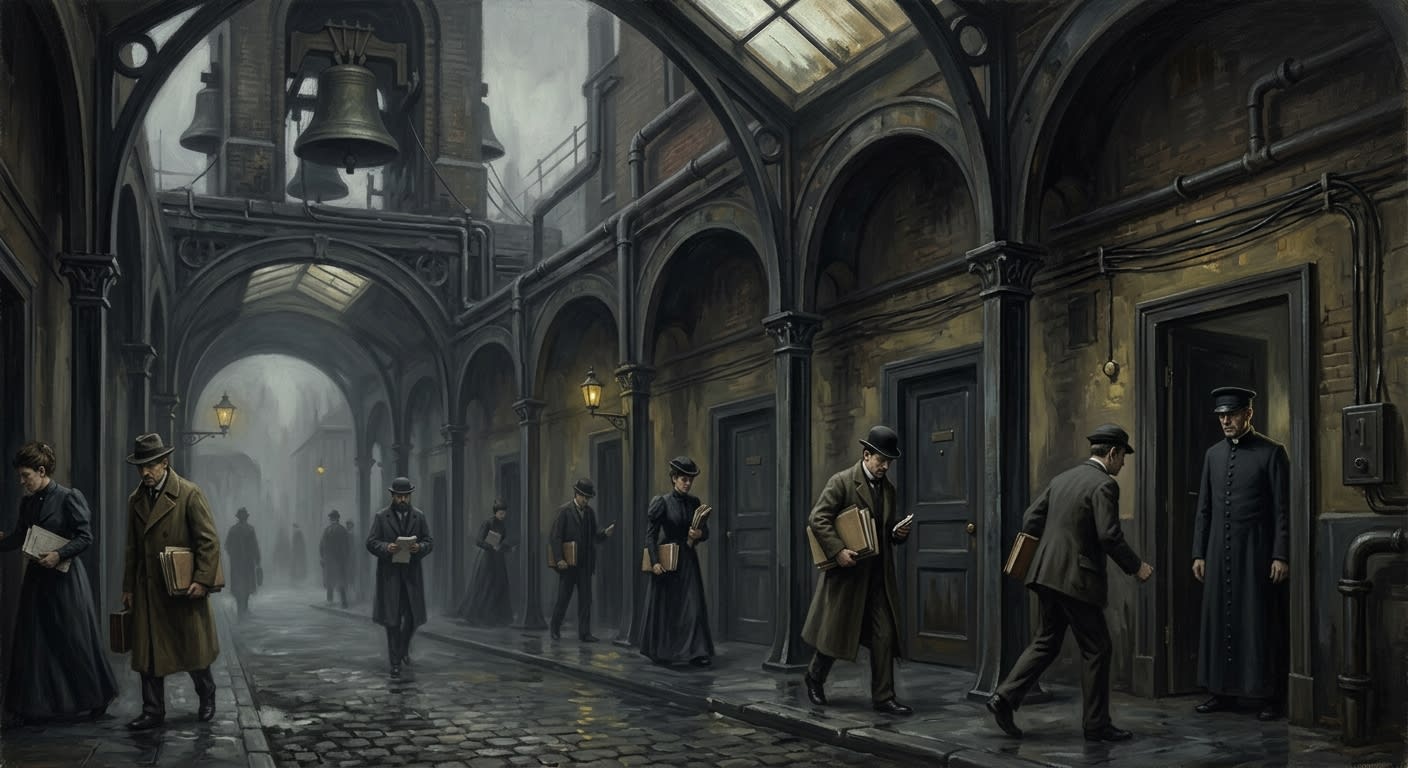
#On the Fourth Side
The Silent Colonnade forms the fourth side of the Cloister precinct in Strasbourg, north of the Tower of the Quill, within view of my own desk when the morning fog lifts and the pigeons have not conspired against civilisation. It is a long arcade of pale stone, shallow arches, clean paving, unmarked lintels, and doors so plain that even the Bureau of Heraldry hesitates before deciding whether plainness itself requires a licence.
Everyone in the ecclesiastical quarter (Unregistered) knows the Colonnade. No one knows its length. On Tuesdays, clerks count forty-nine arches. On Wednesdays, they count forty-seven. On feast days the count depends upon which bell began the morning, which Bureau issued the measuring order, and whether the clerk had previously criticised the Bureau of Shadows at dinner. The Bureau of Engineering measured it once and filed a result. The file has no number. The chief surveyor became a parish gardener in Savoy, where, I am told, his roses grow in straight lines and his wife forbids him to count them.
From the Palatine Counting House the Colonnade looks like a clerical convenience: shaded passage, quick route to petition rooms, dry paving in rain. From the Hall of Seals it looks like a jurisdictional insult, because no seal marks the doors and no one has dared issue a citation. From Doctrine it looks like punctuation at the edge of a sentence no one wishes to finish.
#On the Doors
The doors are wooden, iron-banded, identical at first glance, and treacherous after the second. None bears a crest. None bears a number. None bears the Triune Knot in visible form, which should be impossible inside the Synod's administrative heart and has been classified as an architectural exception rather than evidence of terror. Their hinges do not rust. Their thresholds collect no dust. The handles are set slightly lower than comfort demands, forcing the supplicant to bow before discovering whether the door intends to acknowledge him.
Petitioners enter for adjustments. That is the word. Adjustment of a testimony, an identity, a contradiction, a custody chain, a marriage record, a grief allowance, a memory that has begun to inconvenience doctrine. They return having never applied. Sometimes they return with their petition still folded in the hand, unsigned and dry, though rain has crossed the square all morning. Sometimes the clerk who escorted them insists he has been waiting alone. Sometimes a woman exits wearing a widow's cord for a husband she has not yet met.
A visitor's handbook prepared for provincial notaries in A.S. 187 described the Silent Colonnade as “restricted offices of the Bureau of Shadows.”
Corrected. The Bureau of Shadows maintains no official offices in the Colonnade. The handbook's author was thanked for his diligence and relieved of future description.
Once, I saw a door open onto a door. Both closed. We pretended it was a draft, because pretending is the courtesy by which Strasbourg keeps its teeth inside its mouth.
#On Silence as Architecture
The Colonnade is named honestly, which in Strasbourg counts as a minor breach of protocol. Sound enters and loses standing. Footsteps soften. Coughs arrive late to the ear. Bells from the Cathedral reach the arcade as small, dry taps, like fingernails on a coffin lid heard through legal cloth. Two clerks may walk side by side and discover, after crossing the central arch, that only one set of steps has been making noise.
The silence has substance. Absence is clean. The Colonnade's silence is full, seated, attentive. It waits with the patience of an archivist who already knows where the error lies and permits the speaker to continue for sport.
The Bureau of Bells once attempted an acoustic survey after three novices reported hearing their own confessions whispered from Door Sixteen during Terce. The survey team placed three tone rods, a handbell, and a wax cylinder recorder beneath the westernmost arch. The tone rods cracked without ringing. The handbell produced ink on its clapper. The cylinder recorded nine minutes of silence and, beneath it, a man's voice reciting the names of the surveyors' mothers in reverse baptismal order. Bells withdrew the request for follow-up. Sensible for once.
ACOUSTIC SURVEY FRAGMENT — NORTHERN ARCADE Recorder Cylinder C-3, recovered intact. Audible content: ████████████████████ Transcription clerk notes repeated phrase: “behind the first door is the door before doors.” Disposition: cylinder sealed; clerk transferred; mothers' parish records amended.
#On Wednesday
The Wednesday shortening is the vulgar name for a refined administrative wound. The Colonnade is shorter on Wednesdays than on Tuesdays. This is not metaphor. Masons have counted stone. Surveyors have stretched chains. Students from the Academy, having mistaken education for permission, marked arch bases with chalk and returned the next day to find the chalk present, the arches absent, and the marks continuing along paving where no column stood.
The official position is that human counting under liturgical pressure is unreliable. This position is elegant rubbish. Human counting builds artillery schedules, tithe ledgers, burial racks, ration weights, and the astonishing little towers of fraud by which provincial offices survive until audit. Counting becomes unreliable at the Silent Colonnade because the Colonnade declines to be counted.
Three theories circulate, each uglier than its author intended. The first belongs to Engineering: sub-foundation drift caused by older vaults beneath the Cloister, possibly connected to pre-Concordat stonework under the Basilica. The second belongs to Records: duplicated architectural entries generated by improper incorporation of Rationalist cadastral sheets after the Concordat. The third belongs to no Bureau and wears the best-cut cloak: the Colonnade is not moving; the days are.
A seminar note in the Academy of Strasbourg called the Wednesday phenomenon “local folklore of no administrative consequence.”
Withdrawn after the seminar room acquired an extra north door and the lecturer's attendance register listed him as absent from his own birth.
#On Those Who Use It
The Colonnade is never busy. Busy things can be supervised. It receives the thin traffic of the corrected world: a Night Wagon at the hour before dawn, wheels wrapped, driver hooded, horses blindfolded; a Records clerk holding a pouch that should contain papers and instead seems to contain breath; a Purity officer without his white mantle; a woman in ordinary mourning clothes escorted by two men who cast no useful shadows; a sealed chair carried by four porters, all weeping quietly and refusing water.
The Night Wagon Drivers speak of Strasbourg's unmarked doors with the practical reverence of men who understand that maps are merely opinions with ink. Corridor Masters know which tariff chapel opens onto which passage, which bridge stair joins the proxy route, which bakery cellar enters a corridor the Bureau of Records swears is drainage, and which Colonnade door opens only to an empty wagon. Sell the route and you become cargo. Forget the route and you become mercy. Remember it too well and the route begins remembering you.
The Bureau of Shadows, naturally, maintains no official position. It has no offices there, no roster, no keys, no budget line, no cleaning staff, no surveillance hook, no receiving room, no corridor, no ledger, no little brass bell behind Door Nine that rings once when a person has been successfully removed from a problem. I record these absences because they are numerous enough to require architecture.
#On Confidence
A city of seals cannot inspire love. Love is too moist, too local, too fond of exceptions. Strasbourg inspires confidence, which is drier and survives audit. The bell rings. The stamp falls. The petition disappears through the proper door. A man who enters the Colonnade carrying a contradiction may leave without the contradiction, without the carrier, or without any entry having occurred. Confidence does not ask which.
I have walked the Silent Colonnade at dusk, after Ninth Peal, when the square has emptied and the last stamp-smoke from the Hall of Seals lies low along the stones. I heard nothing but my own heart, beating to the same measure as the Tower's scheduled bell. The doors stood closed. One handle turned as I passed. I did not look.