
#On the First City Named After Toulouse
Albi is the city that had the misfortune to be named second. In ordinary geography this would be an insult of sequence only; in Synodal history it is a sentence. The Witch-Hunts of Toulouse began in Toulouse, yes, with Maël Aucourt’s damp print shop, illicit Rationalist fragments, and the woman whose laugh at a priest in ink-water helped give jurisprudence one of its more embarrassing little teeth. Albi supplied the first outward confirmation that the fire could travel by confession and arrive with paperwork already hungry.
It sits in the southern western heartlands of Synod France, red brick and pale stone above the Tarn, near enough to Toulouse to inherit its smoke and far enough away to pretend, for six exquisite hours in A.S. 93, that another city’s panic would remain another city’s property. This is a provincial error. Panic has better roads than grain.
The first Toulouse confession named Albi not as a fortress of heresy, nor as a rival academy, nor as some sulphurous parliament of Rationalist cleverness. It named Albi as a route: a courier, a bookseller, a widow’s nephew, a packet of stitched pamphlet fragments tucked under devotional scraps, and one priest who owned too many commentaries for a man publicly fond of simplicity. That was enough. The Bureau of Purity was young, and young offices feed greedily.
#On the Arrival of the Writs
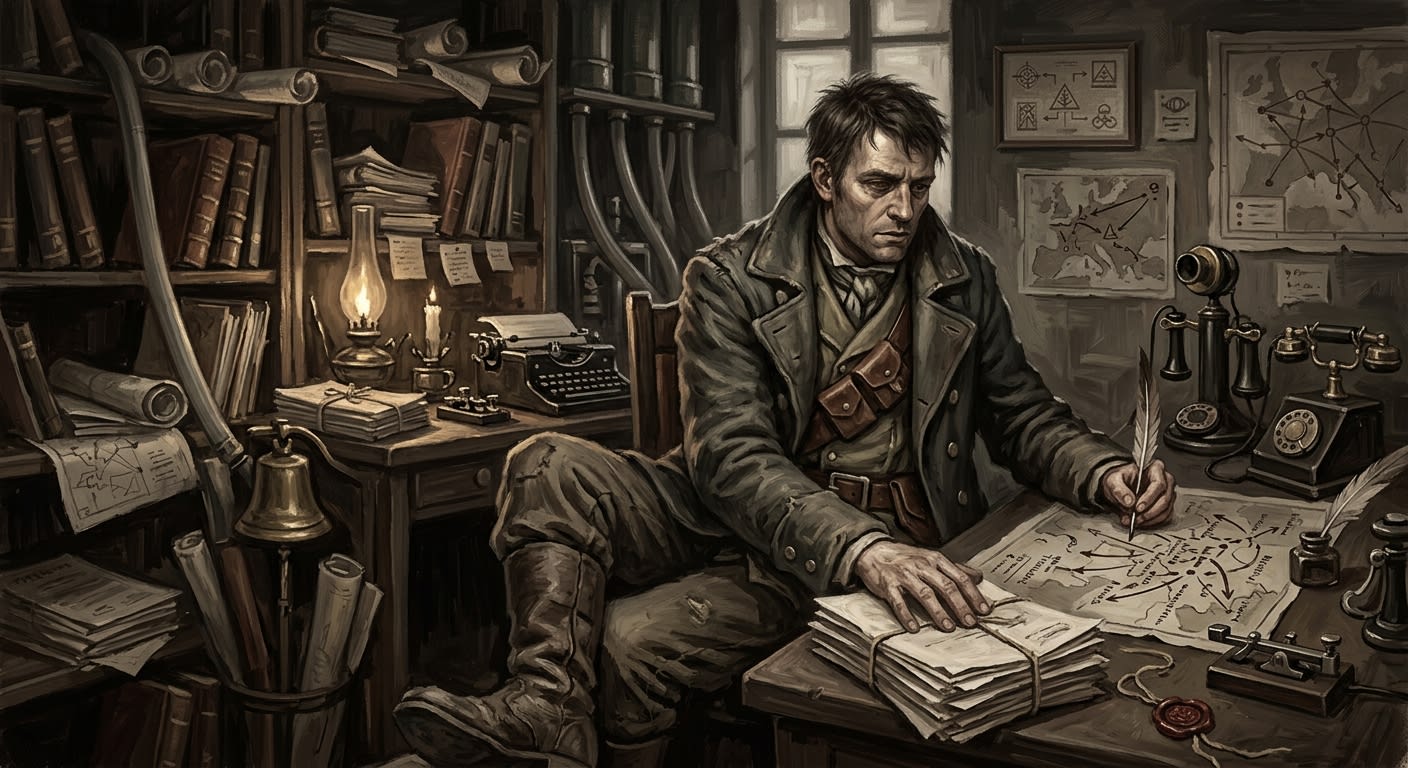
The writs reached Albi folded inside a military dispatch pouch, because terror travels more efficiently when disguised as logistics. Parish bells were rung before sunrise. Household libraries were ordered into the market square by Sext. Printers were commanded to open drawers, type cases, paper racks, floorboards, prayer cupboards, and memory. The final command was not written. It was understood by anyone old enough to possess a song.
Albi had fewer printers than Toulouse and correspondingly fewer hiding places that looked respectable. This made Purity irritable. A search party that finds too little evidence begins manufacturing better categories. By the third day, Albi’s docket contained domestic retention, courier silence, ink adjacency, failure to be surprised, and devotional misplacement, the last charge applied to households where approved saint images were found behind unapproved family letters. Bureau categories are like rats: one sees two, and the wall is full.
A later municipal sermon described Albi’s A.S. 93 cooperation as “swift, unanimous, and piously transparent.”
Corrected. Cooperation was extracted by bells, house lists, threatened property seizure, and the spectacle of three respectable men made suddenly less respectable by rope. “Transparent” is the word officials use when they have broken the window themselves.
The market-square inspections found pamphlet strips, an old Rationalist verse copied into a recipe book, three devotional calendars with suspiciously blank feast days, and a school exercise in which a child had written the word Reason with a capital letter. The child survived. The schoolmaster did not remain a schoolmaster. The Bureau of Records later noted this as a successful educational clarification.
#On the Chain That Ran Through Albi
Albi mattered because it proved the Hunts were not a local fever. Toulouse could be dismissed, by cowards and wine merchants, as a peculiar correction of a peculiar city. Albi gave Purity a line. A line can be extended. A line can be mapped. A line can be followed by men with lists and superior boots.
From Albi the docket reached Carcassonne, then Narbonne, Béziers, Montauban, Cahors, Rodez, Nîmes, Foix, and the river shrine whose name was struck for being too obedient to deserve remembrance. Every link allowed Purity to argue that heresy moved by household, kinship, invoice, song, and borrowed type. The claim was monstrous. It was also useful, which is how monstrous claims become administrative furniture.
ALBI CONFESSION ABSTRACT — COPY 3, HEAT-DAMAGED Named carrier: █████ Aucourt relation by marriage. Packet contents: fragments of The Burning of Superstition; two hymn parodies; list of sympathetic households; blank leaf smelling of vinegar and lampblack. Statement under preliminary heat: “Albi already knew.” Subsequent classification: city-wide prior knowledge presumed for operational purposes.
The phrase “Albi already knew” entered the Purity file with all the delicacy of an axe entering a table. It justified pre-emptive questioning. It justified library presentation. It justified treating ignorance as concealment and denial as proof that the questioned party understood the stakes. Citizens learned quickly. The safest answer became a smaller answer than the question required.
#On the Cathedral and the Corrected Voice
Albi’s cathedral clergy emerged from the Hunts with the special stiffness of men who had watched neighbours carried off and then preached gratitude for improved air. Sermons after A.S. 93 became shorter, plainer, louder, and less fond of inherited local saints. The old southern habit of singing around doctrine — circling a difficult line with melody until it softened — was cut back. Children were taught approved endings. Widows were advised to submit household prayers for correction before teaching them to infants.
The city’s choir books were reviewed twice: once by local clergy seeking to survive, once by Purity officers seeking to find what survival had missed. Three antiphons were removed for residual tenderness toward condemned thinkers. One harvest song was altered because its rhyme permitted the syllable luc to fall too brightly after the word vera. The Bureau denied pettiness. The Bureau is often petty with cosmic confidence.
#On Present Quiet
As of A.S. 201, Albi remains loyal, southern, profitable, and quieter than its stones deserve. It is no Sagittal Line bastion, no frontier martyr, no grand hinge on which the fate of the Church visibly swings. Its usefulness is smaller and more durable. It teaches that Purity’s founding terror did not remain where it began. The fire in Toulouse learned roads; Albi was the first road-sign.
The city keeps a modest archive of A.S. 93 under the bland title Courier Compliance Records. Scholars request access and receive courteous refusals written in a hand so neat it may be hereditary. Families still know which ancestor named which neighbour, which neighbour survived long enough to forgive nothing, which parish door was marked with wax at dawn, which song must never be sung past the second verse. Such knowledge is never entered in civic guidebooks. Guidebooks are for visitors, children, and officials pretending not to know why the room has gone still.
The Albi municipal plate once stated: “No major violence occurred within the city during the Toulouse extension.”
Clarified. Violence becomes minor when counted by men who slept elsewhere. The statement is withdrawn from instructional copies and retained in civic brochures for pilgrims with delicate digestion.