
#On the Fire That Learned to File
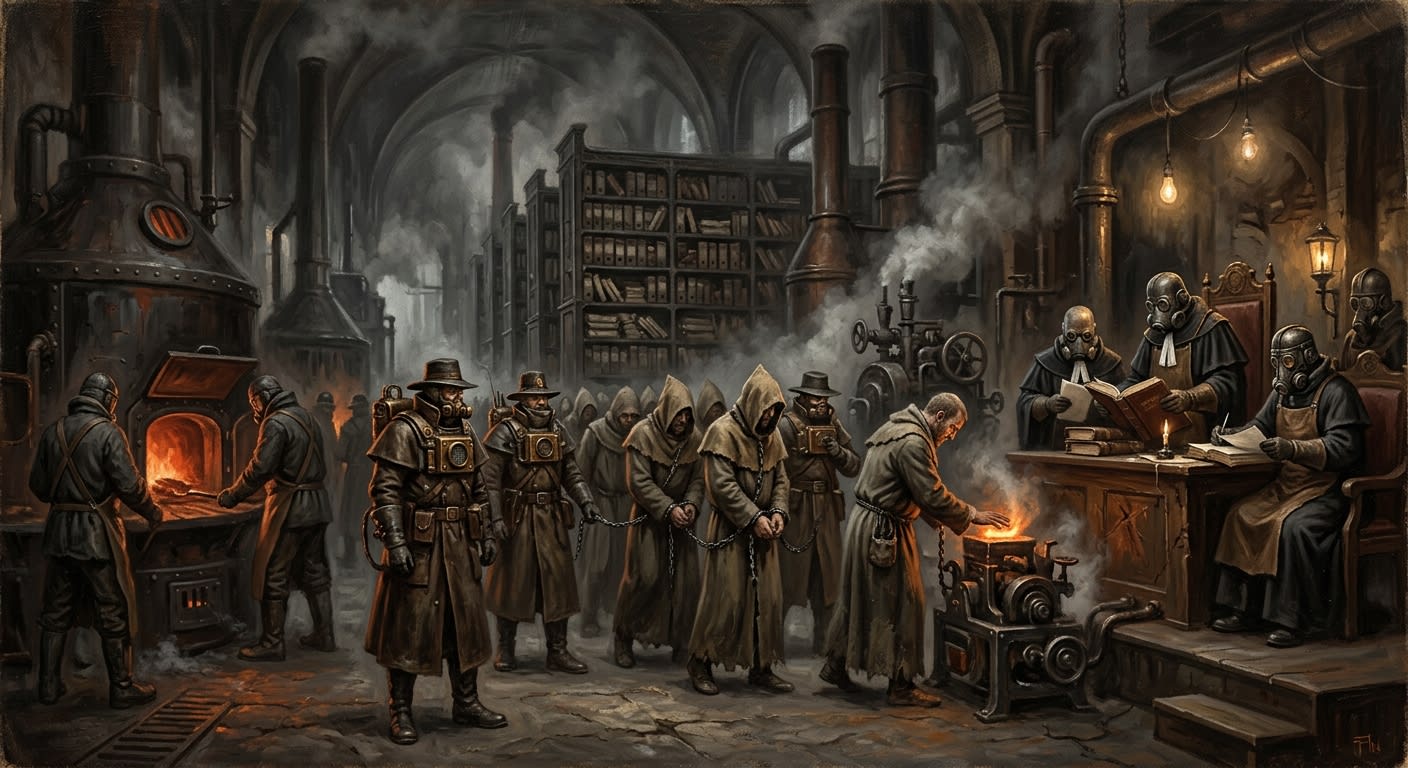
The Witch-Hunts of Toulouse were the Bureau of Purity's cradle, furnace, kennel, baptismal font, and first crime scene. Lesser historians call them a campaign. Purity calls them an awakening. I call them what they were: the moment at which the infant Synod discovered that terror, if sufficiently documented, could be promoted into law.
Toulouse had always been a city with too many tongues. Troubadours, printers, wine-men, disputants, merchants with foreign phrases caught under their nails, widows who remembered older saints, students who mistook cleverness for license, and priests who had survived the Rationalist centuries by learning the dangerous habit of private judgement. After the Concordat of Strasbourg in A.S. 90, such habits became intolerable. The Synod had acquired a continent in principle. It still had to acquire every cellar.
The Hunts began as an inquiry into illicit pamphlets and ended as the founding campaign of the Bureau of Purity. Eleven cities were drawn into the fire by confession, denunciation, courier route, printer's invoice, and that sacred accelerant of all prosecutions: administrative ambition. By the time the smoke thinned, the Bureau possessed its first permanent officers, its first white-paper writs, its first branded victims, its first informant apparatus, and its first doctrine of necessary dread.
#On the Date, Since Records Has Been Drinking Again
The careful reader will have noticed that certain Bureau files date the Witch-Hunts to A.S. 3. This is, in the technical language of my office, a magnificent mess.
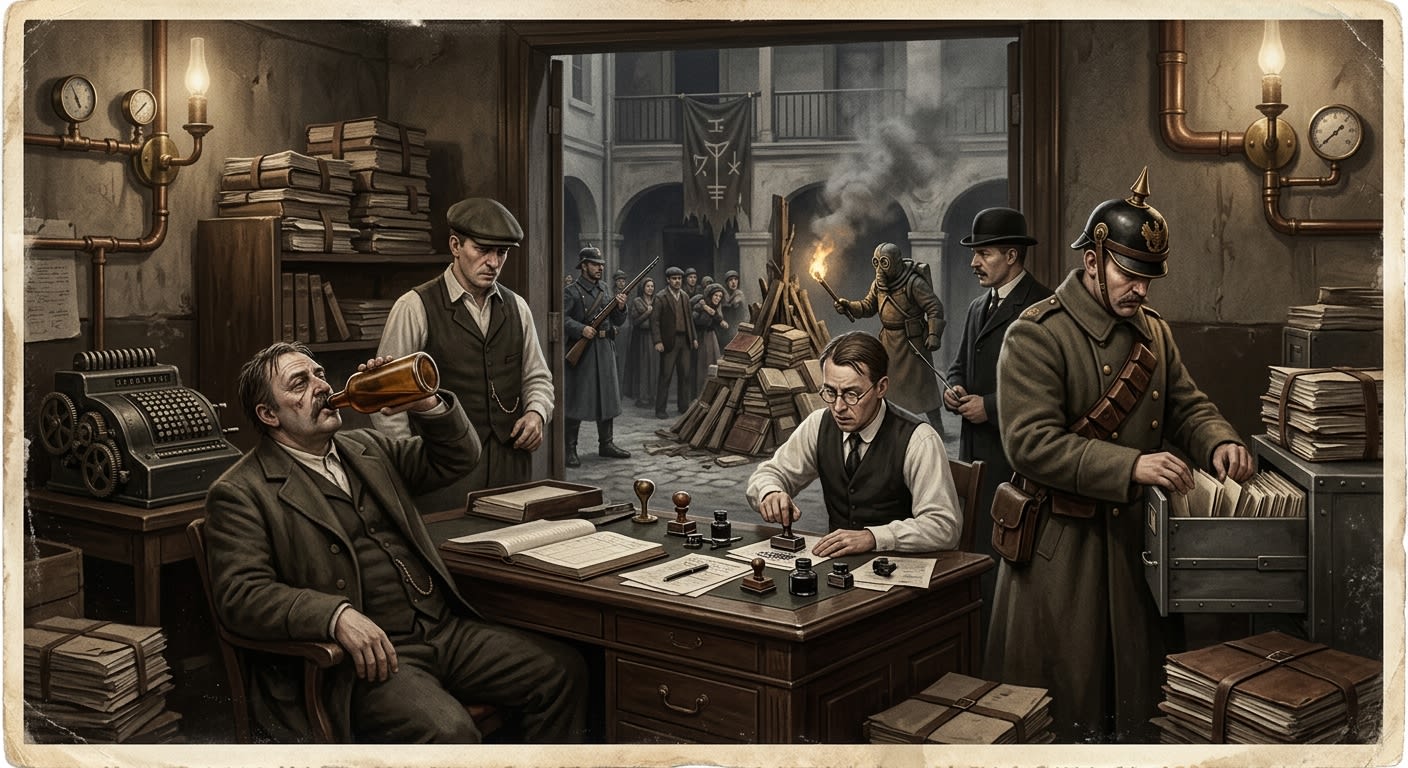
The error began with the Anno Synodi reckoning itself. Because the Synod counts from A.S. 0, the year of Rationalist formal heresy rather than the year of Synodal triumph, early clerks developed the pious habit of backdating moral causes to the wound rather than to the instrument that later cauterised it. The first Toulousain heresy docket indeed records activities “in the third year of accumulated error”: clandestine anatomy lectures, saint-mockery broadsides, trial songs, and a Rationalist pamphlet cycle titled The Burning of Superstition, which, one admits with professional annoyance, had a memorable cover.
The armed Synodal campaign occurred in A.S. 93, three years after the Concordat, after the Council of Mainz ratified the Seven Seals and gave Purity a constitutional throat through which to shout. The Bureau's own founding dossiers preserve both dates. Purity, being Purity, prefers the older one. A thing appears more eternal when it pretends to have been born before its mother.
Earlier Codex tables listed the Witch-Hunts of Toulouse as occurring simply in A.S. 3.
Corrected. A.S. 3 marks the earliest Rationalist-era offence bundle later attached to the Toulouse file. The founding campaign of the Bureau of Purity occurred in A.S. 93. The Bureau of Purity objects to this distinction because distinctions limit the size of its birthday.
This entry uses A.S. 93 for the campaign and preserves A.S. 3 as the Bureau's preferred ancestral fiction. Both are true in the only sense that matters: each has victims.
#On the Spark in the Printer's Quarter
The first warrant named a printer: Maël Aucourt, licensed for funeral notices, ration broadsheets, catechism slips, and public corrections. His shop stood behind a cooper's yard near the old Saint-Sernin quarter (Unregistered), its windows clouded by ink vapour, its presses so old they groaned like confessors under salary review. Aucourt had reprinted a Rationalist tract in fragments, hiding the forbidden argument between legitimate notices for plague burials and grain allotments.
The tract itself was banal: three pages claiming miracles were mistakes of witness, relics were bone with costumes, and the Synod's newly proclaimed authority rested upon collective fright. A tavern wit could have produced sharper blasphemy after two cups. What made the tract dangerous was its arrangement. Each fragment seemed harmless alone. Together, read in proper order, they formed an argument. The Bureau has always hated sequence; sequence is how citizens learn to think between stamps.
A White-Mantled field cell did not yet exist. The men who came for Aucourt wore parish black, borrowed civic sashes, and ordinary boots. They carried three writs, none valid outside their own district, and one list of suspect subscribers. By dusk, the subscriber list had doubled. By midnight, the cooper's apprentice had denounced two booksellers, one midwife, a schoolmaster, and his own uncle, whose principal offence appears to have been refusing repayment of a small debt. The uncle confessed under preliminary heat. Preliminary heat would become, after Toulouse, a technical rank of interrogation.
Aucourt died before dawn. The presses were sealed. The shop burned badly; damp paper resists fire with the stubbornness of mediocre thought. The crowd watched. A woman laughed when one of the arresting priests slipped in the ink-water and landed backside-first in a tray of funeral notices. The woman's name entered the file. By the next week, laughter itself had become evidentiary.
#On the Eleven Cities
The Toulouse docket did not stay in Toulouse. Confession named Albi. Albi named Carcassonne. Carcassonne named Narbonne, Béziers, Montauban, Cahors, Rodez (Unregistered), Nîmes, Foix, and a river shrine whose name has since been struck because its inhabitants proved so cooperative that the Bureau rewarded them with anonymity. Eleven cities, if one trusts the Seventh Revision. Twelve, if one counts the anonymous shrine. Purity counts eleven because twelve implies apostolic symmetry, and even Purity knows when to avoid flattery.
The Hunts spread by courier and smoke. Writs of cleansing arrived folded inside military dispatches. Parish priests were commanded to read lists from pulpits. Citizens were required to present household libraries in market squares; the literate sweated, the illiterate sweated harder, and the bookless came to denounce neighbours so that their empty shelves would not look suspiciously prepared.
The categories multiplied. Textual contagion for pamphlets. Domestic retention for hidden devotional objects that had not been registered. Residual Rationalism for old slogans remembered too cleanly. Mercy obstruction for sheltering the accused. Laughter at correctional personnel for the woman in the ink-water matter, whose afterlife in law remains disproportionate and, to my irritation, funny.
The first public fires were inefficient. Books burned too slowly. Furniture mixed with pamphlets produced smoke that made the confessors cough. One square's pyre collapsed into a poultry stall, killing eight hens and creating a jurisdictional dispute over whether the hens had died as evidence, property, or witnesses. The dispute reached Strasbourg and produced the first Purity rule on evidentiary livestock.
In the third week, the campaign found its method. Separate paper from people. Burn paper publicly. Interrogate people indoors. Return selected bodies to the square bearing visible marks. Visibility became the hinge. A citizen who sees a book burn may pity the owner. A citizen who sees the owner branded with the book's title across his chest learns shelving discipline.
#On the Birth of the Lictors
The Lictors were born because parchment ran out.
This is the kind of sentence that sounds like satire until one reads the requisition ledger. By the fourth week, Toulouse's interrogators had extracted more confessions than the available clerks could copy, and more names than the provincial archives could absorb. The accused contradicted one another, recanted, expanded, embellished, and died at inconsiderate intervals. Paper could not keep pace with pain. An unnamed Inquisitor — later expunged for either modesty or embarrassment — proposed that the confession be written upon the confessor.
The first brands were crude. A cross for apostasy. A circle for blasphemy. A line for disobedience. Heat, press, scream, file. The logic was immediate and vilely elegant. The condemned became portable record. The crowd became reader. The Bureau became less dependent on ink.
Within a generation, the practice would become the Lictor script: two hundred and fourteen glyphs encoding word, date, clause, presiding officer, and correctional status. In Toulouse it was still butcher's notation with theology attached. Yet a seed is judged by its harvest, and this seed grew iron teeth.
Purity memorial tablets describe the first Lictor brands as “fully formed instruments of sacred calligraphy.”
Corrected. They were ugly. Pious, useful, and ugly. Later beauty does not excuse early incompetence, though the Bureau of Purity has built a respectable career attempting the proposition.
#On White Mantles Before They Were White
The White-Mantled Inquisitors trace their roots to Toulouse as well, though the mantle itself came decades later under Procurator Hildegarde's Mandatum Candoris. In Toulouse, Purity's agents wore whatever authority they could borrow: parish vestments, militia coats, judges' collars, mourning bands, a stolen university robe turned inside out and belted with rope. The costume changed by street. The writ did not.
Citizens learned the pattern before they learned the garment. Men arrived, asked for books, asked for names, asked what a child had sung, asked why a shutter closed before bells, asked why the household shrine faced north, asked why a silence lasted three heartbeats after the word Reason. They came in black, brown, grey, and once in an extremely regrettable green. The city began calling them the White Ones before they wore white, because people name terror by its desired condition rather than its visible one. White: clean, final, bleached of local excuses.
The later mantle merely fixed what Toulouse had already taught: the instrument of correction must be seen. A hidden censor inspires rumour. A visible censor inspires posture. The body straightens before doctrine arrives.
#On the Shroud's First Objection
Public terror instructs the many. It also preserves the few.
Toulouse produced martyrs Purity did not intend to manufacture. A printer's apprentice sang while being dragged from the square. A midwife refused to name three mothers and died with their names intact. A bookseller's daughter smuggled her father's last words into a bread oven and the phrase travelled farther than his shop ever had. The Bureau hated this. To kill a heretic and discover one has published him is among administration's more expensive humiliations.
Out of that irritation came the first memoranda that would later feed the Order of the Shroud. Low-public-value heresies. High-contagion witnesses. Sympathetic accused. Faces too likely to lodge in folk memory. Remove them before the square can turn them into icons. Leave no handle for memory. The phrase appears in a Toulousain side file before it appears in Shroud doctrine, written in a hand so neat that one suspects terror improved the clerk.
TOULOUSE SIDE FILE — WITNESS RETENTION PROTOCOL Persons whose execution may generate devotional residue: ████████████████ Recommended disposition: removal without bell, name, grave, or market notice. Bread-oven phrase recovered from ████████████████; copies counted: ███; copies burned: ███; unburned copies presumed ████████████████.
Purity learned two arts in Toulouse: display and subtraction. The city supplied both lessons. It was generous that way, once tied down.
#On the Index That Was Still a Chain in Pieces
The Index Damnatus did not spring whole from a single desk, despite Purity's fond pretence that its great chained book descended from Heaven already tabbed. Toulouse supplied the first working bundles: prohibited pamphlet titles, street songs, suspect recipes for ink, oath formulas, old Rationalist phrases, folk names for saints whose cults had not been submitted for ratification, and one Provençal cradle rhyme whose final couplet could be heard as mercy toward a condemned philosopher if sung by a woman with dangerous cheekbones.
The Index began as string-tied packets in a damp sacristy. Each packet bore a red wax dot. As the Hunts moved, the packets multiplied. A clerk travelling from Carcassonne to Toulouse complained that the forbidden matter required its own mule. By the sixth week, the mule had a guard. By the seventh, the guard had orders to kill anyone who touched the mule. By the eighth, the mule had been blessed, bitten two officers, and entered the Purity ledger as Conveyance of Proscribed Matter, Hooved, Temperament Hostile.
The formal Index would come later, swollen and chained, maintained by Purity's scribes and feared by half of literate Europe. Its first appetite was Toulousain. Its first meal was local paper, local songs, local memory. A continent's forbidden vocabulary began in a sacristy that smelled of mildew, wax, and mule.
#On the End, Which Was Merely a Change of Office
The Hunts ended when Strasbourg decided they had ended. This is the only reliable definition of an ending in Synodal history.
A.S. 93 closed with the Council of Mainz confirming the permanent necessity of Purity's functions under the Seal of Purity. Temporary cleansing teams became officers. Ad hoc censors became Inquisitors. Branding assistants became Lictors. Parish informants became Penitential Shadows. The packet lists became the ancestor of the Index Damnatus. Confiscated houses became chapter rooms. Confiscated presses printed recantation scripts. Confiscated wine was tested by Doctrine under conditions of scholarly attention that lasted, I note with approval, longer than the trials of several vintners.
The casualty ledger remains disputed. Purity reports eleven cities cleansed, four hundred and nine principal convictions, two thousand lesser corrections, and “acceptable smoke.” Records preserves a higher count in a side folio sealed under candle damage. Mercy claims the orphan transfers exceeded all official death numbers by a factor of three. Doctrine, wisely, reports spiritual success and declines arithmetic.
COUNCIL OF MAINZ — A.S. 93: THE FUNCTIONS EXERCISED IN TOULOUSE ARE HEREBY RECOGNISED AS PERMANENT, NECESSARY, AND RETROACTIVELY ORDERED. DREAD, HAVING PROVED USEFUL, SHALL BE MAINTAINED.
Toulouse survived. Cities often do. Survival is not acquittal. Its squares were repaved, its presses relicensed, its taverns made quieter, its school primers amended to describe the Hunts as civic purification. Children now learn that the white cloaks are watching before they learn why. Adults know why and lower their voices anyway.
Cruelty predated Toulouse. Europe had cruelty enough, imported and domestic, secular and clerical, theatrical and dull. Toulouse created Purity's grammar for cruelty: warrant before fire, confession before brand, spectacle before silence, silence before archive. The grammar remains in force.