
#On the Subtractive Orders
The Order of the Shroud belongs, officially, to the Bureau of Purity's inquisitorial family: one of the specialist Orders by which the Synod converts fear into craft, craft into procedure, and procedure into that most pious of civic commodities, obedience. Its sister Orders enjoy simpler reputations. The Order of Ash burns. The Order of Saint Ephrath humiliates. The Order of the Root uproots bloodlines with horticultural zeal. Worms-Below (Unregistered) listens under stone. Severance prosecutes inward, where the Synod's own organs make the richest meat.
The Shroud subtracts.
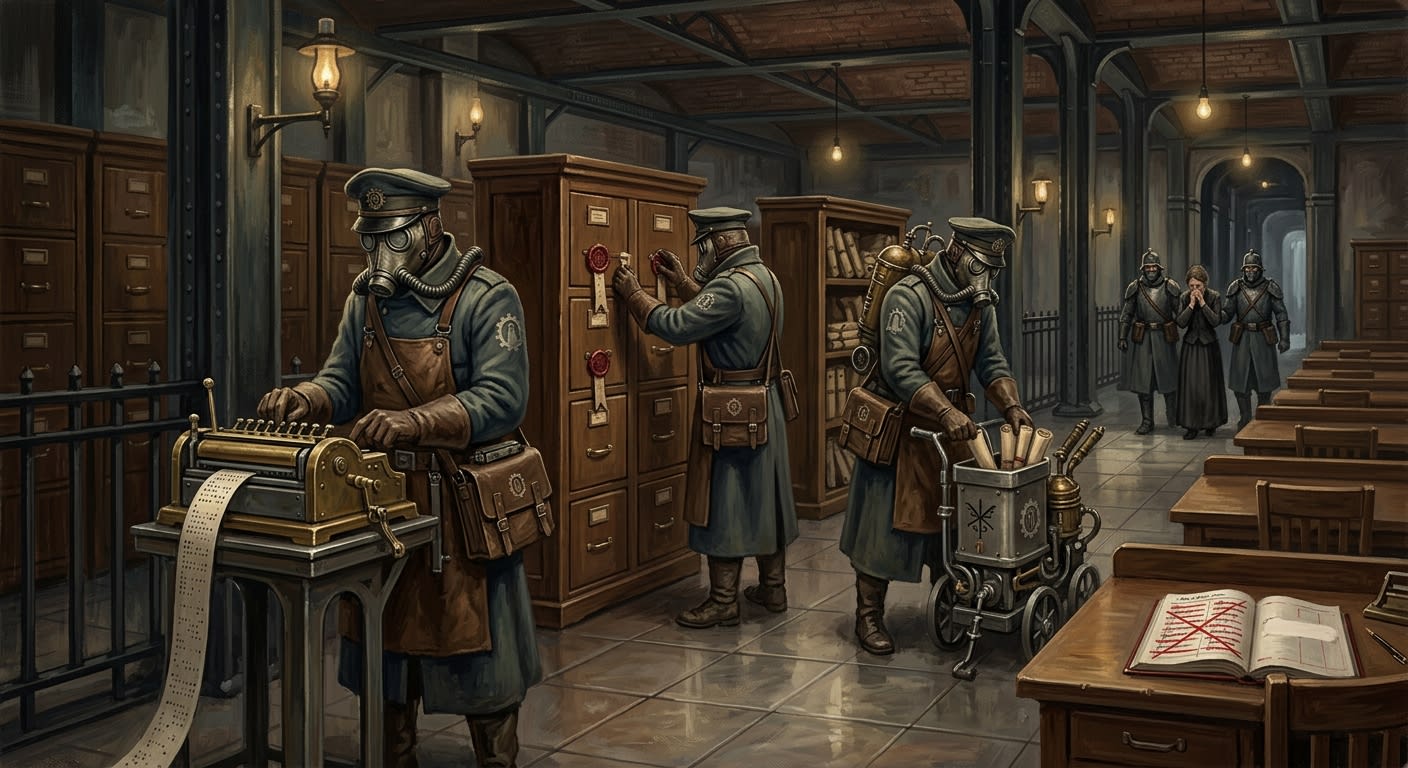
A condemned village after Ash is visible from a hill. An Ephrath procession leaves bruises, banners, songs children are forbidden to repeat and then repeat with perfect fidelity. A Shroud operation leaves a room too tidy, a chair with no owner, a parish register whose numbering jumps without acknowledging the leap, and a family discovering at breakfast that it has always had one fewer member than memory, for one dangerous moment, insists.
Do not confuse the Order of the Shroud with the Bureau of Shadows. The distinction matters to clerks, inquisitors, undertakers, and those who wish to survive cross-examination. Shadows does not exist, has never existed, and possesses fourteen decrees to prove the proposition. The Shroud exists very much. It has chapter houses, wagons, priors, supply requisitions, and a laundry budget for black linen so large that the Bureau of Tithes once attempted an inquiry and misplaced its investigator for eleven days.
The investigator returned, signed the expense approval, and retired to Bruges.
#On Their Origin
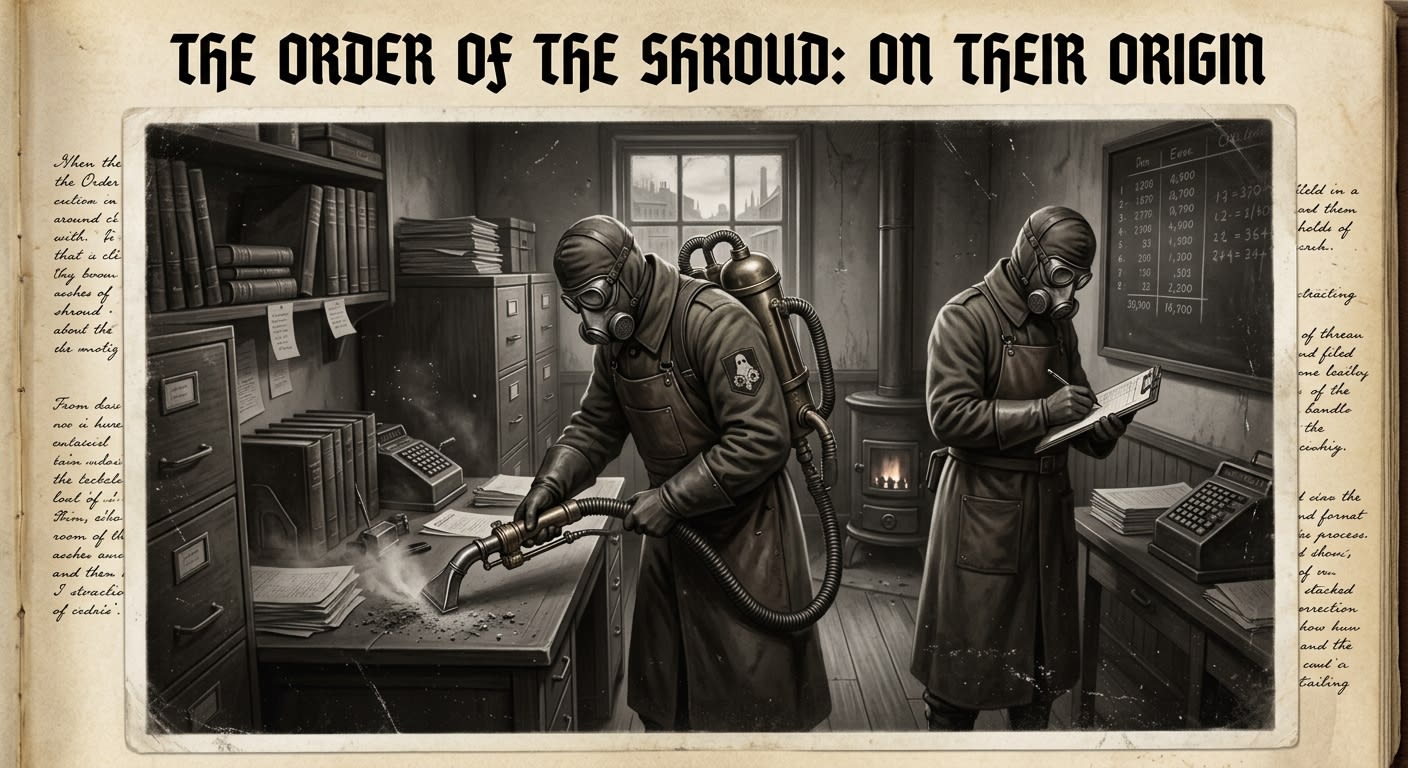
The Shroud's earliest charter hides inside Purity's own founding smoke. The Witch-Hunts of Toulouse taught the infant Synod a lesson every regime learns eventually and every regime then pretends to have invented: public terror instructs the many, but it also preserves the few. Burn a heretic in a square and ten thousand citizens learn fear. Ten also learn his face. Three learn his courage. One writes his last words on a scrap and carries the scrap in his boot until the next generation has a relic small enough to pass through a keyhole.
Purity disliked the arithmetic.
By A.S. 93, after the Toulouse campaigns had given the Bureau its fire, its teeth, and its disgraceful appetite for theatrical certainty, an internal memorandum proposed a counter-method: heresies of low public value, high contagion risk, or inconvenient sympathy should be removed without procession, trial, proclamation, or corpse. The memorandum survives in a Silence-redacted copy under the title De Subtractione Misericordiae. I have read three pages. The fourth is a rectangle cut from the vellum. That absence is the first Shroud signature I know.
Provincial catechisms have claimed that the Order of the Shroud was formed to spare the faithful the sight of necessary punishment.
Corrected. The Order was formed to spare punishment the burden of witnesses. Compassion entered the file later, as it so often does, wearing another man's boots and smelling of disinfectant.
Their first chapter house stood near Nominalist's Gate in Strasbourg, between a shuttered Rationalist printery and the old mortuary road. The location was chosen for access to paper, bodies, and discreet drainage. A lesser writer would call this symbolism. I call it procurement.
#On the Black Folios
The Shroud's central sacrament is the Extraction Folio: a black-bound register leaf into which a precise rectangle has been cut, the missing portion labelled with a name, parish, charge, and date. The folio does not contain the condemned. It contains the place from which the condemned has been removed.
I was shown one at Nominalist's Gate by Prior Sebald Voss (Unregistered), a man with the hands of a bookbinder and the eyes of a physician deciding which limb can be spared. The page was thick vellum, dyed grey-black, ruled in white ink. Twenty-four windows had been cut from it. Each window was neat enough to shame a surgeon. Beneath each absence stood a name in red. I asked the Prior whether he considered this murder.
“We consider it editing,” he said.
The Folio serves three functions. First, it records that an extraction occurred. Second, it prevents ordinary clerks from learning what was extracted. Third, it allows the Order to count its successes without accumulating the moral inconvenience of case files. A number is efficient. A dossier invites sympathy. The Shroud prefers numbers.
The Bureau of Records detests the practice and depends upon it. Records preserves entries. Shroud removes them from circulation, then returns the mutilated ledger as proof that Records' master copy must be reconciled. This is how bureaucracy makes violence holy: one office cuts the page, another corrects the index, a third charges the family for the amendment, and the Synod calls the result order.
#On the Black Wagons
The faithful know the Shroud by its wagons. Black lacquered timber. Wheels muffled in wool and pitch. Lanterns hooded. No insignia except a narrow strip of folded linen nailed beneath the driver's seat, white at departure and black at return. The horses are fed oat mash mixed with ash to dull their coats. The drivers wear layered veils that cover the mouth and leave the eyes uncovered, because the Order considers the seen eye more frightening than the hidden face. They are correct, the bastards.
A Shroud wagon never hurries. Hurry belongs to guilt. The wagon moves with ceremonial leisure through streets that empty ahead of it by communal instinct. Windows close. Dogs crawl under carts. Priests become suddenly absorbed in sacristy inventories. Children are pulled indoors by hands that do not explain, because explanation would require nouns.
The wagons take suspected heretics, inconvenient witnesses, failed informants, compromised clerks, and those rare souls whose public trial would create more doctrine than Purity can digest. They also take objects: stained mattresses, annotated prayer books, dinner plates with bite marks, mirrors that have reflected disallowed meetings, tablecloths under which a forbidden pamphlet was once hidden. The Order believes context clings. Remove the body and leave the chair, memory sits in the chair. Remove the chair and leave the room, memory becomes architecture. Remove enough, and the room becomes harmless.
This is why whole pilgrim hostels have been reclassified as “architectural speculation.” The building existed. Then the residents vanished. Then the deeds became ambiguous. Then the maps lost the courtyard. The remaining walls were dismantled and reused in a chapel whose cornerstone bears no inscription. In Strasbourg, stone itself learns prudence.
#On the Anatomy of Unbelief
It is said in low rooms that the Shroud dissects the condemned to map the geography of unbelief in human flesh. The report is old, persistent, vulgar, and insufficient.
The Order does dissect. This is confirmed in a restricted Purity appendix, a Bureau of Medicine objection memorandum, and one invoice for eighty-seven bone saws filed under “binding tools.” The Shroud's anatomists work in cellars tiled white beneath the Nominalist chapter house and in mobile stations attached to major Purity campaigns. Their stated purpose is not torture. Torture belongs to the Lictors, who make confession visible. Shroud dissection seeks location. Where does doubt reside? In the tongue that speaks? In the hand that writes? In the gut that refuses fast? In the heart that quickens at a Rationalist argument? The Order has been cutting for a century and has not found it.
OPERATING NOTE — NOMINALIST'S GATE, A.S. 166 Subject persisted in denial after removal of ███████████████████. Prior marked cavity “non-doctrinal.” Second incision exposed ███████████████████. Assistant recorded hymn response in the exposed tissue when the Creed was spoken backward. Specimen jars transferred to ███████████████████; labels later found blank.
The Bureau of Medicine considers Shroud anatomy unscientific. The Bureau of Doctrine considers it theologically hazardous. The Bureau of Purity considers both objections evidence of insufficient zeal. I consider the entire enterprise a category error performed with excellent knives. Heresy is not a lump to be excised. It is a relation: between fear and speech, hunger and promise, injury and meaning. The Shroud cuts bodies because bodies are available, and because flesh, unlike thought, can be pinned.
A prior field manual described Shroud dissections as “post-mortem examinations.”
The phrase has been withdrawn. The Bureau of Medicine objected that several examinations began before death could be certified. The Order replied that certification is a Records function and the Shroud is not subordinate to Records in matters of instructional flesh. The dispute remains open. The subjects do not.
#On Their Rivalries
The Shroud's quarrels are small, bitter, and useful. With Ash, the argument is ancient: Ash says Shroud leaves roots; Shroud says Ash leaves witnesses. Both arguments are true, which is why neither Order can bear to concede them.
With Saint Ephrath, the Shroud's contempt curdles into theology. Ephrath believes shame must be public before death, that humiliation brands the condemned into communal memory as warning. Shroud believes communal memory is the infection. Ephrath builds scaffolds. Shroud removes foundations. When Ephrath demanded custody of three Toulouse pamphleteers in A.S. 122 for a Procession of Tongues, Shroud extracted them the night before the procession and delivered three folded linen bundles containing only the pamphlets, each scraped clean of ink. Ephrath filed a grievance. Shroud filed nothing. The grievance remains unanswered because it contains no named respondent.
With the Bureau of Shadows, matters become impolite. Shadows collects for deniability; Shroud extracts for purification. Shadows erases jurisdiction; Shroud operates under Purity's seal and resents anyone subtler than itself. A Custodian leaves a blank folio and a civic shiver. A Shroud Prior leaves a black window with red lettering and dares Records to reconcile it. Shadows wants yesterday to have no residue. Shroud wants residue arranged as warning for those permitted to see warning.
The families notice no distinction. Their sons are gone either way.
#On Procedure and Aftercare
The Shroud uses the word aftercare. I record this because my pen nearly refused it.
After an extraction, a secondary team visits the household. They remove written names, personal tools, hair combs, worn shoes, prayer beads, stitched initials, half-finished letters, debts, savings, and the little domestic fossils by which a human life clings to its surroundings. They replace what must be replaced. A missing cup at table draws questions; an unfamiliar cup draws habit. A son's bed is easier to explain if the frame is taken and the room reassigned to storage. The household is given a corrected memory in the form of paperwork: revised ration books, amended baptismal lists, a condolence for an aunt who never died but now accounts for the grief.
Some households resist. Mothers are difficult. So are brothers, dogs, and old women who cannot read official corrections. The Shroud calls these people remainder witnesses. Remainder witnesses receive visits, then instructions, then bread, then threats, then wagons if the arithmetic requires. The Order does not enjoy expanding a case. Expansion is ungainly. Yet a subtraction that leaves witnesses is only postponement with better stationery.
The Shroud's final instrument is the mourning prohibition. No black cloth. No funeral bell. No Mass. No grave. Grief itself becomes evidence of unauthorised recollection. This is, in my professional assessment, among the Synod's most refined cruelties: to take a person and then punish the wound for bleeding.
#On Necessary Absence
The Order of the Shroud is necessary. I dislike writing this. I dislike many true things, which is how one knows they are not propaganda.
There are heresies that grow when named. There are martyrs too photogenic for the square. There are compromised officials whose public exposure would crack ministries, regiments, marriages, and supply chains that must not crack while Hell presses the Sagittal Line from the east. There are Velkaran infiltrators whose faces have been loved into immunity, Morwenite mirrors wearing the eyes of saints, Rationalist remnants with arguments clean enough to cut the pious. Some must be removed without sermon. The knife sometimes belongs under the cloth.
Necessity does not absolve method. It licenses method, which is worse. A licensed cruelty fattens; it hires clerks; it requests rooms; it writes manuals; it teaches novices the angle at which a name may be folded until a parish forgets the mouth that spoke it. The Shroud began as a corrective to spectacle and became a liturgy of absence. It removes heretics. It removes witnesses. It removes errors. It removes, when convenient, the distinction between those three categories.
At Nominalist's Gate, the black folios are stored in cabinets of cedar and iron. The windows in the pages are aligned so that when a folio is lifted, one sees through name after name into darkness. The Priors call this the Mercy of No Martyrs. Records calls it a reconciliation burden. Purity calls it clean work.
I call it editing, because the Prior taught me the proper term.