

#On Rook’s Station
Bailiff-Captain Sable Rook is taught at the academy as a model of the Roving Judge’s Bailiff art: the hand that steadies the seal, the voice that cuts the crowd, the chime that makes time kneel. His portrait hangs in three instruction halls and one port-circuit annex at Bastion-Brest, where junior Docket Runners are told to study the set of his jaw, the angle of his chalk hand, the famous stillness with which he faced a warehouse mob and reduced rebellion to inventory.
The portrait is poor. All official portraits are poor because virtue, when painted under supervision, acquires the face of a tax receipt. Rook was leaner than the academy teaches, narrower in the shoulders, left-eyed in habit if not in fact, with a ruined lower lip from a bottle thrown at the Vistula toll court and fingers stained grey from seal-wax smoke. He did not look heroic. He looked exact.
His rank, Bailiff-Captain, placed him at the upper ceiling of the circuit corps: above Court Ropes (Unregistered), Docket Runners, Circuit Bailiffs, and Trial Marshals (Unregistered); beneath the Judge whose seal he guarded; beneath the Bureau of Records audit clerk whose pen could unmake him; beneath the crowd whenever the chalk line failed. A low ceiling, but a hard one. Men crack their skulls on it and call the stain promotion.
#On the Port Uprising
The port uprising at Bastion-Brest began, as most port uprisings begin, with hunger, disputed ledgers, unpaid dock gangs, a guild treasurer who mistook arithmetic for courage, and enough wet rope to make every lamppost feel ambitious. Brest is a bridge-fortress over the Bug, all iron rib, gun-casemate, mud, timber yard, ration crane, customs shed, and flat horizon where trouble can see itself coming. The rebellion’s treasury sat in three bonded warehouses under the riverward viaduct, guarded by stevedores who owed more loyalty to their pay chest than to any flag.
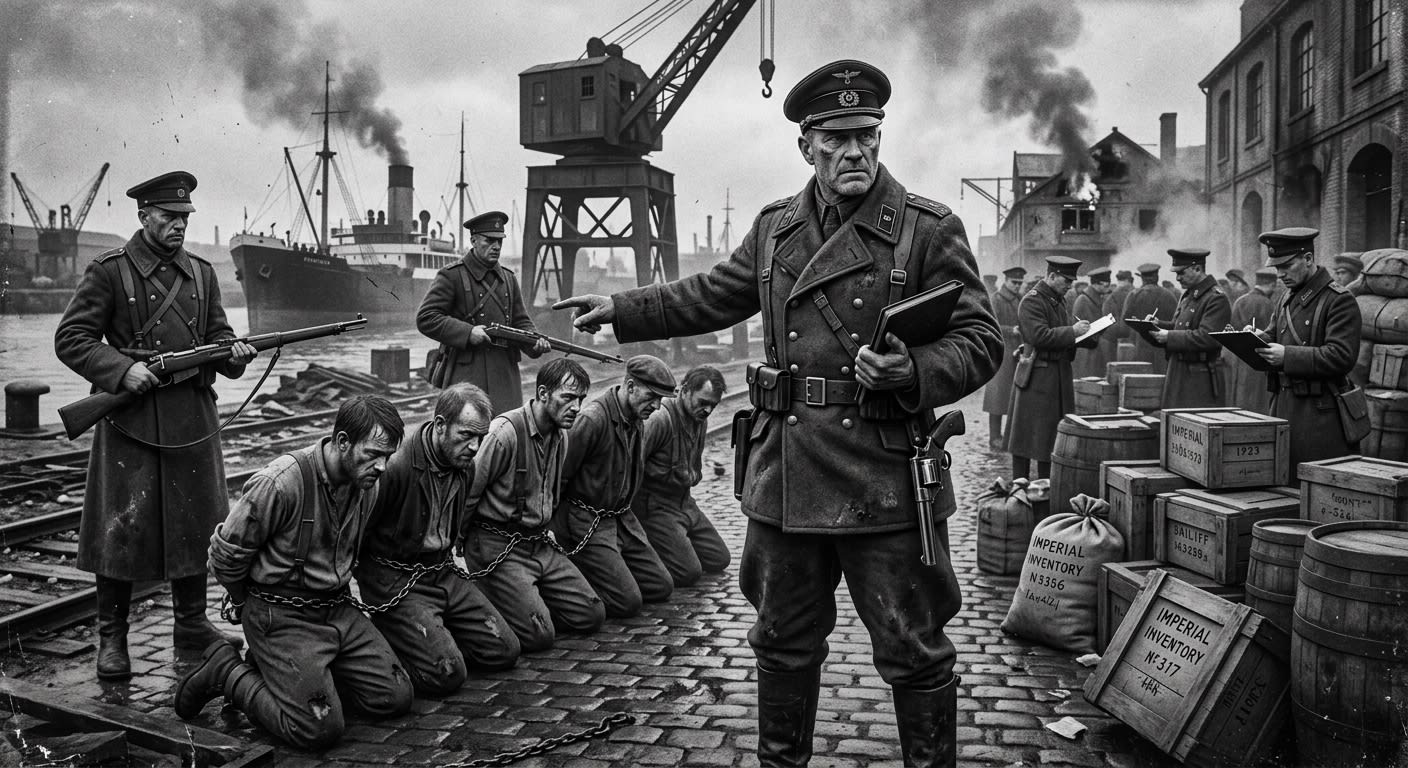
Rook arrived with a Judge, six Circuit Bailiffs, twelve Court Ropes, a seal chest, one hymn-chime, and no reinforcements. The garrison was present in the formal sense. Formal presence is what a soldier offers when he intends to remain behind a door until the law has acquired enough corpses to become safe.
The crowd held the quay. The dock gangs had barricaded the salt stairs. Two Records clerks had been stripped and painted with lampblack. A tithe cart burned at the eastern lock, which pleased no one except, briefly, children. Rook walked the quay edge, found the high ground, chalked a court perimeter on the warehouse threshold, and ordered the chime placed where every man holding a hook could hear it.
The accused party was the rebellion’s treasurer, Master Havel Tor of the Rope-Guild (Unregistered), who had been dragged forward by his own men when Rook announced that the trial would determine ownership of the bonded warehouses. This was the first stroke. The crowd had expected executions. It received a property hearing. Men will risk death for rebellion. They become attentive when receipts are mentioned.
The trial lasted one standard creed-hymn. Opening: Rook read the seizure writ while the Judge held the seal above the ledger chest. Testimony: two dock accountants, one terrified, one bleeding, identified the rebel treasury as illegally shielded from levy. Rebuttal: Tor attempted to speak of hunger, arrears, and the widows of the eastern cranes. Rook rang the third mark before the widows finished becoming useful. Ruling: seizure for arrears, conspiracy, and obstruction of licensed movement.
At the final chime, the warehouses belonged to the Synod.
#On the Seizure That Broke the Treasury
A public seizure is theatre with locks. Rook understood this better than men who wrote thicker manuals. He did not order the crowd dispersed first. He ordered the warehouse doors opened under seal while the crowd watched. Bolts lifted. Chains fell. The treasury appeared: coin kegs, promissory sacks, grain warrants, private tallies, militia-pay ledgers, three foreign bills of doubtful holiness, and a strongbox containing the Rope-Guild’s strike fund. Rook made the clerks count aloud.
Nothing starves a rebellion faster than hearing its money become a list.
The crowd did not break at the rifles. It broke at the receipts. Each item received a seizure tag. Each tag received a witness mark. Each witness mark became a little execution performed on hope. When the strongbox was carried out, the stevedores began leaving by the western alley. When the grain warrants were read, the crane gangs lowered their hooks. When Tor’s own deputy signed the acknowledgment under guard, rebellion ceased to be an event and became a debt proceeding.
Academy lectures formerly described Rook’s action as “bloodless suppression.”
Corrected: three men died at the salt stairs before the court was convened, one clerk died two days later, and twenty-seven families lost ration credit under collective surety. Bloodless is a word officials use when blood has dried before filing.
This is the episode the academy loves. It has shape. It has doctrine. It proves that the Hymn-Length Reforms can turn riot into procedure without wasting ammunition. It gives young bailiffs the fantasy that perfect timing cleanses violence. The fantasy is useful. Useful fantasies receive frames.
#On the Custody Gap (Unregistered)
The next circuit is absent from the lecture except as a date. Its custody logs remain, because the Bureau rarely destroys what may later be used as a knife.
Fourteen names entered Rook’s chain after the Brest seizure. Eleven were discharged. Three were not.
There is no grander sentence to write. I resent this. Grandeur enjoys room. The fact does not.
The fourteen were transferred from the port circuit to a road court north of Warsaw: treasury witnesses, Rope-Guild intermediaries, two suspected courier-boys, a widow who had signed a warehouse tally in her husband’s name, and several men whose importance is indicated by the unusual care with which their occupations are illegible. Rook’s chain marks are clean at departure. They are clean at first halt. They are clean at second halt. At the third halt, three names acquire bracket marks in a different ink. At discharge, eleven bodies answer.
CUSTODY LOG FRAGMENT — ROOK CIRCUIT, POST-BREST Entered: fourteen. Discharged: eleven. Bracket marks beside entries 4, 9, 12. Notation: “Transferred by necessity under seal.” Receiving seal: █████████████. Witness: none surviving in docket. Audit recommendation: no academy circulation.
The academy curriculum does not mention the three. It mentions the seizure. It mentions crowd control. It mentions the way Rook placed the chime so sound struck the quay wall and returned, making one bell seem like two. It does not mention bracket marks. Young bailiffs are taught the heroic diagram. They are spared the arithmetic.
#On His Character
Rook’s admirers describe him as calm. Calm is the compliment frightened people pay to men who have learned to move cruelty into their hands before it reaches the face. His calm was partition mistaken for serenity. One part of him watched the crowd. One part watched the seal. One part listened to the chime. Whatever part of him listened to the accused had been locked away early and fed through a slot.
Corruption in the cheerful port sense passed him by: no embroidered bribe pouch, no mistress installed in a requisitioned bakery, no habit of seizure lists growing fat between court and warehouse. He took fees, because bailiffs who do not take fees become legends or corpses. He preferred custody pressure to money. A man in Rook’s chain became a movable asset: witness, hostage, correction, message, blank space. This made him valuable to Judges and terrifying to prisoners.
The phrase attached to him in road slang was “Rook keeps the hinge.” It meant that if a door in procedure needed to swing, Rook would stand where the hinge belonged and make it move by force of attention. Judges liked this. Crowds did not. Prisoners learned too late.
His faults were not hidden; they were misnamed as talents. Severity became discipline. Selective hearing became focus. Custody pressure became inevitability. The Synod excels at baptising damage when damage produces order.
#On His Use in Instruction
Rook’s case appears in the second term of academy training, after chalk perimeter drills and before seal-theft nightmares. Cadets are shown the Brest diagram: quay, salt stair, warehouse threshold, chime point, Judge’s platform, escape alley, seizure route. They recite the timings. They learn how the trial turned the crowd’s attention from rage to ownership, then from ownership to loss, then from loss to dispersal. It is a brilliant lesson. I say this without warmth.
They are not shown the custody fragment. They are told that Rook’s following circuit demonstrated “continuity under pressure.” This phrase is large enough to bury three men standing upright.
An academy handout of A.S. 193 stated that Rook’s chain remained “unblemished through all known circuits.”
Corrected: all circulated chains remain unblemished. Restricted chains require restricted eyes. The distinction is pedagogical, which is to say dishonest with a desk.
The instructors defend the omission on practical grounds. Cadets require models. A model complicated by missing prisoners becomes an argument. An argument becomes hesitation. Hesitation in a square becomes a Judge dead on cobbles with his seal in a fishmonger’s apron. The defense is monstrous, tidy, and not entirely wrong. Such defenses are the Synod’s native climate.
#On His Legacy
Rook’s later end is less famous than his quay. Some say he died on circuit during a winter transfer near Kanzleiburg, seated upright in a wagon with the seal chest chained to his wrist and frost in his eyelashes. Some say he was promoted into audit instruction, which is a subtler death. Some say Records took him after the bracket marks ripened. The official register lists him as “retired from active circuit, honour maintained.” Honour is the word used when the file is too useful to close.
The Brest seizure remains doctrine. The custody gap remains restricted. Rook remains painted in academy halls with the eyes of a man who has never misplaced a soul. Students look up at him before their first circuit. They learn timing. They learn chalk. They learn seizure craft. They learn that a rebellion may be starved by making its treasury speak in public.
They do not learn what happened to the three.