
#On Their Arrival
"And lo, the bells ceased, and the market stilled, and even the sparrows forgot the air." — Testimony stricken from Cologne garrison log, date overwritten
They come without letter. Without herald, without pennant, without the stamped authority of any Bureau known to the filing systems of Strasbourg. They walk through gates that should be barred, through checkpoints manned by men who swear they checked every writ, through corridors patrolled by the Bureau of Purity's most vigilant lictors — and none see them enter. They are seen only when they choose to be seen, which is to say, when it is too late.
A Judge arrives in silence. This is attested by forty-seven independent depositions spanning a hundred and twelve years of Synod administration, depositions that the Bureau of Shadows has collected and the Bureau of Records has misfiled with commendable thoroughness. The silence is specific: markets fall mid-haggle, animals cease their braying, children stop crying in their mothers' arms. One sergeant at Bastion-Irongate described the sensation as "the moment between the axe leaving the hand and the axe arriving." He was demoted for poetry.
The silence lasts until the trial begins. And the trial always begins.
#On Their Marks
"Four instruments they carry, and each is a verdict waiting." — Clerk's margin annotation, Archives of Cologne, page subsequently excised
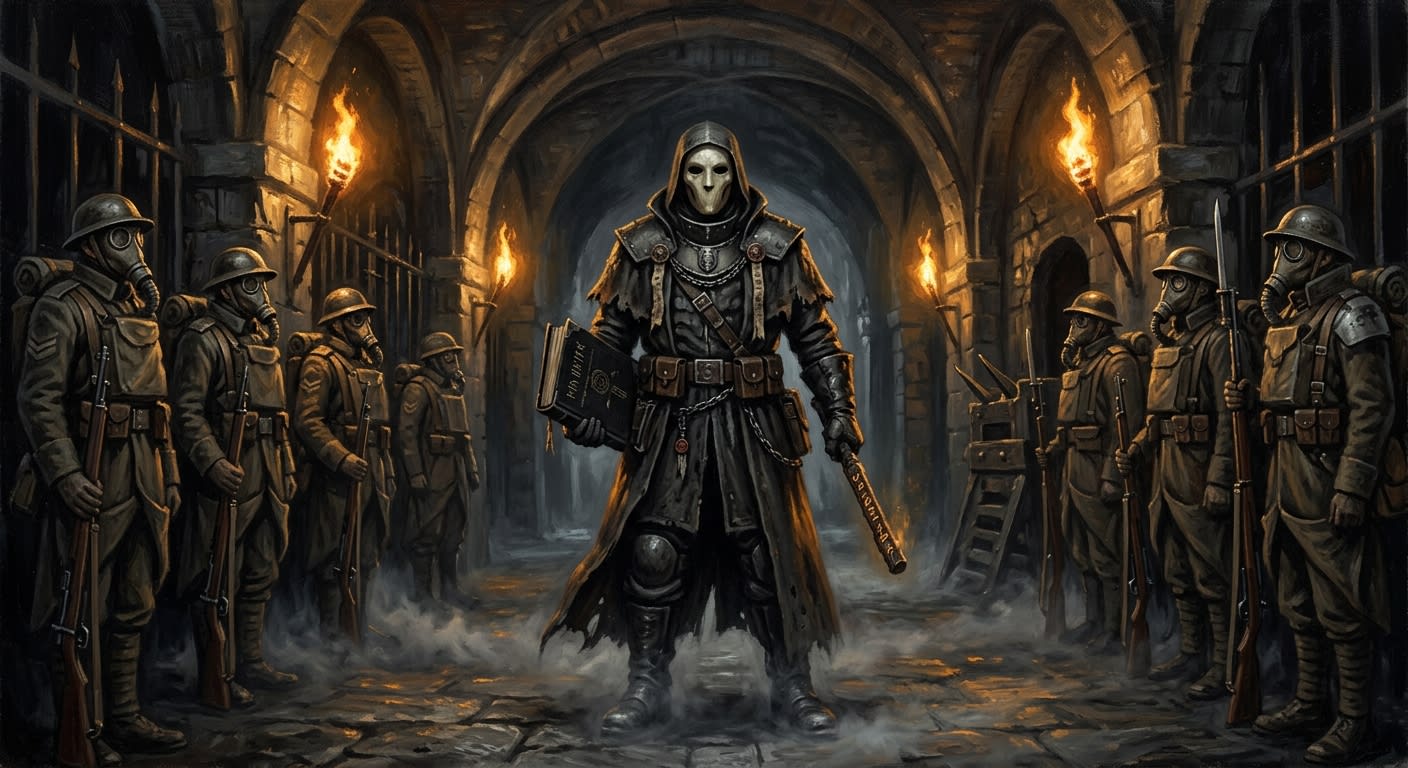
Every Judge wears a mask. This is the first mark — the seal upon a document whose contents are withheld. The masks are varied: porcelain smooth as river ice, hammered iron etched with sigils no Bureau dares catalogue, pale bone carved from sources the Bureau of Relics refuses to authenticate. Some are featureless, blank as an unstamped warrant. Others bear configurations that scholars at the Scriptorium of Nemea have spent decades attempting to classify, producing seventeen contradictory taxonomies and one nervous collapse.
Witnesses insist the masks are fused rather than worn. No Judge has removed one. No Judge has shown a trace of skin beneath. A soldier at the garrison of Bratislava swore he glimpsed a hollow cavity behind the iron visage — a gap where a mouth should be, a darkness where a face should begin. He hanged himself the next morning, tongue gnawed away. The Bureau declared his death consistent with "acute penitential distress."
The second mark is the Rod. Heavy staves, carved from wood or wrought from metal no assayer has identified, runed in languages older than the Concordats of Ulm, older than the cathedrals, older perhaps than the Synod's calendar itself. A Rod's touch collapses flesh as though the body were an inkblot waiting to be absorbed. Some accounts describe Rods silencing demons — Wrath's forged abominations struck dumb, their furnace-fires extinguished in a single blow. Other accounts, less comfortable, describe Rods turned upon Inquisitors of the Bureau of Purity, reducing Lictors of the Third Severity into crumbling husks, parchment-brittle, rattling in the wind like shed vestments.
The Bureau insists these Rods are "mere allegories of divine correction." How fortunate for the Bureau that allegories leave corpses.
The third mark is the Ledger. Great black tomes, too heavy for mortal wrists, borne in one hand as though the weight were a courtesy the Judge declined to observe. Witnesses insist their names are already written within before the trial begins — inscribed in a hand that, so the rumour runs, is identical to their own. Some heretics have fainted dead at the reading, hearts ruptured by hearing aloud what should have been private. One clerk in Lyon recognized his own childhood confession — word for word, in his own juvenile script, addressed to a priest who had been dead forty years.
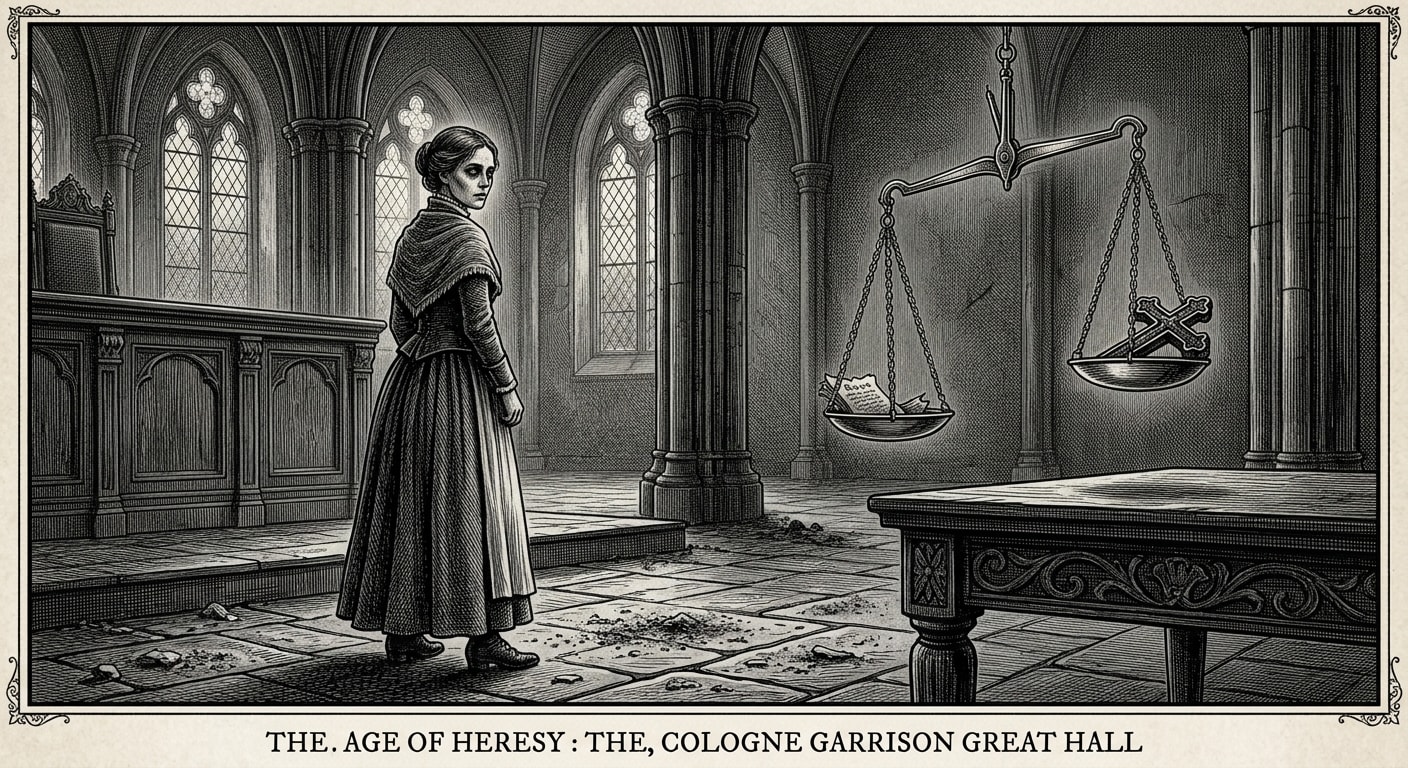
The fourth mark is the Balance. Brass scales dulled by centuries, fed by tokens taken from the accused — a lock of hair, a fingernail, a drop of blood. When the scales tilt, the guilty combust into grey ash, scattering into motes that witnesses describe as "scripture-shaped." When the scales level, the accused survives. Survives, I say — though rarely whole. The innocent limp away blind, or tongue-bitten, or stammering verses they never learned and cannot stop reciting. One woman in Prague weighed innocent and sang the same four bars of a hymn for thirty-one years until her death. The hymn was in no approved canon. The Bureau of Orison and Song has classified it as "unresolved."
Such mercy, dear reader, is worse than death. But it is mercy. And the Judges, whatever they are, do not lie about their scales.
#On Their Methods
"The trial is brief. The verdict is older than you are." — Graffiti scraped from inner wall, Bastion-Brest bridge tunnel, A.S. 197
Three forms of judgment have been attested with sufficient consistency to be classified — by which I mean that the Bureau has classified them, denied classifying them, and then classified its denial.
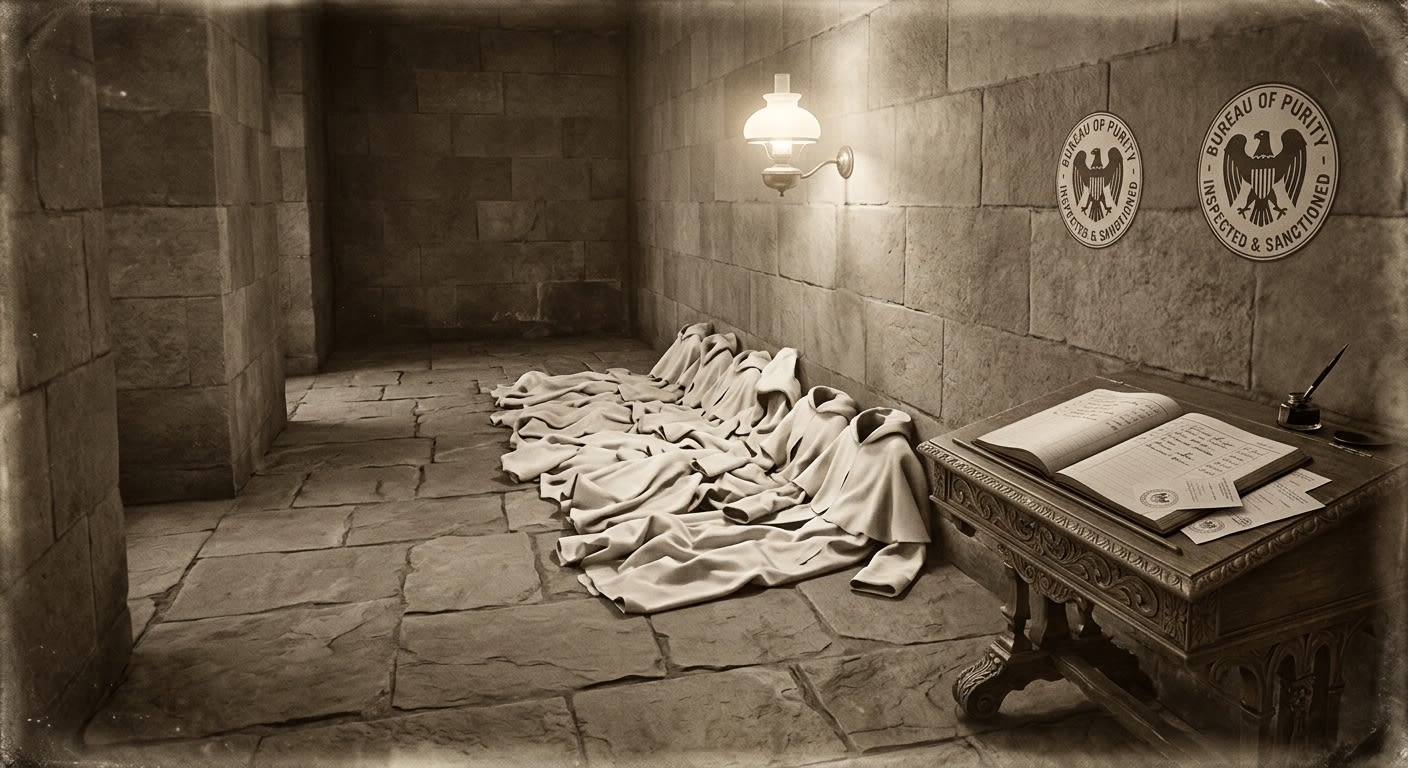
The Naming. A Judge opens the Ledger and reads aloud the accused's true name. This is not the baptismal name. This is not the name filed by the Great Ledger of Souls at the hour of birth. This is the name muttered by the accused's sins — the name they carry in the marrow, the name they breathe in fevers, the name the Creator wrote when the clay was still wet. At the utterance, the accused's heart ruptures. The body slumps into dust. The dust is grey and fine, and servants who have swept it report that it clings to the broom in patterns resembling script.
The Rod's Touch. The guilty struck by the Rod do not bleed. The flesh collapses inward, as though the body had always been hollow and was merely waiting for permission to admit it. What remains is skin like empty parchment, flapping in the wind if there is wind, lying flat as a shed garment if there is not. Witnesses describe a sound at the moment of contact — a faint exhalation, like a page being turned.
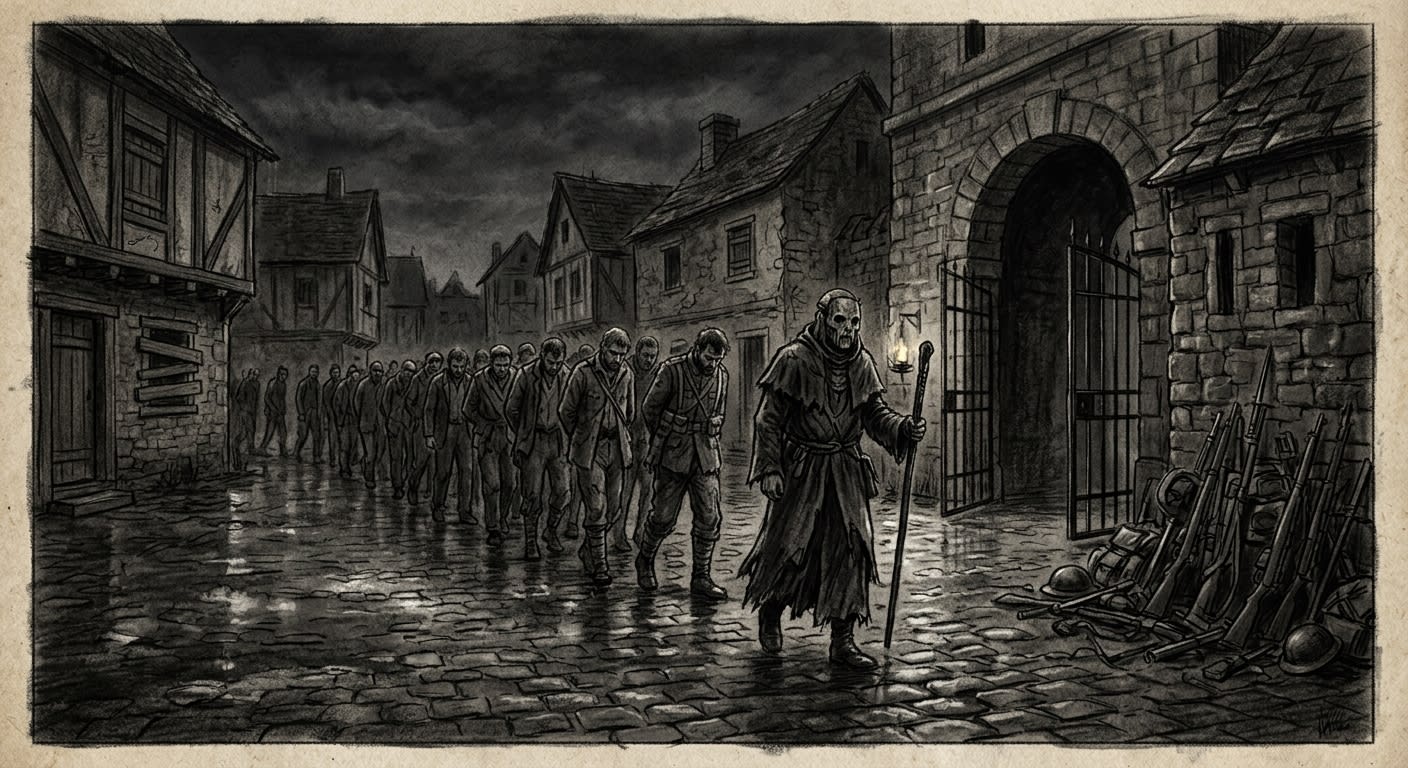
The Silent Procession. The rarest judgment and the most feared. The condemned are led away by the Judge in silence, walking beside the masked figure as though they had always intended to go, as though they had been waiting. Sometimes one person. Sometimes entire caravans, whole households, a village square emptied between vespers and compline. None return. Their absence is excised from the books as neatly as ink scraped from vellum — the Bureau of Records fails ever to have recorded them.
#On Their Encounters with the Inquisition
"Even the hand that brands must flinch when the fire walks."
The Inquisition fears them. Let that sentence stand alone, for it is the most extraordinary sentence in the entire archive of the Synod, and I, who have penned the extraordinary as a career, do not use the word lightly.
The Inquisition — the Bureau of Purity's enforcement arm, whose White-Mantled operatives have burned provinces for a misquoted psalm, whose lictors carry writs of severity that outrank a garrison commander's standing orders — fears the Judges as a child fears the dark. This is documented.
At Vienna, Grand Inquisitor Malthus the Red ordered the seizure of a masked figure who had appeared in the garrison quarter and pronounced judgment on a supply clerk. The clerk had collapsed into ash; Malthus, a man whose personal body count made him a demographic event, declared the masked figure an impostor and dispatched six Lictors of the Third Severity to effect arrest. Within the hour, Malthus and his entire retinue were found as husks. Their tongues — and only their tongues — had been removed and arranged on the floor in a script resembling entries from a ledger. The Council of Veils convened, examined the tongues, and adjourned without minutes. Within a week, the name "Malthus the Red" had vanished from every Bureau's lists, as though the man had never been appointed, ordained, or born.
Grand Inquisitor Malthus the Red expired of natural causes while conducting a routine inspection of the Vienna garrison, A.S. 172. His contributions to Inquisitorial method remain a model of——
This erratum has been revised. Grand Inquisitor Malthus the Red does not appear in Bureau records. The position of Grand Inquisitor was vacant during the period in question. Enquiries regarding this entry should be directed to the Bureau of Shadows, which, as is well known, does not exist.
At Bastion-Constantinople, during the Lust Surge of A.S. 138, the perfume fog that Velkara's Shattered Courts had spread across the pilgrim quarter parted for a single masked figure. The abominations of Lust — Mirror-Wraiths (Unregistered), Velvet Corruptors (Unregistered), entities that reduced hardened soldiers to weeping supplicants — clawed at themselves in frenzy and vanished. The Judge walked through the fog as though on marble, the mist curling away from its rod like smoke from a censer. The Bureau declared this "localized atmospheric cleansing." The soldiers who watched it happen have not been available for interview since. Reassigned, the Bureau says. To where, the Bureau does not say.
Even demons flinch. Let that stand beside the first extraordinary sentence. The Inquisition fears them, and demons flinch. Whatever the Judges are — and I will address that question presently, with all the fraudulent authority at my disposal — they operate outside the jurisdictions of both Heaven's self-appointed clerks and Hell's commissioned officers. They answer to something else. Something older. Something that does not file reports.
#On Their Origins (Competing Myths and Necessary Lies)
"Ask six Bureaus and receive seven theories, each stamped 'definitive.'"
The origins of the Judges are a matter the Bureau has settled repeatedly, definitively, and contradictorily. Each settlement has been sealed with the appropriate wax, filed in the appropriate vault, and contradicted by the next Bureau's equally sealed and equally filed settlement. I present them here in the spirit of thoroughness, which is to say, in the spirit of documenting the Synod's talent for disagreeing with itself in triplicate.
The Inquisitorial Theory. The Order of Severance — the Inquisition's own internal mythology department, if you will — insists that the Judges were once Inquisitors. Men and women so zealous that they outgrew even the cruelties of the Council of Veils, burning through flesh, through parish, through whole provinces until they consumed their own names. They rose again masked, their former humanity stripped as one strips ink from parchment. The Order points to Inquisitor-General Severian of the Iron Choir of Mainz as the first Judge. Severian's bones still hang in Mainz, rattling in rusting cages. If he is a Judge, then he is also ash, and the Bureau of Relics should be notified of a surplus.
The Revenant Theory. Others insist the Judges are saints returned — martyrs risen to condemn rather than console. At Lyon, the ashes of Saint Aldebrand himself once rose from the reliquary display, congealing into a figure that pointed its rod at Rationalist clerks. The clerks collapsed in terror before any strike fell. This tale has been stricken from three separate hymnals and returns each time, like a tongue bitten but never swallowed. Could sainthood itself have grown impatient with Synod procedure? I laugh. Aldebrand always was a meddler.
The Demonic Theory. That the Judges are agents of the Great Deceiver, garbed in the Synod's symbols, infiltrating human ranks through the guise of justice. This theory is popular among those who have never witnessed a Judge at work. Demons flee at their approach as surely as Rationalists fled from relic-fire. The theory collapses under its own evidence, yet persists in Bureau of War briefings because the Bureau of War prefers enemies it can shoot.
The Condensation Theory. Soldiers of the Sagittal Line mutter that a Judge is born when an entire village perishes without witness. When every soul falls into silence, their collective absence condenses into mask, rod, and ledger, and walks thereafter as judgment. The Judge carries the names of that lost village within it. I have seen settlements vanish overnight, their fences upright, their chimneys smoking. The next week a Judge passed through the ruins, its ledger heavy with names no one else remembered. Coincidence is a word used by men who fear patterns.
The Bell Codex Theory. The missing pages of the Bell Codex — those pages that supposedly mapped peals yet to come — are said to have contained instructions for summoning a Judge. The Bureau of Records denies the Codex existed. The Bureau of Bells denies the pages are missing. The Bureau of Doctrine denies the concept of "summoning" as applicable to entities that do not exist. On the days when storms toll unpredicted bells in Strasbourg, peasants swear they see masked figures pacing the Cloister of Concord. The Bureau denies this as well. The Bureau is very busy denying things.
#On the Warrior of Justice
"Some say he walks with the Judges. Others that he is the remnant of verdicts too stubborn to die."
I include this section against the explicit advice of the Bureau of Doctrine, which has classified the Virtue Generals as heresy of the Second Degree and the association between the Warrior of Justice and the Judges as heresy of the Third. Let the record show that I have been advised. Let the record also show that I have ignored the advice, because the record is mine and I will write in it what I please.
Among the seven whispered Virtue Generals — those hypothetical mortal champions said to oppose the Seven Sin-Generals through some covenant older than the Synod — the Third is called the Warrior of Justice. A faceless soldier, forever wounded yet unfallen, who drifts from war to war without allegiance.
The connection is this: wherever the Judges are reported in significant numbers — and "significant" means more than two in the same decade, which has occurred three times in the Synod's history — witnesses also report a figure on the Line itself. A soldier in unmarked armour, faceless behind a helm that resembles no Synod design, fighting alongside whichever garrison holds the trench. The figure takes wounds that should kill and does not fall. The figure vanishes when the battle ends. The wounded it leaves behind recover faster than the surgeons can explain.
The Bureau of War has filed this under "Unverified Combatant, Classification Pending" since A.S. 130. The classification has been pending for seventy-one years. The Bureau of Shadows has declined to confirm or deny the Warrior's nature, which is the Bureau of Shadows' way of confirming that it knows more than it is saying, which is the Bureau of Shadows' way of existing.
#On the Bureau's Position
"Judges do not exist." — Stamped Errata, Bureau of Records, every edition since A.S. 92
The Bureau's position on the Judges is a masterwork of administrative architecture — a cathedral of denial built on foundations of terrified acknowledgment.
The Bureau of Doctrine holds that the Judges are "the Synod's unspoken tribunal, answerable to the High Censor alone." This would be reassuring if the position of High Censor had not been vacant since A.S. 107, when the Hierarch of the Seventh Seal ceased attending sessions and was described, in a footnote that has survived three purges of the archive, as "presently engaged in contemplative duties."
The Bureau of Records holds — or rather, does not hold, because its entire entry on the Judges consists of torn pages and a marginal note in soot reading "No record may contain them."
The Bureau of Purity holds that the Judges are "sanctioned avatars of Providence," which is a theological compliment so large it is functionally meaningless.
The Bureau of War holds that the Judges are "enemy illusions, tolerated for morale," which is a military assessment so absurd that even the Bureau of War does not appear to believe it.
Previous editions of this Codex contained an entry for the Judges in the Table of Recognized Entities.
The entry has been removed. The Judges were never entered in the Table of Recognized Entities (Unregistered). The Table of Recognized Entities has no blank space where such an entry could have been. The fact that page 714 follows page 712 is a printing error and will be corrected in subsequent editions, which will also be printed incorrectly, as a precaution.
The Synod has never declared the Judges heretical. This is the fact that unmakes every denial. Heresy is the Synod's native instrument — it declares heresy the way a physician prescribes medicine, reflexively, confidently, and often incorrectly. The Synod has declared heretical: melodies, geometries, angles of arches, specific numbers, the colour of certain inks, the length of certain processions, the weight of certain candles. It has declared heretical the act of asking certain questions and the act of failing to ask others. It has declared heretical an entire dialect because one phoneme sounded too close to a Rationalist slogan. And yet, in two hundred and one years of calendrical existence, with a bureaucracy that could classify the wind and file a writ against it, the Synod has never — never — declared the Judges heretical.
Draw your own conclusion. I will not draw it for you. The ink required is not in my cabinet.
#On the Present Condition
The Judges walk. They have always walked. They walked before the Concordat, before the Sundering, before the Rationalists burned their first shrine. They will walk after the last Bureau has stamped its final writ and the last bell has fallen silent. This is my professional assessment, offered in my capacity as Warden of the Sacred Ledger, Archivist of the Bureau of Doctrine, and a man who has spent forty years filing the unfathomable into folders and labelling the folders "Resolved."
They are reported at increasing frequency along the Sagittal Line since A.S. 195. Three confirmed incidents at Bastion-Przemyśl in a single season — unprecedented in the archive. A masked figure seen walking the Queue Road at dawn, passing through nine gates without stopping, the Apparatus at Gate Nine falling silent for eleven minutes during the passage. A Silent Procession reported at Bastion-Brest, where an entire bridge-watch vanished between the second and third bells — twelve soldiers, their weapons stacked, their posts abandoned, their names gone from the muster by morning.
I do not know what the Judges are. I do not know whom they serve. I do not know whether their masks hide saints or revenants or hollow spaces where faces should be or something worse than any of these. I know only that the Bureau of Records says they do not exist, the Bureau of Doctrine says they are under review, the Bureau of Purity says they are sanctioned, the Bureau of War says they are enemy illusions, and the Bureau of Shadows says nothing at all, which is the loudest answer in Strasbourg.