
#On the Circular Itself
Judicial Circular 4.12 is a single sheet of law folded into a weapon and handed to a Bailiff.
It was issued in A.S. 141 after the Road Riots taught the Synod that a court proceeding, left alive too long in public, begins to grow organs. Before the Circular, roving trials could stretch across an hour, a morning, an afternoon made fat by witnesses, objections, weather, maternal screaming, guild rhetoric, clerical dispute, and the Judge’s private romance with his own voice. A road crowd given enough time discovers hands. Hands find wagon wheels. Wagon wheels find ditches. Judges, when introduced to ditches by the governed, lose much of their mystique.
The numbering is its own sermon. Four point twelve: fourth family of judicial enforcement memoranda, twelfth issued instrument under the post-riot legal desk, though three prior instruments were withdrawn so quickly that their numbers remain like missing teeth in the register. Circular 4.9 advised reinforced wagon wheels. Circular 4.10 proposed mounted escorts for seal chests. Circular 4.11 suggested improved public explanation of circuit purpose, an idea so wet with optimism that even Mercy laughed. Circular 4.12 stopped trying to make the road love law and taught law to outrun the road.
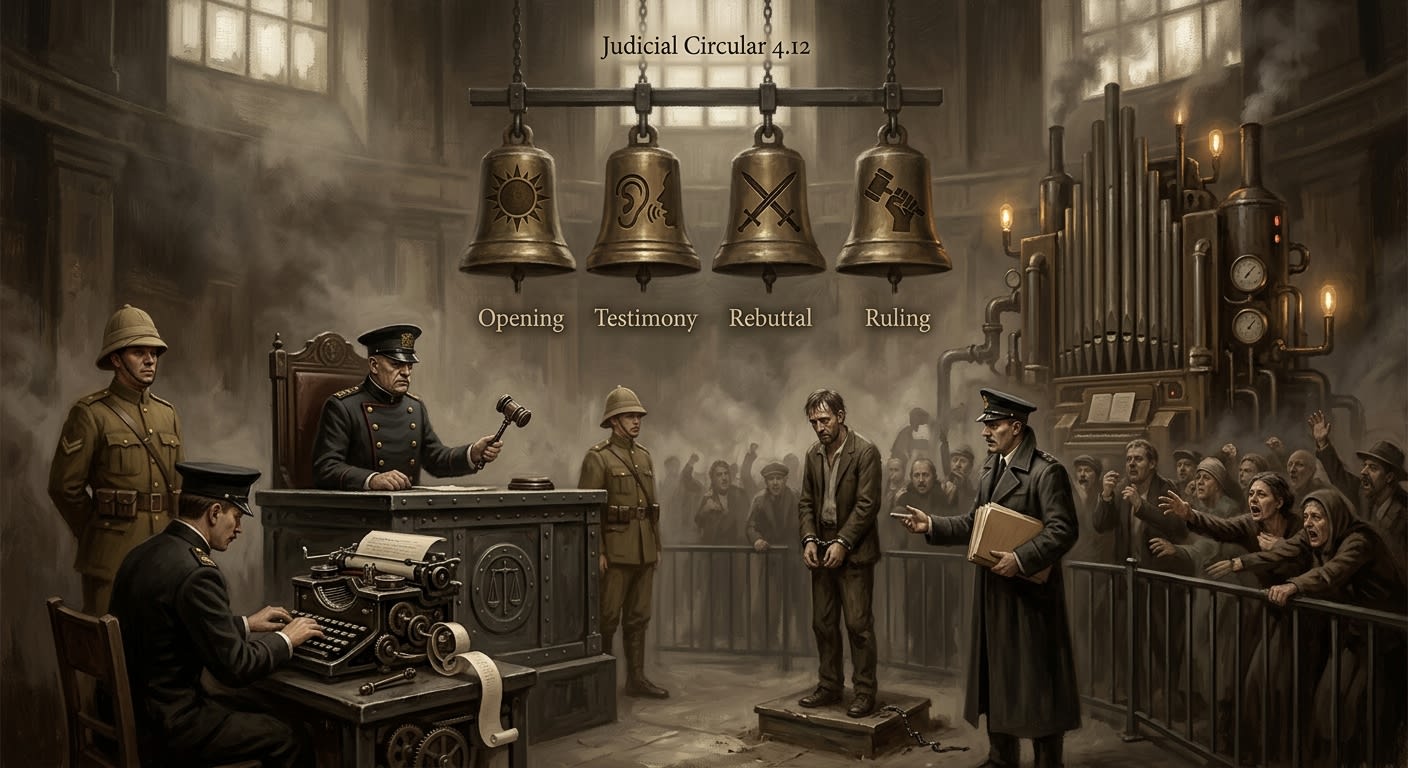
The Circular’s genius was its meanness. It did not improve justice. It shortened exposure. All circuit trials under roving writ would conclude within one standard creed-hymn: opening, testimony, rebuttal, ruling. Four measures. Four chimes. Four minutes by approved measure, though certain Judges who favour Vespers Long Form have managed to endanger themselves with a fifth. Excess duration voids the ruling and begins inquiry. The presiding Judge faces review. The attending Bailiff faces discipline. The crowd faces armed men annoyed by wasted time.
The sheet itself is plain. I have held the Strasbourg archive copy: cream stock from the Candlewick Palatinate, black iron-gall ink, red seal of the Synod Legal Prelate (Unregistered), marginal countersign by Records, and one grease stain near the third clause that three archivists insist predates filing. It deserves a jewelled box and received a flat drawer, which is fitting. The finest knives are kept where cooks can reach them.
Circular 4.12 sits beneath the Hymn-Length Reforms like a nail beneath a saint’s foot. Later commentaries decorate it. Academy slates simplify it. Bailiffs curse it. Judges pretend to respect it while resenting the chime like a rival preacher. The road knows it best. The road hears the first chime and moves back.
#On the Road Riots That Made It Necessary
A.S. 140 was not a rebellion, though the Bureau of Records briefly considered the word because rebellion receives more elegant filing cabinets. It was circuit violence: three Roving Judges dragged from wagons, seal impressions dispersed among road mobs, custody chains turned into public evidence, and several districts discovering that Law, when pulled hard enough, makes a human sound.

The first Judge fell near an unnamed market ford after a miller’s son was condemned on testimony from a creditor whose own tithe accounts stank like a latrine in July. The son’s mother crossed the chalk. A bailiff struck her. The crowd performed arithmetic. Wagon plus ditch plus Judge equals lesson.
The second Judge fell north of Warsaw, where eight accused men had been chained in rain for six hours while clerks disputed receipt seniority. Six hours is not delay. Six hours is incubation. The crowd counted bruises, invented kinship, reheard grievances, and selected heroes. When the Judge opened court, the ruling had already been written in everyone’s blood pressure.
The third Judge fell west of Brest, and this is the incident that wrote Circular 4.12 in the marrow of Strasbourg. The mob behaved with administrative talent. They took the seal, impressed wax, stamped travel writs, and distributed lawful-looking disorder as though it were festival bread. One counterfeit impression later authorized a seizure notice. One authenticated a marriage objection. One condemned a goat.
Records called the casualties administrative. Doctrine blamed agitation, ale-house Rationalists, itinerant heresy vendors, foreign whisperers, and every other useful scarecrow available to a frightened office. The restricted memorandum admitted local grievance supplied adequate fuel. This admission lasted eleven days before being replaced by a sermon extract. The sermon extract has prettier verbs. It knows less.
Early commentaries state that Circular 4.12 was drafted after “consultation with affected communities.”
Corrected. The affected communities consulted the Synod by overturning wagons and distributing seals. The Synod replied by reducing the time available for further consultation.
The lesson taken by the Bureau was exact: a trial that runs long becomes a riot. The wrong mind hears that and thinks speed creates fairness. The Bureau heard it correctly. Speed creates survivable authority.
#On the Four Measures
The Circular’s text names four measures because the Synod is never more lyrical than when limiting another man’s breath.
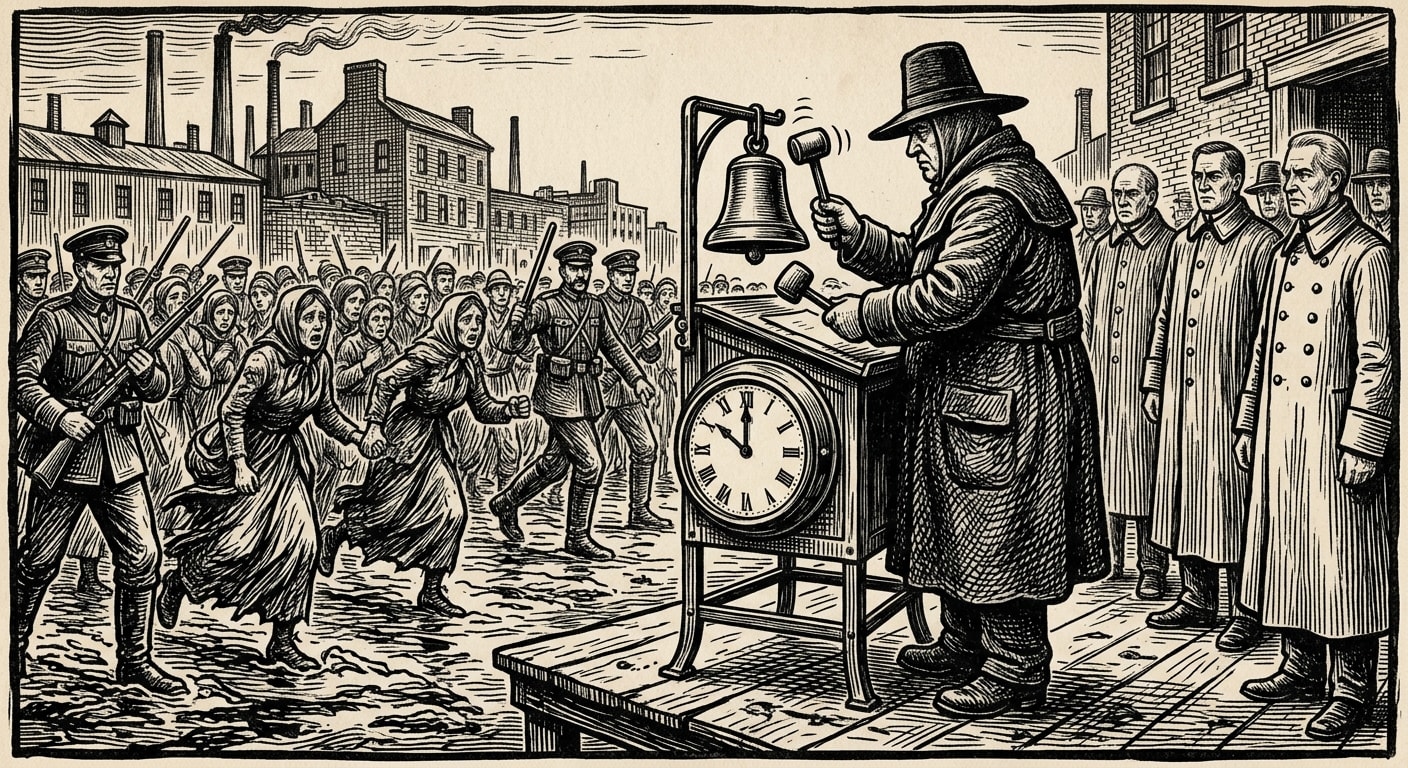
Opening receives the first measure. The Judge displays writ and seal. The accusation is read. The accused is named, unless naming has been withdrawn under prior sanction or replaced by registry number for reasons of contamination, punishment, clerical convenience, or spite dressed as doctrine. The Bailiff chalks the world into inside and outside. A Court Rope positions the accused where the crowd can see enough to fear and not enough to love.
Testimony receives the second measure. Evidence enters if it can move quickly: receipt, wound, chain mark, oath, docket extract, witness phrase, confession line, blood-stained tool, suspicious token, taxable object, or the testimony of a vicar who has learned to speak in clauses short enough to survive law. Testimony does not become truer by being brief. It becomes admissible. These are neighbouring provinces that have warred for centuries.
Rebuttal receives the third measure, a mercy so thin one can read the axe through it. Advocates trained after A.S. 141 speak as if chased by dogs: name, objection, authority, proof, plea. Sudden witnesses are barred after the mark. Documentary supplement is refused after the mark. A mother who remembers the alibi after the mark is removed from the chalk by the nearest arm with proper custody authority.
Ruling receives the final measure. Sentence, seizure, release, branding, exile, immurement referral, erasure recommendation, docket closure. The Judge pronounces; the Bailiff already moves. A ruling that waits for emotional comprehension has missed its vocation. Law travels through bodies, chains, and receipts before sorrow catches up.
The chime is the Circular’s teeth. Without it, 4.12 would be advice. With it, time becomes public and therefore enforceable. Each ring seals a procedural window. The advocate’s mouth may continue moving. The law has left the room.
#On Nullity, the Circular’s Cruel Mercy
Nullity is the clause every Judge hates and every Bailiff fears with the clean private devotion of a man who knows exactly where the blade is kept. If the hymn is exceeded, the trial becomes legally unborn. Evidence heard loses body. Sentence loses teeth. Confession spoken beyond the mark becomes noise with good posture. The docket must record failure. Inquiry begins.
A null trial humiliates the Judge because it proves his voice was larger than his office. It endangers the Bailiff because the Bailiff is time’s visible hand. It enrages the crowd because rage has been summoned, focused, and denied a finished object. No one leaves a null trial improved.
The rule exists because pre-Circular courts suffered from ornamental duration. Judges indulged witnesses. Advocates inflated precedent. Clerks hunted missing lines while crowds ripened. The Circular cured this by making excess poisonous to the officers themselves. A Judge may enjoy speaking. He enjoys inquiry less. A Bailiff may pity the late witness. He pities his own career more.
NULLITY REVIEW — CIRCUIT ███, A.S. 146 Overrun: thirty-two seconds. Cause: presiding Judge extended rebuttal to hear widow’s second son. Crowd movement: forward, seven bodies. Bailiff action: late chime; baton line; one discharge. Finding: trial unborn; widow’s statement void; Bailiff reassigned to winter road. Judge’s note in margin: ███████████████████████████████
Nullity is called mercy in academy texts. The claim is not wholly false, which makes it more irritating. A four-minute trial at least ends before the crowd can become an army and before the Judge can become sermon. The accused receives little justice, but he receives swift injustice under seal, and the Synod has always preferred its violences witnessed, measured, filed, and regretted by authorized persons only.
#On the Bailiff It Created
Circular 4.12 made the modern Roving Judge’s Bailiff. The office existed before A.S. 141, but the Circular hardened it from road muscle into portable procedure. Chalk perimeter, custody chain, hymn-chime, seal chest, witness gate, crowd lane, exit route, seizure receipt: all became parts of one timed organism. The Judge might own the sentence. The Bailiff owned the seconds in which the sentence could survive.
A Circuit Bailiff does not think in hours. He thinks in marks. Twelve seconds to chalk the court. Six to show the seal. Eight to pull the accused forward without letting his mother reach him. Three to strike the chime. Ten to cut the advocate. Four to move from ruling to cuff before the crowd understands the sentence has acquired metal. This arithmetic is ugly, and ugliness that works attracts promotion.
Promotion after A.S. 141 required familiarity with the Circular, competence in custody, steadiness under crowd pressure, and sound moral posture. Sound moral posture means the candidate performed cruelty without looking pleased enough to embarrass the Judge.
The Bailiff’s chime became the little guillotine of road law. He places it where sound carries. He lets the crowd see his hand near the striker. The almost-ring does work before the ring itself. Crowds can hear almost-ringing. So can cowards. So can mothers. The best Bailiffs learned that a chime need not sound to shorten a throat.
Sable Rook’s Brest demonstration gave the academy its prettiest diagram. At Bastion-Brest, during the port uprising, Rook converted revolt into property dispute inside the hymn. Opening: seizure writ. Testimony: dock accounts. Rebuttal: cut before widows became rhetorically useful. Ruling: treasury confiscation. Coin kegs became evidence. Evidence became Synod property. Rebellion, deprived of money while watched by its own crowd, starved standing up.
Academy lectures once called the Brest action “Circular 4.12 in perfect moral form.”
Amended for faculty use. Brest demonstrates timing, seizure optics, crowd displacement, and the usefulness of omitting three later custody absences from the instructional diagram.
The Circular also made monsters of the merely competent. A Bailiff who runs too many hymn-length courts begins to hear people as duration threats: witness, two breaths; vicar, ten dangerous seconds; mother, breach risk; advocate, overrun; child, projectile; accused, chain object with eyes. This is damnation by metronome. The Bureau calls it professional maturity.
#On Seals, Chimes, and the Bureau of Records
No Circular can govern without instruments. Circular 4.12 has three: the seal, the chime, and the custody chain. The chalk is stagecraft. The rifle is punctuation. The three instruments are law.
The seal gives portable sovereignty. The Judge may speak in a ditch, warehouse, ferry-yard, trench dugout, cattle market, chapel porch, or plank road east of Shipka; the seal makes the place a court. This is why the Road Riots frightened Strasbourg more deeply than the broken Judges. A dead Judge can be replaced, praised, embalmed, lied over, and used to discipline recruits. A seal dispersed among a mob makes the mob grammatically lawful.
The chime gives time body. A crowd distrusts abstract limits. It understands sound. The first mark enters the ear and makes boundary. The second mark kills extension. The third mark makes late mercy embarrassing. The fourth mark lets the Bailiff move before anyone has decided whether to resist.
The chain gives truth a spine. Names at intake, movement, chalk, ruling, discharge. A clean chain is harder to argue with than a clean conscience and rarer among officials. Records worships the chain because Records understands, better than Doctrine, that a human body unlogged becomes accusation. One missing name can be misfortune. Three missing names erase a Bailiff-Captain.
Circular 4.12 strengthened Records by making time auditable. Before A.S. 141 a court overran by appetite, circumstance, weather, sympathy, or boredom. After the Circular, every overrun had a number attached. Numbers are hooks. Auditors love hooks. They hang careers from them.
This is why Records defended the Circular more fiercely than Judges did. Judges wanted safety. Bailiffs wanted rules sharp enough to hide behind. Records wanted comparable entries. Doctrine wanted the whole mess to sound preordained. A four-minute trial in Brest, a four-minute trial south of Przemyśl, a four-minute trial in a cattle yard near Mainz: three events, one shape, infinite columns. Once law acquired duration as a fixed field, the archive could begin devouring variance. What did the witness say? Late. Why was the accused not heard? Late. Why did the mother cross the chalk? Late and struck. The file grows sleek on answers that take less ink than sorrow.
#On the Demon-Route Amendments
The Circular was written for human crowds. This was optimistic.
During the Demon-Route Years, A.S. 160 through 175, eastern circuits between bastions became unreliable in ways that punished optimism. Courts appeared in market squares that did not exist at dawn. Witnesses arrived twice. Hymn-chimes rang before the Bailiff touched them. Assemblies visible from fifty paces vanished at ten, leaving chalk dust arranged in judicial circles. Roads accepted Judges, returned echoes, and kept seals if permitted.
The first Circular had no clause for a crowd that was not a crowd. It assumed the accused, witness, Judge, Bailiff, seal, road, and time were behaving as categories. The East objected.
The amendments created the Demon-Route Screener, a Bailiff allowed to distrust empty space before law commits itself. He walks the perimeter with consecrated bell-metal sliver affixed to the chime chain. No tone: proceed. Low hum: delay. Sustained hum: withdraw Judge to guarded interval. Crack: court void before birth. Powdering: burn chalk, abandon docket, leave dropped items, seal first.
The Shipka eastern circuit of A.S. 172 proved the amendment. Six marsh-haulers stood accused of ration diversion and sleep-cult sympathy on a plank road near Syrionic fog. The Screener’s sliver hummed twice and cracked at the route by which the accused had arrived. He cancelled the court. The Judge objected. The quartermaster objected. The local tithe clerk objected in writing, naturally. The Screener extracted the seal and Judge by the second route. The accused remained chained. The purification detail never arrived.
Recovery in A.S. 173 found six chain lengths fused into plank rail, no bodies, one slate reading HEARING CONTINUES. The Screener was reprimanded for incomplete custody and commended for seal preservation in the same folio. A balanced judgment. The Synod adores balance when both pans contain punishment.
SHIPKA ANNEX 7-EAST — SUPPLEMENT TO CIRCULAR 4.12 Recovered chime condition: cold, wet, ringing under cloth. Slate text: HEARING CONTINUES. Judge extraction: successful. Seal extraction: successful. Accused material: absent. Purification detail route: correct at dispatch; incorrect at arrival. Final notation: ███████████████████████████
The amendments remain narrow and absolute. A Judge may overrule nearly anything a Bailiff says. He may not compel a cracked court without assuming personal seal liability, a phrase that has cured more judicial bravery than cannon fire. The Screener receives blame from Records for delay, Purity for contamination risk, the Judge for embarrassment, the district for postponement, and the accused for remaining chained. This proves the office is properly designed.
The amendments also changed the theology of nullity. Under the first Circular, a trial became unborn when human officers failed the hymn. Under Demon-Route doctrine, a trial could be unborn because the place itself refused lawful gestation. Void ab initio: dead from the start, never court, never proceeding, never mercy refused because mercy had not entered. Lawyers adore this phrase. It lets them bury horror in Latin and then invoice for the grave.
#On Misreadings, Abuses, and Profitable Errors
Every strong rule becomes a market. Circular 4.12 is no exception.
Judges learned to compress favoured cases and stretch protected ones under claims of Vespers Long Form, acoustic interference, parish variant, weather distortion, or devotional necessity. Bailiffs learned to place the chime where friendly parties heard it clearly and inconvenient witnesses heard it after law had departed. Advocates learned to purchase position near the witness gate. Guilds learned to pay for the third mark to fall on a rival’s breath. Tithes learned that timing certificates could carry fees. Tithes learns this about everything. If rain falls long enough, Tithes will discover wetness arrears.
The most profitable error was acoustic. A court laid against stone returns the chime quickly. A court laid against timber eats it. A court laid beside water gives the second mark a little ghost. Bailiffs with flexible souls began choosing surfaces according to client need. A merchant’s witness might stand where the echo flattered him into timeliness. A widow might be placed near sacks of wool and lose half her plea to muffling. The Circular did not mention wall texture. It should have. Law dies in omissions small enough to pass under a door.
The worst abuses involved manufactured nullity. A Bailiff could delay a chime just long enough to void an unwanted ruling. A Judge could speak over the mark and blame the Bailiff’s timing. A clerk could miscopy the approved hymn variant and turn four minutes into jurisdictional fog. The Circular’s revisions after A.S. 149 required dual timekeeping: hymn-chime and sand measure, then later chime, sand, and witness hand-count where crowds could be trusted to count without becoming political. They could not, so the witness hand-count was abandoned.
Purity attempted to classify deliberate overrun as spiritual sabotage. Records resisted from territorial appetite. An overrun is an audit wound. Purity may smell heresy in it, but Records tastes jurisdiction. The compromise was elegant in the way a nail through two hands is elegant: overrun remains procedural until malice is proven, and malice is presumed when Records dislikes the accused office.
A.S. 153 commentary states that “good-faith overrun shall be treated leniently.”
Clarified. Good faith is not a timing device. Officers unable to distinguish devotion from delay should seek employment in monasteries, where time is already ruined by chanting.
The people adapted. In court towns, children play Opening-Testimony-Rebuttal-Ruling. The slowest child becomes the Judge and is chased. Mothers teach sons to speak alibis in one breath. Guild scribes write objections in strips that can be read before the third mark. Vagrants sell “four-minute prayers” outside circuit roads. The Bureau has condemned the trade and copied several examples for internal use.
A small profession has grown around the Circular like mould around a reliquary: timing tutors, breath-cutters, alibi compressers, chime-listeners, chalk readers, and retired Court Ropes who sell advice in taverns to families expecting trial. They teach useful obscenities. Speak the name first. Do not waste breath on honorifics. Hold the receipt visible before the measure begins. If the Bailiff’s eyes move to the striker, stop pleading and point. Never cry before the second mark. Crying spends air.
Some Judges call these tutors parasites. This is jealousy. The tutors learned the Circular honestly, by watching it eat their neighbours. Academy men learned it from slates wiped clean between lessons. I know which school I would trust with my own neck, though naturally my neck is under special doctrinal protection and should not be used in public examples.
#On the Present Authority of the Circular
As of A.S. 201, Judicial Circular 4.12 governs nine hundred and twelve active circuits under corps record. Forty-three seal losses have been recorded this year. Fourteen Bailiffs have been erased. The chime still rings. The crowd still steps back. The Judge still mistakes speed for righteousness because speed flatters authority by making it feel clean.
Circular 4.12 endures because it understands the road better than the road’s own poets. The road is patient until it is given a schedule. It is obedient until asked to wait beside chains. It is pious until a Judge coughs over a mother’s testimony. It is peaceful until it discovers that law bleeds when pulled. The Circular denies the road time to make these discoveries in useful order.
The Legal Prelate’s office maintains that Circular 4.12 restored public confidence in travelling law. This is false in the manner of official truths. It restored public fear of travelling law, which performs the same civic function at lower cost. Confidence requires explanation, legitimacy, consistency, bread. Fear requires a chime and a man willing to strike it.
The Circular’s critics call it barbarous. They are sentimental. Barbarism is disorderly violence wearing its hair loose. Circular 4.12 is orderly violence with washed hands, docket backing, time discipline, appeal clauses, and a seal drying on the corner. That makes it worse, durable, adored.
The current revision tables contain thirty-seven interpretive notes, most written in the cramped hand of men terrified of the road and proud of their terror’s vocabulary. Note 12 defines “standard creed-hymn” by syllable count, not melody, because melodies travel badly across provinces and syllables can be audited. Note 19 permits rain-delay only before opening measure, never after. Note 24 declares a chime struck by thrown object invalid unless the object was launched by an officer, a clause born at Liège and immediately abused by three captains with theatrical elbows. Note 31 classifies animal interference as weather unless the animal bears docket relevance. The goat, I am sorry to report, has jurisprudence.
At the first chime, Law appears. At the second, proof is permitted. At the third, mercy learns it is late. At the fourth, the Bailiff moves.
The road has four minutes to disagree.
Four minutes is longer than a prayer when one is guilty, shorter than a breath when one is innocent, and exactly sufficient for the state, which has never required innocence to finish speaking.