
#On the Law That Learned to Sing Quickly
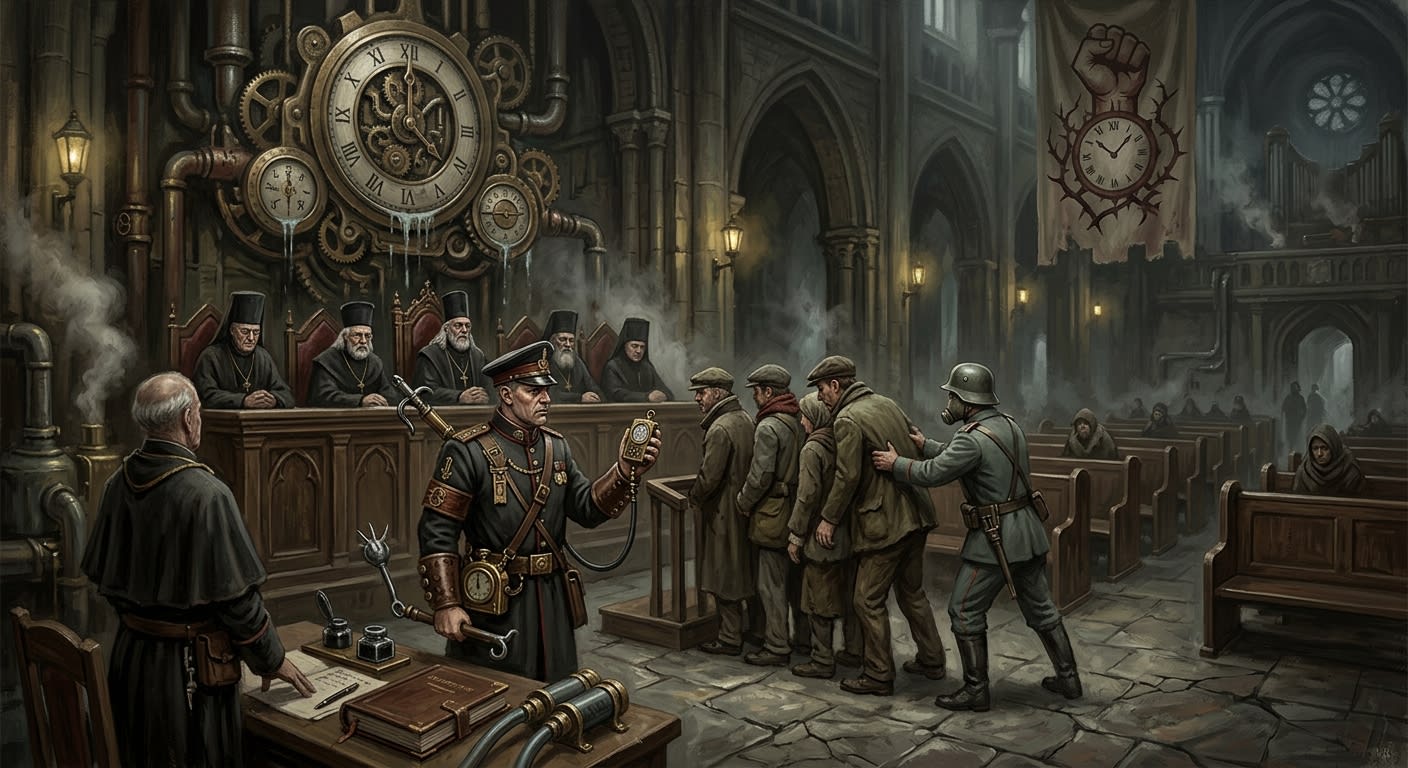
The Hymn-Length Reforms of A.S. 141 were the Synod’s answer to the Road Riots: one standard creed-hymn for every circuit trial, four minutes by approved measure, with opening, testimony, rebuttal, and ruling each sealed by the chime. It is one of the Bureau’s loveliest little brutalities. Before the reforms, justice travelled slowly enough to be hated in detail. After them, it passed like a knife through cloth, leaving the argument to discover it had been divided.
The popular accusation is that the reforms shortened trials to save Judges. This is vulgar and, worse, incomplete. The reforms shortened trials to save authority from the sound of its own hesitation. A Judge dragged from a wagon is a corpse. A seal distributed among a mob is a sacrament of disorder. A crowd given time begins to assemble facts, grievances, jokes, family histories, and missiles. The reform attacked the time.
Judicial Circular 4.12 took the old road maxim — “a trial that runs long becomes a riot” — and made it law. There is a sour candour in that, if one is drunk enough or senior enough to call efficiency candid.
#On the Four Measures
The first measure belongs to opening. The accusation is read, the writ displayed, the seal acknowledged, the accused named if naming has not already been withdrawn by prior sentence. The Judge speaks little. The bailiff watches hands. A Court Rope keeps the witness gate narrow enough that panic must queue.
The second measure belongs to testimony. Testimony, in theory, means evidence. On the road it means whatever can be forced into breath before the chime shuts its mouth: a tithe receipt, a wound shown above the cuff, a cart-mark, a ledger line, a neighbour’s accusation, a confession extracted last night by men whose knuckles have not yet dried. The chime rings. Truth still forming in the throat becomes silence.
The third measure belongs to rebuttal, a courtesy so brief that even courtesy grows embarrassed. Advocates learn to speak like men falling down stairs: name, objection, proof, plea, done. Sudden witnesses are ignored after the mark. The sick are not waited upon. The dead, if relevant, should have arranged representation earlier.
The final measure belongs to ruling. Seizure. Branding. Exile. Immurement referral. Erasure recommendation. Release, rarely, and with enough clerical reluctance to make freedom feel like a filing error.
#On Nullity and Discipline
The reform’s cruelest clause is the null verdict. A trial exceeding one standard hymn becomes legally unborn. Evidence heard evaporates. A confession spoken too late loses body. A sentence announced beyond the mark has no teeth unless a superior office chooses to lend it dentures.
The presiding Judge faces inquiry. The attending Bailiff faces discipline. The crowd faces whatever happens when armed men discover their morning has been wasted.
Early circular commentary described nullity as “protection against excessive procedure.”
Clarified: nullity protects the authority of procedure by punishing officials who permit procedure to become audible enough for objection. Excess was never the danger. Listening was.
Bailiffs hate nullity with a devotion bordering on prayer. Their careers depend upon the chime. They set the stand where sound carries, train their hands to cut testimony with a bell, and learn to watch the Judge’s mouth for those fatal little expansions by which educated men inflate disaster. Some Judges enjoy speaking. Bailiffs fear them more than mobs.
The long-form Vespers variant survives by privilege and bad temperament. Certain Judges claim the longer hymn permits fuller discernment. Bailiffs claim it permits brickwork, sobbing, witness multiplication, and knives moving from sleeve to palm. Both statements can be true; the Bureau, in its charity, files only the first.
#On the Bailiff Made by the Reform
The reforms manufactured the modern Roving Judge’s Bailiff. Chalk perimeter, custody chain, hymn-chime timekeeping, seal chest discipline, witness pen placement, crowd-body reading: all hardened around the new duration. The bailiff became a liturgist of pressure. His work was to make every second visible enough to frighten the parties and invisible enough to flatter the Judge.
A modern bailiff does not think in hours. He thinks in marks. How long to drag the accused from chain to platform. How long to show the seal. How long before the mother crosses the chalk. How long before a guild advocate turns an objection into theatre. How long before a mob discovers rhythm and becomes chorus. The reforms made time a weapon, issued it on a chain, and called the weapon mercy.
The best bailiffs learned to use the chime before touching it. A glance at the stand. A hand resting near the striker. The little pause before testimony. Crowds can hear almost-ringing. So can cowards. So can the guilty, the innocent, and the unhelpfully eloquent.
TRAINING OBSERVATION — CIRCUIT SCHOOL, STRASBOURG ANNEX Subject: recruit failed to ring third mark during maternal appeal. Delay: twenty-one seconds. Crowd response: forward movement, twelve bodies. Instructor response: live correction. Recruit retained: no. Mother in exercise: ███████████.
#On Sable Rook’s Demonstration
Sable Rook became the reform’s academy saint without canonisation, which is the safest kind. At Bastion-Brest, during the port uprising, he used a hymn-length hearing to convert revolt into property dispute. Opening: seizure writ. Testimony: dock accounts. Rebuttal: cut before widows became useful. Ruling: treasury confiscation. The crowd watched coin kegs become evidence and evidence become Synod property. Rebellion starved in public.
The Rook diagram is taught because it flatters the reforms. It shows that time, cut properly, can sever money from rage. It omits the three missing prisoners in Rook’s later custody chain because diagrams are devotional objects, and devotion dislikes arithmetic.
The academy formerly described the Brest action as “the purest expression of hymn-length justice.”
Amended for restricted faculty editions: pure expressions are for catechisms. Brest demonstrates seizure timing, crowd displacement, and the instructional benefit of omitting unsightly custody residue.
#On the Later Amendments
The Demon-Route Years, A.S. 160 through 175, forced amendments onto Circular 4.12. The hymn could control crowds. It could not control roads that produced witnesses twice, chimes that rang before court, or assemblies that vanished when approached. The Demon-Route Screener entered the circuit as the bailiff permitted to cancel the hymn before it began.
This caused fury. A cancelled court stains the schedule. Accused persons remain chained. Local districts complain. Judges resent being rescued before an audience. Yet the amendments held because the alternative was worse: a Judge preserved only as echo, a seal impressed by something with no hand, a chime answering a singer beneath the road.
#On the Present Condition
As of A.S. 201, the hymn-length trial remains the road’s governing sacrament. Nine hundred and twelve active circuits use it. Forty-three seal losses this year have been recorded. Fourteen bailiffs have been erased. The chime still rings. The crowd still steps back. The Judge still mistakes speed for righteousness, because righteousness so rarely travels on schedule.
The people hate the hymn and know its marks by heart. Children in court towns play at opening, testimony, rebuttal, ruling, then chase the slowest child as “the Judge.” This game is discouraged. It is also useful civic education, and so the Bureau has not yet decided whether to ban it or license it.
The reform endures because it performs the central miracle of Synod law: it converts fear into sequence. The first chime gathers the room. The second cuts the throat of doubt. The third buries delay. The fourth gives the bailiff something to enforce.