
#On the Three Syllables
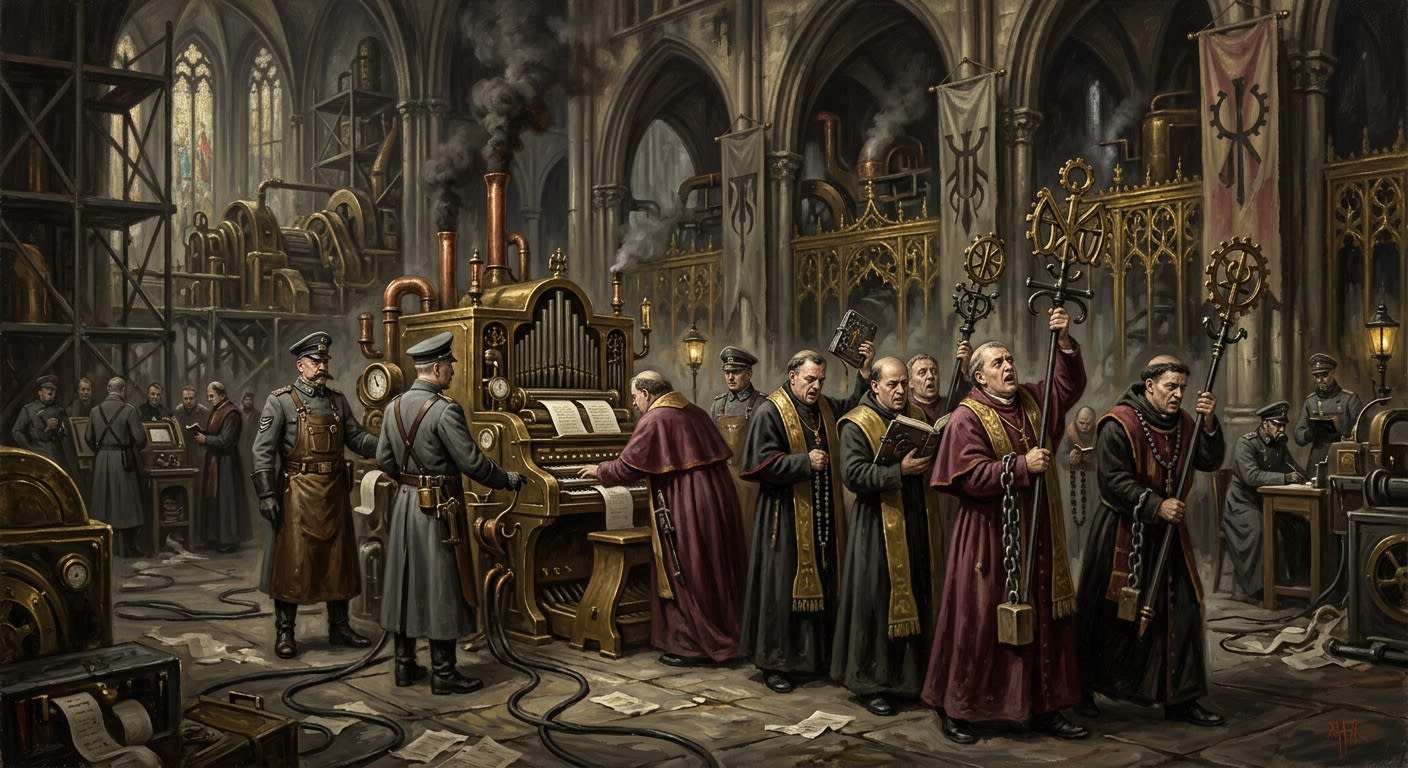
The Bavarian Creed Adjustment of A.S. 178 was a Bureau of Doctrine mandate requiring all public recitations of the Triune Creed in Munich to use the approved Strasbourg cadence markers. The offense lay in three syllables in the fourth line. The punishment was correction. The result was Munich.
The three syllables endure.
This was no rebellion in the vulgar style. No mayor denounced Strasbourg from a balcony. No guild raised a banner. No pamphlets circulated beneath sausages in the market. Munich recited the Creed with full attendance, full posture, full audible piety, and three small Bavarian weights left in the line where Doctrine had ordered lighter Strasbourg metal. A heresy of rhythm is still heresy. A comedy of rhythm is worse, because clerks must pretend not to hear the joke.
#On the Century Before the Order
Munich entered the Synod's administrative apparatus in A.S. 90 with the Concordat, a city obedient in tax, useful in rail, excellent in beer, and privately convinced that Strasbourg was a foreign city with custody of the keys. Doctrine began its homogenisation work at once. A century and eleven years of compliance reports followed. Nine revised catechism curricula were printed. Inspectors counted responses, corrected schoolmasters, annotated parish copies, and trained choirs to strike the approved intervals like nails into a coffin lid.
The Bavarians complied. The Bavarians always comply. They comply the way stone receives rain: without gratitude, without haste, without visible alteration.
Earlier teaching summaries described Munich's doctrinal condition before A.S. 178 as “regional laxity.”
Corrected. Munich's attendance exceeded continental averages, its tithe remittance was exemplary, and its infraction rate sat below the Zone 2 mean. The problem was obedience without surrender.
The Creed had never been absent from Munich. It lived in churches, kitchens, barracks, brewer guildhalls, schoolrooms, funerals, and eastbound departure platforms. Its Munich variant carried dialect, local stress, and an old cathedral habit older than any extant standard. The fourth line lengthened in the throat. Three syllables settled where Strasbourg preferred clipped obedience. The meaning did not change. Meaning was not the charge. Control was.
#On the Mandate and Its Instruments
The A.S. 178 order came bound in red string, sealed by Doctrine, acknowledged by Records, circulated through parish offices, municipal schools, guild registries, barracks chaplaincies, and the administrative rooms of the Provisorium. Teachers received cadence cards. Priests received corrected altar copies. Choir-masters received marked chant sheets. Drill chaplains at the Durchgangskaserne were instructed to correct recruits before eastbound loading. The Bureau of Purity received permission to observe repeated failure, which is the sort of gift Purity kisses before opening.
The machinery performed its office. Records built columns. Doctrine issued clarifications. Purity listened from side aisles with the innocent expression of a wolf disguised as a pew. Parish priests announced the change with that special clerical tenderness reserved for decrees they hate but will enforce because dinner depends on it.
Munich nodded.
At first, compliance improved. It always does when an office is watching. The fourth line shortened in schools. Guild ceremonies produced acceptable cadence. Municipal oaths struck the Strasbourg markers with visible effort. Reports travelled west bearing phrases such as “substantial adoption,” “encouraging correction,” and “residual older habit limited to elder cohorts.” The Bureau filed satisfaction. Satisfaction is the most perishable of bureaucratic foods.
#On Persistence
The old cadence returned by seepage. It returned in kitchens first, where doctrine must pass through steam, children, and impatient husbands. It returned at funerals, because grief is conservative. It returned in the Bräuviertel, because brewers will obey a tax schedule before they obey a throat. It returned in barracks when Munich men corrected outsiders with no words at all, merely by reciting louder. It returned in the old cathedral precinct with such serenity that Doctrine's own observers began marking the variant as “local solemnisation” to avoid paperwork.
By A.S. 190 the reports had become beautiful in their cowardice. “Cadential retention.” “Fourth-line regional colouring.” “Non-semantic variance.” “Approved text with legacy stress pattern.” Each phrase entered the file like a clerk trying to smuggle a pig through a chapel by calling it incense. The Bureau knows a pig. The Bureau also knows the price of admitting one is loose.
A.S. 193 Doctrine circulars claimed that Munich had achieved “full cadence convergence.”
Corrected by audit after the Feast of Saint Corbinian, when 14,000 voices recited the fourth line in perfect Munich form while holding official Strasbourg cards. The cards were printed correctly. The mouths were not.
#On the Present Use of a Small Failure
As of A.S. 201, the Bavarian Creed Adjustment remains in force. Every public recitation must use Strasbourg cadence. Every public recitation is assessed as compliant unless an observer is brave, deaf, ambitious, or new. The Munich variant persists in the fourth line, three syllables wide, older than the order that forbids it and younger than the pride that preserves it.
This failure has value. It gives Doctrine something to correct without burning the city. It gives Purity something to hear without finding treason. It gives Munich a little private altar on the tongue. It gives Strasbourg proof that governance reaches even into breath, which pleases Strasbourg, and proof that breath is not governance, which pleases me.
BUREAU OF PURITY — MARCPLATZ LISTENING POST, A.S. 199 Subject: mass recitation, fourth line. Recorded deviation: ███ ███ ███. Crowd response after correction bell: laughter suppressed, not absent. Recommendation: █████████████████████████████. Doctrine disposition: no action. Maintain file.
The Adjustment stands. Munich stands. The fourth line lengthens. Somewhere in Strasbourg, a clerk updates the compliance table and writes “progress continuing.” He is not wrong. He is simply losing with the correct stamp.