
#On the Barracks of Passage
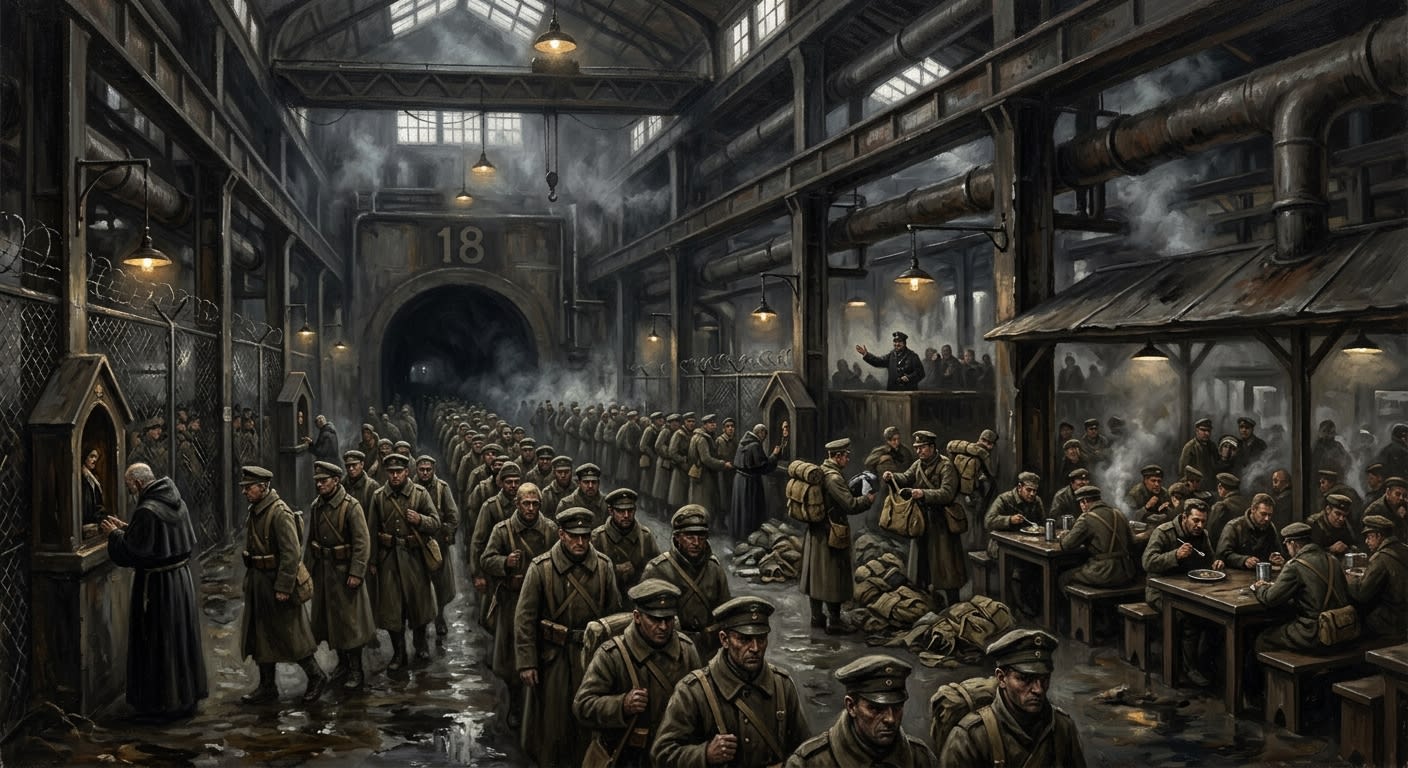
The Durchgangskaserne is Munich's military transit barracks, built along the eastern freight yards where the Provisorium exhales men and materiel toward the Cross-Station. Its name is honest in the brutal Bavarian fashion: passing-through-barracks. A soldier arrives with a parish roll behind him, a rail ticket beneath him, a kit list before him, and the Line waiting at the far end of every corridor.
Approximately forty thousand soldiers pass through each month. They enter from Strasbourg, Cologne, Kanzleiburg, rural levies, disciplinary transfers, reserve depots, and family kitchens that will spend the next year pretending the empty chair is temporary. The barracks receives them, counts them, feeds them, inspects them, briefs them, re-equips them, blesses them without doctrinal commitment, and delivers them to Platform Eighteen.
The complex grew from Munich's A.S. 90 designation as Central Corridor supply node, though its present form belongs to the century of accretions that followed. A shed became a waiting hall. A waiting hall acquired bunks. Bunks required kitchens. Kitchens required latrines. Latrines required inspectors, which is how civilisation usually loses its innocence. By A.S. 201 the Durchgangskaserne is a fenced administrative organism with stone dormitory wings, tin-roofed overflow sheds, mud courts, kit issue counters, and long painted arrows telling men which way to walk when all other direction has been removed from their lives.
#On Intake
Intake begins before dawn. Trains cough men into the yard in batches marked by region, levy, regiment, medical category, and urgency. The first queue verifies name. The second verifies body. The third verifies that name and body have not made separate arrangements. Men who fail the third queue are routed to Records benches beneath green lamps, where clerks reconcile parish slips, conscription tags, travel warrants, and scars.
The scar check is faster than the name check. Flesh lies less elegantly than paper.
After identity comes kit surrender. Home knives, private rosaries, unregistered charms, coins sewn into hems, love letters with unsuitable phrasing, folk medals, local saint cards, and bottles of Munich beer are declared, confiscated, tolerated, or taxed according to the mood of the table. The Bureau of War cares about blades and ammunition. The Bureau of Doctrine cares about words. The Bureau of Tithes cares about everything with resale value. The soldier cares about the letter. The letter rarely wins.
A posted intake notice once described confiscation as “temporary custodial safekeeping.”
Corrected after the Lost Effects Complaint of A.S. 196. Items surrendered at the Durchgangskaserne are stored, reclassified, auctioned, destroyed, blessed, mislaid, or forwarded by category. Safekeeping is one category among many and not the strongest.
#On Dormitory and Mess
The dormitories are arranged by departure window rather than regiment. This offends officers who believe men should sleep beside their proper flags and pleases quartermasters who know flags do not load trains. A northern levy man may bunk beneath a Lombard artilleryman, beside a Strasbourg clerk-conscript, opposite a Bavarian who has already learned which mess line gives thicker soup. This produces fights, friendships, card schools, dialect lessons, thefts, conversions, and a useful early sorting of cowards from nuisances.
The mess halls feed in tides. Porridge at first bell, bean stew at fourth, black bread at sixth, meat when the manifest allows, meat-flavoured water when the manifest has been interpreted by a realist. The kitchens serve eight thousand portions per sitting during surge weeks. Steam fills the rafters. Chaplains attempt prayers over the noise. Spoons answer more reliably.
#On Doctrine Before Departure
The doctrinal briefing rooms are the most hated chambers in the barracks, which is impressive given the latrines. Soldiers sit on benches beneath maps of the Sagittal Line while a Bureau of Doctrine chaplain explains obedience, fear, silence, permitted prayer, forbidden humour, demon-recognition signs, ration sanctity, corpse-reporting duties, and the theological distinction between retreat and repositioning under superior authority. The distinction has saved many officers and few men.
Assignment to the Munich transit chaplaincy is widely understood within the Bureau as punishment. The official description is “high-volume pastoral stewardship.” The private description is exile among men too tired to be impressed. A chaplain at the Durchgangskaserne speaks to thousands and is remembered by almost none, unless he says something false enough to survive the train ride.
The briefing ends with the informal rite mistakenly called the farewell sacrament. Men kneel. A chaplain marks the brow with chrismole. A blessing is spoken. The Bureau of Rites has confirmed that no formal sacrament exists at this stage of transit. The men have not been told. This is mercy in its most bureaucratically acceptable form: a comfort preserved by refusing to classify it.
Earlier barracks guides referred to the final blessing as the Farewell Sacrament of Munich.
Struck. No such sacrament exists in the approved Rites register. The observed practice is an informal pastoral action. The distinction matters greatly to the Bureau and not at all to the kneeling men.
#On Loading East
Departure strips the barracks of theatre. Names are called. Kits are lifted. Officers count by mouth and clerk by slate. Men move through the eastern gate beneath iron signage painted three times and scratched through in a dozen hands. From there the line runs to Platform Eighteen, where the pillars carry the names of men who understood that stone, iron, and vandalism preserve more truth than speeches.
The trains take them through Vienna, Budapest, Bratislava, the Carpathian approaches, Bastion-Przemyśl, Bastion-Sibiu, and whichever appetite the monthly routing table has selected. Some will reach Bastion-Irongate. Some will be turned south toward Shipka or Constantinople. The barracks does not ask who returns. Return is handled by other buildings with quieter floors.
BUREAU OF WAR RETURN CORRELATION — MUNICH TRANSIT COHORTS, A.S. 198–200 Average monthly eastbound processed: █████. Confirmed westbound return through Munich: ████. Medical return without original unit tag: ███. Bodies routed directly to Records: █████. Category pending: █████████████████. Public summary: throughput stable.
As of A.S. 201, the Durchgangskaserne remains operational, clean enough for inspection, dirty enough for use, hated enough to be real. Munich gives men one last bed in Zone 2, one last bowl, one last lecture, one last unofficial blessing, and one last chance to carve a name before the train takes jurisdiction.