
#On the Quarter That Predates the Stamp
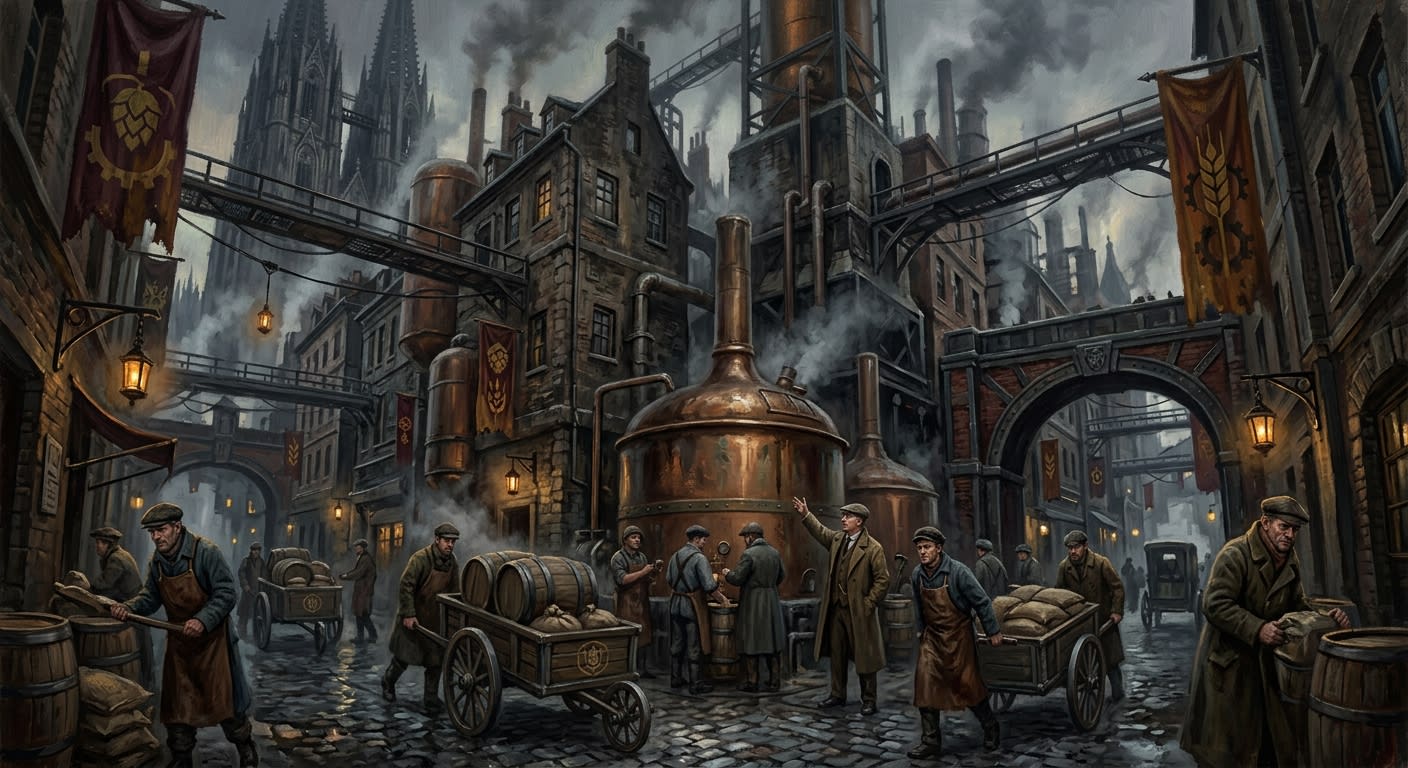
The Bräuviertel is Munich's Brewery Quarter, thirty-seven city blocks wedged between the northern wall of the Provisorium and the old cathedral precinct, so that War, thirst, and the Creator may dispute jurisdiction over the same cobbles. It predates the Concordat. It predates the Synod. It predates, according to the brewers, several forms of sin. The Bureau of Records lists its founding date as “pre-doctrinal, administrative determination pending.”
The determination has been pending for one hundred and eleven years.
The Quarter's streets are narrow, wet, amber-smelling, and permanently accused. Copper kettles steam behind soot-dark windows. Malt sacks lie against chapel walls. Brewery horses drag barrels past auditors who pretend not to be impressed by good harness. The gutters run with yeast wash, rainwater, spilt beer, and the little private sacrileges of men who have worked twelve hours beside heat and grain. It is not clean. Cleanliness is a junior virtue. Continuity outranks it.
#On Production and Division
The Bräuviertel produces approximately two million hectolitres of beer each year. The Bureau of Tithes taxes sixty percent. The Bureau of War requisitions twenty percent for the forward territories under the classification “morale supply, Category: Medicinal.” Munich drinks the remaining twenty percent and regards the whole arrangement as armed arithmetic.
The brewers pay. That is their sin against drama. They do not riot, scorch ledgers, or throw inspectors into vats, except in tavern songs, where inspectors drown musically and return as thinner men. The actual guild masters deliver their excise barrels on time, file weight declarations, submit spoilage claims, and sign receipt books with such pointed neatness that the receiving clerks feel mocked without being able to cite the relevant infraction.
War's requisition has changed the taste of the Line. Munich beer travels east by cask, tanker, bottle crate, medical wagon, chaplain's allowance, and corruption too petty to deserve condemnation. At Vienna it is watered and blessed. At Budapest it is guarded harder than some ammunition. At Bastion-Przemyśl it is issued after trench rotations in portions small enough to be insulting and large enough to cause prayer. At Sibiu, mountain cold improves it. At Constantinople, nothing improves anything, but the men drink it all the same.
#On the Blessed Sugar
The Quarter's true scandal lives in the vats. Munich's brewers use a yeast strain they call Saccharum Benedictum, the Blessed Sugar, said to have survived the Atheist Wars inside a reliquary cask hidden by Benedictine monks while Rationalist soldiers burned the monastery around them. The story contains monks, fire, concealment, continuity, and profitable fermentation. Naturally it has proven impossible to kill.
The Bureau of Relics first received a petition for authentication in A.S. 98. It declined. It has declined annually ever since. This refusal is one of the Bureau's finer achievements: the yeast remains possibly sacred, possibly profane, and certainly taxable. Authentication would satisfy somebody. Declination satisfies everyone who matters.
A prior diocesan notice described Saccharum Benedictum as “a relic of unverified sanctity.”
Corrected by Relics memorandum A.S. 132. The yeast is not a relic, pending authentication; not profane, pending condemnation; not exempt, pending never. It is a fermenting substance under observation.
Doctrine's public position is tidy: fermentation is natural, beer is civil, drunkenness is disciplinary, claims of sacramental yeast are local exuberance. The brewers' private position is older and more dangerous: if the yeast survived martyrdom, then every cask bears witness; if every cask bears witness, then Munich has been performing an unauthorised liturgy for generations; if that is true, the Bureau has been taxing grace by the barrel.
This is why Doctrine prefers natural processes.
#On Taverns, Guilds, and Inspectors
The Bräuviertel is governed by brewers' houses whose family names appear in municipal rolls long before Strasbourg had the courtesy to become inevitable. They maintain kettle ledgers, cellar keys, apprentice oaths, vat blessings, fire crews, cooperage yards, night-watch rotations, and a guild court whose judgments arrive faster than municipal law and sting longer. The guild court cannot imprison a man. It can refuse him beer. Munich understands proportional punishment.
Inspectors enter the Quarter in pairs. Tithes sends excise men. War sends requisition officers. Records sends date-correctors. Purity sends listeners when the songs grow old enough to sound doctrinal. Doctrine sends me, which proves that even the Almighty appreciates style in enforcement.
The taverns carry the Quarter's political life in foam. Men speak more freely after the second mug, less wisely after the fourth, and most truthfully in the interval between. The Bureau of Purity has stationed listeners in the Bräuviertel since the Marienplatz post was established in A.S. 134. Seventy years of reports have produced nothing actionable, which is not the same as nothing. Munich knows the difference. Munich raises its mug to the difference.
#On the Old Cathedral Precinct
The southern edge of the Bräuviertel presses against the old cathedral precinct, where bells, brewery carts, funeral processions, and malt deliveries have learned to negotiate by rhythm. During morning offices the draymen slow. During barrel loading the minor clergy step aside. During feast days both sides claim priority and the street fills with enough incense and beer steam to make a visiting prelate reconsider several categories of sin.
The cathedral chapter dislikes the Quarter's theological imprecision and appreciates its donations. The brewers dislike episcopal lectures and appreciate burial rights. Each party has accused the other of worldliness with complete justice. The old arrangement survives because it is not an arrangement. It is sediment, custom, invoice, baptism, hangover, and bell-metal laid in alternating courses.
A Purity advisory of A.S. 171 warned that cathedral proximity allowed “fermentary superstition” to contaminate parish practice.
Filed, reviewed, and left unacted. Parish attendance in the precinct remains above Munich average, tithe remittance is excellent, and the beer offered after funerals keeps mourners from inventing worse consolations.
#On Present Condition
As of A.S. 201, the Bräuviertel continues its ancient insolence under modern seals. Its barrels feed Munich, the Provisorium, the Durchgangskaserne, the Cross-Station, the eastbound trains, and the particular corner of a soldier's soul where fear sits down and pretends to be thirst. It pays its taxes. It surrenders its requisitions. It refuses to surrender its date.
The Bureau will determine the Quarter's founding when the Quarter becomes young enough to fit inside a box. Until then the kettles boil, the yeast works, the ledgers balance, and inspectors leave smelling faintly of malt despite having touched nothing.