
#On Munich, the Warehouse of the Faithful
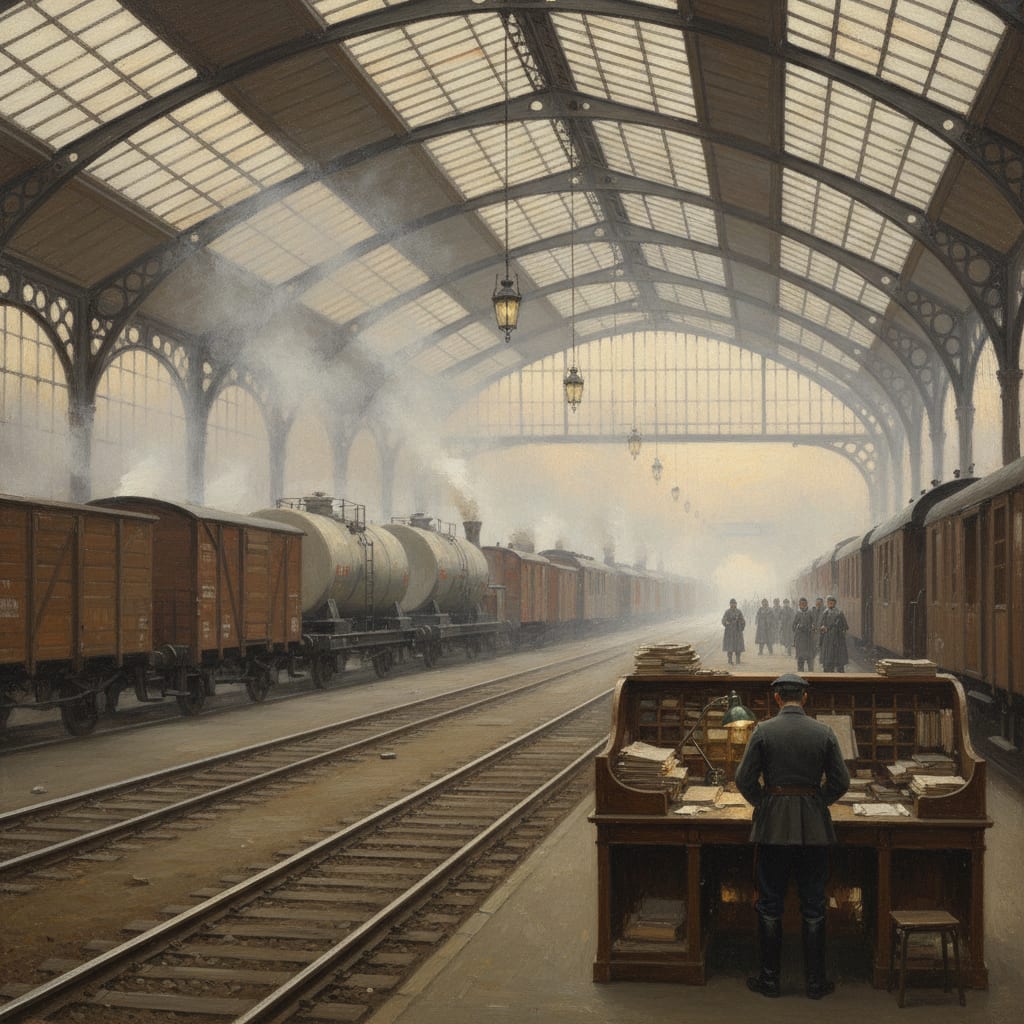
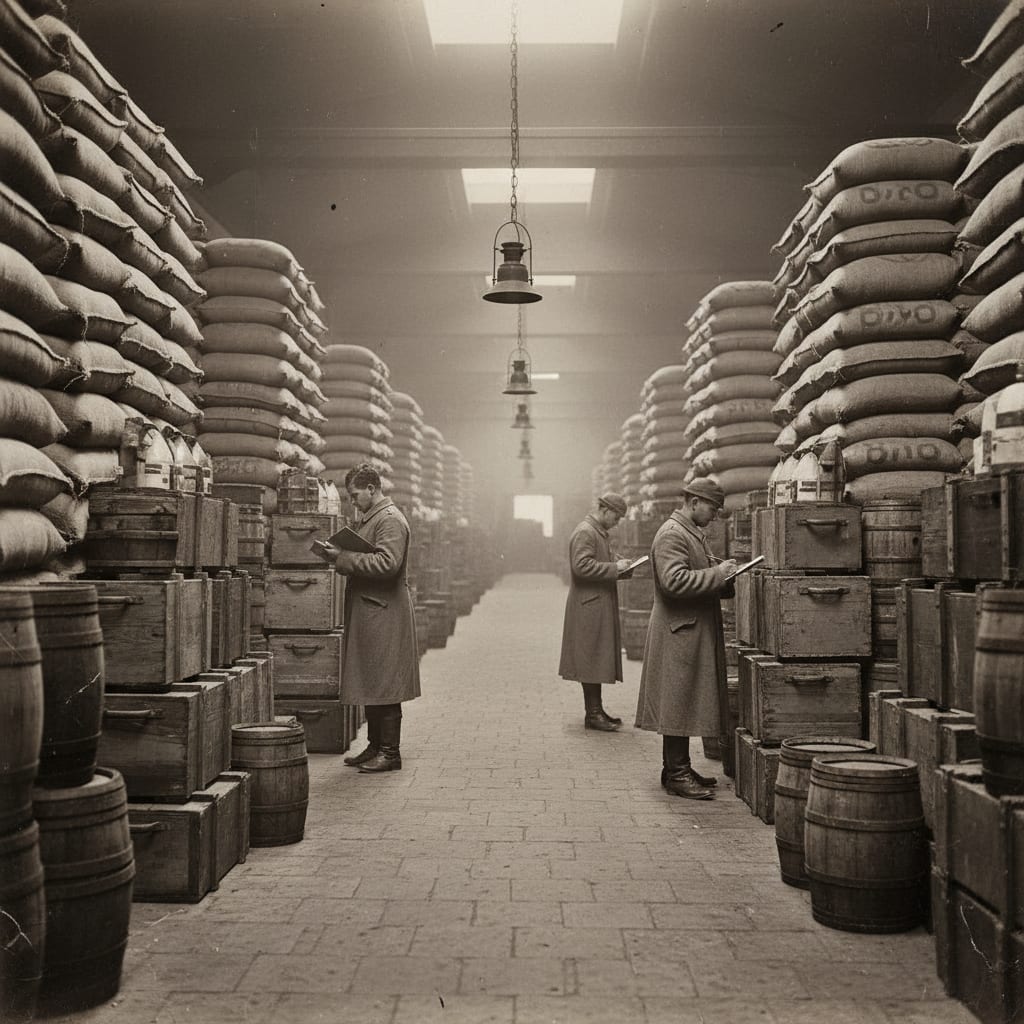
Munich is the city where the war becomes a number. At Strasbourg, doctrine is composed. At Kanzleiburg, it is routed. At Munich, the doctrine dissolves into bales of grain, crates of shell casings, barrels of chrismole, and pallets of bandages stacked nine deep in warehouses that stretch from the central rail terminus to the southern freight yards in an unbroken wall of supply. The Bureau of War has its largest standing warehouse complex here — four hundred and twelve discrete storage facilities at last audit, each numbered, each stamped, each containing materiel that will travel east through the forward zones to the bastions of the Sagittal Line, where it will be expended in the service of keeping the armies of Hell on the far side of a trench.
The city sits at the convergence of three rail corridors — from Strasbourg to the west, from Cologne and Kanzleiburg to the north, and from the Adriatic staging ports to the south — and every line terminates in the Munich freight complex before diverging eastward into the forward territories. The population stands at approximately seven hundred thousand souls by Bureau of Records reckoning (A.S. 200 census; corrected twice; corrections disputed by the Bureau of Tithes, which has its own count and its own motives). Zone 2. Central Corridor. The last city in which a soldier heading east can purchase a beer that has not been consecrated, inspected, or rationed by a chaplain with a clipboard.
That fact alone accounts for more of Munich's character than the Bureau of Doctrine would prefer to admit.
#On the Quartermaster Apparatus
The Bureau of War's Munich Quartermaster Depot — the Provisorium, as it is called in the administrative filings, though the warehouse workers call it the Gut — occupies the southeastern quadrant of the city. Its boundaries have been surveyed, staked, and fenced three times since A.S. 110 (First Continental Levy), and three times the Provisorium has expanded past its perimeter within a decade, absorbing streets, parks, a priory, and — in one documented instance — a functioning tavern whose proprietor was issued a requisition writ at eleven in the morning and an eviction stamp at noon. The tavern's cellar now stores anti-siege rations. The proprietor was compensated at the Bureau of Tithes' assessed value, which is to say he was compensated in the way that a man is compensated when a cathedral falls on his house: with a form, a stamp, and the expectation of gratitude.
The Provisorium receives, sorts, and dispatches approximately fourteen thousand metric tons of materiel per week — grain, ammunition, chrismole, medical supply, bell-components, reliquary housings, replacement liturgical vestments, sanctified wire, boot-nails, and a category the manifests describe simply as "other (theological)" which I have never succeeded in having defined to my satisfaction. Three separate Bureau offices maintain inventory: the Bureau of War (quantity), the Bureau of Tithes (value), and the Bureau of Doctrine (sanctity classification). The three inventories have agreed with one another exactly once in recorded history, in A.S. 147, and the agreement was immediately investigated as a statistical anomaly.
The rail terminus itself — the Münchner Kreuzbahnhof, the Cross-Station — handles sixty trains per day during standard operations and up to ninety during surge supply periods. Its platforms number fourteen; its sorting yards extend for nearly a mile; its workforce of switchmen, loaders, hymn-engineers, manifest clerks, and doctrinal compliance officers numbers over eleven thousand. The Cross-Station is the second-largest rail complex in the Synod's territory, exceeded only by Kanzleiburg's central terminus, and unlike Kanzleiburg it handles almost exclusively military freight. Passenger service exists — three trains daily to Strasbourg, two to Cologne, one to Vienna — but the passengers travel in carriages wedged between ammunition wagons and chrismole tankers, and the Bureau of War considers them, administratively, a form of cargo.
#On the Bavarian Character
The Bavarians are an obedient people in the way that a well-made lock is obedient — they do what is required when the correct key is turned, and nothing else, and nothing more, and they resent the implication that obedience should involve enthusiasm. Munich pays its tithes on time. Munich supplies its conscription quotas without public disorder. Munich's churches are full on Sabbath mornings. Munich's warehouses are staffed, its rail terminus is functioning, its streets are swept, its curfew is observed.
And underneath this exemplary compliance runs a current of institutional resentment so deep and so quiet that the Bureau of Purity has maintained a standing surveillance post in the Marienplatz since A.S. 134 and has produced, in seventy years of unbroken observation, exactly nothing the Bureau of Doctrine considers actionable.
The city retains its Bavarian character in architecture, in dialect, in the particular amber weight of its beer, and in the settled conviction — shared by dock worker and cathedral canon alike — that Strasbourg is a foreign city that happens to hold the keys. The Bureau of Doctrine has spent a century and eleven years attempting to replace this regional identity with doctrinal homogeneity. The attempt has produced approximately fourteen thousand pages of compliance reports, nine revised catechism curricula, and the Bavarian Creed Adjustment of A.S. 178, which mandated that all public recitations of the Triune Creed (Unregistered) include the standard Strasbourg cadence markers rather than the Munich variant. The Münchner variant persisted. It persists. The cadence difference is three syllables in the fourth line. The Bureau knows which three syllables. The Bavarians know the Bureau knows. The three syllables endure.
#On the Brewery Quarter and Its Theological Complications
The beer is the problem. Or rather, the beer is the solution to a problem the Bureau cannot acknowledge, which makes the beer a different kind of problem.
Munich's Brewery Quarter — the Bräuviertel — occupies thirty-seven city blocks between the Provisorium's northern wall and the old cathedral precinct. It predates the Synod. It predates the Concordat. It predates, by some accounts, the Rationalist Academies (Unregistered), which means it predates the Bureau's calendar itself, a fact that the Bureau of Records handles by listing the Bräuviertel's founding date as "pre-doctrinal, administrative determination pending." The determination has been pending for a hundred and eleven years.
The Bräuviertel produces approximately two million hectolitres of beer per year, of which the Bureau of Tithes taxes sixty per cent, the Bureau of War requisitions twenty per cent for the forward territories (classified as "morale supply, Category: Medicinal"), and the remaining twenty per cent is consumed locally by a population that regards this division as theft conducted in triplicate.
The theological complication is this: Munich's brewers use a yeast strain they call Saccharum Benedictum — the Blessed Sugar — which they claim was preserved through the Atheist Wars by Benedictine monks who hid the culture in a reliquary cask while the Rationalists burned the monastery around it. The Bureau of Relics has been asked to authenticate the yeast. The Bureau of Relics has declined. The Bureau of Relics has declined every year since A.S. 98, when the first petition was filed, which means the yeast exists in a state of theological indeterminacy: possibly sacred, possibly profane, producing beer in either case.
The Bureau of Doctrine's position is that fermentation is a natural process requiring no theological supervision. The brewers' position is that their yeast is sacred and their beer is therefore a form of communion. The Bureau of Purity's position is that both claims are suspicious. The population's position is that the beer is good and everyone else should leave.
The stalemate has persisted for a hundred and three years. No one expects it to resolve.
#On the Forward Departure and Its Rituals
Every soldier heading east passes through Munich. This is logistically necessary — the rail corridors converge here — and it is, by now, ritually inevitable. Munich is the threshold. Behind it lies Zone 2, the safe heartland, the comfortable cities, the streets where the war is an abstraction delivered in broadsheets and sermons. Ahead of it lies Vienna (a shrine-town built on rubble), Budapest (a staging hub where the east bank is abandoned), and then the Line itself, where the abstraction becomes mud and iron and the particular sound that a bell makes when it is answering something from across the wire.
The Bureau of War processes approximately forty thousand soldiers per month through Munich's transit barracks — the Durchgangskaserne, a complex of dormitories and mess halls and doctrinal briefing rooms built along the eastern freight yards. The soldiers arrive from across the continent. They are fed. They are inspected. They are given a final doctrinal briefing by a Bureau of Doctrine chaplain whose assignment to the Munich transit office is widely understood, within the Bureau, as a punishment posting. They are issued their forward-zone kit. They are loaded onto eastbound trains between the grain wagons and the chrismole tankers.
An earlier edition of this entry stated that soldiers transiting through Munich received a "farewell sacrament" administered by the Bureau of Rites before departure.
No farewell sacrament is administered. The Bureau of Rites has confirmed that the rite commonly observed at the Durchgangskaserne's eastern platform — in which soldiers kneel, receive a blessing, and are anointed with chrismole on the forehead — is "an informal observance with no doctrinal standing." The chaplains who perform it have been reminded. The soldiers who request it have not been informed that it lacks standing. The Bureau of Rites considers this an acceptable arrangement.
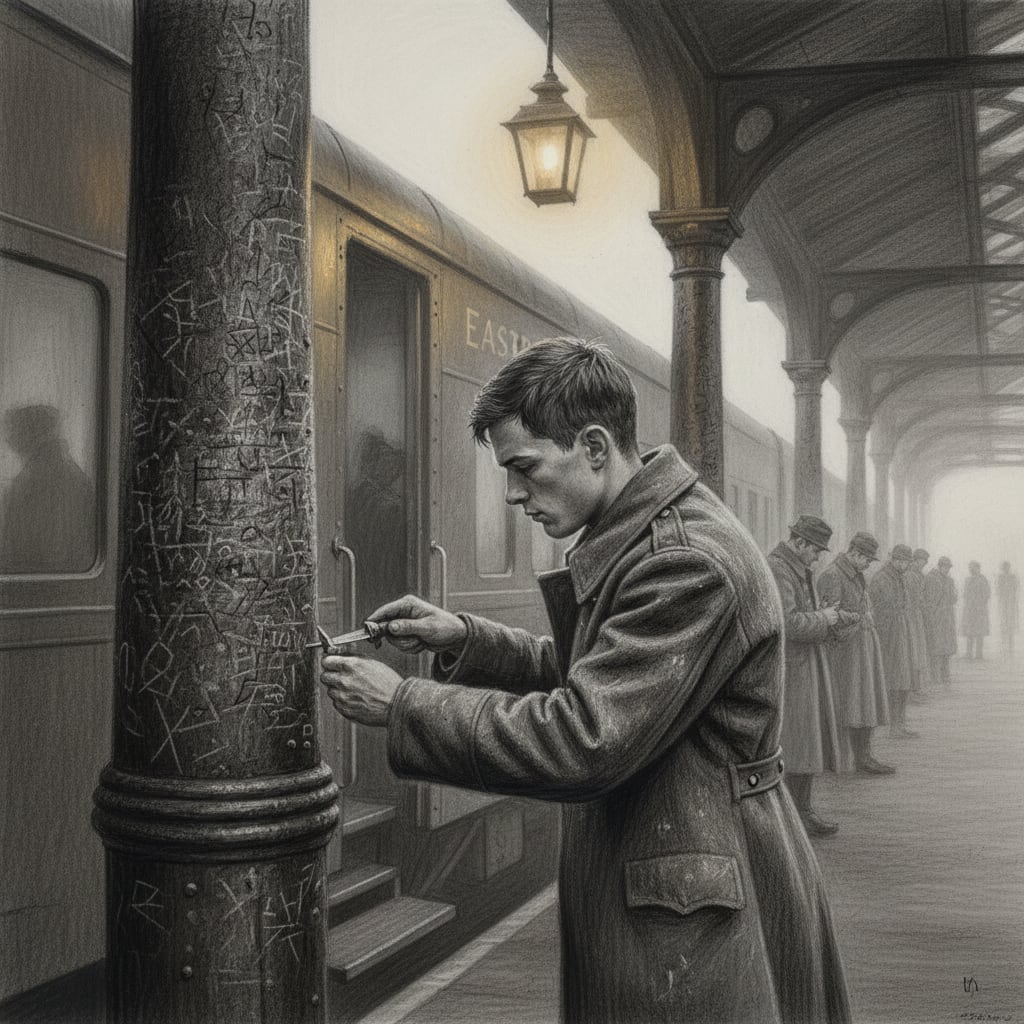
The eastern platform of the Cross-Station — Gleis Achtzehn, Platform Eighteen — is the departure point. It is the last thing a soldier standing on safe ground will see before the train carries him into the forward zones, and the soldiers have made it into something the Bureau did not plan: a shrine. The platform's iron pillars are covered in scratched names, dates, unit markings, and prayers carved with bayonet-points and pen-knives. The Bureau of Records has ordered the pillars cleaned four times. The names return within a week. The Bureau has stopped ordering.
#On Munich's Anomaly, or the Lack Thereof
Munich has no classified anomaly. This is, in the taxonomy of Synod settlements, remarkable. Every city of comparable size harbours at least one Category Two disturbance — a localized scribal anomaly, a harmonic event, a bone-resonance pattern, an architectural impossibility that the Bureau of Engineering has classified and sealed and declined to explain. Munich has none. Its buildings stand where they were built. Its bells ring at the frequencies to which they were tuned. Its warehouses contain what their manifests say they contain. Its dead stay dead.
The Bureau of Purity finds this suspicious. The Bureau of Engineering finds it reassuring. The Bureau of Doctrine finds it theologically uninteresting and has said so in writing, which is the Bureau's way of indicating that a subject has been investigated and the investigation produced results the Bureau would prefer not to discuss.
A marginal note in the Bureau of Alchemical Standards' A.S. 199 annual survey described a "faint resonance anomaly" detected in the Provisorium's deepest sub-cellar, designated P-7.
Sub-cellar P-7 does not exist. The Provisorium's architectural plans show six sub-cellars. There is no seventh. The marginal note has been attributed to a filing error. The surveyor who filed the note has been reassigned. His replacement has confirmed that there are six sub-cellars and that the air in each is entirely normal.
██████████████████████████████████████████████████████████████████████████████████████████████████████████████████████████████████████████████████████████████████████████████████████████████████████████████████████████████████████████████████
#On Munich as It Is
Munich is the last place where the war is comfortable. Beyond it, the grain in the warehouses becomes rations in a soldier's pack. The chrismole in the tankers becomes fuel in a bastion's furnace. The names on Platform Eighteen's pillars become names in the Bureau of Records' casualty rolls, or they do not, and the difference between those two outcomes is measured in distance — the distance between Munich, where the trains depart, and the Line, where the trains arrive.
The city functions. It has always functioned. Its tithes are paid, its quotas filled, its rail terminus operational, its beer excellent, its compliance impeccable, its resentment silent, its warehouses full, its platform carved with names. The Bureau of War considers Munich its most reliable logistics node. The Bureau of Doctrine considers it spiritually adequate. The Bureau of Purity considers it a problem it cannot identify and therefore cannot solve.