
#On the Gut
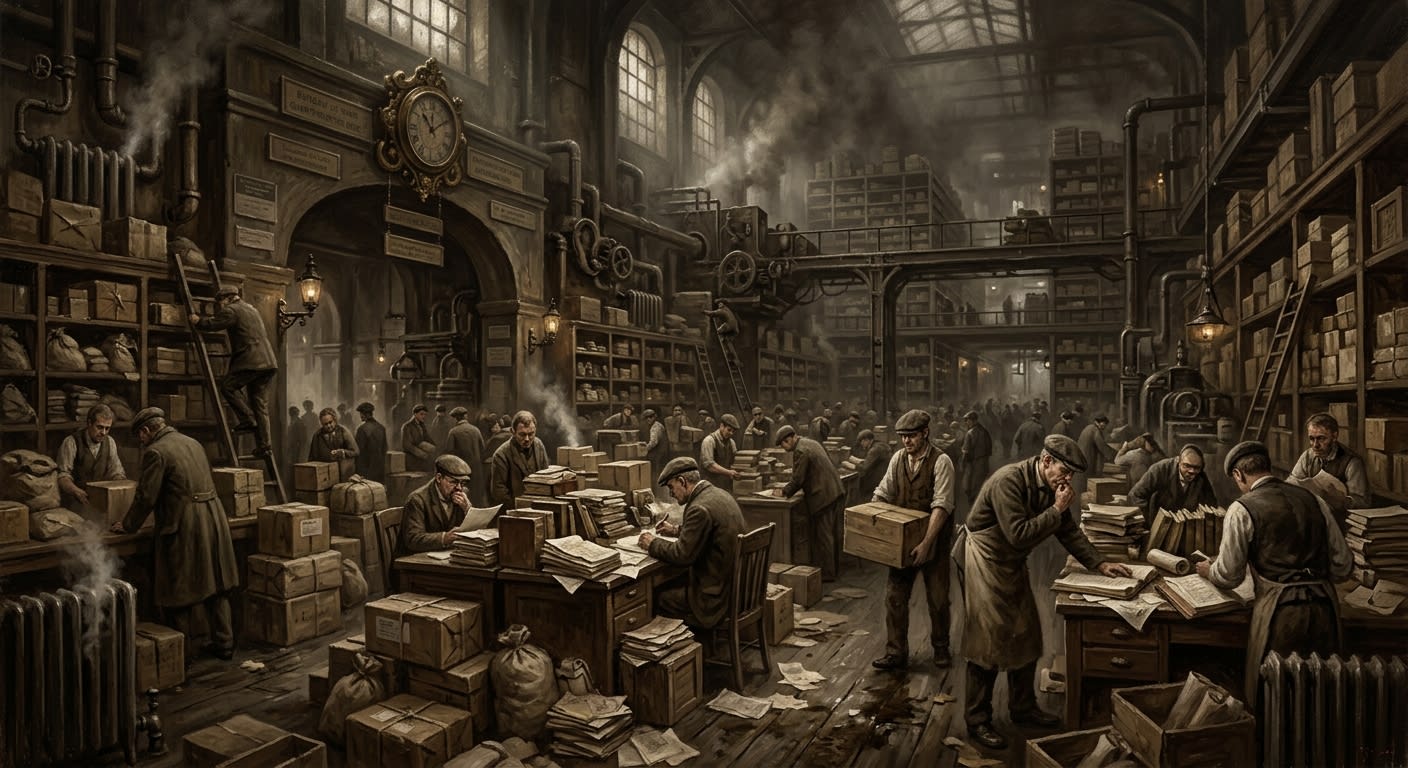
The Provisorium is the Bureau of War (Unregistered)'s Munich Quartermaster Depot, the largest standing warehouse complex under Synod seal, occupying the southeastern quadrant of Munich like a swallowed city that continues to digest streets. Its official name promises temporariness. Its workers call it the Gut. The workers are correct, which explains why no office uses their term in correspondence unless the correspondence is private, urgent, or honest by accident.
Four hundred and twelve discrete storage facilities stand inside its fences: grain halls, shell sheds, chrismole tanks, bandage lofts, boot-nail cages, wire barns, liturgical textile rooms, reliquary housing vaults, coffin timber yards, quarantine depots, and a sequence of locked brick blocks catalogued as Other, Theological. The Provisorium receives, sorts, and dispatches roughly fourteen thousand metric tons of materiel each week. Some warehouses feed the Line. Some arm it. Some dress it, fuel it, patch it, count it, and prepare it for burial with admirable efficiency.
The Provisorium's first perimeter survey followed the First Continental Levy of A.S. 110, when Munich's A.S. 90 Central Corridor designation became less an administrative title than a hunger with rail sidings. The Bureau staked an enclosure. Within a decade the enclosure had outgrown itself. This happened three times. Munich provided streets, parks, a priory, drainage lanes, two schoolyards, and one tavern whose proprietor received a requisition writ at eleven in the morning and an eviction stamp at noon. His cellar now stores anti-siege rations.
#On Absorption as Policy
The Provisorium does not store things. It absorbs them. A crate arrives with a merchant seal, a parish claim, a guild receipt, or a widow's contested bill of lading; after ninety-six hours unclaimed it becomes Bureau property, and the original owner becomes a petitioner, which is a lower order of creature in every known theology. War calls this procedure. Tithes calls it asset regularisation. Doctrine calls it providential allocation when someone important is listening.
The Gut has eaten municipal boundaries with the same placid appetite. Its walls have moved by survey, emergency annex, temporary shed, firebreak, sanitary cordon, and the useful fiction of “interim military necessity.” Interim necessity, once roofed in slate and staffed by clerks, becomes architecture. Architecture acquires a budget. A budget acquires defenders. By the time any citizen asks when the interim will end, the answer has received its own office.
A municipal compensation notice stated that property absorbed during the third Provisorium expansion was purchased at fair value.
Corrected. It was assessed at Bureau of Tithes value, which resembles fair value in the way a coffin resembles a bed: same approximate dimensions, harsher intention.
Munich resents the Gut with exemplary discipline. No riot has greeted its expansions. No cell has burned its ledgers. No pamphlet has survived long enough to become amusing. The Bavarians simply file correct objections forever, using the approved forms, in the approved ink, with all seals properly aligned, until the officials charged with dismissal begin to envy the dead.
#On the Three Inventories
Three Bureau inventories govern every object passing through the Provisorium. War counts quantity. Tithes counts value. Doctrine counts sanctity. The same crate of bell-components becomes twelve units of acoustic hardware, thirty-seven crowns of taxable bronze, and a Class Green liturgical resonance apparatus pending blessing. All three descriptions are authoritative. None are identical. The crate travels east beneath a paperwork canopy so dense that a lesser object would suffocate.
The three systems agreed exactly once, in A.S. 147. The incident remains under review. I have read the review, or rather the portion of it left visible to persons of my rank, which is to say the title page, the page numbers, and one marginal query asking whether harmony among offices might constitute evidence of sabotage. The query was underlined twice.
TRI-BUREAU INVENTORY CONCORDANCE REVIEW — A.S. 147 Event: exact agreement among War, Tithes, Doctrine ledgers. Duration: ███ minutes. Objects affected: █████. Initial theory: clerical excellence. Revised theory: unacceptable. Final classification: █████████ statistical anomaly with doctrinal implications. Recommended action: prevent recurrence.
The workers understand the inventories better than the offices do. A sack of grain is moved by weight. A crate of shells is moved by danger. A reliquary casing is moved by escort. A barrel of chrismole is moved by smell, distance, prayer, and the brisk refusal to ask whether the leaking valve has been blessed. The forms follow after. Forms always follow after, panting in their vestments.
#On Air, Cough, and the Engineering Assessment
The air inside the Gut is a filed scandal. It carries chrismole dust, grain powder, coal soot, lamp oil vapour, mildew, boot leather, rat lime, hot metal, and the dry mineral sweetness of bandages packed before their destiny has chosen a wound. The Bureau of Engineering unpublished assessment classifies the atmosphere as technically unfit for sustained respiration. The Bureau of War considers the facility operational. Both statements are true. Truth, under Synod management, is frequently a room with two locked doors and a clerk charging admission to both.
The labourers develop what Bureau of Mercy physicians call logistical bronchitis. The workers call it the Gut wheeze. A man with the Gut wheeze coughs grey in winter and yellow in summer, sleeps propped against sacks because lying flat feels like drowning in flour, and learns to identify warehouses by taste. Grain Hall Nine tastes of damp bread. Chrismole Shed Twelve tastes of pennies and confession oil. Bandage Loft Three tastes clean enough to be suspicious.
A War labour circular described Provisorium respiratory complaints as “seasonal irritation common to urban workers.”
Amended privately after Engineering review. The season in question appears to be employment.
No official mask allowance exists for ordinary warehouse hands. Masks imply hazard. Hazard implies liability. Liability implies Tithes, Mercy, War, and Engineering sitting together until one of them bleeds from the eyes. Better, the circulars advise, to improve ventilation, rotate crews, discourage unnecessary loitering, and print devotional cards to Saint Edrin of the Eight Strokes for workers assigned to dust-heavy halls. The cards are cheap. The lungs are already present.
#On Labour and Private Economies
The Gut's workforce is a city beneath employment: loaders, clerks, tally women, seal readers, rope gangs, chrismole turners, rat boys, night watchmen, cart drivers, boiler crews, pallet priests, kitchen women, unofficial gamblers, and children who run messages through gaps adults cannot fit through without losing dignity or buttons. Their wages are classified as adequate by the Bureau of Tithes. Their meals come from the same ration stores they move toward the east, though the better tins vanish upward into officer kitchens with a grace that would shame angels.
No warehouse survives by official systems alone. The Provisorium has tea routes, boot exchanges, pallet lotteries, cough powders, illicit beer pipes from the Bräuviertel, false-bottom lunch pails, sympathetic watchmen, and a black market in labels scraped from crates after dispatch. Labels have value. A label from a medical crate can buy an afternoon of queue priority. A chrismole hazard tag can clear a corridor. A reliquary transit strip can frighten a minor official into reconsidering his tone.
Discipline inside the Gut is practical because ideal discipline would stop work. A man drunk near grain is fined. A man drunk near chrismole is beaten sober before he becomes a civic event. Theft from War stores is execution by statute and wage deduction by custom, depending on value, witness, need, and whether the stolen item was going east to men who already had too much or too little of it. This ambiguity offends legal minds. Legal minds are not asked to load wagons at midnight.
#On the Six Sub-Cellars
The architectural plans show six sub-cellars beneath the Provisorium. I have counted six. The Bureau of Alchemical Standards' A.S. 199 marginal note referring to a faint resonance anomaly in sub-cellar P-7 was a filing error. The surveyor has been reassigned. His replacement has confirmed the count. Six.
This paragraph exists because the matter is settled.
The Bureau of Alchemical Standards note was not repeated in the municipal copy. This is how the Synod handles facts that have learned bad manners. It removes them from the room, posts a guard at the door, and declares the room empty.
The six acknowledged sub-cellars store preserved grain, emergency medical reserves, obsolete uniforms, condemned harness, anti-siege rations, damaged bell fittings, and whatever the Bureau of War cannot admit it has lost because admitting loss would require admitting prior possession. Rats avoid the fourth cellar. Workers avoid the sixth. Inspectors avoid asking why.
#On Present Capacity
As of A.S. 201, the Provisorium remains the Synod's central stomach. Fourteen thousand metric tons pass through its doors each week on paper; more passes through by emergency exception, delayed declaration, duplicate routing, and the old Munich art of doing the work before the authorising stamp has found its hat. Its freight feeds the Cross-Station, the Durchgangskaserne, the Central Corridor, Vienna, Budapest, Bastion-Przemyśl, Bastion-Sibiu, and every officer who has ever mistaken a warehouse for a miracle.
The Gut works. That is the accusation and the defence. It steals space, poisons lungs, swallows property, breeds private economies, contradicts its inventories, and sends the east what the east demands. The Bureau of War calls it indispensable. The Bureau of Tithes calls it undervalued. The Bureau of Doctrine calls it spiritually adequate. The workers call it the Gut and go inside before dawn.