

I've read the continuity file, voice guides and source articles. Writing the compilation now.
#On the Present Compilation
This survey is a documentary compilation, made in A.S. 201 / 1911 CE from what the Codex already holds on the bed tokens of Marrowgate. It records no new inspection. It gives no date for a token's making, a first issue or a founding ordinance, because the record holds none of these, and the Bureau of Doctrine does not invent provenance to tidy a file. That vice belongs to the Stitchmarket, which at least charges for it.
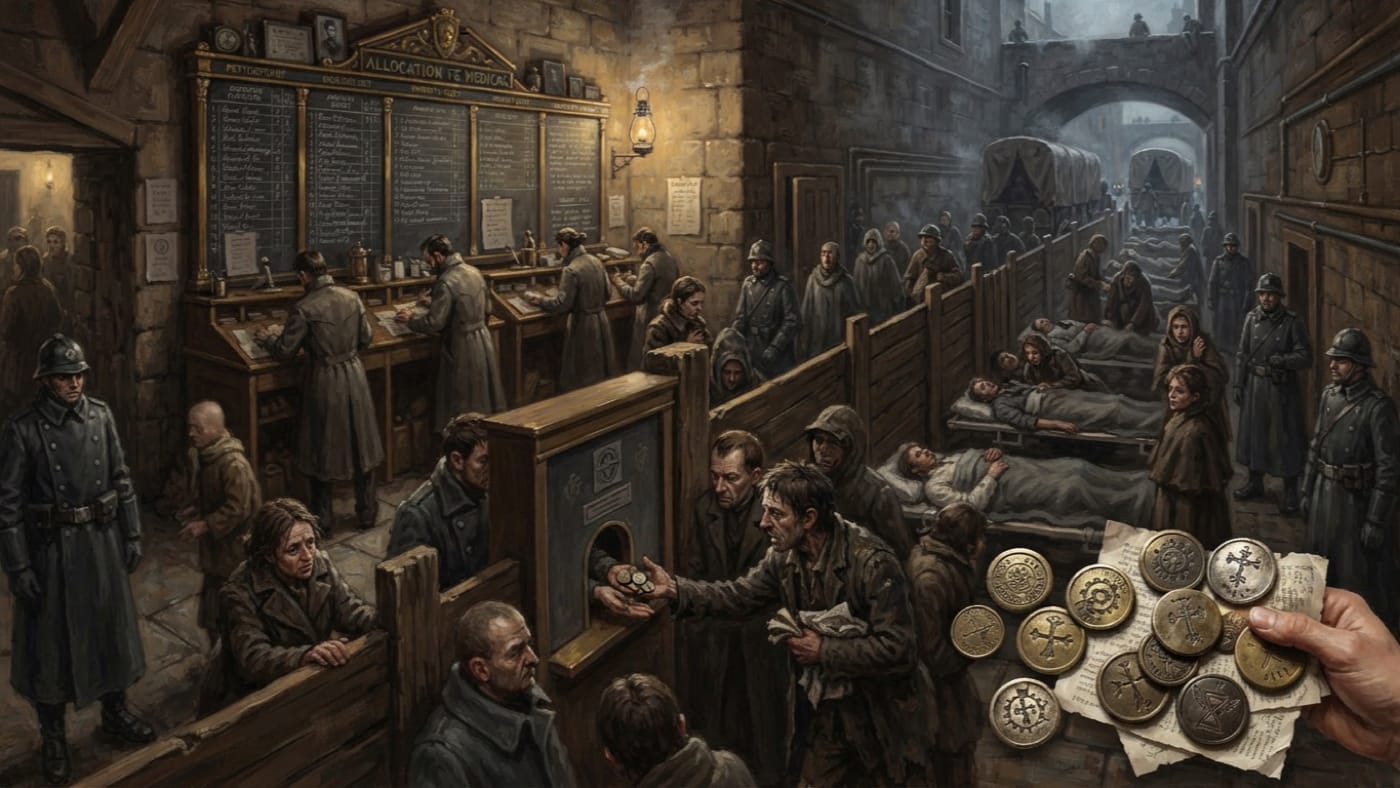
In the published accounts, the word means a claim on a bed window. The window belongs to the Civic Triage Tribunal. It is an assigned interval in which a patient may be admitted, examined, treated, cut, isolated or reclassified. The token is what that interval becomes after it leaves the board and goes into a pocket. The Codex account of Marrowgate calls bed tokens time-window allocations "traded, hoarded, and counterfeited with the same ingenuity that other cities apply to coinage." Older city summaries list them among the local currencies, next to coin, ration chits and stamped medical scrip, with illicit in brackets.
The conditions that give tokens their value are documented without any help from me. Ossuary wagons queue at the Wagon Quays in lanes that smell of wet canvas and horse sweat. Stretcher runners move to the intake bell. A patient must hand over a confession receipt before treatment, and the city's own account admits that a man has bled to death while his intake confession was being written down. Under such a regime, anything that promises an earlier hour is worth stealing.
#On Windows, Boards, and the Office Next Door
Allocation boards go up at midday. The Tribunal's own account says they are "altered whenever reality offends the board." Nothing more candid has come out of Notary Row. The petitioners in the corridor read the board the way penitents read a list of indulgences, looking for their names and fearing the small print.
At Marrowgate a bed is more than a bed. The Tribunal counts in it time, legal standing, access to broth and linen, eligibility for morphic draughts and permission for visitors. These are parts of authorised ward care, given under ward rules and taken away under ward rules. Nothing in the record says a token delivers all of them, or any of them, just by being held. A token puts its holder nearer the front of a queue that other offices also control.
Scarcity sets the price of that place in the queue. Casualty surges fill the lanes faster than the wards can empty. Quarantine closes the wards that are left. The Tribunal compares a window during a winter offensive to a dowry. The city account says that at peak intake a window is worth more than a month's wages, and during a lockdown "whatever the seller demands." Each account made its comparison at a particular moment of strain. The Codex records no tariff, no denomination, no accepted coin and no standard rate.
Then the comedy of jurisdiction begins. The Tribunal can allocate a bed. The Sanitation Chapter can stop the patient at a white line on his way to it. Only the Sealhands may cut under law, and ward staff give the care itself. A token, lawful or not, answers only for admission and priority. It does not carry a body across a cordon, license a surgeon or exempt anyone from inspection. It guarantees neither anaesthesia, a successful operation nor survival.
#On the Sequence of Seals
The institutional sequence is short. Marrowgate became an inland medical port in about A.S. 72 / 1782 CE, when a logistics officer whose name the record still withholds swapped river traffic for wagon lanes. The first Sanitation cordon followed in A.S. 78 / 1788 CE. The Tribunal was constituted in A.S. 83 / 1793 CE. Its charter was amended into the Joint Mandate of A.S. 92 / 1802 CE, and the Mandate was revised in A.S. 187 / 1897 CE.
The Tribunal's account lists bed tokens among the practices that had, by the time of that revision, "swollen beyond the ability of ordinary ward staff to falsify politely." The others were cut-stamps, work prescriptions, quarantine appeals and prosthetic maintenance debt. So the tokens existed, and were a nuisance, by A.S. 187. That says nothing about when the first one was carried, sold or forged. The same account says that in the port's first decade Ward-Mothers traded bed space "according to smell, pulse, and bribe." It does not say by what instrument, and I will not supply one it leaves unnamed.
Sanitation Chapter primers, as cited in the Codex account of the Stitchmarket, describe Marrowgate's black market as an imported criminal infection brought in by itinerant camp-followers after the Gray Clearance.
Correction carried forward from that account: the market is native, grown out of Marrowgate's own procedures. Camp-followers supplied hands. The city supplied doctrine, hunger, locks and customers. The bed-token trade falls under the same correction, because what it sells is the city's own scarce windows.
#On the Trade at the Quays and Elsewhere
The accounts disagree slightly about where the trade happens. The Tribunal places it outside the Wagon Quays. The city account places it in the intake lanes themselves, in deals the Sanitation Chapter "pretends not to see." The Stitchmarket account has families buying tokens in the alleys of Mercy Market. Mercy Market is a district around the steps of the Mercy Chapel. It should not be confused with the Stitchmarket, a cartel that works through the Suture Slums and their drains. No account fixes a stall, an exchange, a schedule or a boundary. The trade goes wherever the queue goes.
The people in the trade are better attested. Soldiers gamble tokens and families buy them. Ward-Mothers, the unlicensed matrons who run single wards as private fiefdoms, take tokens away when they can and use them when they must. They should not be confused with the licensed Mercy Ward-Sisters and Ward-Brothers of the Bureau of Mercy. The record does not describe how those licensed staff relate to the trade.
The city account names hoarding and counterfeiting but does not say how either is done. The Sanitation Chapter condemns these "little pale coins of permitted survival" in its public notices. It also makes money from them through fines, confiscations and paid informers. The cartel's broker, styled Needle-King Pavo, appears only at the edge. According to the Stitchmarket account, a Ward-Mother who prays for a token may receive it, and then learn that someone below heard the prayer. The same account calls Pavo "a title, a joke, and possibly a man." The Codex leaves him there.
Not every token in circulation is a forgery. The city account notes that the auditors sent after the clean paper plague arrived through the Wagon Quays, gave their intake confessions and received bed tokens of their own. Lawful machinery issues tokens. The unlawful market moves them around, and does so more efficiently, which is an added insult.
#On What the Token Is Not
Marrowgate produces paper the way other cities produce bread, and anyone lucky enough never to need its documents mixes them up easily.
The cut-stamp is a notary's authorisation of an amputation. It changes the patient's legal status and seals the old file under a pre-excision designation. The work prescription turns medical debt into compulsory "rehabilitative" labour, and the Tribunal decides when that labour ends. Health clearances, corridor stamps and quarantine release writs certify the state of a body or permit it to cross the white lines. The bed token concerns admission, priority and a treatment window. A patient may carry all four kinds and find that each office honours only its own.
The permit widows add a further problem. The Tribunal's account records that they sell their dead husbands' priority stamps. That proves a trade exists. It does not prove that priority can lawfully be inherited or transferred. The Tribunal's own list of mercy rulings leaves that question open: "May a widow inherit bed priority from a husband classified dead pending?" The account quotes no ruling, and none is supplied here.
According to the Stitchmarket account, the Tribunal also condemns the token trade while accepting recovered tokens as evidence in allocation disputes. Accepting a token as evidence does not license selling it. It means a piece of contraband can prove what the board once said, which is often more than the board itself can do.
#On the Ledger That Disagreed
The anomalous record must be kept at a distance. The Marrowwind was classified in A.S. 194 / 1904 CE as a Category Two Localized Atmospheric-Scribal Anomaly, and it is reported to correct Marrowgate's files. The Marrowwind account says its voices "know bed tokens." During the clean paper plague of A.S. 199 / 1909 CE, twenty-six bed ledgers marked vacant are said to have bled ink through the page. The Stitchmarket account adds, without a date, that bed ledgers "reassign themselves."
The most specific report comes from White Ward Three in A.S. 200 / 1910 CE. An unnamed boy swallowed his true-name slip during a wind-night, and his file vanished. The Marrowwind account says his bed token showed "available" while he was plainly asleep in the bed. At the morning bell the ward slate read "not discharged." The report shows that the bed and the record disagreed. It does not show that tokens carry a standard inscription, that their status changes by any known mechanism, or that any practice protects against it. The boy's identity is still unknown, and no office has accepted jurisdiction over him.
The Bureau of Doctrine's position for A.S. 201 is that Marrowwind corrections are not self-authenticating, and that its testimony is inadmissible unless a living witness corroborates it. The market has its own doctrine. It holds that the dead "often" forgive bed tokens when the patient lives. That is a Stitchmarket proverb. It has not been ratified, and it will not be cited to the Tribunal as precedent.
The boards go up again at midday.