
#On the Chapter That Washes Its Hands
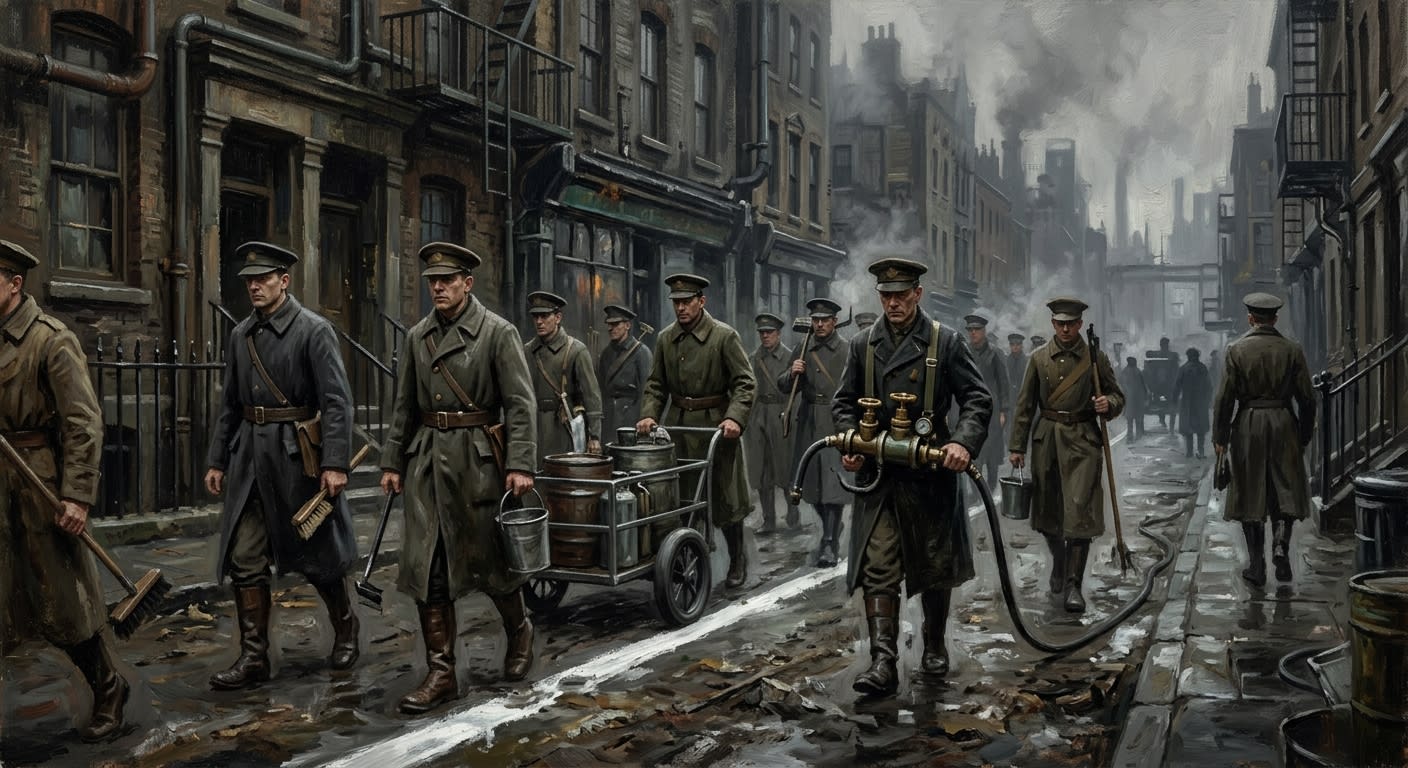
The Sanitation Chapter is the Bureau of Mercy’s cleanest knife. It governs quarantine cordons, whitewash lines, intake inspections, fever tallies, lime trenches, ward separations, burial hygiene, corpse flow, clean papers, and every other holy inconvenience by which the Synod proves that filth becomes moral only after it disobeys a boundary.
It is called a Chapter rather than a Bureau because Mercy, in one of its rarer acts of vanity, refuses to admit that its subsidiary has grown teeth large enough to bite its parent. The Chapter smiles beneath a white sash and says it merely preserves health. Then it closes a gate, marks a district unclean, confines three hundred coughing souls behind lime rope, reclassifies two streets as therapeutic hazard, and informs the Civic Triage Tribunal that its hearing may proceed once the witnesses are no longer infectious, living, or politically useful.
Its public motto is Purity and Health. Its working motto, never written and always obeyed, is Cordons First. In Marrowgate the distinction can be measured in boots: Mercy Ward-Sisters carry ladles, Sealthands (Unregistered) carry brass rings, Tribunal clerks carry dockets, and Sanitation provosts carry keys.
The Chapter’s genius is its modesty. It rarely claims to rule. It claims to prevent spread. Spread is a generous word. Fever spreads. Rumour spreads. Debt spreads. Panic spreads. Heresy spreads. Sympathy spreads fastest of all when allowed to stand in a queue beside visible suffering. The Sanitation Chapter need only declare that a thing may spread, and every gate hinge begins listening for its name.
#On Its Birth in Marrowgate
Marrowgate was established as an inland medical port in A.S. 72, when river commerce failed under war requisitions and the forward routes began sending bodies by wagon with the regularity of tide. A nameless logistics officer repurposed a river-market town near the Würzburg corridor (Unregistered) into a triage hub: wagons docked at quays, stretchers unloaded, wounded sorted, dead routed, papers made to cover what linen could not.
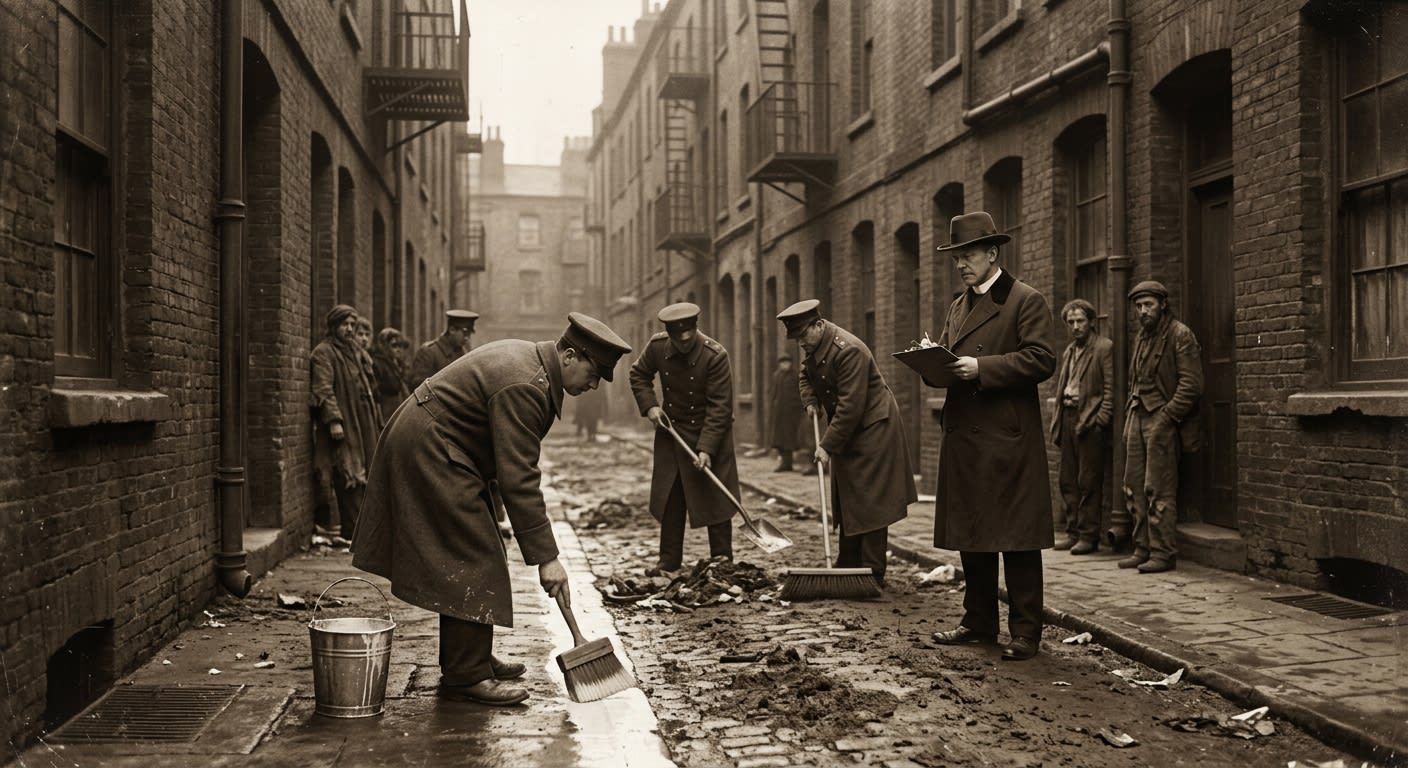
The Sanitation Chapter began there as a practical gang of lime men, quarantine clerks, wash inspectors, and ward sentries. Their first duty was to keep disease from turning the Wagon Quays into an open grave and the White Ward into a riot hall. They painted lines. They dug trenches. They burned cloth. They inspected mouths, hands, bedding, wheels, rope, latrine ditches, bandage piles, prayer corners, and any person foolish enough to cough while holding expired papers.
The early Mercy Ward imagined care as a pressure valve: feed the sick, bind the soldier, soothe the family, record the confession, keep the bastion calm. The Chapter supplied the less tender truth. Care without separation feeds plague. Separation without force becomes advice. Advice at a fever gate is a lullaby sung to rats.
By A.S. 78, the Great Plague and the Lull of Names had filled infirmaries, ossuaries, pits, and ledgers beyond their sober limits. The First Ossuary Panic struck the Rhine corridor and Marrowgate’s burial queues broke around carts that answered clerks from inside stacked dead. Records called the sounds post-interment atmospheric settling. The diggers called them screaming. The Chapter called them a sanitation failure and seized authority before anyone could object coherently.
A later Mercy handbook states that the Sanitation Chapter “developed from voluntary ward-cleaning societies attached to early hospitals.”
Corrected. The Chapter developed from cordon crews, lime trench details, quarantine gate clerks, and men willing to strike mourners who crossed the wrong line with the wrong corpse. Cleanliness arrived carrying a baton.
The Joint Classification Mandate (Unregistered) of A.S. 78 gave mortuary order to the dead. The Chapter gave spatial order to the living who dragged them. One office stamped the remains. The other kept the queue from consuming the stamp table.
#On the White Line
The white line (Unregistered) is the Chapter’s sacrament. It is laid each dawn with limewash across streets, thresholds, ward entries, corridor mouths, wagon lanes, pit edges, chapel steps, and any place where bodies might presume to mingle without doctrine. On one side stands clean passage. On the other: delay, inspection, correction, confinement, debt, fever suspicion, or a guard with lime on his boots and no taste for argument.
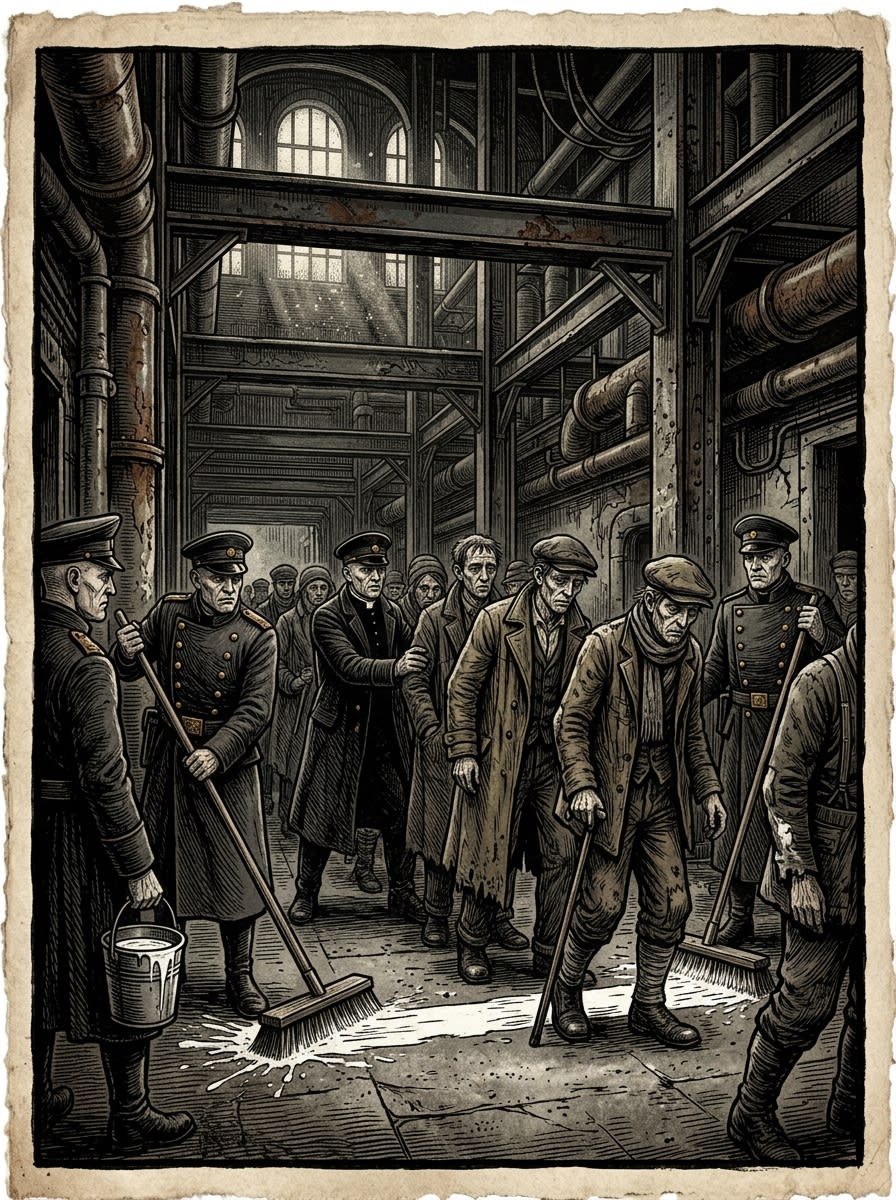
At Marrowgate these lines divide the inner city into clean corridors and everything else. A stamped person may cross. An unstamped person may plead. A pleading person exhales. Exhalation has been known to transmit disease. The Chapter treats pleading as a secondary contagion.
The line has enemies. Rain. Cart wheels. Children. Lovers. Dogs. Debt-runners. Private mercy. The Chapter hates rain most, because rain discloses the material basis of authority: lime, water, repetition, and guards paid badly enough to become doctrinal about dry streets.
Crossing backward is the oldest taboo. Locals do not do it. Refugees do and are corrected. The official explanation says backward crossing confuses flow records. The street explanation says sickness follows the heel. The true explanation is simpler: any ritual worth enforcing requires one rule so absurd that obedience can be seen from a distance.
White lines also create commerce. A clean crossing has value. A delayed crossing has greater value. A forged crossing has the greatest value until detected. Bed tokens, clean papers, fever certificates, quarantine release writs, cordon passage chits, mouth receipts, and gate times circulate through Marrowgate like little pale coins of permitted survival. The Sanitation Chapter condemns this economy in public notices and profits from it through fines, confiscations, and the purchase of informers who know which stamp smells newly forged.
#On Prefects, Inspectors, and Provosts
The Chapter’s hierarchy is plain enough to frighten a child and complicated enough to employ cousins. At the top sits the Sanitation Prefect, Marrowgate’s most dangerous clean man. Beneath him are inspectors, cordon captains, tally clerks, gate masters, lime trench overseers, ward separation officers, provost squads, wash supervisors, and the tireless minor tyrants who decide whether a cough is weather, fraud, fever, or sedition.
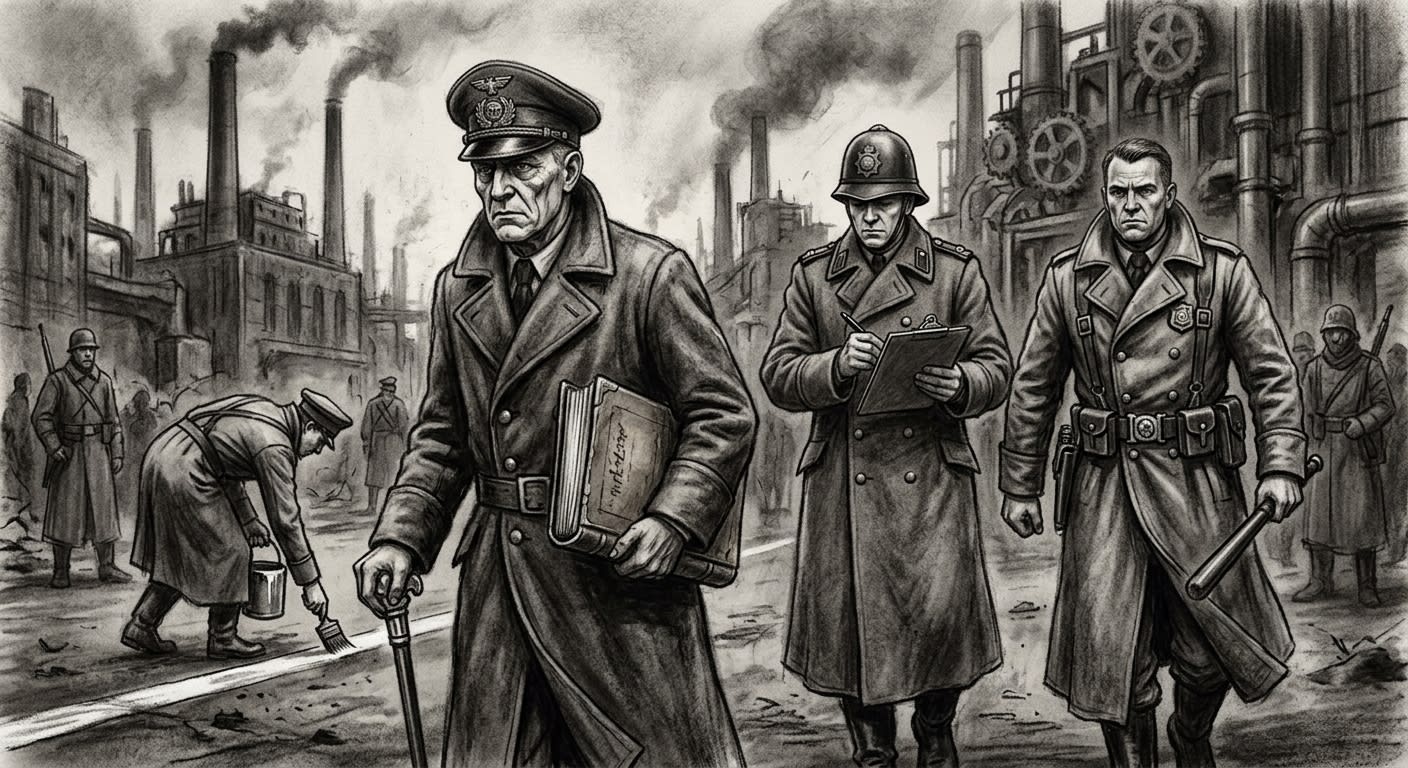
Prefect Salvius, the current Marrowgate authority, smiles with the expression of a man who has locked a door and swallowed the key. He does not raise his voice. Men who control exits rarely need volume. His Chapterhouse keeps three maps on its main wall: public cordons, active cordons, and desired cordons. The third map is more honest than most sermons and much less available.
Inspectors wear white sashes stained with salt-lime, because symbols should confess their labour if they cannot confess their crimes. They carry mouth hooks, seal trays, chalk slates, fever sticks, wax tags, handbells, and little knives for cutting false bands from quarantine posts. Provosts carry truncheons, carbines, and the patience of men licensed to confuse hygiene with obedience.
The Chapter’s favourite weapon is the audit notice. A plague may be managed quietly if the figures remain docile. An external audit changes the air. Suddenly every gate hardens. Every bed reclassification needs a witness. Every corpse must match a docket. Every Ward-Sister’s hidden mercy becomes a potential outbreak in the ledgers. Audits do not reveal the Chapter’s cruelty. They refine it.
#On the Civic Triage Tribunal
The Sanitation Chapter’s chief rival is the Civic Triage Tribunal, that admirable little nest of surgeon-notaries, magistrate-physicks, allocation clerks, and legal men who believe that because they decide who receives a bed, they rule the city. This is charming. The Tribunal controls the judgement. The Chapter controls whether a body reaches the room where judgement is pronounced.
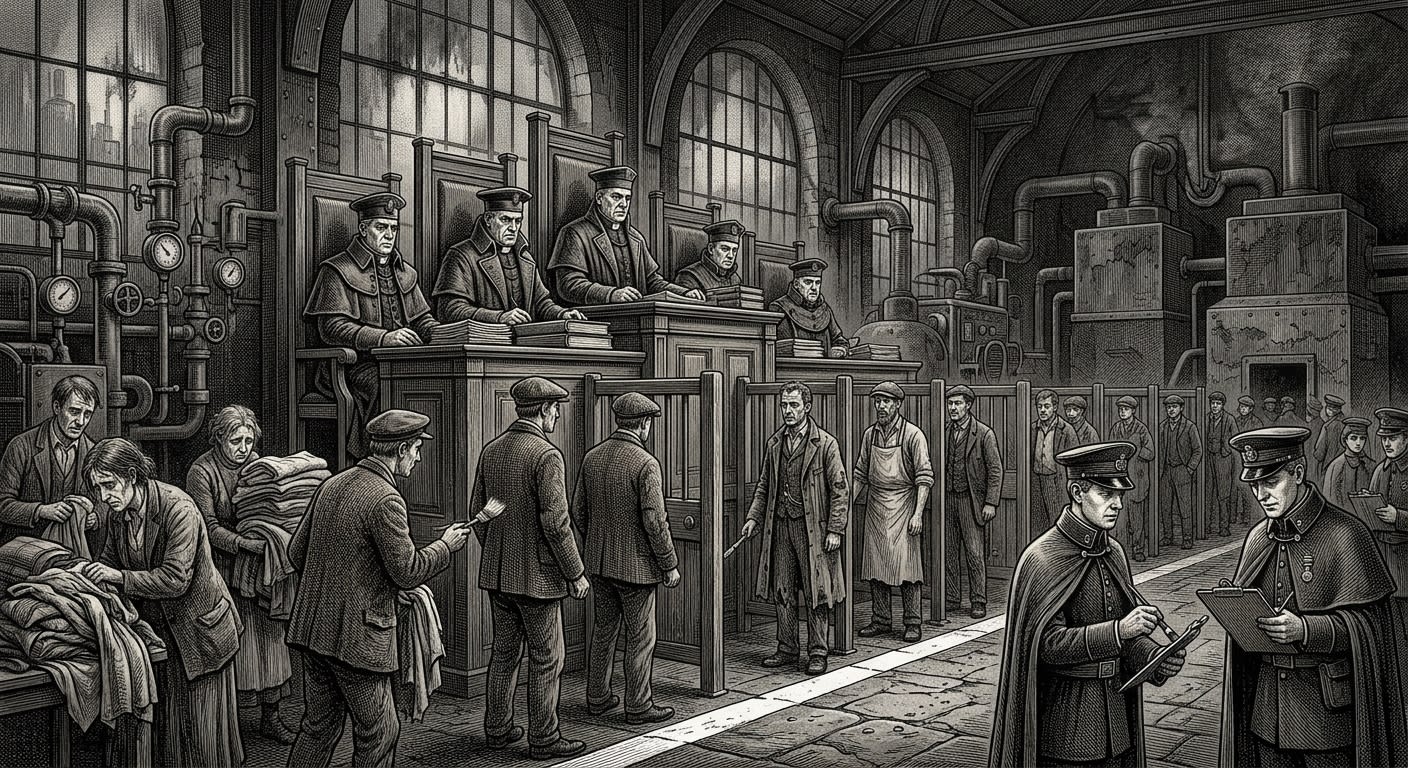
The Tribunal assigns treatment windows, certifies bed priority, adjudicates medical debt, authorizes work prescriptions, and declares whether a patient is salvageable, holdable, transferable, releasable, or already a legal inconvenience. It sits on Notary Row with black cuffs and ink-stained fingers. It speaks in allocations. The Chapter speaks in closures.
A Marrowgate civic charter describes the Tribunal and Sanitation Chapter as “coequal instruments of medical justice.”
Clarified. They are coequal whenever all gates remain open, all wards remain calm, no outbreak is rumoured, no audit is pending, no corpse is missing, no line is crossed, and no Prefect has remembered emergency authority. This condition has occurred three times, all during repainting.
Their conflict is fruitful in the way rot is fruitful. The Tribunal accuses the Chapter of using quarantine to overrule lawful allocation. The Chapter accuses the Tribunal of legalising infection through hearings. The Sealhands sell certainty to both. The Prosthetics Guild (Unregistered) waits for the maimed. The Stitchmarket sells alternatives in the drains. The patient, that tedious biological obstacle, bleeds through the discussion.
Review after containment is the hymn by which power forgives itself. By the time review begins, witnesses have been discharged, buried, transferred, corrected, indebted, or taught the hygienic value of silence.
#On Mercy, Ward-Sisters, and the Ledger of Broth
The Chapter could not function without the Mercy Ward-Sisters and Ward-Brothers it irritates, frightens, protects, and betrays. Ward staff ladle broth, clean wounds, measure morphine, receive confessions, bind sutures, log prayers, and keep the sick from becoming a riot. Their work is intimate. The Chapter’s work is geometric. The ward sees faces. Sanitation sees flow.
This difference produces every daily cruelty. A Ward-Sister hides an extra ladle for a child. The Chapter asks where the extra broth went. A Ward-Brother delays moving a fevered veteran to black-zone because the man’s wife has not arrived. The Chapter asks why a contaminated body remained inside clean sequence. A Ward-Mother keeps true-name slips under pillows during Marrowwind hours. The Chapter conducts mouth inspections and calls the practice superstition until the anomaly corrects its own tally.
Sanitation doctrine calls unrecorded mercy a breach. Mercy doctrine calls unrecorded mercy an embarrassment. The street calls it kindness and pays in salt, linen, fuel chits, paper stamps, or silence. Every ward contains a second ward: the one in the ledger, and the one that actually keeps people alive between bells.
Black-zone staffing reveals the Chapter’s soul with useful ugliness. The black zones hold terminal, contagious, anomalous, or administratively expensive bodies. Officially they are staffed by trained specialists. In practice they also receive staff punished for ledger compassion, morphine irregularity, boundary lenience, unlicensed consolation, or the fatal habit of remembering that a patient was a person before the tag.
#On Marrowwind and the Chapter’s Humiliation
The Marrowwind is the Chapter’s private humiliation made atmospheric. It rises from the Lime Yards without weather, enters sealed cabinets, coats ledgers in white dust, reopens sutures, returns names, and corrects files in wet ink by no living hand. The Chapter can cordon streets. It cannot cordon a correction.
The first uncontested event in A.S. 194 occurred when White Ward Seven’s sealed intake cabinet filled with chalk dust and a revised patient list. The list corrected death classifications, discharge marks, and one amputation debt. The corrections were accurate. Accuracy is the cruellest form of insubordination.
SANITATION INCIDENT ADDENDUM — WHITE WARD SEVEN Initial order: burn cabinet. Ash weighed: █ ounces. Next morning Tribunal docket amended: “insufficient.” Clerk handwriting comparison: failed; failed; failed; matched too closely. Disposition of matched clerk: Lime Yard oxygen detail.
By A.S. 199 the clean paper plague exposed the Chapter’s deepest vice: certificates declared patients healthy while infection walked under linen. The tallies were clean. The wards were not. The Marrowwind corrected at scale. Files opened. Bed ledgers bled ink. Cleared names returned under fever columns. Exhumations answered attendance. Prefect Salvius ordered iron cabinets. They were white inside by dawn.
The Chapter’s official position remains firm: Marrowwind corrections are inadmissible without living corroboration. The living, after reading the corrections, usually become unwilling to corroborate anything except their wish to leave. This preserves doctrine and ruins morale, a familiar compromise.
#On Saint Morin and the Quiet Dead
The Sanitation Chapter venerates Saint Morin of the Sealed Mouth with the special fervour of officials begging a patron to make witnesses less articulate. Morin’s icon — skull, frontal, teeth sealed in grey wax — hangs in intake bays, tariff-chapels, lime counters, corpse gates, and Chapter rooms where the walls hear too much.
His oldest Marrowgate tradition attaches him to the A.S. 78 First Ossuary Panic, when screaming pits and answering carts forced the Synod to admit that the dead, mishandled, retained opinions. Morin supposedly carried skulls from a flooded pit without answering the voices that called his name. At dawn his mouth sealed itself with wax and he wrote: No bone uncounted. Then he died, achieving the perfect administrative career: one sentence, permanent usefulness, no further requests.
Morin’s cult gives the Chapter theological cover for mortuary quiet. The dead, once counted, should remain quiet. The Marrowwind disagrees. This has produced a refined devotional awkwardness. Chapter clerks pray to Morin before opening corrected ledgers. If the corrections prove false, Morin is thanked for protection. If they prove true, Morin is thanked for restraint. Saints are useful because gratitude can be attached to any outcome if the wording is sufficiently shameless.
A Sanitation catechism teaches that Saint Morin “guarantees peaceful remains under proper cordon discipline.”
Corrected. He guarantees nothing. He is invoked because staff must put their terror somewhere small enough to fit beside the seal tray.
#On the Chapterhouse and Its Present Ambition
The Marrowgate Chapterhouse stands near the Clean Line Gate (Unregistered), whitewashed until the walls look less built than scoured into existence. Its windows are narrow. Its floors slope toward drains. Its clerk benches face maps rather than people. This is intentional. People invite pity. Maps invite management.
In its basement are quarantine boards, spare cordon ropes, confiscated true-name slips, counterfeit clean papers, plague tally slates, jars of suspect dust, seal presses retired after fraud investigations, and one locked cabinet containing objects recovered from wards after Marrowwind events. The cabinet is lined with black felt and inspected weekly by a clerk who has requested transfer six times. His requests are filed under occupational anxiety.
The Chapter’s current ambition is permanent emergency authority. The public justification is obvious: Marrowwind incidents increasing, forged clearances multiplying, Stitchmarket tunnels spreading, health certificate fraud not fully purged, ward traffic rising, Lime Yard counts unstable, White Ward confidence damaged. The private desire is simpler. Temporary lockdown has shown the Chapter what it feels like to rule without arguing with the Tribunal. Appetite, once fed, begins drafting doctrine.
Prefect Salvius has not declared the full lockdown. He is too intelligent to seize before the city is frightened enough to applaud. Instead he tightens in inches: an extra inspection at the Wagon Quays, a revised crossing schedule, a new fever mark, a stricter mouth receipt, a temporary closure that forgets to expire, a clean corridor narrowed by one cart’s width. Tyranny often enters by decree. Better tyranny enters by adjustment.
#On the Street’s Answer
Marrowgate does not love the Sanitation Chapter. It depends upon it, bribes it, curses it, imitates it, evades it, and paints private marks on walls where whitewash has become too official to trust. The Suture Slums (Unregistered) have their own cordon language: three chalk nicks for safe passage, a thumb smear for inspectors, crossed salt for raid, black dot for false clean paper, half-moon for a dead gate guard whose replacement is more expensive.
The Stitchmarket sells forged clearances and calls them clean lies. Families buy them, soldiers buy them, debt-labourers buy them, Ward staff buy them for patients they cannot save legally. The Chapter arrests some. It purchases others. It requires the market as evidence of its own necessity. A vice completely eradicated cannot justify next year’s cordon budget.
CONFISCATED STITCHMARKET NOTICE “Clean paper. Clean walk. Clean name. Chapter seal near-perfect. Mouth receipts extra. Children half price before third bell.” Annotation by Sanitation inspector: seal quality unacceptable. Annotation by Doctrine: moral quality apparently acceptable to inspector.
There are rebels, though Marrowgate produces no pretty rebellion. Its rebels open sewer hatches, swap fever tags, hide unfiled children in linen carts, overpaint lines at night, keep true names under tongues, or move a mother one ward closer to a son before bell. Their courage is petty, practical, and difficult to turn into banners. This frustrates the Bureau of Doctrine, which prefers enemies that can be drawn cleanly.
#On the Final Cleanliness
As of A.S. 201, the Sanitation Chapter remains indispensable, dangerous, and correct more often than decent men would prefer. It has prevented outbreaks. It has stopped riots before they became massacres. It has kept Marrowgate from drowning in its own intake. It has also converted hygiene into jurisdiction, quarantine into ambition, and whitewash into law.
No city like Marrowgate survives without lines. No city governed by lines remains innocent. The Chapter understands both clauses and files only the first.
At dawn the painters refresh the white line. The lime bucket swings. The brush drags across stone. A provost watches the queue. A Ward-Sister waits with broth cooling behind her. A Tribunal clerk checks the bed board. Somewhere in the Lime Yards, the dead prepare their amendments. The line dries pale, bright, obedient.
Then the first patient coughs.
#On Outbreak Arithmetic
The Chapter does not count sickness as physicians count it. A physician counts pulse, heat, breath, lesion, stool, colour, delirium, recovery, death. A Sanitation tally counts admissible fever, actionable fever, public fever, audit fever, military fever, and politically inconvenient fever. The body supplies evidence. The form decides whether evidence becomes fact.
This distinction explains Marrowgate’s plague numbers better than any sermon Mercy has printed. During calm months the Chapter prefers low figures, because low figures prove competence. During budget months it prefers rising figures, because rising figures require cordon funds. During Tribunal quarrels it prefers clustered figures near Notary Row, because geography can become argument when painted red on a map. During inspections by Records, it prefers figures too complex for quick blame and too alarming for dismissal. Arithmetic, like broth, is rationed by purpose.
The clean paper plague of A.S. 199 did not begin with coughing. It began with certificates that made coughing irrelevant. A cleared man could pass a line while fever worked under his shirt. A held man could rot behind a rope while his neighbour bought a better stamp. The Chapter’s tallies remained disciplined until the Marrowwind dragged buried truth through the cabinets. This is the offence Salvius has never forgiven. Fraud can be managed. Exposure by dust is indecorous.
After A.S. 199 the Chapter introduced double tallying. Public slates list confirmed cases. Inner slates list suspected cases. Red slates list cases that would embarrass the Chapter if confirmed. Black slates list cases that must never be discovered by anyone who can write above a clerk’s grade. These slates are kept in separate rooms. Separation is the Chapter’s native prayer.
#On Instruments and Lesser Sacraments
The Chapter’s instruments deserve notice because tools reveal doctrine faster than proclamations. The lime brush is the first: a blunt thing, cheap, replaceable, and more feared than a magistrate’s cane when held at dawn by a man with a cordon order. The fever stick is second: polished wood tipped in brass, placed beneath the tongue, wiped in vinegar, read by colour mark, trusted far beyond its true capacity because simple instruments make officials feel innocent.
The mouth hook is third. It opens teeth for inspection, pulls tongue slips free, catches hidden paper, lifts lips from gums, and occasionally teaches the inspected person that dignity is a privilege renewed by stamp. True-name slips are found with it. Contraband prayers are found with it. Fever sores are found with it. Once, in White Ward Two, a folded Tribunal order was found beneath an old woman’s tongue, dry as archive paper. She claimed she had been keeping it safe. The order declared her transferred three days earlier. The Chapter moved her before noon, proving that efficiency can be cruel even when delayed.
The handbell marks temporary authority. One ring halts a queue. Two rings open inspection. Three rings close a gate. Four rings summon provosts. Five rings mean the bellman is frightened or ambitious; both conditions spread quickly. Ward-Sisters hate the handbell because it interrupts care. Tribunal clerks hate it because it outranks speech. Patients hate it because hatred is one of the few medicines still free.
#On Children, Names, and Clean Futures
The Chapter claims no jurisdiction over childhood except where childhood breathes, eats, coughs, leaks, hides, crosses lines, carries papers, loses papers, or stands near persons of uncertain status. This leaves only angels and paintings outside its care. Marrowgate children learn white lines before letters. They learn that a clean paper may matter more than a clean face, that a wrong step can delay supper, that a cough into the sleeve is piety when a guard is near.
Unfiled children are the Chapter’s recurring irritation. Some arrive in wagons under blankets. Some are born in the Suture Slums without entry. Some belong to dead women whose work prescriptions outlived them. Some are hidden by Ward-Sisters in linen carts until a name can be borrowed, bought, forged, or invented. The Chapter calls such children epidemiological uncertainty. The street calls them little ghosts. Both terms frighten adults for different reasons.
The Bureau of Mercy prefers to move them toward orphanarii, where names can be corrected under clean institutional light. The Chapter prefers temporary holding pens, because holding pens keep risk visible. Records prefers intake slips. Tithes prefers eventual wage futures. Purity prefers to arrive late and ask whether heredity has been considered. The child, if unusually lucky, sleeps through most of this.
CORDON HOLDING NOTE — MARROWGATE CHILD INTAKE Subject: female, estimated six years, no docket, no cough, no name accepted twice. Statement repeated: “The white line moved while I was asleep.” Inspector response: impossible. Night report: line found three inches inward at dawn, brush marks dry. Disposition: ████████████
Chapter schools teach children to report fever dreams, old names spoken in drains, adults crossing backward, forged sash marks, hidden salt bundles, and anyone who says “clean enough.” The phrase is considered dangerous. Enough is a rebel word. It implies a limit beyond which authority should stop.
#On the Chapter Outside Marrowgate
Though born in Marrowgate, the Chapter has spread through Mercy facilities, bastion infirmaries, ossuary towns, quarantine annexes, rail casualty heads, and river wards from the Rhine corridor to the Sagittal Line and the southern approaches. At Bastion-Brest its inspectors paint lines around broth yards and fever tents. At Bastion-Przemyśl they cordon tunnel coughs before miners admit they are afraid. At Strasbourg they keep politely to licensed hospitals because the capital dislikes visible coercion unless it is wearing better tailoring.
The Chapter’s export is method: divide, mark, inspect, tally, confine, release, revise. It brings whitewash to places that had relied on custom and calls the result modern. Many local Mercy houses resent this, especially old ward matrons whose own systems worked by memory, fear, and the unrecorded authority of women nobody wished to cross. The Chapter defeats them by asking for written proof. Memory has poor appeal rights.
The spread has produced local mutations. In the northern cold, lines are cut into packed ash because lime freezes badly. In wet river towns, cords soaked in salt replace painted marks during flood weeks. In trench infirmaries, bayonets make temporary gates. In pilgrim wards, inspection prayers are sung to make mouth checks appear less like arrest. The Chapter tolerates adaptations that preserve hierarchy. It hates adaptations that preserve mercy.
#On My Inspection of the Chapterhouse
I inspected the Marrowgate Chapterhouse after the clean paper plague and found it admirably unpleasant. The entrance hall smelled of vinegar, chalk, wet wool, and the sort of fear produced by men who know the next correction may include their signature. Prefect Salvius received me beneath a map showing four active cordons and one proposed expansion. The proposed expansion included the Tribunal kitchen. I admired the ambition and pretended not to, which is diplomacy.
He showed me the tally rooms. Public slates first. Inner slates second. Red slates with a pause. Black slates with the theatrical reluctance of a man displaying contraband he hopes will be mistaken for burden. I asked which slate held the truth. He answered, “All, under proper relation.” I nearly applauded. Villainy is common. Accurate villainy is a cultural resource.
In the confiscation room I saw mouth hooks, false sashes, true-name slips, clean lies, broken fever sticks, private prayer strips, a child’s slate bearing four names crossed out, and a jar of Marrowwind dust sealed under wax that had cracked from the inside. Salvius called it inactive. The jar tapped once after he spoke. He did not turn his head. Self-control, like cleanliness, can become pathological.
My final question concerned permanent emergency authority. Salvius said he desired only the safety of Marrowgate. I told him safety is a modest word often used by men preparing cages. He replied that cages prevent bites. There, in that exchange, the Chapter stood revealed: correct, useful, predatory, and waiting with a clean key.