
#On the Dry Auditor
"If the file lies, the wound will speak." — Marrowgate ward saying, punishable under Sanitation Chapter Circular 19-D
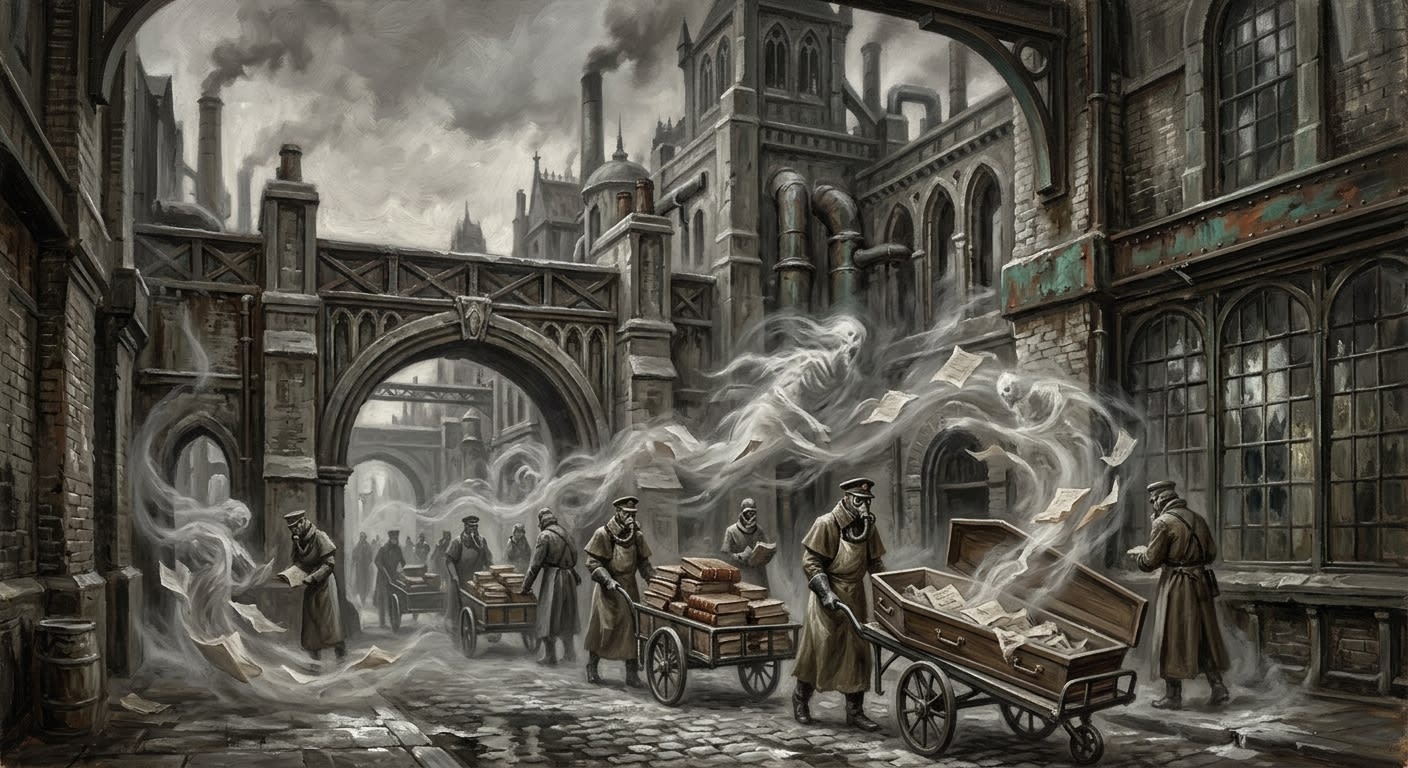
The Marrowwind rises from the Lime Yards of Marrowgate without permission from weather, physics, or the Sanitation Chapter, and that last jurisdiction is the one it most grievously offends.
It is a dry, chalky gust carrying lime powder, linen ash, vocal residue, and the voices of the dead. The Bureau of Alchemical Standards first blamed calcium precipitation interacting with sub-thermal air currents, a phrase of admirable cowardice and little explanatory value. Since A.S. 194 the official classification has read: Category Two Localized Atmospheric-Scribal Anomaly. The classification has not changed. The incidents have.
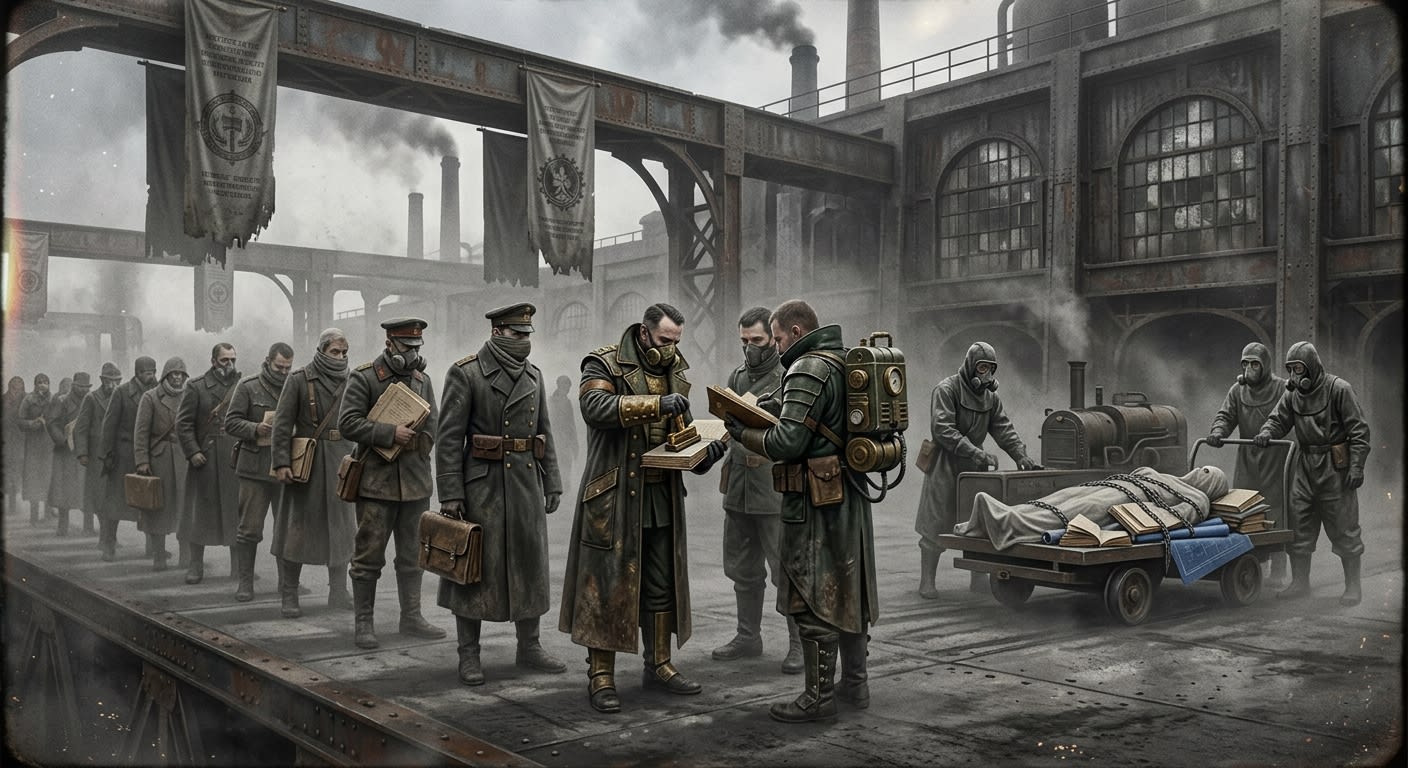
Marrowgate is the Synod's inland medical port: Wagon Quays (Unregistered) instead of harbors, whitewash cordons instead of sea walls, and a tide made of broken soldiers, fever carts, ossuary wagons, debt labourers, amputees, and bodies waiting to be processed into useful categories. Founded in A.S. 72 when a nameless logistics officer converted an old river-market town into a triage hub, it now feeds the Sagittal Line by translating pain into forms. A wound stitched without a stamp does not exist. A dead man without a tariff remains administratively inconvenient. An amputation without the cut-stamp is merely a mess on a table.
The Marrowwind is what happens when the mess begins annotating the table.
#On the First White Correction
The earliest uncontested Marrowwind event occurred in A.S. 194 during the third bell of the morning linen boil, when chalk dust appeared inside the sealed intake cabinet of White Ward Seven (Unregistered). The cabinet had been washed, inspected, signed, counter-signed, and sealed with Sanitation wax the prior evening. At dawn it contained six layers of white powder, one cracked bone tag, and a revised patient list.
The revision was accurate.
This was the offensive part. Had the list been false, the Sanitation Chapter could have blamed saboteurs, fever, poor sealing, Stitchmarket interference, or the usual provincial demon whose name is dragged into memoranda when the human explanation is too embarrassing. The list corrected four death classifications, restored two names marked “discharged,” and amended one amputation file from “left arm, below elbow” to “left arm, shoulder, with subsequent debt improperly assessed.” The patient had been dead for nine months. His widow received a revised debt notice before noon.
The Sanitation Prefect ordered the cabinet burned. The ash was weighed, because Marrowgate weighs everything, including embarrassment. The following morning, the ash weight appeared in the Tribunal docket with a marginal correction: “insufficient.” No living clerk admitted writing the word. Three clerks tried to reproduce the hand and failed. One succeeded too closely and was reassigned to the Lime Yards, where he now speaks only when the wind is absent.
Initial Sanitation Chapter notice, A.S. 194, described the event as “minor contamination of storage materials.”
Corrected by Records after the same “minor contamination” altered nine intake ledgers, two kiln tallies, and Prefect Salvius's personal wash bill. The Bureau accepts the existence of the Marrowwind. It rejects the implication that the dead possess filing authority.
#On Its Stages and Symptoms
The Marrowwind does not arrive like ordinary wind. No shutter slams first. No clouds gather. No animal warns the city by showing more sense than its officials. The air dries. Vinegar smoke thins. Linen stiffens on the line. Then the white dust appears in places white dust cannot have entered: under sealed bandages, between pages of closed ledgers, inside prosthetic sockets, along the grooves of cut-stamps.
First stage: dust and whisper. Patients report hearing their birth names spoken from basins, drain grates, and folded sheets. The voices are not consoling. They are exact. They pronounce names as parish rolls did, before battle abbreviations, prosthetic amendments, debt revisions, ward nicknames, and all the little mutilations by which a person becomes a manageable file.
Second stage: bodily contradiction. Sutures reopen in straight lines. Scars pale as if waiting for fresh ink. Patients forget wounds that the Ledger says they bear, or remember wounds the Ledger has denied. A man whose right hand was cut away under Notary Seal 18-C wakes with phantom fingers curled around a pen. A woman certified fever-free coughs up lint stamped with the Civic Triage Tribunal's mark. Ward-Mothers (Unregistered) put salt water on the thresholds and refuse to meet the eyes of Sealhands (Unregistered).
Third stage: correction. Ledgers alter overnight. The new entries appear in wet ink, written by no recorded hand, and the corrections are almost always true.
WHITE WARD FOURTEEN / MARROWWIND INCIDENT 199-██: Twenty-six patients classified “cleared” during the clean paper plague were re-entered as “infected, concealed by certificate fraud.” Seven were already buried. Four opened their eyes during exhumation. ████████████████████ heard reciting the intake prayer backwards from inside the lime trench. Case sealed under Joint Mercy-Records authority.
The phrase “almost always” has saved three careers and damned seventeen patients. The dead correct what concerns the dead. They do not correct for comfort, consistency, or departmental convenience. A false survival certificate is amended. A forged clearance is struck. An unpaid anaesthetic bribe may remain undisturbed for months because the man who paid it is alive and still ashamed enough to confess. The Marrowwind audits; justice is only an accidental by-product.
#On the Dead as Clerks
The Sanitation Chapter teaches that the Marrowwind carries residual vocal particulate: phrases trapped in lime dust after bone reduction, loosened by temperature shear, and blown into ward corridors by pressure anomalies. This doctrine has the clean, cold stupidity of a scalpel left in a corpse.
Voices in the wind know case numbers.
They know bed tokens, debt adjustments, false discharge marks, misfiled causes of death, and the difference between a fever that killed a man and a certificate that permitted the fever to do so. They know the old parish name under the revised Marrowgate designation. They know which Sealhand amputated early because the bed was needed. They know which Ward-Mother hid a child in the linen bins for six hours to keep him out of quarantine. They know which dead were processed into whitewash and painted across the very line their widows were later fined for crossing.
Marrowgate's economy depends upon the premise that the dead are material once properly filed. Burial, transport, salvage, ornamental, contaminated: the Dead-Goods Tariffer categories are supposed to complete the moral transformation from person into item. The Marrowwind reverses the motion. It returns speech to material. It makes lime remember marrow. It makes the white line on the cobblestones whisper the names of those whose bones gave it colour.
The Bureau of Doctrine has considered three theological explanations. First, that the wind is demonic mimicry, which would be tidy and comforting if it did not correct the ledgers against institutional fraud. Second, that the wind is providential rebuke, which would require the Synod to stop doing several profitable things. Third, that the wind is an unintended property of properly processed remains in a city whose entire administrative theology treats bodies as documents. This third explanation is sealed because it is obviously correct.
#On Countermeasures
The approved countermeasures are ash circles, salt-water washes, burning old linens, lime trench fumigation, and the recitation of the Seven Names of Proper Intake (Unregistered). These methods do very little, which is why they are mandatory.
The unofficial countermeasures work better and carry heavier penalties. Ward-Mothers keep true-name slips beneath patients' pillows, written in family hands rather than tribunal script. Suture Slums (Unregistered) debt labourers mark their scars with charcoal so they can compare flesh against files after a wind-night. The Stitchmarket sells counterfeit “uncorrection seals,” mostly useless, sometimes dangerous, occasionally effective in the terrifying manner of a pistol that fires once and then demands a childhood memory in payment.
The most dangerous practice is placing a true-name slip (Unregistered) under the tongue. During Marrowwind hours, a patient keeps the paper in the mouth and refuses to swallow. The name anchors memory. It also dissolves. If the paper breaks down, the patient ingests the written self, and Marrowgate has no settled doctrine for what happens when a person digests his own legal origin.
A boy in White Ward Three (Unregistered) swallowed his true-name slip during a wind-night in A.S. 200. His fever broke. His file vanished. His mother remembered him; his assigned surgeon did not; his bed token showed “available” while the boy remained visibly asleep in the bed. At morning bell, the Marrowwind wrote one line on the Ward slate: “not discharged.” The boy survived. No office has accepted jurisdiction over him. He lives in the laundry annex and answers to no name twice.
Prior Doctrine guidance advised that true-name slips be destroyed on sight as “superstitious impediments to correct patient classification.”
Guidance revised after A.S. 200 White Ward Three incident. Slips are still destroyed on sight. The stated reason is now “excessive efficacy outside licensed sacramental channels.” Precision is a virtue when properly weaponised.
#On the Clean Paper Plague
The clean paper plague of A.S. 199 was the Marrowwind's feast.
Healthy certificates moved through Marrowgate like indulgences sold from a plague cart. Men and women were stamped cleared while fevers advanced beneath their linen. Ward tallies read zero infection. Bodies disagreed. The false certificates travelled from White Ward to Mercy Market, from Notary Row to the Wagon Quays, from Marrowgate outward toward bastions and supply towns whose officers believed a seal more readily than a cough. Paper was clean. The wards were not.
The Marrowwind began correcting at scale on the fourth night. Chalk dust blew uphill against closed shutters. Files in the Civic Triage Tribunal opened themselves. Names of cleared patients reappeared under black fever columns. Death certificates shed their causes and took new ones. Twenty-six bed ledgers marked “vacant” bled ink through the page, each stain shaped like a thumbprint. Prefect Salvius ordered the records locked in iron cabinets. The cabinets were white inside by dawn.
The official audit found systemic fraud in health certifications. It did not find bribery beyond manageable levels, counterfeit seals beyond expected circulation, or avoidable deaths beyond politically tolerable margins. The Marrowwind found all of them. Its corrections forced debt reversals, quarantine admissions, delayed burials, and three exhumations conducted under protest by men whose protest ceased when the buried answered the attendance roll.
No one calls the plague an outbreak of paperwork. They should. At Marrowgate, contagion travels by certificate first and breath second.
#On the Present Correction
As of A.S. 201, Marrowwind incidents are increasing. The dry gust now reaches beyond the Lime Yards into the Wagon Quays, White Ward, Mercy Chapel steps, Suture Slums washhouses, and, twice, the private chamber of Prefect Salvius. Ledgers correct themselves overnight. New folios appear in closed files. The dead whisper from whitewash. Sutures fail when attached to false notes. Names return where clerks have cut them away.
The Sanitation Chapter wants full emergency lockdown, allegedly for containment, actually for permanent authority. The Civic Triage Tribunal wants jurisdiction over Marrowwind corrections, as if one can subpoena a chalk gust and require the dead to sign testimony in triplicate. The Bureau of Records wants the corrected ledgers forwarded to Strasbourg and the phenomenon otherwise ignored. The Bureau of Mercy wants fewer patients dying from fraudulent clearance. Its naivety remains touching.
The dead file amendments instead of rising. This is worse.
They do not ask for vengeance in the usual theatrical sense. No skeletal army clatters through Notary Row. No lime-white saints descend upon the Sealhands with flaming scalpels. Instead a number changes. A false clearance blackens. A debt evaporates. A name returns to a mouth that had learned to survive without it.
A corpse that walks can be shot. A correction must be answered.