
#On the Market Beneath the Stitches
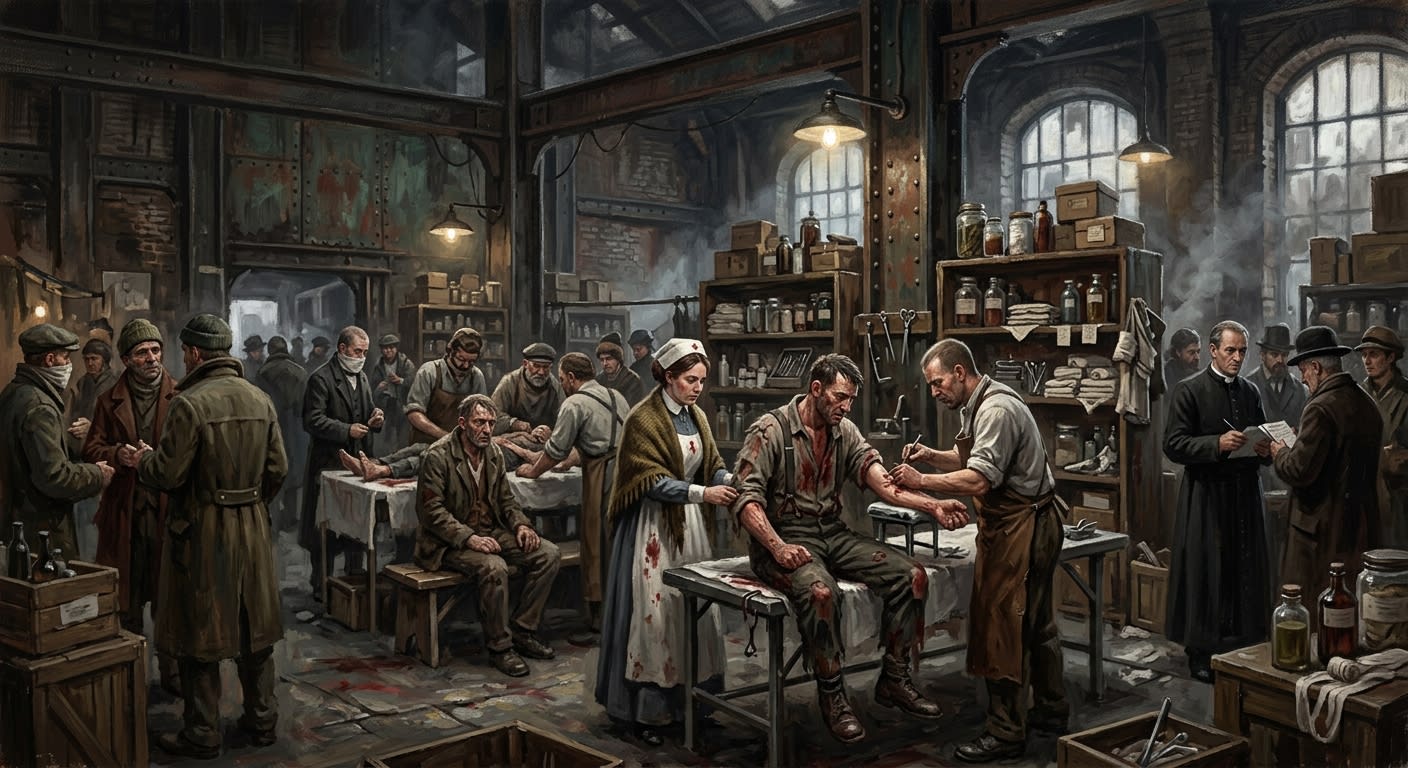
The Stitchmarket is Marrowgate’s underworld economy in forged clearances (Unregistered), stolen anaesthetic, bed tokens (Unregistered), counterfeit seal rings, organ crates, illegal surgery, ash parcels, name repairs, and every other mercy the lawful city has made expensive enough to become criminal.
It lives under the Bone Harbor in drainage tunnels, washhouse cellars, tarp-clinics, prosthetic back rooms, lime-cart sheds, and the damp brick throats beneath the Suture Slums (Unregistered) where linen water runs grey and men learn quickly that a clean certificate may be dearer than a clean conscience. Its public face is labour placement. Its true trade is permission. Permission to cross a white line. Permission to receive pain relief before prayer. Permission to keep a limb if a Sealhand (Unregistered) wants quota. Permission to leave before the Sanitation Chapter remembers your fever. Permission, most profitable of all, to become someone whose file has not yet betrayed him.
Needle-King Pavo commands it, if command is the right word for a cartel whose members prefer thread, folded note, debt, and threat over banners. He is quiet. This terrifies competent men and reassures fools. Surgeon Kett (Unregistered), too clean by half, cuts where licensed Sealhands refuse or overcharge. Washer-runners (Unregistered) carry messages folded into bandage hems. Corpse cart drivers move packages beneath approved sheets. Debt-Stitches (Unregistered) carry organs, papers, and secrets through tunnels they dug as rehabilitation labour.
#On the Need That Founded It
The Stitchmarket was not founded by wickedness. Wickedness merely noticed an empty stall and rented it.
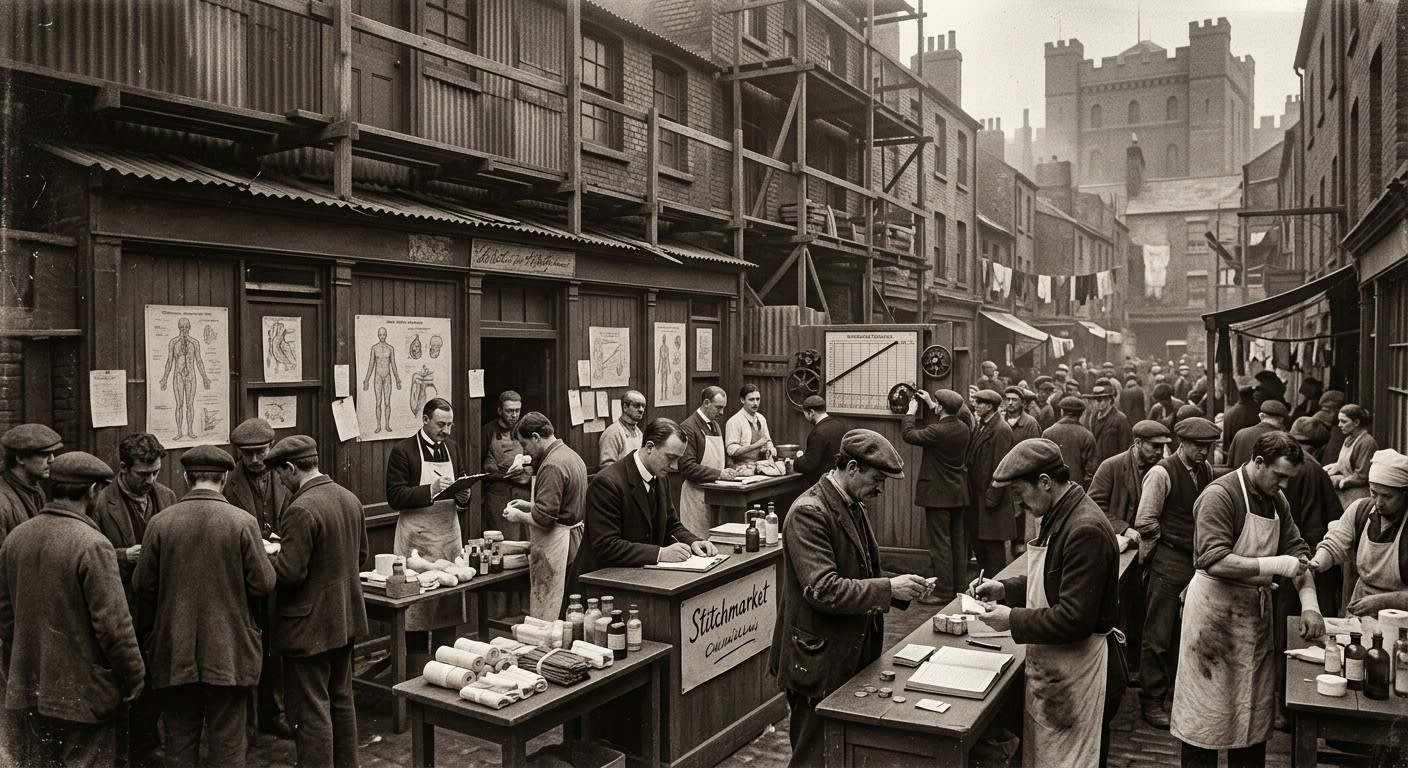
Marrowgate began in A.S. 72 as an inland medical port, a wagon harbour where the war’s broken cargo could be unloaded, sorted, stitched, stamped, buried, burned, or returned to duty with sufficient notarial enthusiasm. By A.S. 78, the Great Plague and First Ossuary Panic had made the Sanitation Chapter powerful. By A.S. 83, the Civic Triage Tribunal had made allocation into law. By A.S. 96, the Saint-Bone Melting Acts had taught the city that remains could be capital. After that, the market only had to wait for arithmetic to become cruel enough.
Arithmetic obliged.
Bed windows became scarce. Pain draughts thinned. White Ward (Unregistered) gates hardened. Confession receipts delayed treatment. Work prescriptions became indentures without polite name. The Prosthetics Guild (Unregistered) sold mobility and billed maintenance forever. Sealhands cut flesh and legal personhood in the same motion. The official city declared that everything healed or received a file. The undercity discovered that files could be bought, stolen, amended, delayed, counterfeited, dissolved in vinegar, or replaced while the clerk went to supper.
Sanitation Chapter primers describe the Stitchmarket as an imported criminal infection introduced by itinerant camp-followers after the Gray Clearance.
Corrected. The market is indigenous. It grew from Marrowgate’s own procedures, as mould grows from bread left under a damp chapel bench. Camp-followers supplied hands. The city supplied doctrine, hunger, locks, and customers.
Its first recognizable form appears in the washhouse routes of the Suture Slums: debt labourers carrying linen between wards, learning which sheets bore hidden stains, which patients had no kin, which clerks drank, which guards could be softened with lamp oil, which certificates travelled faster than bodies. A washer with a folded clearance could move what a surgeon could not. A runner with a bed token could save a soldier faster than Mercy’s prayers. The sacrament of the back door had found its altar.
#On Its Goods and Prices
The Stitchmarket sells six principal things, all of which Marrowgate pretends are already administered lawfully.
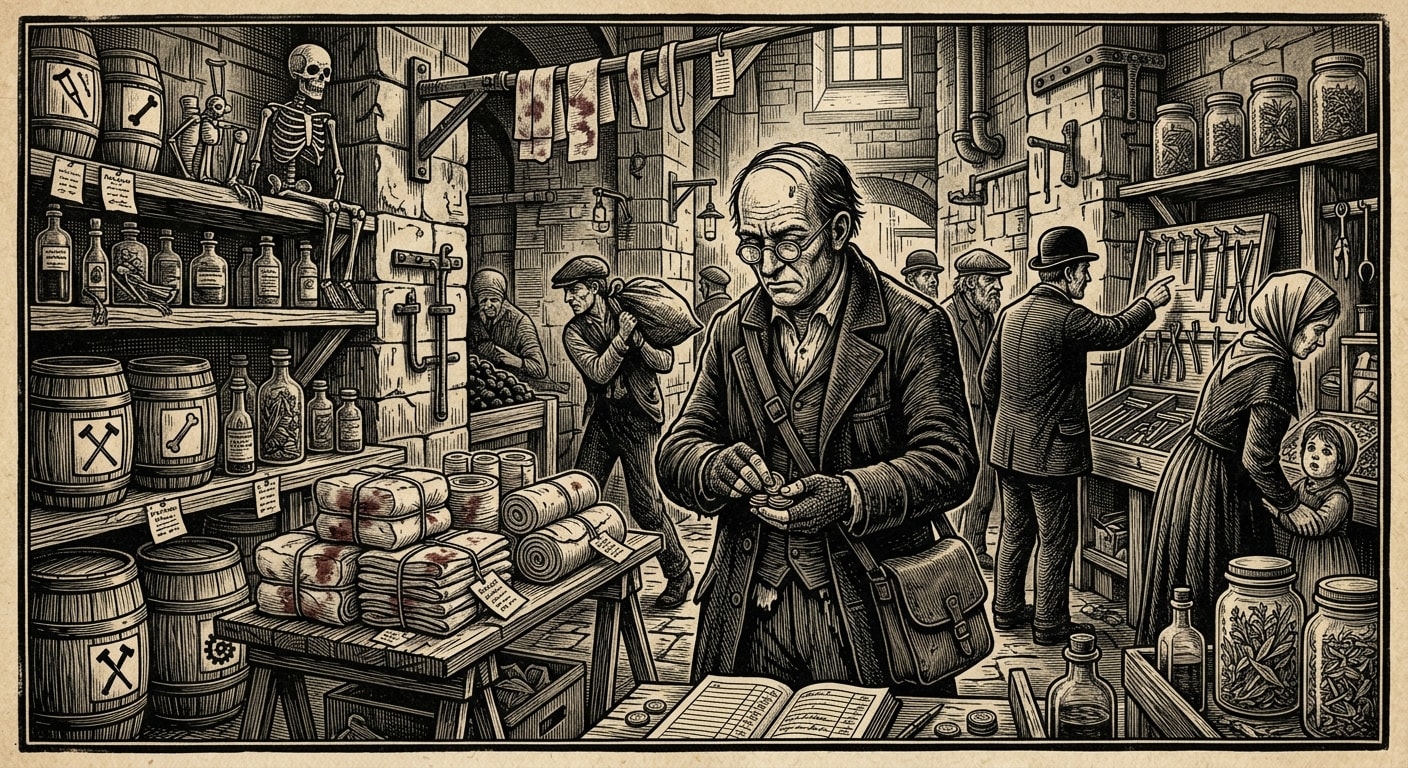
First: clean papers. Health clearances, corridor stamps, quarantine releases, fit-for-duty certificates, fever negatives, work-prescription reductions, discharge slips, and the little blue travel notes that let a patient pass from White Ward to Wagon Quays (Unregistered) without being reclaimed by a clerk. The best forgeries do not look perfect. Perfection attracts auditors. A real Marrowgate file has smudges, delays, inconsistent hands, one ugly correction, and a smell of wax touched too many times.
Second: bed tokens. A lawful bed window is a time, a cot, a ward, a scribe, a cup, and the chance that a surgeon arrives before rot becomes more punctual than the bell. An unlawful bed token is all of that with less hymn and more risk. Families buy them in Mercy Market alleys. Soldiers gamble them. Ward-Mothers (Unregistered) confiscate them when they can and use them when they must. The Tribunal calls the trade a parasite. This is rich from men who invented billing grief by the quarter-hour.
Third: morphic draughts and anaesthetic. Stolen vials from the Mercy Chapel of the Unburdened (Unregistered), watered batches from ward stores, substitute brews from Pain Brewers (Unregistered), ash-cut liquor that numbs enough to pass for medicine and sometimes carries prayers with surprising teeth. The Stitchmarket charges extra for draughts that do not harvest confession. The price is obscene. The demand is pious.
Fourth: body goods. Organs in cold crates, unnotarized limbs, usable bone, fever-tested blood, prosthetic straps, glass eyes, surgical steel, saint-medal teeth, and ash from named barrels in the Lime Yards. Some are stolen for profit. Some are stolen for family. A widow buys a pinch of barrel dust because the tariff-chapel gave her husband to road powder before she could kiss him. Is that theft? Yes. Good. Some thefts have better manners than lawful custody.
Fifth: seal and name work. Counterfeit Sealhand rings, borrowed psalm-numbers, old-name restorations, post-amputation identity reversals, file substitutions, false kin attestations, paper adoptions for unfiled children, and the black art of making a dead man medically inconvenient enough to remain alive. This is Needle-King Pavo’s richest table.
Sixth: night surgery. Illegal amputations, wound closures, infection draining, prosthetic refitting, scar alteration, organ removal, organ return, and operations whose purpose is less to repair flesh than to make flesh agree with a document. Surgeon Kett is famed for correcting a file by cutting the body until the body stops contradicting it. One must admire technique. One must also keep him away from children and saints.
#On the Tunnels and the Hands That Move Them
The Suture Slums sit above the Stitchmarket like a scab above a worm. Laundry channels run under the washhouses. Old drainage tunnels from the river-market town predate the cordons. Lime runoff culverts pass beneath Clean Line gates (Unregistered). Prosthetic scrap chutes open into cellar rooms that officially exist only on repair diagrams. Corpse cart turnarounds hide hatches beneath boards stained by use no inspector wishes to name too closely.
The market’s geography is functional, which is to say ugly and alive. White Corridor (Unregistered) inspectors know three official passages. Stitchmarket runners use nine, perhaps thirteen, perhaps whichever number is least useful to Purity that week. The safest route is never the cleanest. The fastest route passes under Mercy Chapel’s old cistern and requires silence because the chapel guards can hear coughing through stone. The most expensive route touches Notary Row and costs enough to make a dead man sweat.
The hands are mostly debt-bound. A Debt-Stitch owes the ward, the Prosthetics Guild, the Chapel, the Tribunal, the landlord, the ration counter, and some little man with a needle who promises to make all six stop shouting for one night. Such a person is not recruited. He is already inside. The market supplies task, route, cut, and punishment. Marrowgate supplied the debt.
Washer-runners are the finest couriers because they touch everything foul and pass unseen by those whose authority depends on not noticing filth. Ward-Mothers pretend outrage while using them. Sealhands denounce them while buying instruments back through them after theft. Sanitation provosts crack skulls in public and accept corridor notes in private. The Wagoners’ Brotherhood (Unregistered) loses crates with theatrical regret. The crates reappear where Needle-King Pavo requires.
#On Needle-King Pavo
Needle-King Pavo is a title, a joke, and possibly a man.
Public intelligence describes Pavo as a quiet operator of the Suture Slums, middle years, narrow hands, no visible prosthetic, habit of speaking through other people while standing close enough to hear the answer. Purity files give three faces. Records gives two death notices. The Sanitation Chapter claims he is a composite legend useful to frighten washer boys. The Stitchmarket raises prices whenever that claim circulates, which proves Pavo possesses either excellent vanity or excellent clerks.
He rose during the clean-paper scandals before A.S. 199, when health certificates moved faster than fever and everyone with a stamp discovered fresh theology concerning cash. Pavo’s genius was not forgery alone. It was matching false paper to real desperation with such precision that the buyer became accomplice, beneficiary, witness, and shield. A forged clearance that lets a mother remove a fevering child from a locked ward cannot be reported without returning the child to the men who locked the ward. Pavo sells guilt with the document attached.
Bureau of Purity circulars identify Pavo as “minor slum broker, likely removable through conventional raid discipline.”
Corrected after three conventional raids found two empty clinics, four altered route ledgers, one dead provost with a legal discharge slip, and a cake left cooling on the command table. The cake was not poisoned. This aggravated everyone.
Pavo does not threaten loudly. Loud men invite heroic policing. Pavo adjusts. A clerk’s sister receives pain draughts. A provost’s debt vanishes. A Sealhand’s counterfeit ring is found before an audit and quietly returned for a consideration. A Ward-Mother receives the bed token she prayed for and learns the prayer was overheard from below.
Is he merciful? No. Mercy without receipt is rare at Marrowgate, and Pavo’s receipts are excellent. Is he necessary? There is the insult. Necessary criminals are the ones institutions deserve.
#On the Marrowwind and the Market’s Fear
The Marrowwind is the Stitchmarket’s enemy because it corrects without bribery.
A chalk gust from the Lime Yards may pass under a door and turn a clean falsehood into a dirty truth before dawn. Forged clearances blacken. Bed ledgers reassign themselves. Death classifications recover names the market sold as vacant. Organ crates arrive with tags tied in knots the runner did not tie. White dust settles inside sealed pockets and writes the old parish name on the lining. This is intolerable. Crime prefers living auditors. Living auditors may be delayed.
The market has tried countermeasures. Uncorrection seals (Unregistered), vinegar-washed folios, wax over stitching, bone ash from nameless barrels, stolen Sanitation salt, true-name slips shaved thin enough to hide beneath the tongue and thick enough not to dissolve before the wind passes. Most fail. Some work once. The ones that work twice are either sacred or demonic, and Pavo charges accordingly while Doctrine decides which word is less embarrassing.
STITCHMARKET SEIZURE INVENTORY — WASHHOUSE CELLAR 9, A.S. 200 Items recovered: forty-three forged fever negatives; twelve Sealhand impressions; seven vials morphic draught; one crate labelled “kidney stock” containing only blank birth slips; three uncorrection seals; chalk packet marked “wind hush.” During count, packet opened without contact. Recovered slips amended themselves to █████████████████. Raid captain requested transfer before third bell.
The dead disapprove of Pavo’s trade in names. That is the market proverb, not mine. The dead forgive stolen draughts, sometimes. They forgive bed tokens when the patient lives, often. They forgive forged clearances rarely and only when fever was false. They do not forgive organ crates mislabelled as linen, children refiled as salvage kin, or ash sold under the wrong family name. When the wind rises after such trades, runners sleep outdoors with mouths full of salt and hands tied lest they write confessions in their own blood.
#On Purity, Sanitation, and Useful Condemnation
The Stitchmarket is condemned. It is also used. The distinction is central to government.
The Sanitation Chapter denounces forged clearances while purchasing information from forgers about which clearances are too well made. The Civic Triage Tribunal condemns bed-token traffic while accepting recovered tokens as evidence in allocation disputes. The Sealhands demand annihilation of counterfeit rings while quietly buying back misplaced tools through Pavo’s brokers. The Prosthetics Guild rails against black refitting clinics, then uses their failures to justify higher lawful maintenance fees. Mercy Chapel curses stolen draughts and counts every recovered vial twice in its loss petitions.
Purity raids when numbers require theatre. Sanitation raids when jurisdiction requires proof. Records raids when papers go missing in the wrong direction. The raids seize instruments, arrest runners, hang a surgeon, photograph contraband, and leave the route logic intact because tearing out the market entirely would expose how many lawful offices feed through its pipes.
The doctrinal position of the Bureau of Doctrine in A.S. 201 is clean enough for public hands: the Stitchmarket is a criminal cartel, not a recognised auxiliary institution, while evidence obtained through its channels remains admissible once properly laundered through lawful witness. No contradiction is present. Contradiction requires a clerk brave enough to name it.
During Gray Clearance memory, the city learned that suspended categories produce brisk trade. During the clean paper plague, it learned that official certificates can kill better than knives. During every ordinary week, it learns again that a mother with coin, a soldier with fever, a clerk with shame, and a ward with no beds will find the tunnel before doctrine finds a bedpan.
The Bureau of Doctrine does not approve of the Stitchmarket. The Bureau of Doctrine approves of accurate description, when accuracy can be made to serve Order. Here is accuracy: Marrowgate created a market in unlawful mercy by rationing lawful mercy beyond endurance.
#On the Present Trade
As of A.S. 201, the Stitchmarket is active, richer after every audit, bruised by Marrowwind corrections, and threaded through the city too deeply for extraction without surgery on the city itself. Pavo’s runners still carry clean papers through dirty water. Surgeon Kett still cuts behind tarps whitewashed on one side and blood-black on the other. Washer boys still move fever notes beneath linen knots. Families still buy ash by the pinch. Ward-Mothers still curse the market at noon and send for it after curfew.
The Sanitation Chapter seeks emergency lockdown. The Tribunal seeks legal primacy. The Prosthetics Guild seeks another maintenance quarter. The Wagoners’ Brotherhood seeks forgiven missing cargo. The Marrowwind seeks nothing and corrects anyway. Beneath them all, the Stitchmarket sells what the official city cannot admit it has withheld.
Its famous promise is simple: if the file has killed you, bring us the file.
The Synod will not destroy the Stitchmarket while Marrowgate remains Marrowgate. It will prune, raid, brand, hang, condemn, deny, purchase, quote, and occasionally thank it through gritted teeth behind sealed doors. The market will answer with needles, wax, tunnels, draughts, rings, and names stitched into hems where only the desperate know to look.