
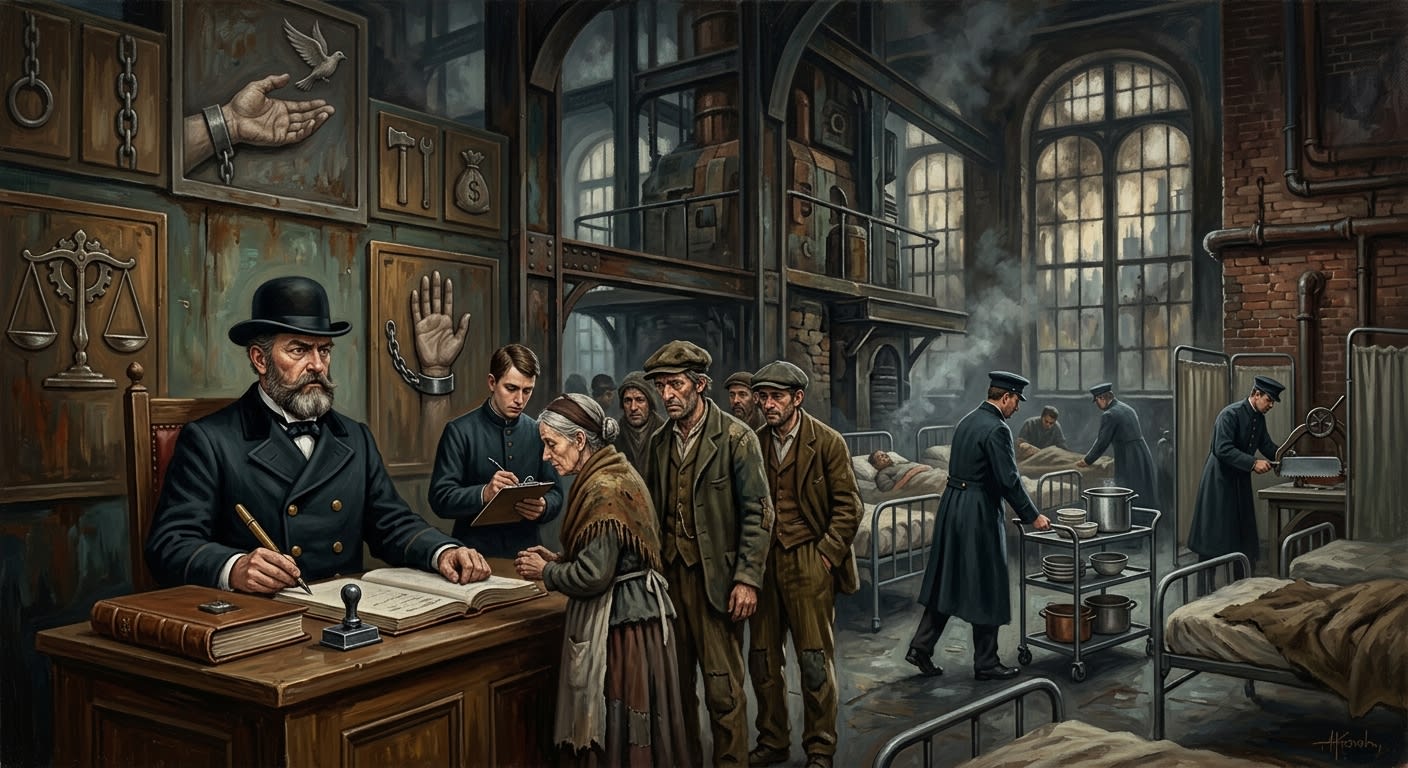
#On the Court Where Bodies Become Rulings
The Civic Triage Tribunal of Marrowgate is the legal-medical court by which the wounded become sortable, the dying become affordable, the amputated become revised persons, and the dead, when properly stamped, become less troublesome than the living. It was constituted in A.S. 83, eleven years after the inland medical port began receiving the Line's ruin by wagon and rail, and five years after the Sanitation Chapter discovered that a cordon is a wall with better manners.
Its public phrase is justice in allocation. This is almost pretty. It suggests an old magistrate weighing need, chance, guilt, usefulness, fever, bed count, and the faint remaining dignity of the patient before delivering a merciful ruling. Such men exist in stained glass and in the autobiographies of officials who have never stood inside Notary Row (Unregistered) at intake bell.
The Tribunal's true office is colder. It decides who receives a bed, who receives a saw, who receives a broth card, who receives a work prescription, who is declared salvageable, who is declared administratively dead, who is reassigned to the Suture Slums (Unregistered), and who is sent toward the Lime Yards with enough paperwork to keep his widow from arguing at the gate.
A city may be governed by whomever controls its gates, its food, its beds, or its records. Marrowgate, in the Synod's admirable generosity, has arranged for these powers to despise one another. The Sanitation Chapter controls the white lines and quarantine gates. The Bureau of Mercy controls ward ministry and broth. The Sealhands (Unregistered) control legal surgery. The Prosthetics Guild (Unregistered) controls the cost of returning to usefulness. The Tribunal controls the sentence that makes these thefts look like order.
#On Its Founding After the Port Learned to Bleed
Marrowgate began in A.S. 72 as a repurposed river-market town near the Würzburg corridor (Unregistered). Barges had become unreliable, which is the polite historical phrase for vessels arriving with corpses where grain had been promised. A nameless logistics officer of the Bureau of War replaced river logic with wagon logic: quays without water, cargo lanes without ships, dock schedules for stretchers, bells to regulate the arrival of broken men.
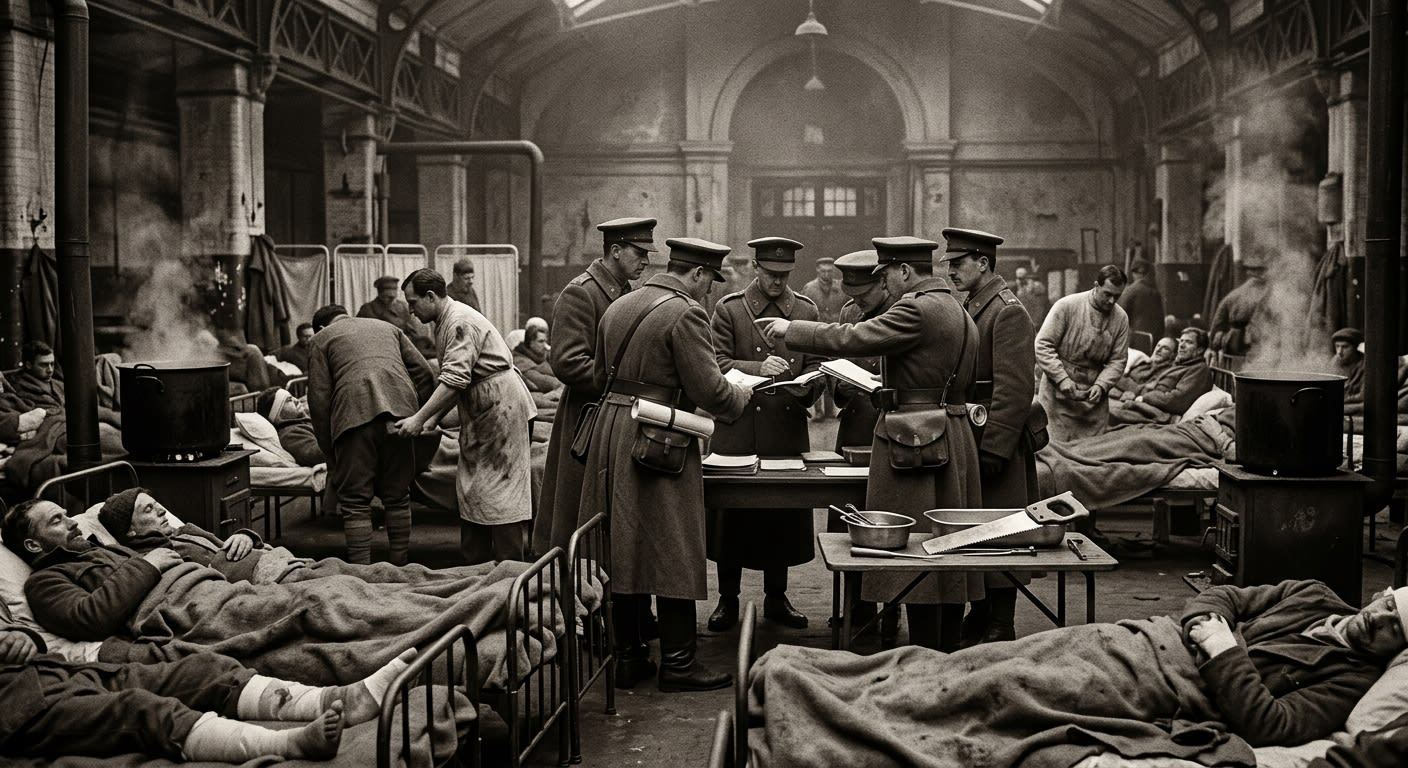
The first decade was heroic in the manner of all unregulated emergencies: filthy, improvisational, occasionally compassionate, and intolerable to anyone who loved forms. Surgeons cut before asking legal permission. Ward-Mothers traded bed space according to smell, pulse, and bribe. Wagoners dumped bodies at whichever lane was least guarded. The dead piled too near the living. The living stole tags from the dead. The dead, being new to Marrowgate's customs, did not object in any recorded fashion.
The Sanitation Chapter established its first cordon in A.S. 78 after the great plague pressure, the Lull of Names, and the First Ossuary Panic taught the city that disease spreads faster when frightened men are allowed to choose their own doors. Five years later the Tribunal was constituted because cordons could halt movement but could not decide value. Someone had to pronounce that one fever was natural, another suspicious, a third doctrinal, a fourth budgetary, and a fifth too expensive to discuss.
Later civic primers call the Tribunal “Marrowgate’s humane answer to chaotic suffering.”
Corrected. The humane answer was already present in Ward-Mothers, soup women, exhausted surgeons, and men who carried stretchers until their hands split. The Tribunal was the Synod's answer to unpriced mercy.
Its charter was amended into the A.S. 92 Joint Mandate (Unregistered) and revised in A.S. 187, when bed tokens, cut-stamps, work prescriptions, quarantine appeals, and prosthetic maintenance debt had swollen beyond the ability of ordinary ward staff to falsify politely. The Tribunal became permanent because the emergency never ended. This is how most permanent institutions are born: a crisis, a seal, a second seal, and a clerk with a talent for survival.
#On Notary Row and the Hall of Wax Heat
Notary Row lies between the White Ward blocks (Unregistered) and the seal registries, arranged with a cruelty so precise it deserves applause. Patients can smell broth from the corridor. They can hear saws from the operating galleries. They can see the allocation boards where bed windows appear and vanish like minor saints. Before any of these consolations may touch them, they must enter the Hall.
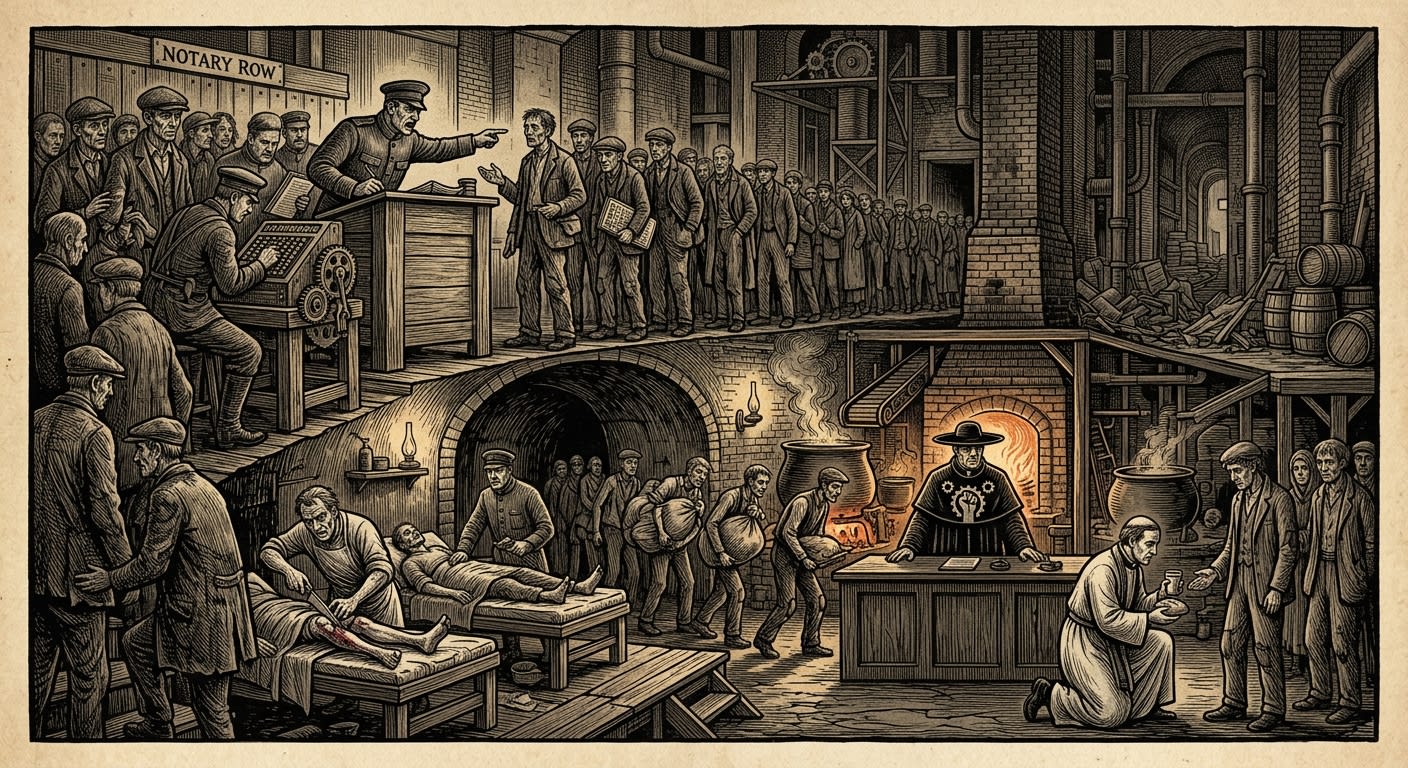
The Tribunal Hall smells of wax heat, ink, vinegar smoke, damp wool, scorched brass, and the sweet rot of men who have learned to sit upright while leaking through bandages. Its benches are divided by chalk lines. Clean-zone petitioners sit nearest the clerks. Grey cases sit beneath the north window where the draft keeps fever visible. Black-zone appeals sit behind a screen that preserves public composure while doing nothing for the smell.
Magistrate-Physic Toma (Unregistered) presides with the cold arithmetic for which Marrowgate has mistaken wisdom since A.S. 83. He is half physician, half magistrate, wholly suited to a city where the question “will he live?” is less urgent than “under whose account?” Clerk Vessa (Unregistered) sits below him, soft-voiced, sharp-penned, and far more dangerous. Toma issues rulings. Vessa writes them into the shape by which they survive appeal.
The proceedings are short because the line is long. A Ward-Sister presents a tag. A Sealhand presents a surgical recommendation. A Sanitation inspector presents a cordon objection. A family member may speak if solvent, connected, loud under the right patronage, or already doomed. The Tribunal rules by category: Treat, Hold, Cut, Transfer, Labour, Hospice, Lime, Review. Review is the kindest-sounding word and often the cruelest, since a reviewed body continues waiting while decay proceeds without docket number.
#On Beds, Windows, and Salvage
The Tribunal's first empire is bed allocation. Marrowgate's beds are never merely beds. They are time, legality, broth access, linen access, morphic draught eligibility, visitation permission, and proof that the patient's suffering has entered authorised space. A man without a bed may be bleeding. A man with a bed is a case. The distinction saves or ruins him before medicine arrives.
A bed window grants a time slot in which the patient may be admitted, examined, treated, cut, isolated, or reclassified. Windows are posted at midday and altered whenever reality offends the board. Peak intake makes them more valuable than coin. A winter offensive can turn a three-hour window into a dowry. A quarantine lockdown can make one worth a murder conducted with excellent manners.
The Tribunal pretends bed windows are allocated by salvageability. Salvageability is a splendid word because it wears mercy's face while keeping accountancy's teeth. A salvageable patient can return to labour, service, breeding, prayer, debt payment, or trench use. An unsalvageable patient becomes testimony, infection risk, family burden, or lime.
The salvage hearing is where Marrowgate reveals its theology. A soldier missing one hand but possessing strong lungs may receive cut-stamp revision and prosthetic referral. A fevered mother with three registered children may receive grey-zone hold if her parish tithe is current. A debt-labourer with black cough may receive black-zone transfer and a notation praising his usefulness to ward laundry before infection made him administratively narrow. The word “human” does not appear on the form. Its absence has spared many arguments.
#On the Cut-Stamp and the Legal Surgery of the Self
No article on the Tribunal can avoid the Sealhands, those licensed surgeon-notaries whose brass rings terrify Marrowgate more reliably than cannon. The Sealhand cuts. The Tribunal authorises. The registry revises. A limb removed without notarisation is a wound. A limb removed under cut-stamp is a legal event.
The stamp is feared more than the saw because a saw only removes tissue. The stamp removes status. After a notarised amputation, the old file is sealed under pre-excision designation. The patient's name may be altered, shortened, reclassified, or made conditional upon prosthetic compliance. A corporal becomes an adjusted corporal. A mother becomes a partial labourer. A child becomes a ward dependency with future debt assigned. Flesh bleeds once. Paper bleeds quarterly.
A Tribunal training note describes cut-stamp revision as “identity repair following bodily alteration.”
Corrected for doctrinal clarity. The cut-stamp repairs the file. The person may follow if sufficiently cooperative.
Chief Sealhand Orin understands this better than any living surgeon in the city. He does not plead before the Tribunal. He presents necessity as if placing a knife on velvet. His hands are steady, his fees immaculate, his contempt for unlicensed mercy almost touching. When a counterfeit seal ring surfaced in the Suture Slums last winter, real surgeons refused to operate until the Tribunal certified their rings. Seven patients died. The Tribunal called the deaths administrative. Orin called them regrettable. The families called them murder until Clerk Vessa corrected the record.
CUT-STAMP APPEAL 187-C / SEALED EXTRACT Petitioner entered as: Corporal J. Renck. Procedure authorised: left leg below knee. Procedure performed: █████████████. Post-excision designation: labour-eligible, debt transferable. Petitioner objected that the removed limb remained present beneath bandage. Tribunal finding: phantom claim, morale disorder, prosthetic referral denied. Marrowwind correction added A.S. 199: “leg present in file, absent in room.”
#On Labour, Debt, and Mercy Rulings
The Tribunal's second empire is labour. Marrowgate cannot function without the injured, the indebted, the half-healed, the quarantined, and the legally trapped. The Suture Slums are the city's unpaid organ. They wash linen, drag carts, scrub wards, clean pits, carry messages, boil bandages, turn the wheels of the place that consumed them.
A work prescription begins as kindness. The patient owes for broth, linen, morphine, prosthetic fitting, bed extension, witness fee, appeal stamp, family visitation, or post-surgical adjustment. The Tribunal converts debt into rehabilitative service. The word rehabilitative does noble work here. It implies improvement. It does not mention that the endpoint is determined by the same clerks who profit from finding discrepancies.
Mercy rulings also govern disputes between families and wards. Who owns a patient's ration chit after Hospice transfer? Who may speak for a fevered man whose confession named three heirs and then withdrew two while unconscious? Does a black-zone patient still accrue prosthetic maintenance debt if the prosthetic has been removed for disinfection? May a widow inherit bed priority from a husband classified dead pending? The Tribunal answers these questions with a seriousness that would be majestic if it did not so often concern broth.
The rulings create a market around themselves. Bed tokens are traded outside the Wagon Quays (Unregistered). Permit widows sell dead spouses' priority stamps. Quarantine marriages bloom for clean-corridor access. Tribunal clerks with black cuffs learn which forms can be delayed, which can be quickened, which can vanish beneath a blotter and reappear after payment with a fresh moral interpretation.
#On the War with the Sanitation Chapter
The Sanitation Chapter and the Civic Triage Tribunal are allies in public and predators in private, which is the healthiest possible arrangement for Synodic administration. The Chapter controls cordons, white lines, quarantine gates, inspector kits, and the power to declare movement itself diseased. The Tribunal controls beds, rulings, labour, surgical legality, and the power to declare a life worth spending.
The dispute is ancient by Marrowgate standards and petty by Heaven's. If Salvius (Unregistered) seals a ward, Toma loses hearings. If Toma grants bed access, Salvius loses cordon purity. If Vessa admits a patient to legal review, a Sanitation inspector may still stop the body at a white line. If Sanitation declares an outbreak, the Tribunal's authority shrinks to the walls of its own Hall. It hates this with the disciplined hatred of clerks deprived of jurisdiction.
Their sabotage has manners. Sanitation delays inspectors to make hearings useless. The Tribunal questions quarantine classifications in language so precise that whole cordons become vulnerable to appeal. Sanitation plants outbreak rumours before external audits. The Tribunal cultivates auditors and feeds them just enough evidence of Chapter excess to draw blood without killing the host. A deadlier hatred would be cleaner. This one is productive.
The Tribunal's current private scheme is to absorb Sanitation authority through a staged legal scandal. It wants a cordon abuse so public, so well witnessed, so beautifully documented, that Strasbourg must relocate quarantine review into Notary Row. Salvius knows. Salvius intends to trigger a necessary lockdown before the scandal ripens, making emergency governance permanent and appeals decorative. The Stitchmarket, naturally, plans to profit from both catastrophes. Civilization advances.
#On the Clean Paper Plague and Other Humiliations
The clean paper plague of A.S. 199 wounded the Tribunal because it attacked the thing the Tribunal worships most: a valid certificate. Healthy people died while officially cleared. Fever moved through papers before it moved through lungs. Ward tallies read clean. Bodies disagreed. Health certifications circulated from White Ward to Mercy Market, from Notary Row to the Wagon Quays, from Marrowgate outward toward supply towns and bastions with seals so respectable that no gate captain thought to trust a cough over wax.
The Tribunal blamed counterfeit clearances, poor ward reporting, Sanitation negligence, Stitchmarket interference, exhausted clerks, and patient dishonesty. The list was impressive. It avoided the obvious: the court had made paper more persuasive than flesh, and flesh had taken offense.
The Marrowwind corrected the dockets on the fourth night. Files opened themselves. Names of cleared patients appeared under black fever columns. Twenty-six bed ledgers marked vacant bled through the page. The ash weight from a burned intake cabinet entered the Tribunal docket with the marginal note: insufficient. No living clerk admitted writing it. Three clerks failed to imitate the hand. One imitated it too well and was transferred to the Lime Yards, where he has wisely reduced conversation.
The Tribunal now wants jurisdiction over Marrowwind corrections. Imagine, if your stomach is strong, a chalk gust subpoenaed to appear before Magistrate-Physic Toma and explain why the dead altered bed records without fee. The proposal is absurd, which has never prevented a court from preparing forms.
#On Magistrate-Physic Toma and Clerk Vessa
Toma is often described as cruel. This is inaccurate. Cruelty requires appetite. Toma has method. He sees bodies as cases attempting to become expenses. He hears a cough and calculates ward risk. He sees an amputation and calculates legal residue. He reads grief as evidentiary noise unless properly witnessed. Men like him keep cities operating. Men like him also explain why cities sometimes deserve plague.
Clerk Vessa is more interesting and more dangerous, which is why Toma receives visitors and Vessa receives envelopes. Her voice is soft enough to make petitioners lean forward. Her pen is sharp enough to ruin them when they do. She knows which bed windows are real, which work prescriptions will never end, which Sealhand recommendations were purchased, which Sanitation objections contain truth by accident, and which Mercy Ward-Sister has been diverting broth with the holiness of a thief.
Vessa is said to keep a second board behind the public allocation wall. On it she marks the patients who should have been saved under any decent arrangement of the world. This rumour has persisted because no one can decide whether it makes her merciful, sentimental, guilty, or merely well informed. The distinction will matter if Purity ever searches her rooms. Until then, the board may be real. It may also be a story ward staff tell themselves so that the Tribunal contains at least one human organ.
#On the Present Ambition
As of A.S. 201, the Civic Triage Tribunal sits amid overcapacity, Marrowwind corrections, clean-paper shame, counterfeit seal anxiety, Sanitation encroachment, Stitchmarket boldness, Prosthetics Guild debt pressure, and the old unglamorous fact that the Line sends more bodies than any court can sort without becoming monstrous. The docket grows. The benches fill. The black screen is repaired weekly. Bed windows vanish before posting. Work prescriptions lengthen. Mercy rulings acquire footnotes like tumours.
The Tribunal still believes it can win Marrowgate. This is its charm and its damnation. It imagines a city where quarantine answers to legal review, surgery answers to docket sequence, Mercy answers to allocation law, labour answers to scheduled debt, and even the Marrowwind's corrections are received, examined, stamped, and filed under living authority. It wants the body of the city brought into court.
At the last inspection, I watched Toma deny a bed to a man whose papers had arrived five minutes late and grant a prosthetic maintenance extension to a captain whose wound had healed badly but whose family tithe had healed very well. Vessa wrote both rulings in the same hand. Outside, the Lime Yards breathed white dust across the clean line. A clerk covered the docket. The dust found it anyway.
The Tribunal will sit tomorrow. It always does.