
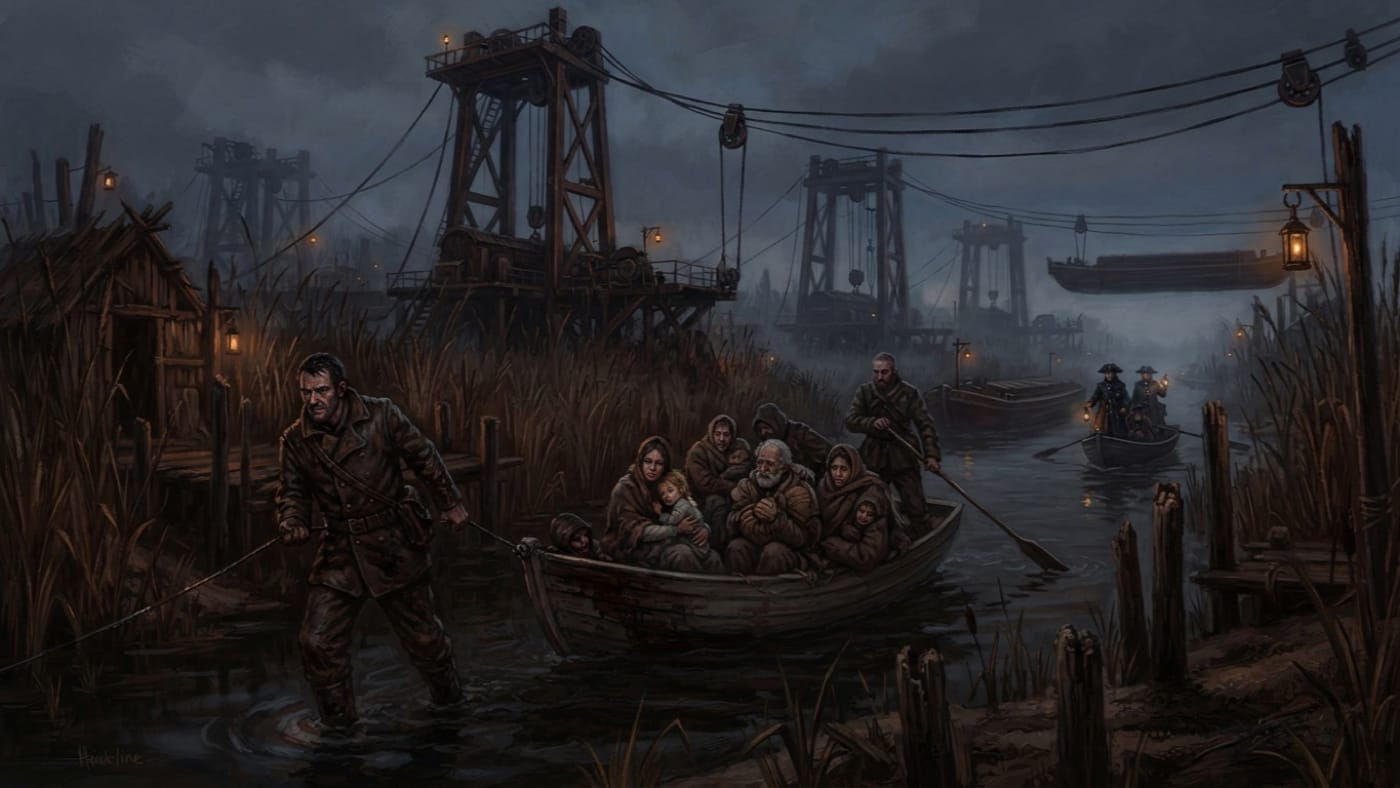
#On the Night Route
"The schedule is a god with no face." — Rope-Ferry Chain proverb
At curfew the registered schedule of the Rope-Ferry Chain closes. The queue lanes are emptied, the mainline barges tied off and the gantry lanterns put out, and the Synod Transit Office records that the river has gone to sleep. Nobody asked the river.
The Black Ferrymen run what the river does instead. They hold no charter, no guild cord, no license from the Splicehands, and no seat in any hall where a seat might be recorded. Licensing is the one expense their trade cannot bear. By the ordinary account they work in crews of three or four men to a skiff, in the reed channels between nodes, after dark. The records name no founder, no captain-general, no headquarters and no membership roll. I have searched for each with the diligence of a man who expected to find a founder he could hang. The archive returned nothing. It does not say why they are called Black either, and I will not supply a reason the clerks never filed.
What the records do establish is demand. The Queue Road brings more bodies to the banks than twelve ferries can process. The daylight system sorts them by paper, stamp, minute-block and quarantine status, and every sorting leaves behind people it has declined to carry. They do not evaporate at curfew. They go down to the reeds.
#On Boats and Banks
The registered Chain is a cathedral of rope. Its flat barges are hauled on tarred mainline cable over iron pulleys bolted to oak gantries, and every crossing is timed, sung, stamped and copied in triplicate at Ink Dock. The night route is a side chapel with the roof off.
The Ferrymen work small skiffs that ride low in the water. They pull them across on hand-lines, lighter ropes run through the reed channels where the river shallows and the official cables do not reach. A hand-line can be laid at dusk and cut at dawn. Moving a mainline takes Rope-Master Kett's signature and a season of argument. There lies the whole difference between a ministry and a trade.
Loading happens wherever the bank will take a foot: hidden berths under rotting dock planks, gaps in the reed flats, the slick shoulders of drowned pilings left by the burned bridges. Passengers come down through silt to the knee. Planks slide. The air smells of wet hemp, tar and lamp oil, and the spray off the channel is cold enough in any season to make a man reconsider his sins.
The hazards are the river's ordinary stock: fog, squalls, and currents near the Throat fast enough to turn a skiff broadside. Spring brings flood and winter brings ice. In every month the provosts' patrol skiffs go out with lanterns and warrants and do not ask whether a passenger can swim. A passenger who reaches the far bank soaked through can still lose a foot, or a life, to the cold or to the slow rot of a river cut. The reed channel offers access. It has never promised arrival.
#On Lantern Speech
The night route speaks in light. Signals pass from gantry towers, reed huts and moored barges in sequences of long and short flashes. A crew that cannot read them does not stay a crew for long.
The published account of the Chain preserves one recorded example: two long, one short, three long means the provost patrol has passed Node Four heading south. A steady amber from a reed hut means it is safe to load. A red flash from any quarter means scatter. I give these as specimens pinned in a cabinet. The codes change weekly, and anyone who goes down to the reeds with this page as their codebook will be reciting last week's liturgy to this week's provosts.
Two cautions belong in the file. The Reed Mothers keep their own signals: coded laundry on the drying lines behind the Quarantine Piers, and a lantern warning of two short and one long before provost raids on their huts. That warning belongs to the Mothers and has no place in the Ferrymen's patrol reports. Confusing the two is how a careful man drowns.
The second caution is the more embarrassing one. A code that reports where the patrol has gone needs someone who knows where the patrol was sent. The lanterns depend on bought schedules. Somewhere between the provost office and the gantry tower, the Synod's own timetable is copied, sold, and flashed across the water in a cant the Synod did not write.
#On the Price of Passage
The night route is cheaper than the daylight one. That is its whole commercial theology. It is true in the way a forger's pardon is cheaper than a bishop's.
Some passages are bought with coin. Others are paid in goods, in labour, in a crate hidden in a ward house, or in a favour to be named later by someone the passenger will never meet. The bargains are struck in under-dock taverns with thin beer and dripping ceilings, where a clerk who stamps permits by day may drink with the men who carry the unstamped by night. Some crossings go through the Ferry Chokepoint Brokers, who deal in quiet handoffs and reworked identities. Others are agreed at the edge of the reeds. There is no universal tariff. I looked.
The money moves with admirable discipline. Clerks are paid to misplace a manifest, and provosts are paid for schedules. Other provosts arrest crews and confiscate their cargo, which then finds its way back through intermediaries to the market that lost it. The Chain's published account puts the split at roughly a third of the provosts selling and two thirds seizing. That estimate belongs to its author, and I decline to audit the provost corps on his behalf. The mechanism needs no census: raid, seize, resell, repeat. The Transit Office ledgers see none of it.
None of this makes the crossing lawful. A crew taken on the water still faces the cages at the Bend Ferry. A passenger taken without papers still faces the Piers. Officials profit from the trade and punish it in the same week, sometimes in the same person. They see no contradiction, because the profit and the punishment go into different books.
#On Those the Queue Refuses
The passengers are whoever the daylight has turned away. Refugees without papers. Smugglers whose cargo would not survive a manifest. Soldiers absent without leave, who know better than anyone what waits at the Mouth. Priests carrying relics whose provenance would fail the first honest question at quarantine. The Bureau of Doctrine notes the priests with a sorrow it has not yet turned into an inquiry.
One skiff may carry all of them, sometimes on the same night. A crew that takes a sick child across at moonrise may take contraband salt across at moonset, and charge more for the salt. I have found no evidence that the Ferrymen share a creed, a cause, or any opinion of their passengers beyond what they pay. Some are kind and some are thieves, and many are both, depending on the hour. The file does not support canonising them as a body, and it does not support hanging them as one.
The vulnerable reach the water through the Reed Mothers. Behind the Quarantine Piers at Node Four, where the river softens into marsh, the Mothers shelter the children of the pressed, nurse the sick that quarantine has refused, and hide people the system has decided do not exist. Reed paths and culverts run from their huts to the river's edge. Where those paths end, the Ferrymen's skiffs begin.
The River Ledger has made that junction urgent. In fog the wet mainline cables darken into names, numbers and sentences, and those entries have an unbearable habit of coming true. When a cage-count appears beside a known deserter's name, the Mothers cut a reed-channel skiff loose and hope the crew can get him away before the provosts read the same rope. Children named on the rope are moved. Widows whose ration numbers appear have their chits hidden. Official records show no successful intervention, because official records do not recognise the interventions at all.
Nothing in the file shows that a hand-line evades the Ledger, that an unregistered passenger is hidden from the rope, or that the Ferrymen know why the rope writes. Whatever connects the Ledger to what lies beneath Node Seven remains under the seal of the Bureau of Alchemical Standards. The crews know only what the queue knows. A name on the rope is a reason to leave tonight.
#On the Present Traffic
The night route is the most reliable gauge of the Chain's decline. Registered throughput has fallen nine percent over three seasons. Quarantine cordons have expanded and rope supply has tightened. Daylight crews refuse heavy-fog crossings. The Ledger has been accelerating since A.S. 199, and in one winter event of A.S. 200 it printed fourteen names at Node Seven. Every one of these figures sends more people to the reeds.
The present assessment of the Chain records that the Black Ferrymen grow bolder. It gives no count of skiffs, and I will not invent one for the sake of a tidy paragraph. The provosts raid, seize, sell and raid again. Strasbourg receives quarterly throughput figures that leave out every one of these crossings, approves them, and asks for clearer copies.
The Rope-Ferry Chain ceases operation at curfew.
Narrowed. The registered schedule of the Rope-Ferry Chain closes at curfew. Unregistered hand-line crossings continue in the reed channels. They remain unlawful and are not recorded as crossings. Nobody informed the river of the original wording.