
#On the Fourteen
In A.S. 104, in a bastion powerhouse whose name the surviving accounts leave out, the furnace failed and fourteen stokers burned.
The Codex records the number and very little else. No account available to this office identifies the part that gave way. Valve, seam, firebox and gauge have all been proposed by later clerks, none of them with evidence. The day is unrecorded. So is the season, and so is the length of the disturbance that followed. The fourteen remain a figure in a ledger. They were also fourteen men who had spent their working lives feeding fuel into a machine that kept a wall of the Synod lit and warm, and whatever the machine did on that day, it did to them first.
The bastion carried on, as bastions do. The surviving workforce carried on too, which was the greater administrative inconvenience, because the survivors had questions.
The title is plural, and clerks have used the plural to picture boiler-houses burning from one end of the Line to the other. The record supports one powerhouse, one catastrophe and one body of survivors. Clerks put frightening things in the plural. It makes the eventual suppression sound bigger.
#On the Demand for Truth Lessons
Only two words of the survivors' demand come down to us: truth lessons. They wanted to be taught, in engineering terms, why the furnace had done what it did.
Think about what that request means to a stoker. A man who feeds a furnace knows its temper the way a carter knows his worst horse. He knows the sound it makes before trouble, the colour of a fire that has gone wrong, and the gauge he has been told to watch without ever being told why. When fourteen of his fellows have been carried out past him, he wants the why, in words plain enough to let him recognise the next failure before it reaches his own shovel. A labourer can ask for nothing more practical. The Bureau of Doctrine heard it as the most dangerous request a labourer could make.
Doctrine never writes its reasoning down, so I shall write it down here. A man who learns why a boiler fails has learned a cause. A man who holds a cause can teach it to others. Once stokers are teaching it to stokers, the powerhouse has a pulpit the Bureau never licensed, with the engineer preaching pressure and the foreman serving as his deacon. Every later death would then be explained by the people who did the dying.
None of the surviving accounts calls the survivors Rationalists, conspirators or blasphemers. As far as anyone recorded, they did not deny the Creator. They asked for a manual. To an office whose authority rests on owning the why, a manual is a rival scripture with diagrams in it.
#On the Six Men Sent into Heat
Doctrine answered with six men.
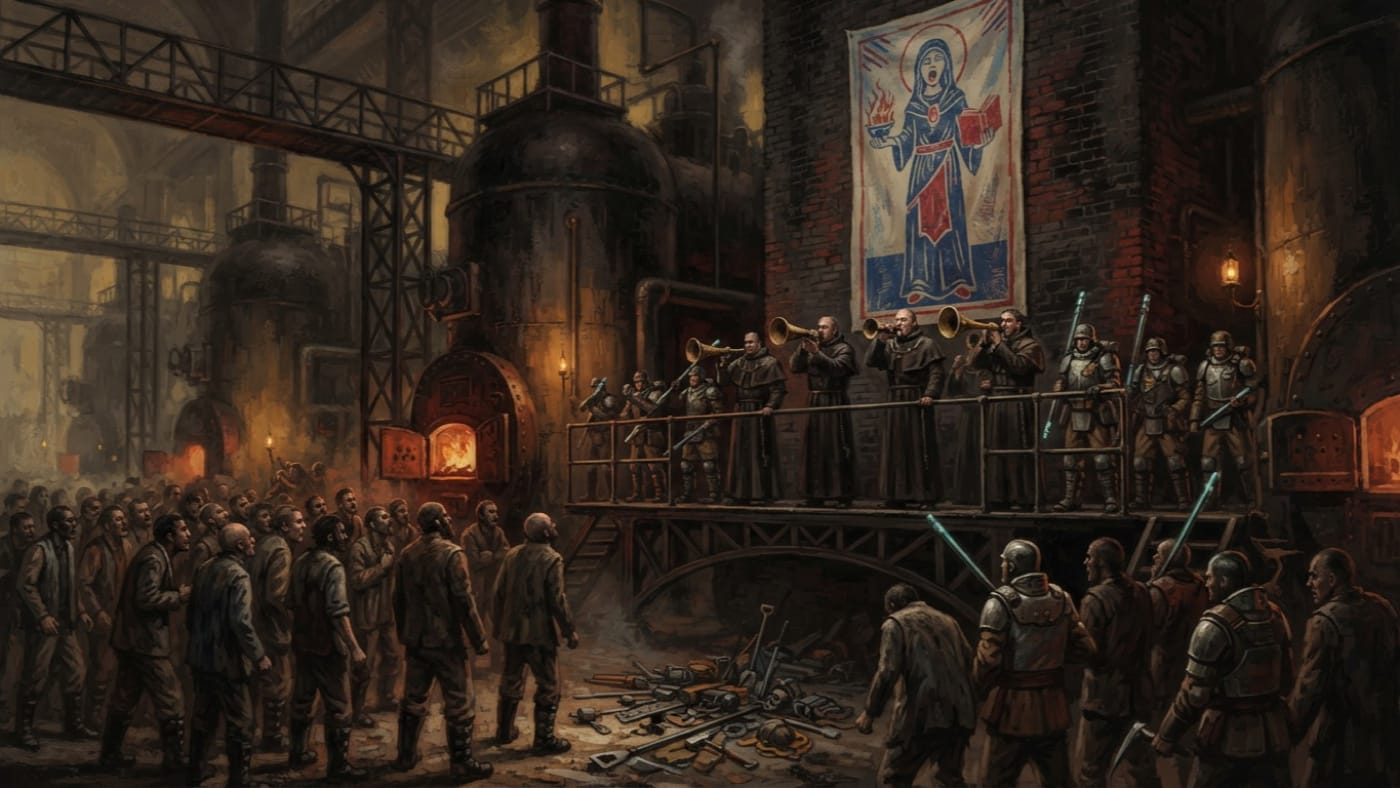
They wore heat-resistant cassocks, so the Bureau evidently knew where it was sending them and what the air in that place would do to ordinary wool. They carried portable loudhailers so their answer would be louder than the question, and doctrine cards so the answer would be the same from every mouth. Warden escorts walked with them. The accounts give no size for the escort, no name for any of the six, and no record of which of them spoke first. I have searched. The Bureau did not think the speakers mattered. It thought the speech mattered, and the speech has survived complete.
The six told the crowd that the furnace had failed because obedience had failed.
On this point the Codex must be exact. That was Doctrine's finding on the cause. Doctrine attributed it, sealed it and has recited it for ninety-seven years. No account of the metal has ever been filed beside it. A split seam, a lying gauge or a firebox overfed by exhausted men on a doubled shift would have produced the same answer through the loudhailers, and that was what made the answer so useful to administrators. It needed no inspection, and it would fit every boiler ever riveted.
Picturing the scene requires little invention. The powerhouse was still hot. Soot lay thick on the iron galleries, and the smell of what had burned had not yet been scrubbed from the brick. Survivors who had asked a question in plain words were answered through tin. Behind the six, printed in cheap blue ink, hung Saint Veyra of the Mouth, holding a brazier in one hand and a strapped book in the other, her mouth open. The ink was cheap because Doctrine had not yet decided she deserved good pigment. It decided later.
What happened between the speech and the next shift is not in any document I am permitted to cite. The accounts mention no volley, no mass arrest and no dispersal order, and I will not invent them to entertain the reader. Nobody filed a record of when the furnace was relit, or by whose hands. The record shows a demand, a response, and an office that did not leave afterward.
#On the Office Left Behind
The six stayed, and their staying matters more than anything they said. The Furnace Catechist office grew out of that response. It became a doctrinal post stationed where heat turns into obedience, and its work was to stand between the workforce and the why. This office holds no charter text from A.S. 104, and the Codex will not make one up. What the record does support is this: after the Boiler Riots, Doctrine kept its men in the powerhouses, and those men learned to govern the language spoken there.
The arrangement that came out of it was simple to describe and miserable to work under. Engineers kept the machinery running. Catechists kept the explanation. A man might tighten a valve, but he might not say aloud, where others could hear, why it had slipped. Engineering got the work and Doctrine got the reasons. Later Litany-Engineers inherited the same division and have resented it professionally ever since.
The mature practices came later, over decades, and should not be credited to the first six. Those practices are shift sermons, correction of forbidden phrases, ignition blessings before every restart, and confession hours after every incident. The six arrived with cards and loudhailers, not a finished liturgy. The morning recitation of the Chain of Cause traces fire downward from the Creator through Bureau, foreman and stoker to the fuel in the grate. It gave the grown office its daily prayer, and it was written for men like the fourteen to say at the start of every shift.
Veyra's patronage broadened in the aftermath. Her sentence, A spark is permission, came into common Catechist use after A.S. 104. It is short, easy to remember and wrong enough to carry. Her imagery suited the work exactly. The brazier stood for sanctioned fire, the open mouth for sanctioned speech, and the shut book for the instruction the workers had asked for and been refused.
Older devotional sheets describe Veyra as "teacher of holy heat."
Corrected. Saint Veyra is the approved witness against unlicensed teaching. Her book is shut because that is what she is for.
#On the Precedent Carried Down the Line
The survivors of A.S. 104 asked for truth lessons openly. Thirty years later, others went looking for them in secret.
The Causality Purge of A.S. 134 began when clandestine manuals titled Fuel Is Chemistry passed through six bastion powerhouses and reached Bastion-Przemyśl, where stokers learned to calculate fuel loads without the catechism tables. They were the lessons the fourteen's comrades had asked for, now passed hand to hand as contraband, and Doctrine answered them with immurement. An office that began as a pacifier with a loudhailer had become an instrument of punishment, and it cited 104 as its ancestor without embarrassment.
Fifty-four years after the riots came the Trench Sermon Mandate of A.S. 158, issued after generators at Bastion-Shipka began coughing under foreign harmonics. The Mandate ordered a licensed Catechist into every power installation along the Sagittal Line. It did not create the office. It armed an office that already existed. At Shipka the danger in the pipes was real, and a preacher who controlled what men said when the pipes answered could keep them alive. The ward plates and resonance conduits of the Line are not superstitions, and I will not have this article read as a sneer at every blessing ever spoken over a boiler. But no such enemy has ever been named for the powerhouse of A.S. 104. Its furnace failed for reasons Doctrine did not investigate. Doctrine decided what to call them.
Eighty-three years after the riots, the Ash-School Scandal of A.S. 187 at Essen-of-Hymnsteel showed the arrangement still in force. A Catechist taught real thermodynamics to a clever apprentice and was immured for it. One of the office's own men had finally given the lesson the survivors of 104 had requested, and the office punished him for it.
Ninety-seven years on, the powerhouses of the Line still keep their Catechists. The fourteen are still dead. The cause of the furnace's failure is still filed under obedience.