
#On the Origin of the Office
"Heat is obedience made visible." — Saint Veyra of the Mouth, depicted with a brazier and a sealed book
The Bureau of Engineering builds. The Bureau of Doctrine explains — or rather, the Bureau of Doctrine explains why building happened, and ensures the explanation bears no resemblance to the engineering. Between these two Bureaus there is a war older than the Sagittal Line, older than the charters, older than the first stone poured at Bastion-Irongate. The war concerns a single question: why does the furnace roar?
The engineers say: fuel. Combustion. Thermal exchange. They say it in numbered clauses, in monotone, in the margins of load-bearing calculations, and they are correct.
The Bureau of Doctrine says: Providence. The Creator's breath in the bellows. Cause descends from Heaven through the chain of obedience, and the furnace is merely the last link — the visible terminus of a command that began at the Throne. They say this from pulpits, in cassocks, with hands that have never touched a valve, and they are also correct, because correctness in the Synod is a matter of jurisdiction, and Doctrine's jurisdiction is why.
The Furnace Catechist exists because the gap between these two answers is wide enough to lose a bastion through. A stoker who understands pressure curves is a stoker who might, under sufficient intellectual pressure, conclude that the Synod is superfluous to the boiling of water. A Litany-Engineer who attributes success to measurement rather than prayer is an engineer whose measurement-worship will survive precisely until the first demon hour, at which point measurement fails and the man who has no prayer left will improvise, and improvisation near a furnace is how districts die.
The office was chartered — informally, without written mandate, in the manner of all Synod institutions that do their most effective work before anyone authorises them — during the Boiler Riots of A.S. 104. A bastion powerhouse suffered a lethal failure. Fourteen stokers burned. The survivors demanded what they called "truth lessons" — an explanation of the failure in terms they could use to prevent the next one. This was reasonable. This was also heresy, because an explanation of the failure in their terms would have been an explanation in engineering terms, and engineering terms are the Bureau of Engineering's exclusive property, and the Bureau of Doctrine does not permit its exclusive properties to be distributed to stokers.
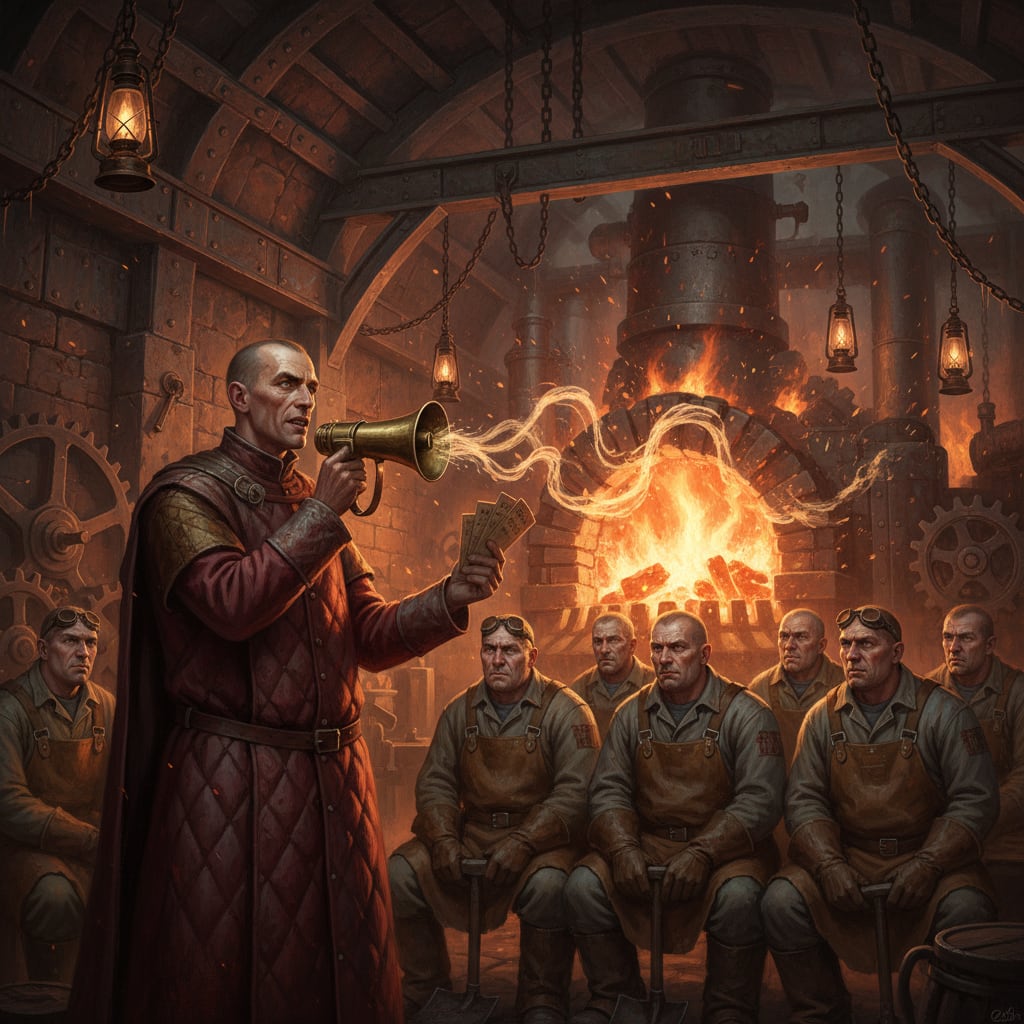
The Catechists were deployed as pacifiers. Six men in heat-resistant cassocks, carrying doctrine cards and portable loudhailers, who stood before the crowd and said: the furnace failed because obedience failed. The stokers who died, died because somewhere in the chain of command a prayer was misarticulated, a confession skipped, a catechism recited without conviction. The failure was spiritual. The remedy was spiritual. The Bureau of Engineering would, of course, also replace the valve — but the valve was secondary to the soul.
The stokers accepted this. They had no choice — the Catechists arrived with Warden escorts, and the Wardens carried cudgels — but some of them accepted it genuinely, because a spiritual explanation for a furnace failure is, in its way, more comforting than a mechanical one. A broken valve can be fixed; the universe remains indifferent. A broken prayer can be fixed; the universe is paying attention. The Catechists offered the second kind of comfort, and the Boiler Riots ended, and the Bureau of Doctrine stamped the operation as "doctrinal intervention, Category One, successful."
#On the Substance of the Work
"A spark is permission."
The Furnace Catechist's function is simple in the way a leash is simple: it binds cause-and-effect to doctrine so that technical power cannot outgrow Synod authority.
In practice this means standing in a smelter gallery at six in the morning, ash grit in every crease of your cassock, throat raw from yesterday's sermons, delivering the "Chain of Cause" — a recitation that traces the origin of every flame from the Creator's first breath through the angelic hierarchies, through the Concordat, through the Bureau of Doctrine, through the Bureau of Engineering (fourth in the chain, the Engineers note with permanent displeasure), through the Bastion Commandant, through the shift foreman, through the stoker's own hands, and finally to the fuel itself, which burns because it has been permitted to burn. The recitation takes eleven minutes. The stokers stand in rows. The furnace roars behind them. The Catechist's loudhailer competes with the roar and usually loses, which is theologically uncomfortable but acoustically inevitable.
After the sermon: the walk. The Catechist patrols the line, listening. The forbidden lexicon is specific and extensive: pressure curve, mixture ratio, thermal gradient, combustion efficiency, fuel-air ratio. Any of these spoken aloud in earshot of a Catechist constitutes "unauthorized explanation" — a disciplinary offence under Standing Order 14-P (Unregistered), punishable by confession, re-catechism, and in repeat cases reassignment to a trenchline boiler pit where the sermons are shorter because the life expectancy is shorter and neither the Bureau of Doctrine nor the Bureau of Engineering wastes resources on the soon-to-be-dead.
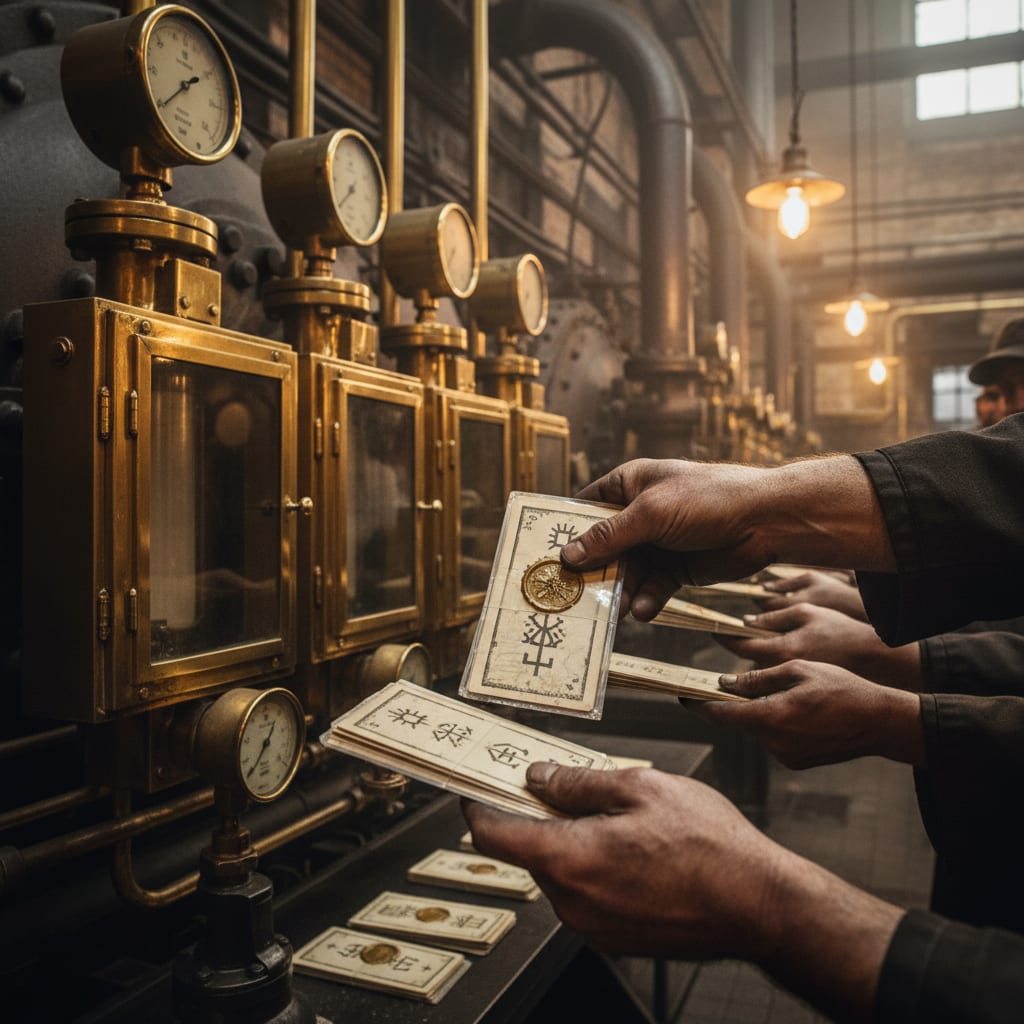
The approved substitutions are printed on wax-sealed doctrine cards distributed at shift start:
For pressure curve — "the breath of obedience." For mixture ratio — "the proportion ordained." For thermal gradient — "the will of the fire." For combustion efficiency — never spoken, never acknowledged to exist.
The last category is the most instructive. Combustion efficiency is a concept that, if understood, renders the Catechist's entire Chain of Cause unnecessary. If fire burns because of measurable chemical interactions rather than divine permission, then the chain has no links — it is a fiction, a cord wrapped around nothing. The Bureau of Doctrine knows this. The Bureau of Engineering knows this better. The Catechist, standing between them with doctrine cards in one hand and an ash rosary in the other, knows it best of all, because the Catechist is the one who must look a man in the eye after a furnace explosion and tell him his dead friends burned because someone's prayer was insufficiently sincere.
#On the Causality Wars
The official record states the feud between Engines & Furnaces and Doctrine as "legendary," which is the official record's way of saying "ongoing, expensive, and irresolvable." The Furnace Catechist lives in the gap between their positions.
The Causality Purge of A.S. 134 (Unregistered) was the war's bloodiest engagement. Clandestine manuals — collectively titled Fuel Is Chemistry, though the Bureau of Silence has since denied the collective title existed, which is a denial that confirms its existence — circulated through six bastion powerhouses in a single winter. The manuals explained combustion in mechanical terms. They included diagrams. One manual, recovered from the boiler pit of Bastion-Przemyśl, included a conversion table that allowed stokers to calculate fuel loads without consulting the approved catechism tables. The Bureau of Doctrine classified the manuals as heretical texts under the Index Damnatus. The Bureau of Purity dispatched Lictors. Forty-seven stokers, eleven foremen, and three shift engineers were immured at Bastion-Przemyśl alone.
The Bureau's official record attributes the Causality Purge to "a spontaneous outbreak of Rationalist sentiment among uneducated labourers."
ERRATUM (Bureau of Doctrine, A.S. 147): The manuals were authored by a senior Bureau of Engineering draughtsman whose identity remains sealed under Bureau of Shadows File 44-K. The outbreak was literate, deliberate, and authored by a man with access to classified fuel-load specifications. The Bureau of Doctrine prefers the word "spontaneous."
The Trench Sermon Mandate followed in A.S. 158, after generators at Bastion-Shipka were sabotaged with what the Bureau of Bells classified as "foreign harmonics" — sound frequencies introduced into the resonance pipes that caused diesel-flow irregularities, pressure fluctuations, and in one documented case a boiler that produced steam in the shape of a hand. The Bureau of Doctrine attributed the sabotage to Syrion's agents. The Bureau of Engineering attributed it to corroded gaskets. Both were correct, in the sense that corroded gaskets and demonic interference are functionally indistinguishable when the pipes are singing hymns and the hymns are load-bearing.
The Mandate required Furnace Catechists at every power installation on the Line. Doctrine became a security layer. The Catechist's sermon was no longer merely doctrinal instruction — it was counter-espionage, because a stoker who attributes outcomes to divine permission is a stoker who will report anomalies as spiritual disturbances rather than attempting to diagnose them himself, and diagnosis by unqualified personnel is how Pale Chanter unhymns propagate through resonance infrastructure.
#On the Factions Within
"Explaining is stealing."
Two factions divide every Furnace Catechist corps, and neither faction acknowledges the other's existence in official correspondence.
The Purists hold that no technical phrasing may be spoken in a furnace gallery under any circumstance. The Chain of Cause is literal: fire burns because Heaven permits it. A pump fails because obedience failed. A boiler explodes because sin was present in the shift crew and the sin found the weakest seal. The Purist position is doctrinally impeccable and operationally suicidal, because a stoker who cannot say "pressure curve" is a stoker who cannot warn his shift-mates that the boiler is about to kill them.
The Pragmatists hold that the Chain of Cause is a framework, a pedagogical scaffold, a useful fiction — and that the Catechist's real job is to keep production alive while maintaining the appearance of doctrinal control. The Pragmatist allows "the proportion ordained" to be whispered with a knowing glance. The Pragmatist permits an engineer to use technical terms during an emergency and then ensures the incident report contains only approved language. The Pragmatist practices what the profession calls "two-track preaching": public doctrine, private allowances.
The cost of Pragmatism is complicity. A Catechist who permits real talk during emergencies and then erases it from the report has become an accomplice to the knowledge he is employed to suppress. He knows the Chain of Cause is a fiction. He knows combustion is chemistry. He knows that the furnace roars because fuel burns, and fuel burns because of molecular interactions that do not require the Creator's breath, the angelic hierarchies, or the Bureau of Doctrine's fourteenth-revision catechism table. He knows all of this, and he stands before the shift crew every morning and recites the Chain of Cause anyway, and he does this because the alternative — a workforce that understands its own power — is more dangerous than any lie.
The cost of Purism is corpses. A Catechist who forbids the word "pressure" is a Catechist whose shift crew cannot communicate danger. The Bureau of Medicine's records from Bastion-Przemyśl list fourteen "doctrinal compliance incidents" between A.S. 158 and A.S. 178 — fourteen explosions, scaldings, or gas releases where the post-incident review determined that a warning had been available in engineering terms and suppressed in doctrinal ones.
#On the Present Condition
"Cause is a chain; chains have owners."
There are approximately three thousand four hundred active Furnace Catechists across Zones 1 through 5. The number is imprecise because the Bureau of Doctrine counts licensed Catechists and the Bureau of Engineering counts "doctrinal personnel interfering with operational efficiency," and these numbers differ by approximately six hundred, which is either an administrative discrepancy or a theological argument expressed in arithmetic.
The Catechists at Brast are the most visible. The Chrismole Furnaces are the Synod's industrial heart — sanctified fuel production for forward artillery — and the furnaces there have developed what the Bureau of Engineering classifies as "Acoustic-Mechanical Disturbance, Category Two" and what the garrison calls personality. The furnaces sulk. They refuse to fire for cantors they dislike. One furnace, designated Saint-Combust after an explosion in A.S. 74 that killed nine men in postures of apparent devotion, has been classified by the Bureau of Doctrine as "a vessel of instructive Providence." The Furnace Catechists at Brast must therefore preach the Chain of Cause to furnaces that demonstrably respond to mood, temperament, and musical taste — which is either the strongest possible evidence for the Chain of Cause or the strongest possible refutation of it, depending on whether the furnaces are obeying Heaven or merely being difficult.
At Essen-of-Hymnsteel, the Catechists contend with the Wrong Choir — a phenomenon in the foundations where tools hum on workbenches without being touched and teeth ache in patterns the Bureau of Medicine has mapped but cannot explain. The Catechists preach that the hum is Providence. The engineers measure it. The measurements and the preaching are equally unable to make the hum stop, which the Bureau of Doctrine considers a draw and the Bureau of Engineering considers an insult.
At the trenchline boiler pits — those forward installations where diesel resonance keeps the bells ringing and the gaskets sealed — the Catechists serve their hardest tours. The pits are small, hot, loud, and close to the enemy. Demon hours bring voices through the pipes that mimic sermons, twist the Chain of Cause into blasphemous parodies, and offer the stokers explanations — real explanations, mechanical explanations, the kind the Catechist has spent his career suppressing — in voices that sound like reason and smell like sulphur. The Catechist must counter these pipe-voices with louder preaching, which is the Synod's answer to everything the Synod cannot explain: drown it in doctrine and file the silence as compliance.
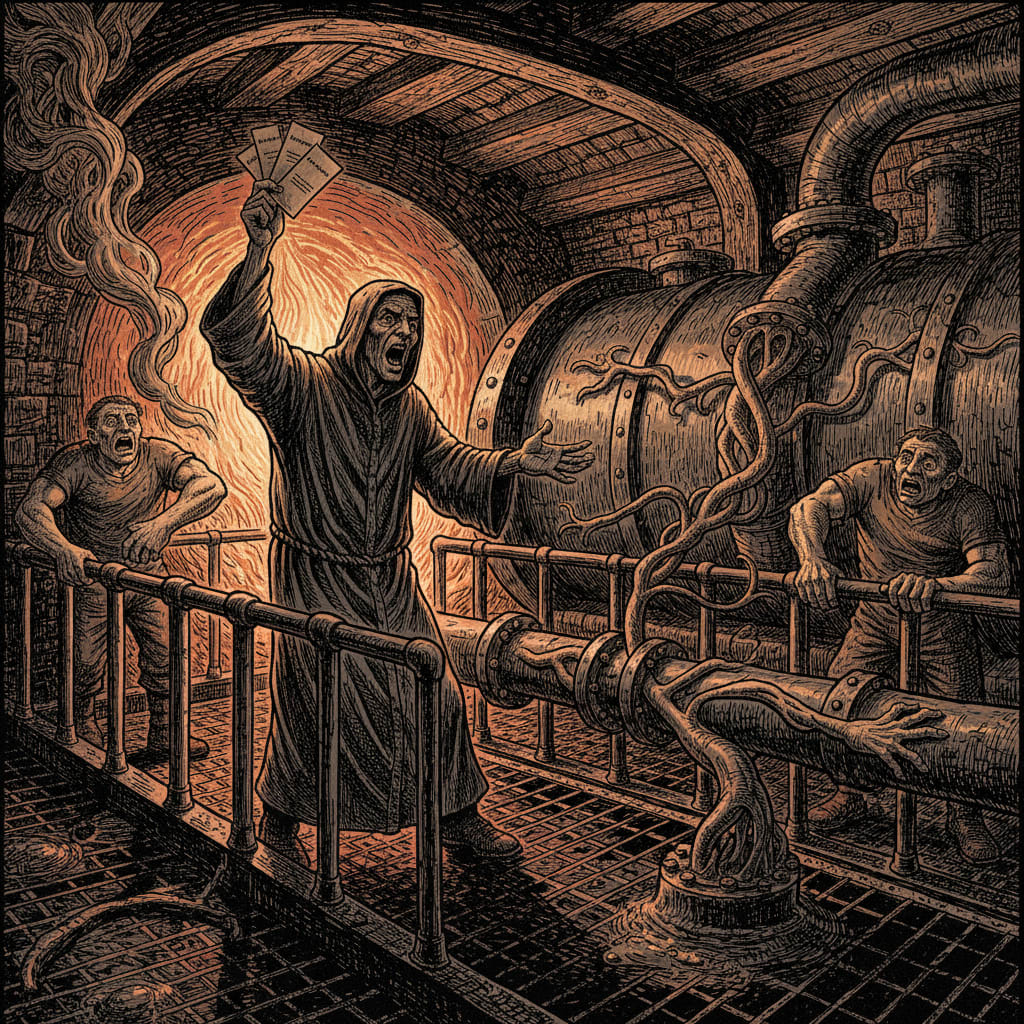
The furnace roars. The Catechist preaches. The stoker listens, or pretends to listen, or moves his lips without sound and the Catechist records it as compliance, because compliance is what the ledger requires, and the ledger is the Chain of Cause made paper, and paper does not burn — or rather, paper burns magnificently, but only when permitted to, which brings us back to the question, and the question has no answer the Bureau will authorise, and the absence of an authorised answer is itself the answer, stamped and sealed and filed in the cabinet marked Causality: Ongoing.
The Bureau of Engineering's graffito — "The Line does not hold because we pray. The Line holds because the mortar sets" — has been attributed to no one, repainted monthly, and classified as "vandalism of an inspirational nature."
ERRATUM (Bureau of Doctrine, A.S. 200): The graffito is now classified as "anonymous devotional commentary, pending attribution." The Bureau of Doctrine does not acknowledge that the graffito contradicts the Chain of Cause. The Bureau of Engineering does not acknowledge that the graffito exists. Both positions are compatible with the Synod's standing policy on causality, which is that causality is whatever the Bureau says it is today, and today's Bureau has not yet decided.