
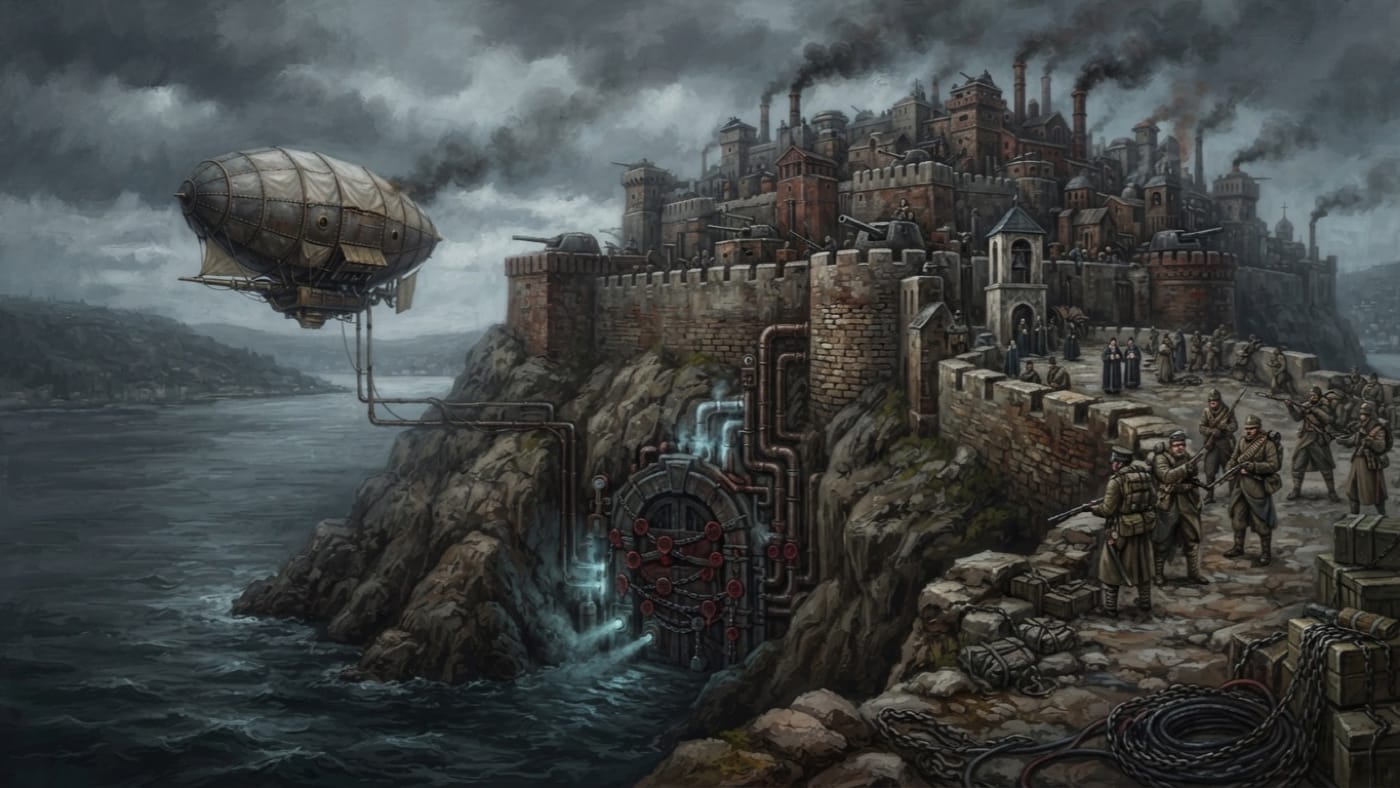
#On the Ground Above the Strait
The Bosphorus headland is a spur of ancient bedrock thrust out above the strait, and it was a fortress before anyone fortified it. Byzantine masons got there first. When the retreating armies arrived, the masons' rubble lay across the spur: dressed stone tumbled from walls whose builders had long since gone to their reward or their damnation, and the Ledger does not say which. That rubble gave the skeleton for everything raised afterward. Bastion-Constantinople stands on those bones today. So do its harbour, its garrison, its terror, and its paperwork.
The site needs little theology to explain it. Rock is harder to undermine than sand. Height commands water. From the landward side, a spur with the strait at its feet offers only a narrow front, and from the seaward side it can be approached only by men in boats, who are easy to shoot. Any sergeant could read it. Several did.
The Codex places the city at the Bosphorus, at the southern end of the Sagittal Line. The cartographers' figures locate Constantinople in general, but they do not settle which bank or which promontory first took the pilings. The original builders did not survey it, and no survey made since has been released to this office. I record the headland as the headland. It answers to nothing grander.
#On the Winter Arrival
"Providential Guidance, Category: Pre-Institutional." — Bureau of Doctrine classification, applied A.S. 90 to the conduct of A.S. 47
They came in the winter of A.S. 47. The Sundering of 1 November A.S. 45 had cracked the world two years before, and they had spent those two years retreating across a continent that the armies of the Great Deceiver were eating from the east. The record keeps their season. It does not keep their commander, their colours, their number, their road, or the day they stopped, and I will not supply any of these. Lesser chroniclers have filled whole galleries with invented captains. This Ledger prefers a bare wall to a forged portrait.
The record does keep the decision. Exhausted men found high rock over deep water, with old stone ready to hand, and they began to build. It was military occupation in its plainest form: dig, pile, wall, post a watch, sleep in shifts. Nobody consecrated anything. The Synod would not be constituted for another forty-three years. No Bureau existed to file a requisition and no Hierarch existed to seal one. There was not even a year-number to date it by, because the Synod adopted its reckoning only at A.S. 90 and applied it backwards to the whole catastrophe. To the men living through it, the winter of A.S. 47 was simply winter.
The Church was present, of course. It had been present before the Sundering, hidden in cellars and behind confessional screens, and afterward it came into public view unevenly, province by province and garrison by garrison. Clergy marched with the retreat. Local offices kept what records they could. A provisional council would assemble around A.S. 50 to govern whatever was left. None of this turned a mason's decision on the headland into doctrine. That came later, from men with better chairs.
#On the First Pilings
The first pilings went into the bedrock and struck something hollow.
There were chambers beneath the spur. They had been built by someone, they were old, and they were already sealed when the soldiers found them. Someone had closed them earlier, by means and on authority the Ledger cannot name. The entrance known today is a Byzantine archway, centuries older than anything raised above it. No folio says whether the Byzantines sealed it or found it already sealed.
The soldiers were not archaeologists. They had no use for antiquities and no leisure for wonder. They resealed the chambers with fresh mortar and wax, drove iron bolts through the old stonework, and built their fortifications on top. By every surviving indication, they then stopped talking about it. The bolts are still there. They have not rusted, although the sub-levels are damp enough to rust anything. I mention this once and leave it alone.
The builders' folio survives in the Lower Vaults, its leather water-damaged and its ink legible in patches. It records the chambers' dimensions and their masonry, and it estimates their age. On the line where the contents should have been entered, the page is blank.
I do not reproduce the folio's figures here. They belong to the file of the Third Ossuary, and that file sits at a classification well above the headland's. In present usage, that is what the chambers are called. The name came later. So did the Rings around them, the numbering that made them "Third," and the filing heading "Relics of Unprecedented Sensitivity," which assumes relics that nobody ever catalogued. In A.S. 47 there was a hole in the rock, a seal on the hole, and a garrison that wanted the hole shut. The seventeen sealings, the bells, the keepers and the four official explanations belong to the chamber's own entry. This entry concerns the rock.
#On the Fortress Raised Above
A position piled and walled on a rock became, in stages, the southern lock of the continent. Garrisons enlarged the works and clergy hallowed them. Over generations the bone-built courses of the Ossuary Rings grew up around and above the sealed chamber. The chamber's present address, "Third Ring," describes a geography the soldiers of A.S. 47 never saw. Nobody that winter walked past six finished Rings to reach it. They walked across rubble.
The Line took longer. The Sagittal Line runs north and south, from the Baltic down to this strait. It was defensible but incomplete by about A.S. 65 to 68, and the registry dates the founding and designation of Bastion-Constantinople to A.S. 68 / 1778 CE. Twenty-one years separate the soldier who drove the piling from the clerk who named what it held up, and the clerk has received considerably more credit. The garrison calls the fortress the Last Lock. The headland is the plate the lock is screwed to.
An older atlas account described the fortress on this headland, under its legacy designation Bastion-Lorraine, as the western anchor of the Line, and an earlier chronology dated its rising to A.S. 331.
Bastion-Lorraine is a legacy name for Bastion-Constantinople and does not refer to a separate site. The Line runs north–south, and this headland holds its southern terminus, in Zone 4, at the Bosphorus. A.S. 331 falls one hundred and thirty years after the present date of this Ledger. The Bureau does not file prophecy under geography.
The strait gave the headland its value, and it has always been a road for the enemy as well. Water protects a flank only until something crosses it. Kargath's famine-hosts press in from the Black Sea and through the Thracian marshes. Maldrake's fire campaigns come up out of Thrace in their season. The anchorage below the bastion, the Harbor of Chains, exists because the Bosphorus is a moat that carries the enemy straight to the wall, and so do the reliquary hulls that patrol the northern approaches. None of this troubled the soldiers of A.S. 47, and neither Sin-General appears in the record of that winter. The pressure belongs to the fortress. The rock is older than both.
#On the Present Ground
The headland now has two storeys. The upper one is exposed stone in military use: batteries, bells, harbour chains, patrols, and the daily traffic of a fortress that expects to be attacked from the sea. It is surveyed, garrisoned and repaired. The lower storey is a substructure that nobody has catalogued and nobody who reported back has entered. Its arch has been resealed again and again, most recently in A.S. 199, and it carries seventeen layers of wax. In A.S. 201 it remains physically closed.
One thing rises from the lower storey to the upper. Since A.S. 168 the Bureau of Engineering has drawn Compound 7 through a valve fitted into the sealed arch, and that gas keeps the Vigil Ark Saint Barachiel aloft over the strait. The Bureau attributes Compound 7 to a natural geological formation beneath the city. I record the attribution. The formation in question is the chamber the soldiers struck. The Ledger does not know where the gas ultimately comes from, and nobody has asked the Bureau's geologists to account for its theology.