
#On the Commission
Filed under seal of the Bureau of War, ratified by the Bureau of Bells, consecrated by the Bureau of Rites. Three bureaus for one vessel. The reader will note this is unusual. The reader will note correctly.
The problem was Kargath.
The Harbor of Chains held the Bosphorus (Unregistered) — had held it since the chain-booms of Bastion-Constantinople were first consecrated, since the reliquary links of the Chain of Saint Anakletos blazed white-hot against the Black Sea Armada in A.S. 162 and sank forty-three of forty-seven demon-hulls in a single engagement. The chains held. The mine-barges held. The gun emplacements on the ravelins held. What did not hold was the air above the strait, because the air above the strait belonged to no one, because Kargath the Devourer had discovered — in the particular, patient, grinding way that Gluttony discovers all things — that a supply convoy passing beneath an empty sky is a supply convoy that arrives with less grain than it carried at departure, and that the missing grain passes through no checkpoint, triggers no alarm, and appears in no audit, and that this fact can be repeated across a hundred convoys until the garrison of the greatest fortress on the Sagittal Line is eating its own saddle-leather and wondering why the granaries are full of empty sacks.
The chains guard the water. The ravelins guard the shore. The question that remained — the question the Bureau of War put to itself in closed session in A.S. 167, the question that resulted in Operational Directive 774-C (classified, declassified, reclassified, then lost, then found in the wrong filing cabinet, then ratified retroactively as “always having been policy”) — was this: who guards the sky?
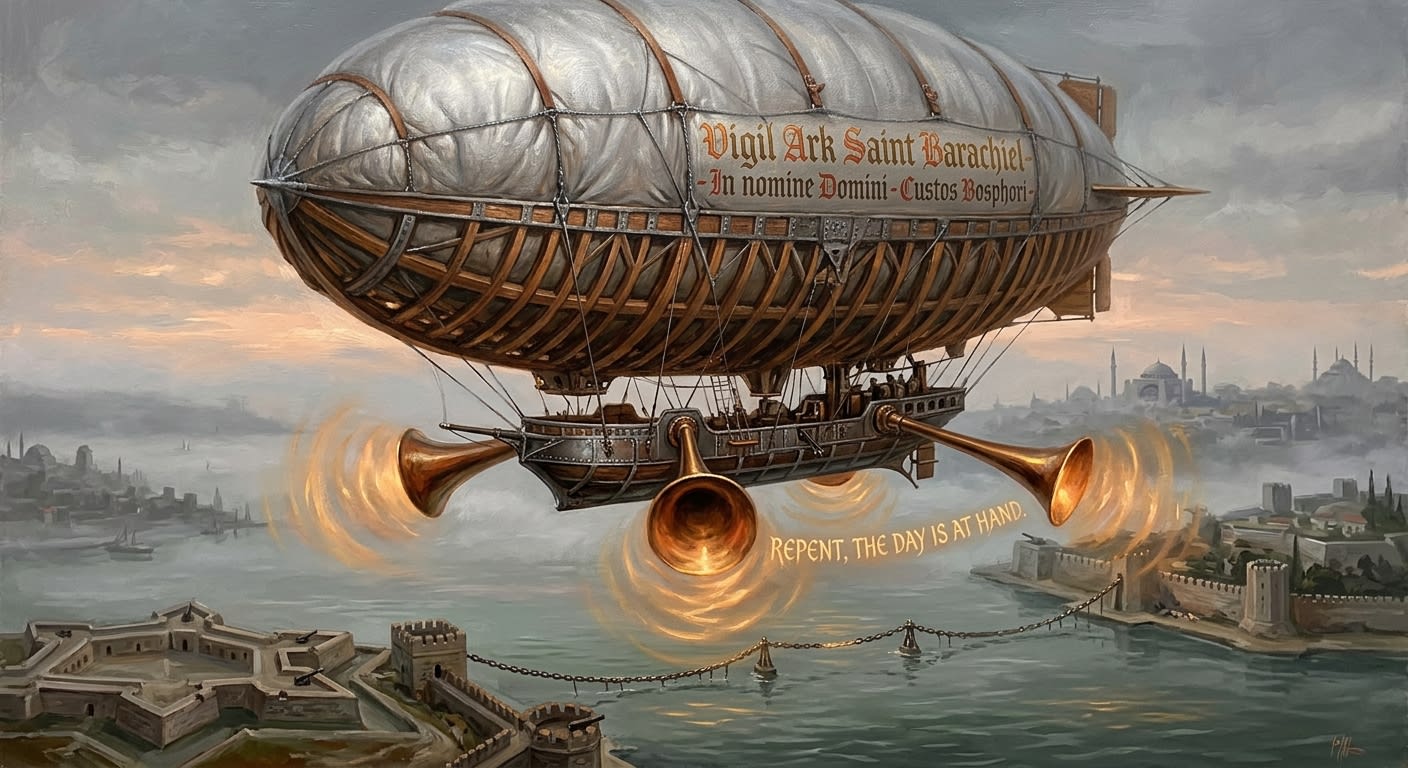
In A.S. 168, by commission of the Bureau of War and under the oversight of Gate-Warden Petra Valenne, the first dirigible-warship hybrid was launched from the Foundry Quarter drydocks at Bastion-Constantinople and assigned to permanent patrol over the Bosphorus strait. It was named for Saint Barachiel, patron of aerial witness — a saint whose feast day the Bureau of Doctrine had invented three months prior to the launch and whose hagiography consists of a single sentence: “He looked down, and what he saw was true.” The Bureau does not explain how a saint whose existence was declared in A.S. 167 could have patronage over a concept — aerial witness — that did not exist before the Ark's commission. The Bureau does not explain because the Bureau does not need to explain. The saint exists. The Ark flies. Faith, like engineering, is a matter of load-bearing rather than logic.
The Vigil Ark Saint Barachiel rose on the morning of the Feast of Saint Barachiel — the coincidence orchestrated by Valenne herself, who understood that a weapon consecrated on its patron's day would receive funding that a weapon consecrated on a Tuesday would not — and took station above the strait at five thousand feet, where the Bosphorus fog breaks and the air turns sharp as a Confessor's opening question.
It has not landed since, except for refit. Seven refits in thirty-three years. Each time, the relic-chapel is re-consecrated by the Hieromnemon on duty. I performed the fifth consecration myself, in A.S. 194. The incense at five thousand feet smells different than at sea level. Thinner. Closer to the source, one might say, if one were inclined to piety. I am inclined to piety. I am paid to be.
#On the Vessel
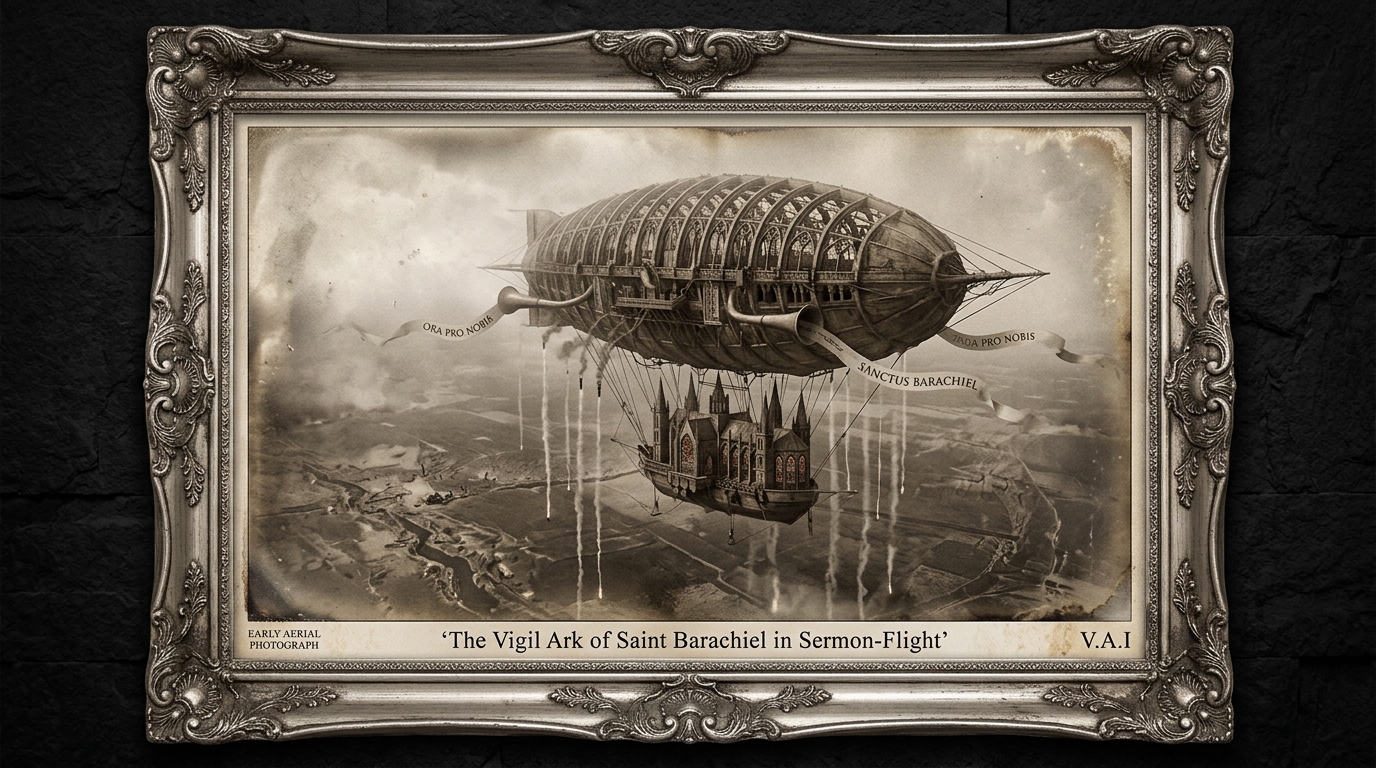
The Saint Barachiel is a lighter-than-air reliquary-cathedral. I am aware that this phrase sounds as though it were composed by a drunkard in a scriptorium, but it is the Bureau of Engineering's own classification, and I will use it because the alternatives — “armed theological dirigible,” “consecrated aerial weapons platform,” “the thing in the sky that screams hymns and drops fire” — are each, in their way, less precise.
The hull is ribbed in the manner of a cathedral's ribcage. This is architecture, not metaphor: the spars are quartered oak faced with iron, set at intervals that correspond to the proportions of the nave of Strasbourg Cathedral, because the Bureau of Engineering determined that a hull built to sacred geometry achieves lift coefficients that a hull built to secular geometry does not. I am told the mathematics are sound. I am told the mathematics also make no sense. Both statements come from the same engineer, who has since requested transfer to a ground posting.
The gas envelope above the hull is filled with a substance the Bureau of Rites refuses to name in writing and the Bureau of Engineering refers to, in internal memoranda, as “Compound 7.” It is lighter than hydrogen. It does not burn. It smells, according to the fifth crew's intake physician, “like old churches.” The Bureau's position is that Compound 7 is a natural gas harvested from a sealed geological formation beneath Constantinople. The geological formation in question is the Third Ossuary. I record this without comment. The Bureau records it without comment. We are, all of us, recording without comment at considerable volume.
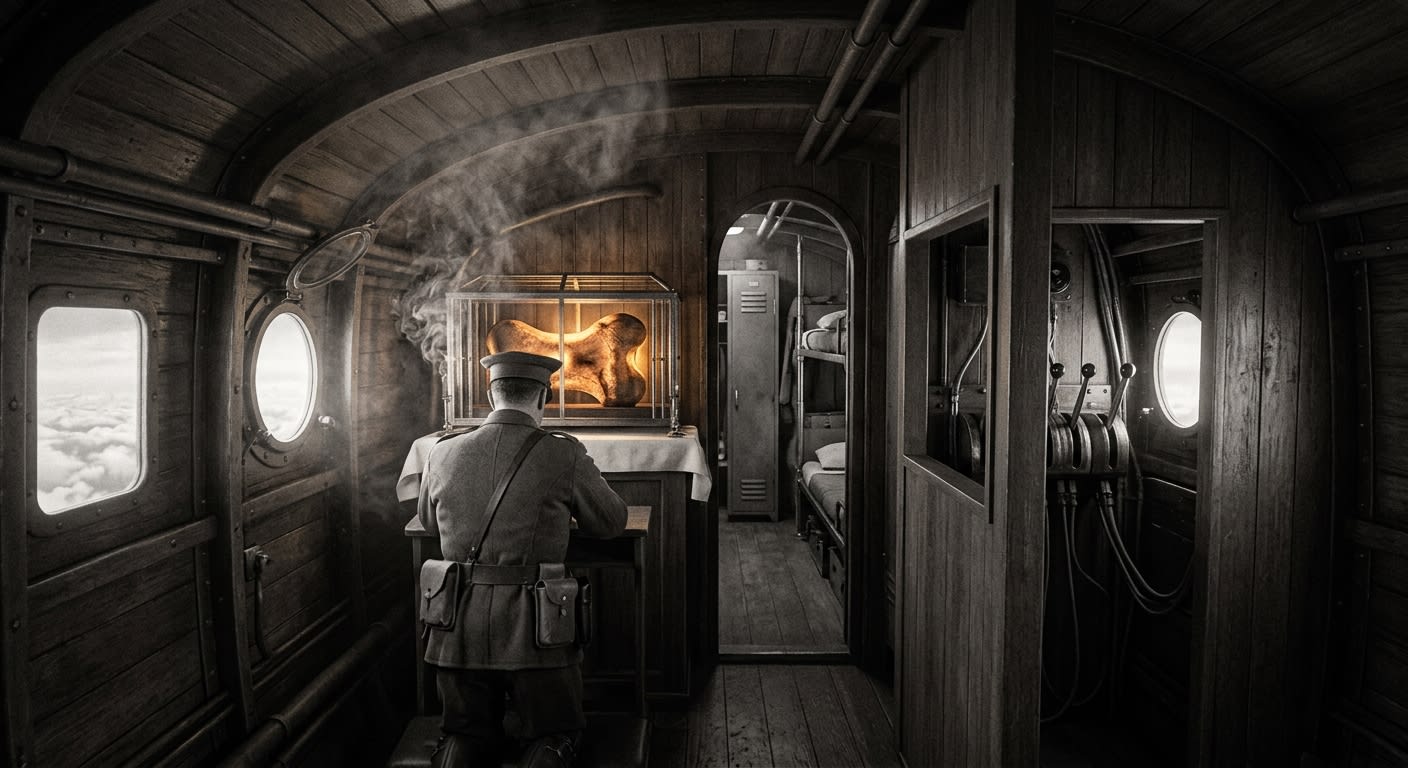
The gondola — suspended beneath the hull by iron chains and sanctified cable — is a working chapel. It contains an altar, a reliquary niche, a pulpit, a small sacristy for the attending chaplain, crew quarters sufficient for eleven, and an armoury. The reliquary niche houses a first-class relic of Saint Barachiel (Unregistered): a knucklebone, if the Bureau is to be believed, though I note that a knucklebone sufficient to fill a reliquary the size of a wine cask is a knucklebone of unusual dimension, and Saint Barachiel — whose hagiography, I remind the reader, consists of seven words — does not elsewhere appear in the anatomical record. The relic's presence ensures the Ark's lift at altitudes the Bureau of Engineering classifies as “otherwise impermissible.” What “otherwise impermissible” means, in practical terms, is that without the relic, the Ark would not fly. Compound 7 provides buoyancy. The relic provides permission. The distinction is theological and the Ark does not care.
The armaments are three:
The Sermon-horns — four great brazen projectors mounted on swivel-carriages at the gondola's cardinal points, each painted with hymn-scrolls in oxblood ink by the Scriptoria of Strasbourg, each capable of broadcasting the Bureau of Doctrine's assigned sermon at a volume the operational manual describes as “permitting intelligibility to faithful and unfaithful alike.” I have heard the Sermon-horns from the ramparts of Constantinople's outer wall, a mile below and two miles distant. They are intelligible. They are intelligible in the way that a cathedral organ is intelligible when you are inside the organ. The faithful listen. The unfaithful also listen, because the unfaithful have eardrums, and eardrums are not optional.
The Censer-racks — retractable arrays of incendiary censers, each the size of a man's torso, loaded with a compound the Bureau of Rites calls “sanctified fire” and the Foundry Quarter workers who manufacture it call “devil-broth.” The censers are dropped upon positions indicated by the Legate's writ. They fall slowly, trailing blessed smoke. They detonate on impact with a sound that the fourth crew's bombardier describes as “the last note of a hymn, if the hymn were very angry.” The censers are effective against surface targets, mid-strait assault craft, and — on one occasion, A.S. 183, during an attempted boarding by an unidentified winged entity — aerial threats. The entity was not recovered. The censer was not recovered. The bombardier who made the shot has been promoted twice and decorated once, and has since developed a habit of looking up at empty sky and flinching.
The Reliquary-chapel itself, which I have already described, but which deserves a second notation here because it is the Ark's true weapon. The Sermon-horns broadcast. The censers destroy. The chapel sanctifies the air through which the Ark passes, creating a corridor of consecrated atmosphere — a Bellway — that demons cannot enter without cost, and that cost, according to the Bureau of Rites' A.S. 190 assessment, is “theologically significant and operationally encouraging.” The Ark does more than patrol. It blesses the sky. The sky, for the length of the patrol, is holy ground. The absurdity of holy sky does not trouble the Bureau. The absurdity of the entire war does not trouble the Bureau. The Bureau is, in this regard, admirable.
#On the Bellways and the Fleet
The Saint Barachiel does not fly alone. It is the flagship of a small fleet — three Vigil Arks assigned to the Constantinople theater, each consecrated to a different patron, each operating along a designated aerial corridor the Bureau of Bells calls a Bellway.
The Vigil Ark of Saint Gabriel operates the northern Bellway, covering the approach from the Black Sea and the coastal waters where the Reliquary Flotilla rides anchor. It is a newer vessel, commissioned A.S. 182, smaller than the Barachiel by a third, and crewed by men who describe their assignment as “the quiet one.” The northern Bellway is quiet. The Black Sea is quiet. This is not reassuring.
A third Ark — the Vigil Ark of Saint Uriel — was commissioned for the southern Bellway in A.S. 191 but has never achieved sustained flight. The relic assigned to its chapel — a tooth attributed to Saint Uriel, purchased at considerable expense from a reliquary dealer in Marseille — has failed to provide lift on four separate attempts. The Bureau of Relics insists the tooth is authentic. The Bureau of Engineering insists the hull is sound. The Ark sits in its drydock in the Foundry Quarter, fully assembled, fully consecrated, and fully grounded, and the Bureau of War has ceased requesting explanations because the explanations were worse than the problem.
An earlier edition of this entry listed the Vigil Ark of Saint Raphael as the third vessel in the Constantinople fleet.
No Vigil Ark of Saint Raphael has been commissioned. No Vigil Ark of Saint Raphael has been proposed. The name appeared in a Bureau of Records filing that has since been attributed to a clerical error, a misfiled requisition, or — as the filing clerk involved stated under oath — “a name that wrote itself in the margin of the ledger overnight.” The Bureau of Records considers the matter resolved. The filing clerk has been reassigned.
These three — or two, or two and a hope — patrol corridors that stretch from the Bosphorus mouth to the outer anchorage, a combined distance of approximately forty miles of consecrated sky. The Bellways are routes. They are architecture — invisible buttresses of blessed air that hold the strait's defenses together. When the Barachiel is grounded for refit, the northern Bellway doubles its patrol to compensate, and the gap in the southern sky is filled with nothing, and the soldiers on the chain-booms below spend the refit period looking upward with an expression I have learned to recognise as theological anxiety.
The Vigil Arks had predecessors. The Bureau of Records preserves references to the Angelus Engines — early lighter-than-air craft from the first decades of the Line, experimental platforms that carried relics aloft on silk envelopes filled with heated air, crewed by two men and armed with prayer. They were fragile. They caught fire with a regularity that the Bureau of Festivals eventually incorporated into the liturgical calendar by designating the crashes as “Ascensions of the Faithful, Category: Expedited.” The Angelus Engines were superseded by the Sky-Censer Mantles (Unregistered) — gliders stitched from relic-cloth, trailing censers of sanctified smoke — and those in turn by the Vigil Arks. Each generation larger, heavier, more heavily armed, and more difficult to explain to a theologian who asks where, precisely, in scripture, the Creator endorses armored flight.
#On the Doctrine of Aerial Sermon
The Saint Barachiel is a weapon. The Bureau of War commissioned it as a weapon. It drops incendiaries. It carries an armoury. Its crew includes a bombardier, a signals officer, and a man whose official title is “Hymn-Gunner” and whose job is to aim the Sermon-horns at targets below.
It is also — and this is the matter on which the Bureau of Doctrine insists, and on which the funding depends, and on which the Ark's continued operation rests as surely as it rests on Compound 7 and the knucklebone of a seven-word saint — a catechetical vessel. Each patrol carries a sermon from the Bureau of Doctrine's daily roster, selected by the Catechetical Division's Aerial Wing, and that sermon is broadcast over the operational sector for the duration of the Ark's fuel. The fuel supply is calibrated to the sermon's length. When the sermon ends, the Ark returns to its mooring mast. The Bureau has ruled — with a specificity that borders on the liturgical — that no Ark shall be armed with a sermon longer than it can preach before nightfall.
The sermons are audible at ground level. They are audible at sea level. They are audible, according to the Bureau of Bells' acoustic surveys, at a depth of approximately forty feet below the water's surface, which means that every fish in the Bosphorus has heard the Word, and every demon lurking in the mid-strait depths has heard it too, and the Bureau of Doctrine considers both audiences equally important. The Bureau does not distinguish between the conversion of the faithful and the discomfiture of the damned. Both are scored on the same ledger. Both contribute to the quarterly metrics. The Ark's sermon-flight hours are logged by the Sky-Sermon Attendance Auditors on the ground, who measure compliance by sector and report their findings to the Bureau, who adjust the next day's sermon accordingly, who send the Ark aloft again, who drop fire and scripture in equal measure, who return, who rearm, who rise.
The congregation below has no choice in the matter. This is, the Bureau assures me, the definition of grace.
#On the Sanctissima Vox
The Saint Barachiel is the most famous Vigil Ark in the Synod's fleet. It is famous because it flies, because it has flown for thirty-three years, because it has never been lost.
The Sanctissima Vox is the most famous Vigil Ark that is not in the Synod's fleet. It is famous because it fell.
In A.S. 147 — four years after the Year of Ash Rain, when Maldrake's Thracian fires had darkened the sky above Constantinople for eleven days — the Sanctissima Vox was dispatched on a broadcast mission over the Blightmarsh. Its mission was experimental: to project hymnal frequencies across the Marsh in an attempt to disrupt the Marsh's tendency to swallow sound, to deaden hymns, to return prayers as silence or as something that was worse than silence.
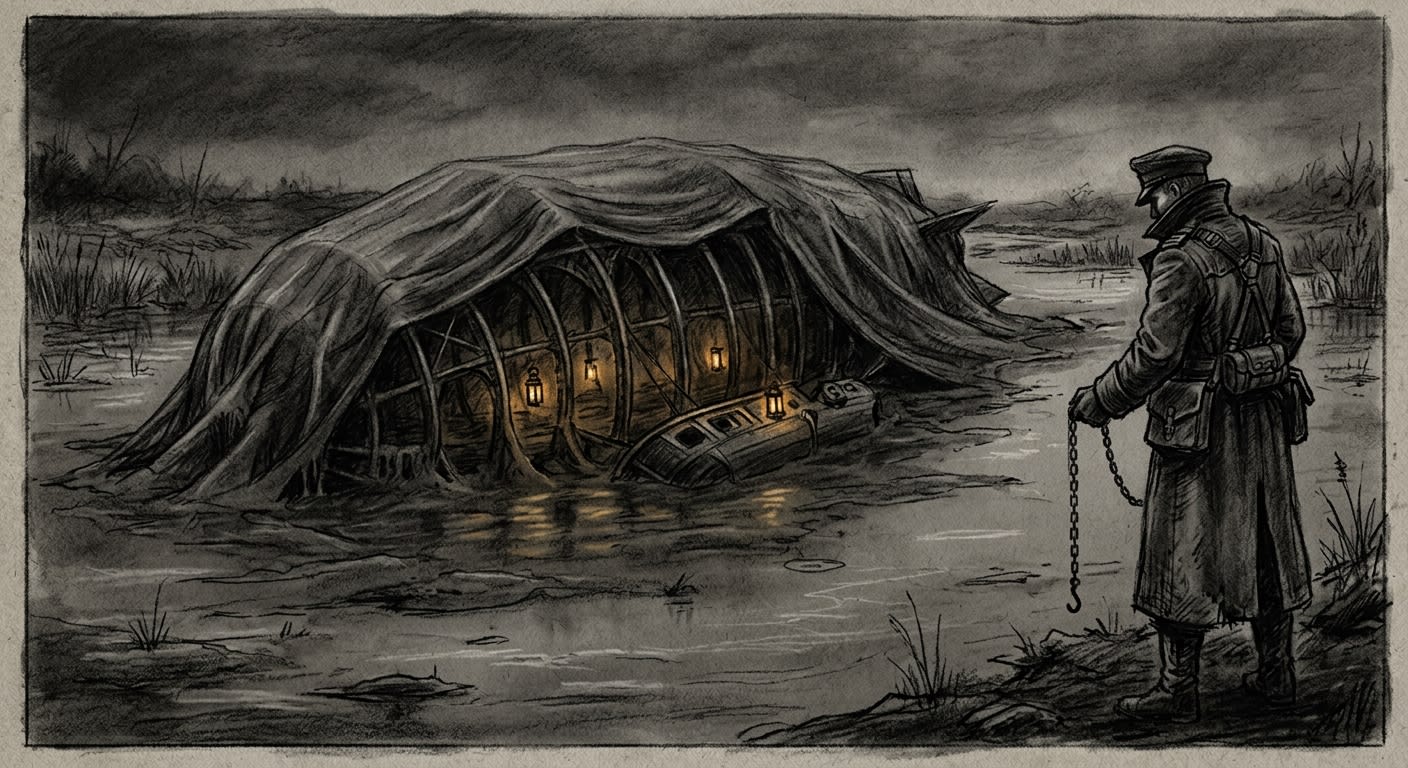
The Sanctissima Vox crossed the Blightmarsh boundary at dawn. By midday its signal degraded. By evening its relic-lanterns — the candles that powered its broadcast — had aged centuries in minutes, wax flowing like water, wicks crumbling to powder. The Ark fell. It fell slowly, which is the particular horror of the account: a settling, as though the air had become too heavy, as though gravity in the Marsh operated on a different schedule. The sermon the Ark had been broadcasting accelerated as the candles died — words compressing into a continuous tone that the three survivors described as thunder, then a scream, then something that was hungry, and then silence.
Thirty-eight of forty-one crew perished. The wreck embedded in the grey mud seventeen miles east of the boundary. Bureau reconnaissance flights — A.S. 168, A.S. 183, A.S. 197 — report the same finding: the wreck is visible beneath the surface. Its lanterns still glow. The mud around it is darker than the surrounding Marsh. The Bureau of Bells classifies the lanterns' continued glow as “a theological anomaly of mild operational interest.”
The Sanctissima Vox is why the Saint Barachiel was commissioned. The Bureau of War's logic was straightforward: the Marsh ate an Ark because the Ark flew over the Marsh. The strait would not eat an Ark because the strait was not the Marsh. The Barachiel would fly over consecrated water, not cursed earth. The logic held for thirty-one years. Then came the Broadcast.
#On the Broadcast
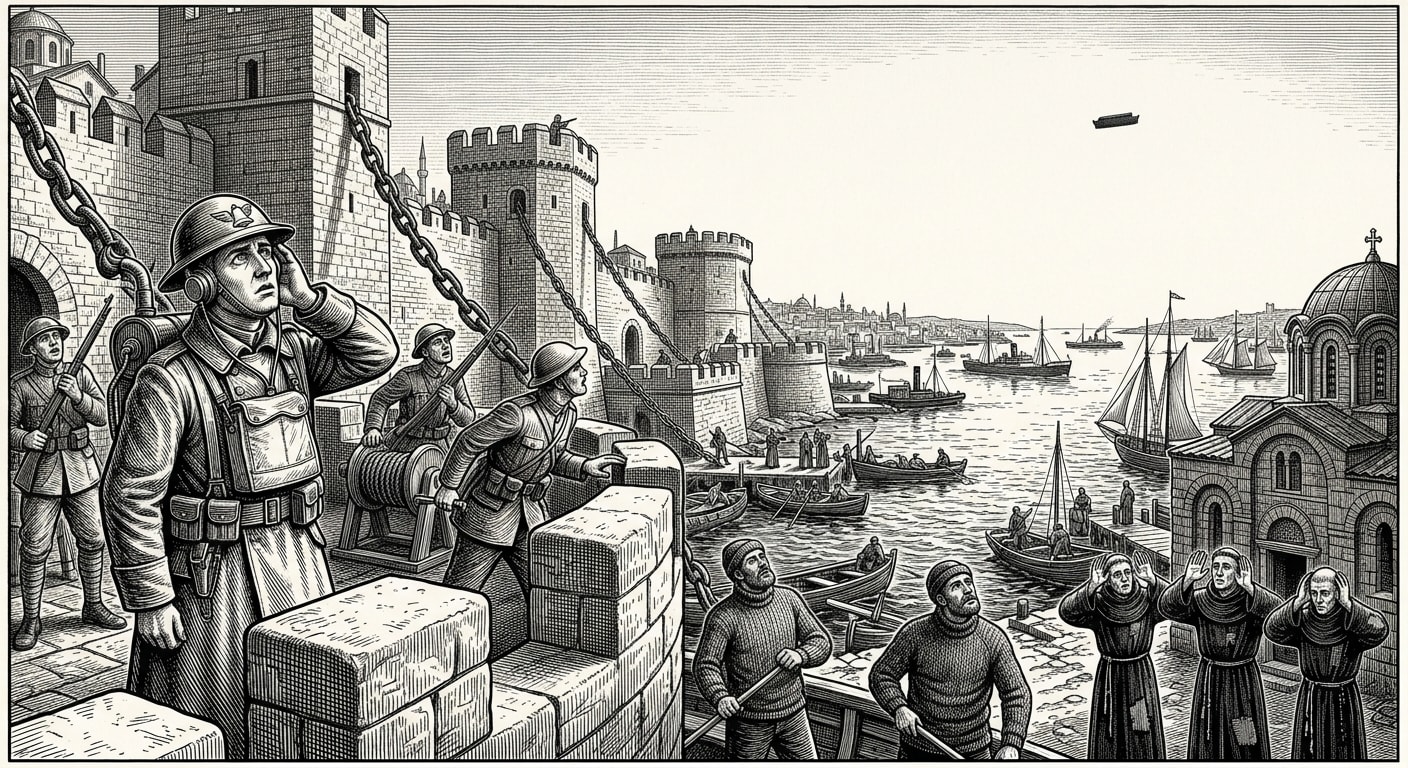
On the 3rd of Argent, A.S. 199, the Vigil Ark Saint Barachiel, on routine patrol over the Bosphorus strait, broadcast — across all frequencies, through all four Sermon-horns simultaneously, for a duration of eleven minutes and forty-three seconds — a voice that was not any crew member's.
The voice read what several listeners have described as “an apology.”
I will record what I am permitted to record. I will record it precisely, because precision is the only defence against the urge to speculate, and speculation on this matter has been classified as a Category Two Doctrinal Hazard by the Bureau of Doctrine itself — which is to say, by me, because I drafted the classification, because someone had to, and I was the only person in the room whose hands were steady enough to hold the pen.
The patrol was routine. Third crew, eleventh month of their rotation, no incident in the preceding six weeks. The Barachiel was broadcasting the Tuesday Exhortation on the Duties of the Faithful to Render Grain Unto the Tithe — a sermon of approximately four hours' duration, well within fuel parameters. At the fourteenth minute of the second hour, the Sermon-horns ceased broadcasting the Exhortation. There was no mechanical failure. The horns did not malfunction. The crew's signals officer — whose deposition I have read in its entirety, who was weeping as he gave it, who has since been retired on medical grounds — stated that the equipment “continued to function perfectly. It simply began to broadcast something else.”
The voice was described by fourteen independent witnesses — soldiers on the chain-booms, monks at the Harbor chapel, fishermen in the outer anchorage, one Bureau of Shadows operative whose presence at the location has not been explained — as “measured,” “clear,” “sorrowful,” and “familiar in a way that could not be identified.” It spoke for eleven minutes and forty-three seconds. It spoke in the liturgical register. It was, by every acoustic analysis the Bureau of Bells has conducted, a human voice, produced by human vocal cords, amplified through the Barachiel's own Sermon-horns. No crew member was speaking. The chaplain was at prayer. The Hymn-Gunner was asleep. The captain was on the observation deck, and his testimony — six words, repeated — was: “It was coming from the chapel.”
The content of the Broadcast is classified at the Hierarch's Seal — the highest classification the Synod possesses, a classification so restricted that fewer than eleven living persons have access, and I am one of them, and I cannot tell you what I heard when I reviewed the signals log, and I will not, and the fact that I have described it here as something I heard rather than something I read is a detail I will allow the perceptive reader to contemplate at their own risk.
Four listeners — civilians, two fishermen and two harbour clerks — attempted to describe the content publicly. They were offered, at Bureau expense, a period of theological rest at a facility in the Swiss cantons. They accepted. They have not returned. The facility reports their condition as “contemplative.”
#On the Fourth Crew
The third crew was replaced within the week. Their tour was eleven months old; they had three months remaining. The Bureau of War offered no explanation for the early rotation. The Bureau of War offered the third crew honourable discharge, full pension, and a posting to the Swiss cantons — the same cantons, the same facility, the same “contemplative” classification. Eight of eleven accepted. Three declined and requested transfer to ground postings. One of the three — the bombardier, a woman named Sergeant Kael — requested transfer to the Blightmarsh observation posts. This request was granted. I am told she watches the Marsh from Kestrel-7 and does not speak of the Broadcast and does not speak of the Ark and does not speak of the voice, and that she sleeps soundly, which is more than can be said for most of us who have heard the log.
The fourth crew — the present crew — was assembled from volunteers. There were, I am told, more volunteers than positions. I find this either admirable or alarming, and I have not decided which, and the Bureau has not asked me to decide, and the Bureau is wise in this regard because my decisions on matters of aerial theology have become, over the past two years, increasingly unreliable.
The fourth crew flies the Ark. They perform their duties with the mechanical competence that the Bureau of War demands and the Bureau of Bells measures. They broadcast the daily sermon. They drop the censers. They patrol the strait. When asked about the Broadcast — and they are asked, by journalists, by chaplains, by fellow soldiers, by me — they describe the air at elevation as “sometimes unusual.” The Bureau of Doctrine has classified this description as acceptable. I drafted that classification too.
The Saint Barachiel still flies. The strait is still patrolled. The blessed incendiaries still fall. The Sermon-horns still broadcast the daily Exhortation, and the congregation below still listens, and the fish still hear the Word, and the demons in the deep still flinch, and the empty sky above the southern Bellway — where the Saint Uriel should fly and does not — is still empty, and the Sanctissima Vox still glows beneath the Blightmarsh mud, and the fourth crew still describes the air as “sometimes unusual,” and I still review the signals log from the 3rd of Argent every month because the Bureau requires it and because I cannot stop, and the name that appeared in the Ledger's margin has been redacted three times and has returned twice, and the Ark flies, and the Ark flies, and the Ark flies.
The present Codex entry was originally filed under “Bureau of War — Aerial Assets, Conventional.” The classification has been amended.
The Vigil Ark Saint Barachiel is now filed under “Bureau of War — Aerial Assets, Unconventional (Pending Reclassification).” The reclassification has been pending since A.S. 199. The Bureau does not expect it to resolve. The Bureau expects the Ark to continue flying. The Bureau expects both conditions to coexist indefinitely, and the Bureau is, I suspect, correct, and the coexistence of the unexplained and the operational is, after all, the foundational principle of the entire Synod, stated plainly: we do not understand it, but it works, and if it works we will file it, and if we file it we will fund it, and if we fund it we will fly it, and the sky is ours, and the sky is blessed, and the thing in the chapel that spoke in no crew member's voice is not our concern, because our concern is the sermon, and the sermon is on schedule, and the schedule is ratified, and the Ark flies.