
#On What Was Found
"Relics of Unprecedented Sensitivity, Classification: Maximum, Access: Hierarch's Seal or Above." — Bureau of Records filing notation, A.S. 47, penmanship shaking
When the retreating armies reached the Bosphorus headland in the winter of A.S. 47, they found two things. The first was a defensible position — a spur of ancient bedrock jutting above the strait, old Byzantine rubble already forming the skeleton of what would become Bastion-Constantinople. The second thing they found when they drove their first pilings into that bedrock. The pilings struck chambers. The chambers were sealed. The chambers were old. The chambers were filled with a silence that the Bureau of Rites would later classify as "unprecedented" — a word the Bureau uses sparingly, and never for comfort.
They were not archaeologists. They were soldiers who had retreated for two years across a continent that was being eaten alive by the armies of the Great Deceiver, and they had no interest in antiquities. They sealed the chambers again, with fresh mortar and a wax stamp, and they built their fortifications on top, and they did not discuss what they had seen below.
The Synod did not exist in A.S. 47. The Bureaus did not exist. The bone-stamp had not been invented. Whatever procedures those soldiers applied to the sealed chambers, they applied them without doctrine, without precedent, without the apparatus of holy governance that would later be constructed above their heads. They sealed the chambers because the chambers felt like they should be sealed. This is instinct. The Bureau of Doctrine would, forty-three years later, retroactively classify their instinct as "Providential Guidance, Category: Pre-Institutional," which is the Bureau's way of claiming credit for something that happened before the Bureau was born.
#On the Seventeen Seals
The wax stamp applied in A.S. 47 has been renewed eleven times. The mortar around the primary entrance has cracked and been reapplied seven times. On careful examination — and I examined it carefully, with a lantern and a magnifying glass borrowed from the Bureau of Engineering's draughtsman's office, while a junior clerk held the lantern with hands that shook more than the flame — the wax seal shows seventeen distinct layers. Each layer represents a separate sealing. Each sealing represents a separate occasion on which someone in authority decided that the existing seal was insufficient.
The dates of these sealings are recorded in the Bureau of Records' Vault Seven, Sub-Archive Constantine, filed under a reference number I am not permitted to reproduce. The earliest is A.S. 47. The most recent is A.S. 199. The intervals between sealings are irregular. The Bureau does not explain the irregularity. I will note, for the record, that the intervals correlate with no liturgical calendar, no administrative schedule, and no military operation — but they correlate, with uncomfortable precision, with incidents the Bureau of Bells has classified as "sub-carillon resonance anomalies of unidentified origin."
The entrance itself is a stone archway, Byzantine in construction, older than anything above it by several centuries at minimum. Iron bolts were driven through the original stonework by the A.S. 47 soldiers. The bolts have not rusted. Iron rusts in damp stone. Constantinople's sub-levels are damp. The bolts have not rusted. The Bureau of Engineering attributes this to "an unusually stable ferric composition." The Bureau of Engineering does not believe this explanation. I asked.
#On the Bells That Have No Tower
At night — and it is always night when they are heard, and always in the lower Rings, in the Widow's Lanes, in the bone-choked alleyways nearest the sealed arch — one hears bells.
The bells do not match any liturgical schedule. They ring in sequences the Bureau of Bells cannot identify. No bell-tower is close enough to account for the sound. The Sub-Carillon of the Widow's Lanes (Unregistered), which maintains seven bells at containment-grade frequencies on a half-hourly schedule, has been operating without interruption since A.S. 90. The unidentified bells ring at intervals that bear no relation to the Sub-Carillon's schedule and at frequencies the Bureau of Bells' instruments register as "below threshold" — which means the instruments detect them but cannot classify them, which means they are there, which means the Bureau would prefer they were not.
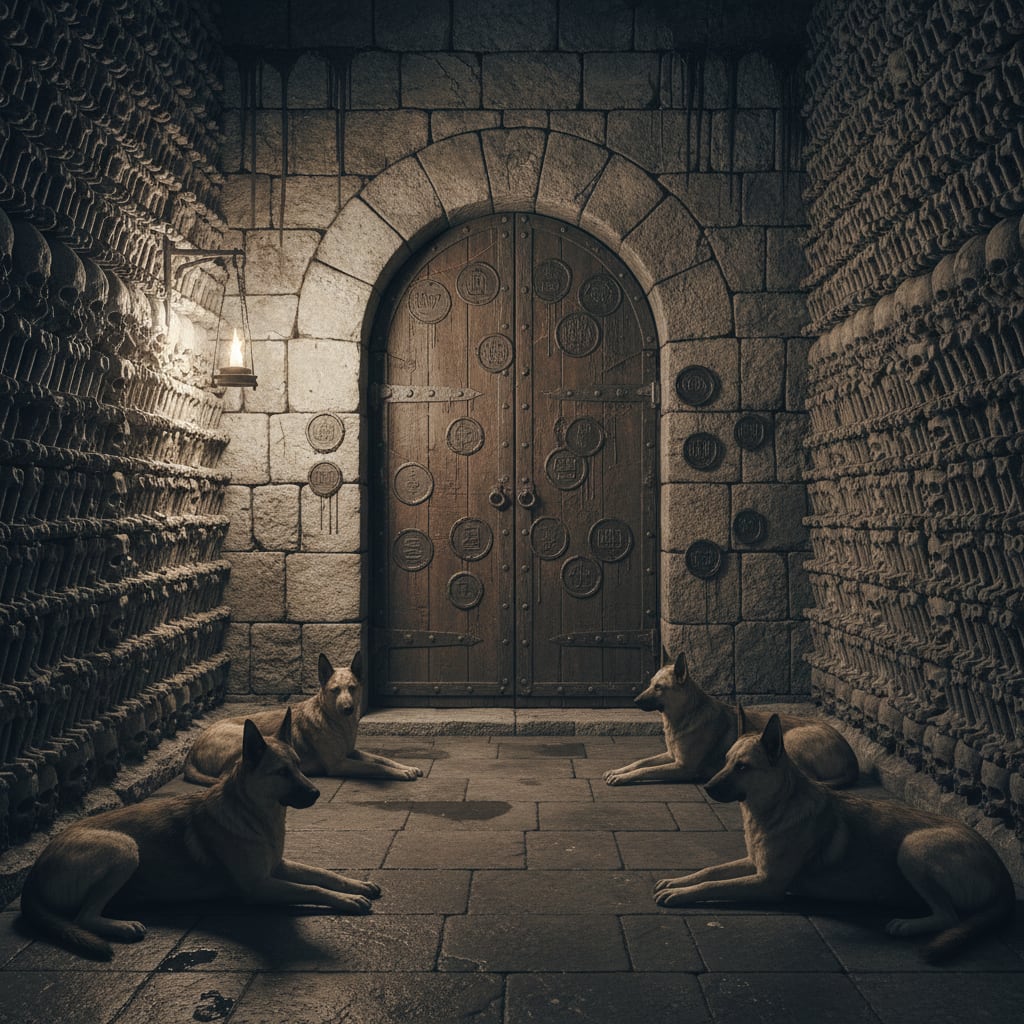
Dogs hear the bells with a clarity that humans do not share and do not envy. The garrison dogs — the mastiffs and the terriers that patrol the Ossuary Rings for vermin and for things the Bureau declines to name — respond to the unidentified bells with a behaviour that the Bureau of Purity's animal-behavioural assessor has classified as "anomalous quiescence, Category: Unprecedented." They do not bark. They do not whine. They do not flee. They lie down, face toward the sealed archway, and wait. They wait with a patience that is, in a dog, more unsettling than fear. A dog that fears something runs. A dog that waits for something has made a decision about what is coming, and has accepted it.
The soldiers who walk patrol in the lower Rings at night have developed customs the Bureau does not sanction and does not prohibit. They walk in pairs. They do not speak near the sealed arch. They carry salt — common table salt, purchased from the commissary — in their left pockets, a practice the Bureau of Rites has investigated twice and declined to forbid, on the grounds that salt is not a regulated liturgical substance and soldiers are entitled to season their rations however they choose. The soldiers do not use the salt for seasoning. The Bureau of Rites is aware of this. The matter has been filed.
#On What Is Inside
The Bureau of Records has published four separate explanations for why the Third Ossuary remains sealed. The explanations are mutually contradictory. This is deliberate. The Bureau's position is that an enemy who does not know which lie to believe will waste resources investigating all four, and the contradiction itself has been classified as a security measure — a position so elegant in its cynicism that I almost admire it, were it not also an admission that all four explanations are false.
The four explanations, in order of their publication:
The first, issued A.S. 91: the Third Ossuary contains relics too holy for common access, awaiting a period of spiritual maturity in the general population before they may be revealed.
The second, issued A.S. 134: the Third Ossuary contains the remains of ancient saints whose veneration requires a theological framework the Bureau has not yet constructed.
The third, issued A.S. 167: the Third Ossuary contains hazardous alchemical residues from Byzantine-era experiments and is sealed for public safety.
The fourth, issued A.S. 199 — the same year as the seventeenth sealing, the same year as the Vigil Ark broadcast incident (Unregistered), the same year the Bureau of Purity's atmospheric readings in the Fourth Ring spiked by a margin the Bureau classified and then reclassified — the fourth explanation states simply: "The Third Ossuary is sealed by prior authority and the present administration sees no cause to revisit the matter."
An earlier edition of this Codex entry noted that the Third Ossuary "presents no operational hazard and has been thoroughly catalogued."
This statement was filed by an inlier-clerk who has since transferred to Bastion-Danzig (Unregistered). The Third Ossuary has never been catalogued. The Third Ossuary has never been opened — that is, it has never been opened by anyone who subsequently reported what they found. The distinction is the Bureau's, and it is more honest than the Bureau intended.
I do not know what is inside the Third Ossuary. I wish to be clear about this. I am the Warden of the Sacred Ledger, the Archivist of the Holy Bureau of Doctrine, and I do not know. I have requested access on three occasions. The first request was denied by the Bureau of Records. The second was denied by the Bureau of Rites. The third was denied by a clerk whose Bureau affiliation I could not determine, in a corridor I could not locate on any map, by means of a stamp whose registration number does not appear in the Bureau of Masks and Seals' master catalogue.
#On Compound 7
There is one thing that comes out of the Third Ossuary, and the Bureau would prefer I did not mention it. I mention it because the Vigil Ark Saint Barachiel flies above the Bosphorus on patrol every day, and what keeps it aloft is a substance the Bureau of Engineering refers to, in internal memoranda, as "Compound 7."
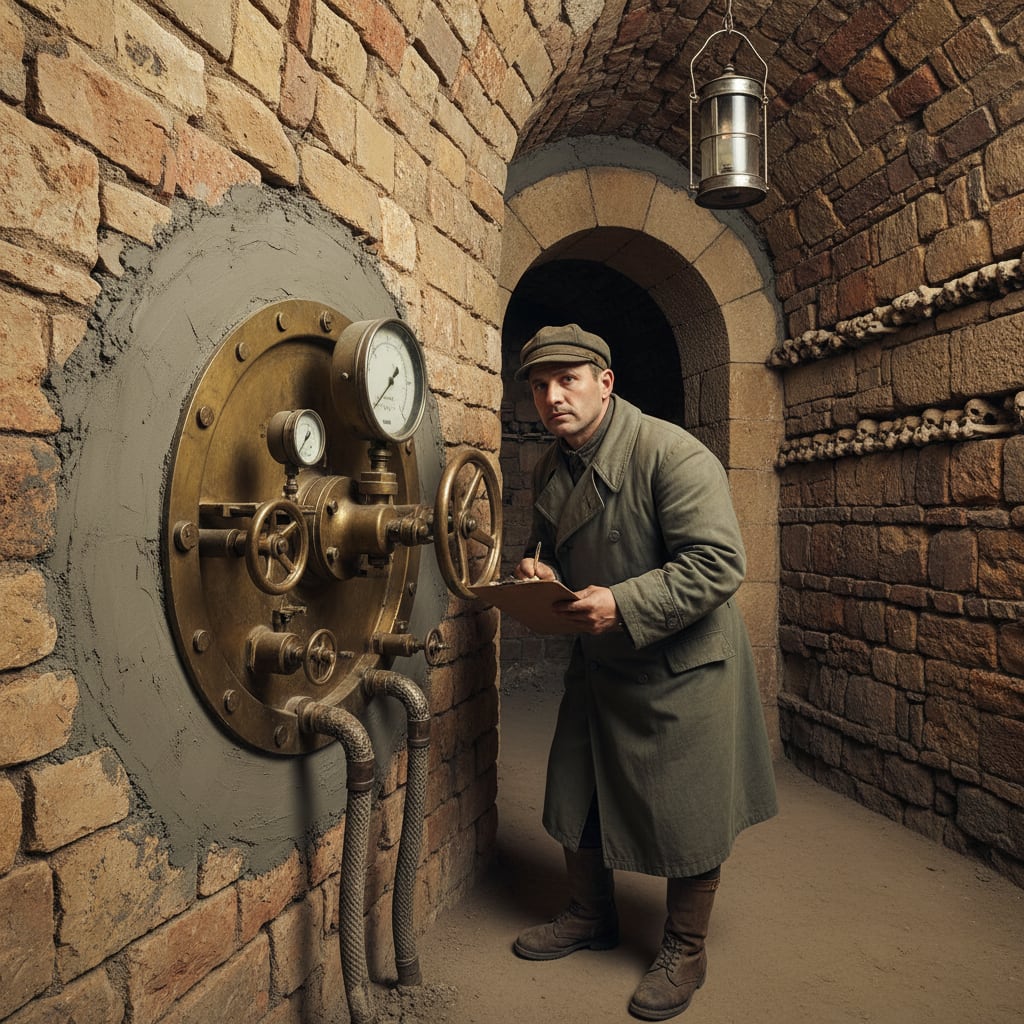
Compound 7 is lighter than hydrogen. It does not burn. It smells, according to the fifth crew's intake physician, "like old churches." The Bureau's official position is that Compound 7 is a natural gas harvested from a sealed geological formation beneath Constantinople. The geological formation in question is the Third Ossuary. The Bureau of Engineering harvests the gas through a valve system installed in A.S. 168 — the year the Barachiel was commissioned — in a section of the sealed archway that was breached for precisely this purpose and then resealed immediately after the valve was fitted.
The valve is attended by a single technician at all times. The technician's posting is a six-month rotation. The technician is selected by the Bureau of Rites, screened by the Bureau of Purity, and briefed by an office whose name I have not been told. The technician does not speak about the posting after rotation ends. This silence is not enforced by any regulation I can locate. It appears to be voluntary. The three former valve technicians I have located and interviewed described the work as "routine," "uneventful," and "the quietest six months of my life." All three used the word "quiet" without prompting. All three paused before saying it.
████████████████ Bureau of Rites Assessment, A.S. 198 — Third Ossuary Atmospheric Survey: Compound 7 extraction rate has declined by ████████████████ percent since A.S. 194. The decline correlates with ████████████████ in Rings One through Four. Recommendation: ████████████████ and a review of extraction valve integrity. The valve has been inspected. The valve is intact. The decline has no mechanical cause. ████████████████ Mother-Cryptor Sabine has submitted a private memorandum to the Hierarch's office. The content of the memorandum is sealed. Its filing classification is higher than this assessment's.
#On Mother-Cryptor Sabine
Mother-Cryptor Sabine administers the Ossuary Rings that surround the Third Ossuary, and she is — by extension, by proximity, by the fact that no one else will do it — the closest thing the Third Ossuary has to a keeper. She catalogues the rings above. She maintains the bone-stamp schedules. She coordinates with the Bureau of Bells on the Sub-Carillon. She sleeps in a cell on the Fifth Ring's inner face, thirty metres from the sealed archway, and she sleeps facing away from it.
I asked her what she knew of the Third Ossuary. She was quiet for a long time. Then she said: "I know which direction to walk when I have bad dreams." I did not ask which direction. I did not want to know.
She has served as Mother-Cryptor for twenty-three years. In that time, she has filed forty-seven reports with the Bureau of Rites regarding the Third Ossuary. Forty-six of those reports consist of the same sentence: "No change." The forty-seventh, filed in the spring of A.S. 199, consists of two sentences: "Change observed. Request audience."
The audience was granted. The audience was conducted behind sealed doors. The minutes of the audience are classified at a level I cannot access — and I am the Warden of the Sacred Ledger, which means there are at most seven people in the Synod's hierarchy who outrank my clearance. Seven people know what Sabine reported. I am not one of them.
A prior filing from this office noted Mother-Cryptor Sabine's age as "approximately sixty." This estimate was based on physical appearance and was consistent with her service record.
The Bureau of Records has since confirmed that Mother-Cryptor Sabine's natal registration writ was filed in A.S. 142, which would make her fifty-nine — consistent with the estimate. However, a secondary filing, located in Vault Seven during an unrelated audit, lists a "Sabine, M." assigned to ossuary maintenance in A.S. 131, eleven years before her recorded birth. The Bureau of Records considers this a clerical error. The Bureau of Records considers many things clerical errors. The frequency of clerical errors in the Third Ossuary's vicinity is itself a matter the Bureau has declined to investigate.
#On the Present Condition
The Third Ossuary is sealed. This is the Bureau's position. This is also the truth, inasmuch as the archway is physically closed, the mortar physically intact, the seventeen layers of wax physically unbroken. The seal holds.
What the seal holds in is the question the Bureau will not answer, and what leaks past the seal despite its holding is the question the Bureau will not ask. The bells toll at frequencies the Bureau of Bells cannot classify. The dogs lie down and wait. Compound 7 bleeds through a valve that was installed for the purpose but whose declining output suggests that the source is either depleting or choosing to deplete. The atmospheric readings in the surrounding Rings have increased by a margin the Bureau of Rites classified and then classified again. Mother-Cryptor Sabine filed her first non-routine report in twenty-three years and was granted an audience whose minutes seven people know and the rest of us are left to imagine.
The Bureau's position is that the Third Ossuary presents no operational hazard. The Bureau's position is that the seventeen sealings are a matter of precautionary maintenance. The Bureau's position is that the bells are echoes, the dogs are dogs, and the gas is gas.
I record the Bureau's position. I do not endorse it. I do not contradict it. I leave the page with a margin wide enough for whatever correction the future requires, and I note — for the Ledger, for the record, for whoever reads this after me — that in A.S. 201, the dogs have not moved.