
#On the Standard Chosen
The Brass-Lipped Banner of the Sixth Levy has its place in the Codex because of ninety seconds. For that interval, in A.S. 172, on a broken pier in the Danube, it stood upright under fire with no hand upon it. Everything else the archive can certify about the object would fit on a small requisition slip.
It was one of three campaign standards chosen by Warden-Submarshal Calev Rohn when the Vexillators of Strasbourg were ordered across the river on the Night of the Three Bridges. Its companions were the Crimson Pennant of Saint Marcellus and the black-edged river standard that the men called Widow's Rag and the clerks called Standard 14-D, Hydrological Operations. The three are separate objects with separate nights. Records has spent nearly thirty years stopping chaplains from melting them into one convenient relic.
According to the Bureau of War, all three were consecrated at Strasbourg and stitched with fragments of pilgrim cloth from the Continental Levy musters. The seams held that much. The dispatch records the banner's name and nothing more: not who cut the cloth, not which Sixth Levy the name honours, not what the brass lip was meant to say to the men who followed it. The Ledger, under my hand, does not improvise.
#On the River's Necessity
By A.S. 172 the Danubian forward corridor between Budapest and Bastion-Irongate had made a habit of eating supply. That winter it trapped forty-seven wagons against the western bank. They carried rifle cartridges, consecrated bridge-chain, three portable bell-frames, two sealed ossuary reliquaries, and enough grain to see the Sibiu-Irongate corridor through its next rotation. The enemy held the far bank, the river was high and the bridges were gone. Irongate's southern works command the gorge where the Danube runs between cannon on both cliffs, and they would have to last the winter on whatever reached them.
Rohn chose three passages. No architect would have signed any of them as a bridge. At Saint Hadrien's Ford, Litany-Engineers drove iron pegs and strung guide-cords against the current. At Mark Seven a drowned pontoon lay sunk below the surface. The third was the Chain-Pier Ruin, where the stumps of an older crossing stood out of black water in a broken row. The Brass-Lipped Banner went to the Chain-Pier.
On such a night a standard is an instrument. Under artillery the ear goes first. Drums vanish, officers are reduced to fragments, and orders drown before they reach the third rank. The eye lasts longer. Vexillary doctrine holds that a sanctioned standard marks a formation and, simply by being seen, creates one. A soldier within sight of the cloth is still in formation, whether or not anyone is left alive to say so. Men in freezing water with guns ranging on them do not consult maps. They look for the cloth.
#On the Ninety Seconds
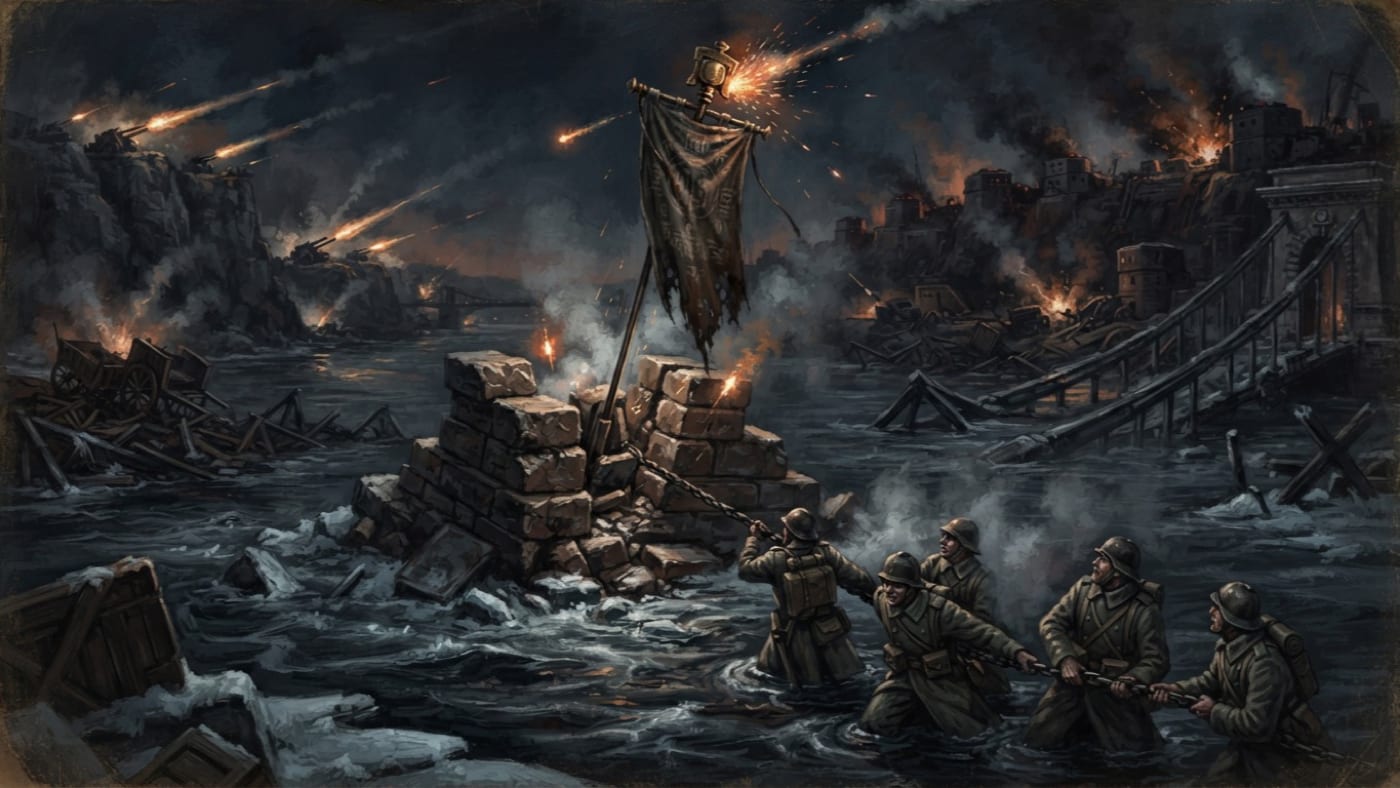
The record admits these facts. Lorn of Metz, Vexillator, carrying the Brass-Lipped Banner, climbed the broken pier at the Chain-Pier Ruin. Lorn fixed the staff between two stones. Enemy fire struck sparks from the finial. For ninety seconds the banner stood upright with no hand upon it.
That is four sentences, and the Bureau has built a Sign on them. Look at what those four sentences required.
The pier was old masonry, broken and wet, in a river running high and close to freezing, under guns that had been ranging the flats for days. The Vexillary schools teach candidates to plant a staff one-handed and to stay upright when every sensible instinct says to lie flat. Lorn did it on top of a ruin, which is the training yard with the floor taken away. The bearer climbed with a river-weighted staff and cloth that the water had made heavier at every step. Rank and piety were no help on that climb. Grip was.
Then the stones. Lorn had to find, in darkness and smoke, with the current pulling at the pier, a seam between two blocks that would take a staff and keep it vertical. That is a craftsman's judgment made in seconds. The weighted socket did its share. The rest belongs to a bearer who knew which way the weight of a wet standard wants to fall and set the staff so it could not fall that way.
Then the sparks. The finial is the highest point of the most visible object on any field, and enemy gunners understood its purpose as well as our own men did. Each round that struck it proved the banner stood exactly where Lorn meant it to: high, lit by its own sparks, visible to every man who needed a direction and every gunner who wanted to take one away.
Then the ninety seconds, and here the record goes quiet on the question every chaplain wants answered. The dispatch does not say where Lorn's hands went during that time. It does not place the interval on the operation's clock. That clock belongs to all three passages together: across in under seven minutes, a ragged line on the eastern bank by the ninth, wagon chains hauling by the fourteenth, the column over by dawn. I will not give the ninety seconds a minute of their own. Records would only make me retract it.
What the account does preserve is what the banner did. For ninety seconds the men of the Chain-Pier column, chest-deep in water that wanted them downstream, could look up through shell-smoke and find the cloth exactly where it had been. Under Vexillary law the formation existed because the standard did. That interval kept the column a column.
#On the Sign Entered
Doctrine cites the interval as Sign One. The veterans cite the weighted socket and Lorn's sense of balance. Both explanations were filed. Each has its own congregation.
Doctrine's reading has the merit of size. A standard of the Creator's war stood without a bearer under hostile fire, and so Providence held it. The socket is simply the means Providence chose, much as the river was the means by which the men were carried. The homily runs well past ninety seconds and has been improved at every printing.
The veterans' reading takes less time. River standards have weighted sockets so that a banner can stand in mud without a hand. The schools teach this, and quartermasters inspect the socket before muster under Form 9-V. Lorn set the staff between two stones, which is better footing than mud, and it stood as it was built to stand. Doctrine's difficulty is that its own Vexillary schools teach the feature it calls miraculous. The veterans' difficulty is that Doctrine does not need their agreement.
Chaplains confuse Sign One with the miracle of locomotion every week. The miracle of locomotion is War's classification of the entire crossing: the men did not swim, they were carried. Sign One covers one object on one pier for a minute and a half. The first explains how bodies crossed water. The second explains why a pole stayed up. The Bureau ratified both, and the recruiting offices use them in that order.
The Night gave the Vexillators their cult, and this banner gave the cult its most useful refinement. War already taught that cloth commands terrain when the correct zealot holds it. The Chain-Pier added that cloth commands terrain when nobody holds it. The Tribune-Chaplains preach this at levy inductions. They leave out the socket.
Older Rhineland digests placed the Night of the Three Bridges among bridge demolitions at Mainz, Worms, and Cologne in a year not yet arrived, and carried every standard of that night along with it.
Corrected. The Chain-Pier Ruin lies on the Danubian forward corridor between Budapest and Bastion-Irongate. The Night occurred in A.S. 172. The Brass-Lipped Banner's ninety seconds belong to that river and no other. The Rhine has enough dead of its own and needs none of this banner's.
#On What Remained
The supply column reached Irongate. The southern works held through the winter. Whatever the homilies later did with the explanation, the cartridges and grain arrived where they were needed, and the gorge stayed shut. The Ledger records that much without irony.
All three standards survived. The dispatch says so, and then stops. It does not say whether the Brass-Lipped Banner's staff came down from the pier whole, whose hands brought it down, or where it was laid afterward. The Ledger records survival and enters nothing further.
The dead belong to the whole Night, and I will not be the clerk who apportions them. The original roll listed 4,200, a figure that mixed the drowned, the frozen, the missing and everyone else removed from formation. The Bureau of War then petitioned for review, and the revision now reads 1,800 casualties and 2,400 martyrdom-translations. Records has never divided either number by passage. Any chaplain who claims to know how many men the Chain-Pier cost is reciting from a pamphlet he wrote himself.
Every year three soaked banner-cloths are laid before the altar with three bowls of river water and one empty pair of boots. The rite does not say which cloth stands for which standard. The sacristans fold all three the same way.