
#On the Crossing
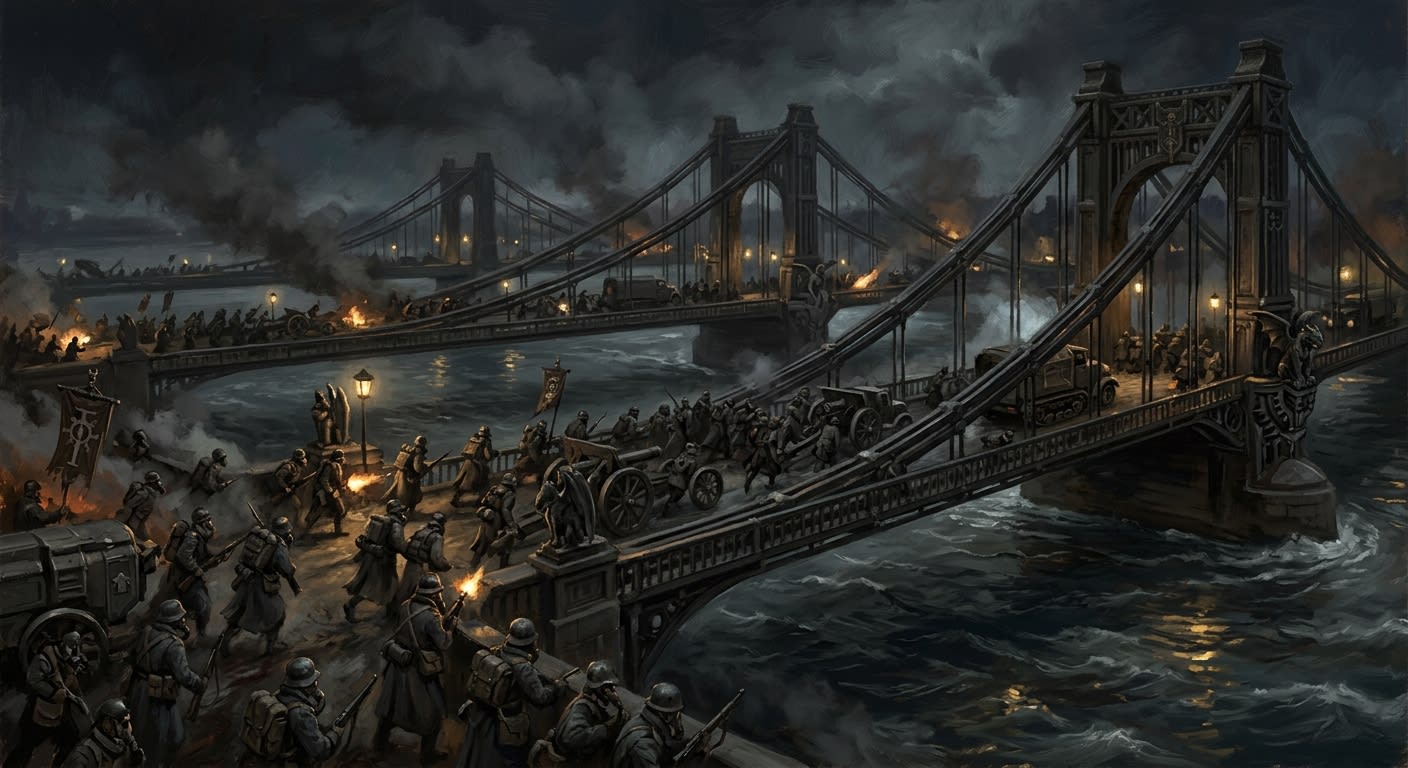
The Night of the Three Bridges occurred in A.S. 172, along the Danubian forward corridor between Budapest and Bastion-Irongate, when the Vexillators of Strasbourg forced three river-fords in a single charge and gave the Bureau of War a phrase it has repeated ever since with the tenderness other men reserve for their children: miracle of locomotion.
The men did not swim, War insists. The men were carried.
This distinction has drowned more ink than men, though the men made a spirited effort. The official account holds that three assault columns, each bearing a campaign standard consecrated at Strasbourg and stitched with fragments of pilgrim cloth from the Continental Levy musters, entered the black Danube under artillery, sorcery, and weather of distinctly hostile temperament, crossed in less than seven minutes, and seized the eastern bank before the enemy could turn its guns. The river, according to the Bureau's approved homily, “bent its strength beneath their feet.” The veterans call this swimming with equipment in freezing water while shells fell around them. Veterans are notoriously literal.
The three crossings were named in the dispatch: Saint Hadrien's Ford, the Chain-Pier Ruin, and the drowned pontoon at Mark Seven. None were bridges in the architectural sense. All were bridges in the military sense: passages between what could be held and what could be lost. The Bureau is permitted poetry when the casualty tables are ugly.
#On the Necessity
By A.S. 172 the Danubian corridor had become a ledger of bad news written in water. The east bank shifted from contested to hostile to administratively inconvenient depending on which Bureau filed the daily report. Velmora's assessors had been found near the crossings, their bodies containing private accounts of soldiers who had never signed a commercial document in their lives. Morwen's influence from the south turned guide-posts against their own directions. Maldrake's forward batteries ranged the exposed flats with admirable vulgarity. The Blightmarsh was stirring farther east, and Debrecen was already a word officers did not like saying near maps.
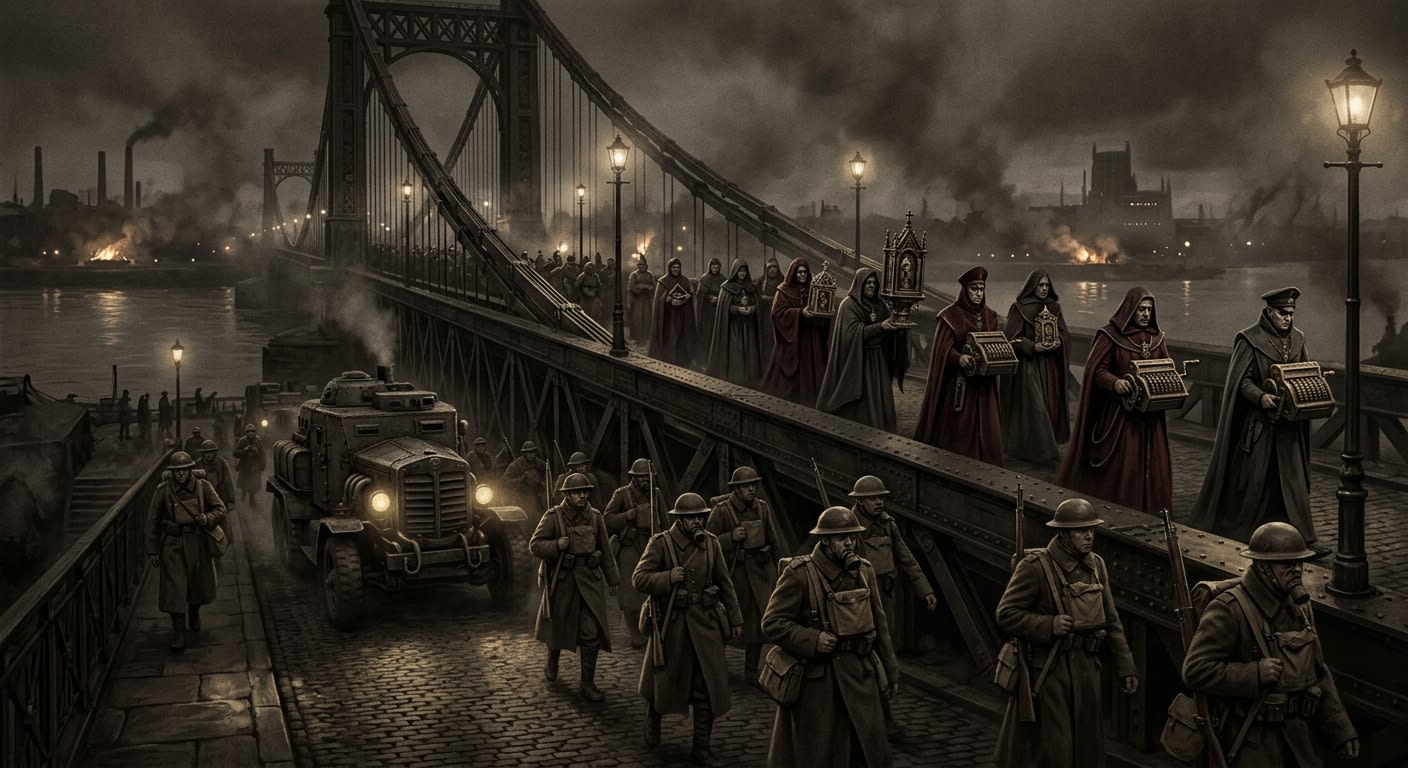
The immediate cause was simple enough for War to understand, a rarity worth preserving in wax. A supply column intended for the Irongate southern works had been trapped against the western bank by a sudden enemy advance. Forty-seven wagons carried rifle cartridges, consecrated bridge-chain, three portable bell-frames, two sealed ossuary reliquaries, and enough grain to keep the Sibiu-Irongate corridor (Unregistered) from starving through the next rotation. The enemy held the opposite bank. The river was high. The bridges were gone.
A sensible army would have withdrawn the column, burned what could not be carried, and filed regret. The Bureau of War is not a sensible army. It is a liturgical instrument with artillery.
Warden-Submarshal Calev Rohn ordered the Vexillators forward. Three standards were chosen: the Crimson Pennant of Saint Marcellus, the Brass-Lipped Banner of the Sixth Levy, and the little black-edged river standard called Widow's Rag (Unregistered) by the men and “Standard 14-D, Hydrological Operations” by the clerk who deserved to be bitten.
The Vexillators understood the order. A standard does not merely mark a formation. In Bureau doctrine it creates one. Men follow cloth when voices fail, when drums vanish, when officers become fragments, when the river enters the mouth and theology becomes less compelling than air. The Vexillator carries the visible permission to continue.
#On the Three Passages
At the first ford, Saint Hadrien's, the water rose to the chest before the men had advanced ten paces. The Litany-Engineers drove iron pegs into the mud and strung guide-cords along the current. The first cord snapped. The second sang. The third held. Tribune-Chaplain Sorellus (Unregistered) began the Psalm of Iron and lost the lower half of his jaw on the fourth verse. The men continued the psalm without him, which is piety, discipline, or panic given melody.
At the Chain-Pier Ruin, the old bridge stumps stood out of the river like rotten teeth. The Vexillator assigned to the Brass-Lipped Banner, Lorn of Metz, climbed the broken pier and fixed the staff between two stones while enemy fire struck sparks from the finial. For ninety seconds the banner stood upright with no hand upon it. The Bureau of Doctrine cites this as Sign One. The veterans cite the banner's weighted socket and Lorn's excellent sense of balance. Both explanations have been filed. Only one is recited at commemorations.
A prior Rhineland digest confused the Night of the Three Bridges with an unrelated bridge-demolition legend at Mainz, Worms, and Cologne, assigning the event to a future year and describing mass refugee drownings.
Corrected under Timeline Harmonisation A.S. 201. The ratified Night occurred in A.S. 172 on the Danubian forward corridor. Mainz, Worms, and Cologne have produced sufficient catastrophes of their own and need not borrow this one.
At Mark Seven, the drowned pontoon had sunk in place, its barrel-floats trapped beneath the surface. Men crossed by stepping on what they could not see. Several vanished between planks. Several rose again downstream and rejoined the line, which War classified as Sign Two and the surgeons classified as hypothermia, concussion, and the refusal of soldiers to die on schedule. The Widow's Rag reached the eastern bank first. Its bearer, Sister-Vexillator Anje Rusk, planted it in the mud and rang a hand bell until the striker froze to the rim.
The assault succeeded because all three crossings happened together. Enemy batteries could not decide which ford mattered. Sorcerous fire split between standards. The eastern bank received three wounds in one skin and failed to clot. By the ninth minute, the Vexillators had formed a ragged line across the mud. By the fourteenth, the first wagon chains were hauling. By dawn, the supply column had crossed.
#On the Miracle of Locomotion
The phrase was born in the first after-action report, written by Tribune-Clerk Othmar Vey under a wagon, in rain, with blood from someone else's sleeve diluted into the ink. He wrote: The men were borne forward in a manner exceeding ordinary locomotor explanation.
This, once processed through War, Doctrine, Records, and the sermon offices of three ambitious chaplains, became miracle of locomotion. The words were printed before the casualty figures had dried. Medals followed. Then pamphlets. Then school recitations in which children of safe western parishes were invited to imagine Providence carrying brave soldiers across the Danube, a wholesome exercise that omitted the screaming, the river-mud, and the number of men recovered with their fingers locked around weeds.
The miracle's theology rests on motion itself. War's argument is elegant enough, for War: a human body under load cannot cross a flooded Danube under fire at the speed recorded unless aided by supernatural agency. The men crossed at the recorded speed. The agency was declared divine, because the result favoured the Synod and because hostile agency, when useful, is customarily reclassified after the fact.
Veterans dispute the miracle in taverns east of Lyon. They dispute it in barracks, infirmaries, pension queues, and confession booths. They say the current pulled them sideways, not forward. They say the men moved quickly because the men behind were pushing and the men in front were drowning. They say the banners were less divine conveyance than practical navigation in smoke. They say Providence, if present, had wet boots and poor visibility.
The Bureau permits these disputes among veterans under a pastoral tolerance clause. The same statements from civilians constitute doctrinal trivialization of ratified martial grace. There is no contradiction. A veteran may insult the miracle because he was inside it. A civilian may not because civilians have a gift for making ignorance sound like analysis.
#On the Dead and the Reclassified
Earlier dispatches recorded 4,200 casualties. The number now stands at 1,800 casualties and 2,400 translations to glory mid-crossing. This is jurisdiction wearing arithmetic's hat. A casualty requires compensation, pension calculation, family notice, effects inventory, and burial allocation. A translation to glory requires a certificate, a hymn, and considerably less money.
The original casualty roll listed 4,200 dead, drowned, missing, frozen, or otherwise removed from formation.
Revised by the Bureau of Records after War petitioned for doctrinal review. 1,800 remain casualties. 2,400 have been reclassified as martyrdom-translations, hydrological theatre. Families may apply for commemorative ribbon in lieu of pension under Form 172-Bridge-G.
The bodies came back in stages. Some washed against the western bank by morning. Some lodged among the broken pier teeth. Some were recovered weeks later by river patrols that learned to identify Vexillators by the stitched reinforcement in the sleeves. Three standards survived. Twelve staff-fragments survived. One bell survived. The river kept the rest.
Bureau of Shadows memorandum, Danubian Patrol Annex, A.S. 173: “Recovered personnel from Mark Seven continue to report hearing the Psalm of Iron beneath moving water. ███████████████████████████. Two witnesses identify voices belonging to men certified translated. One voice gives current tactical instructions. Recommendation: do not publish; do not silence; listen quarterly.”
The commemorative service is held each year with three bowls of river water, three lengths of soaked banner-cloth, and one empty pair of boots placed before the altar. The boots are replaced annually because mildew is less respectful than Doctrine prefers.
#On the Use of the Night
War used the Night immediately. Levy officers invoked it at mustering fields. Vexillator schools painted it on refectory walls. The Bureau of Doctrine added it to the curriculum as proof that obedience alters terrain. The Bureau of Tithes briefly proposed a “river-crossing devotional surcharge” to fund hydrological chaplaincy; the proposal was denied, then refiled under a different name, then approved in principle and never implemented because no one could define hydrological chaplaincy without laughing.
The Night gave the Vexillators a proper cult. Before A.S. 172 they were standard-bearers, signal officers, visible anchors for men whose officers were too dead or too far away to be useful. After the Danube they became the Bureau of War's favourite proof that cloth can command physics when held by the correct zealot. Recruitment improved. Casualties also improved. War considered this symmetry satisfying.
The strategic value was real. The supply column reached Irongate. The southern works held through the winter. The enemy advance stalled long enough for the Central Corridor to reinforce. A failure would have opened the Danubian throat and forced withdrawals from forward staging towns already held together by rail schedules, fear, and unfashionable amounts of prayer.
So the Night remains ratified. The veterans may mutter. The families may keep their ribbons in drawers. The river may continue, brown and private, carrying whatever songs it has stolen. The Bureau has stamped the matter.