
#On the Office That Prays Forward
“The sermon begins when the officer stands up. The assault begins when he keeps standing.” — Bureau of War field maxim, authorised with reluctance by Doctrine
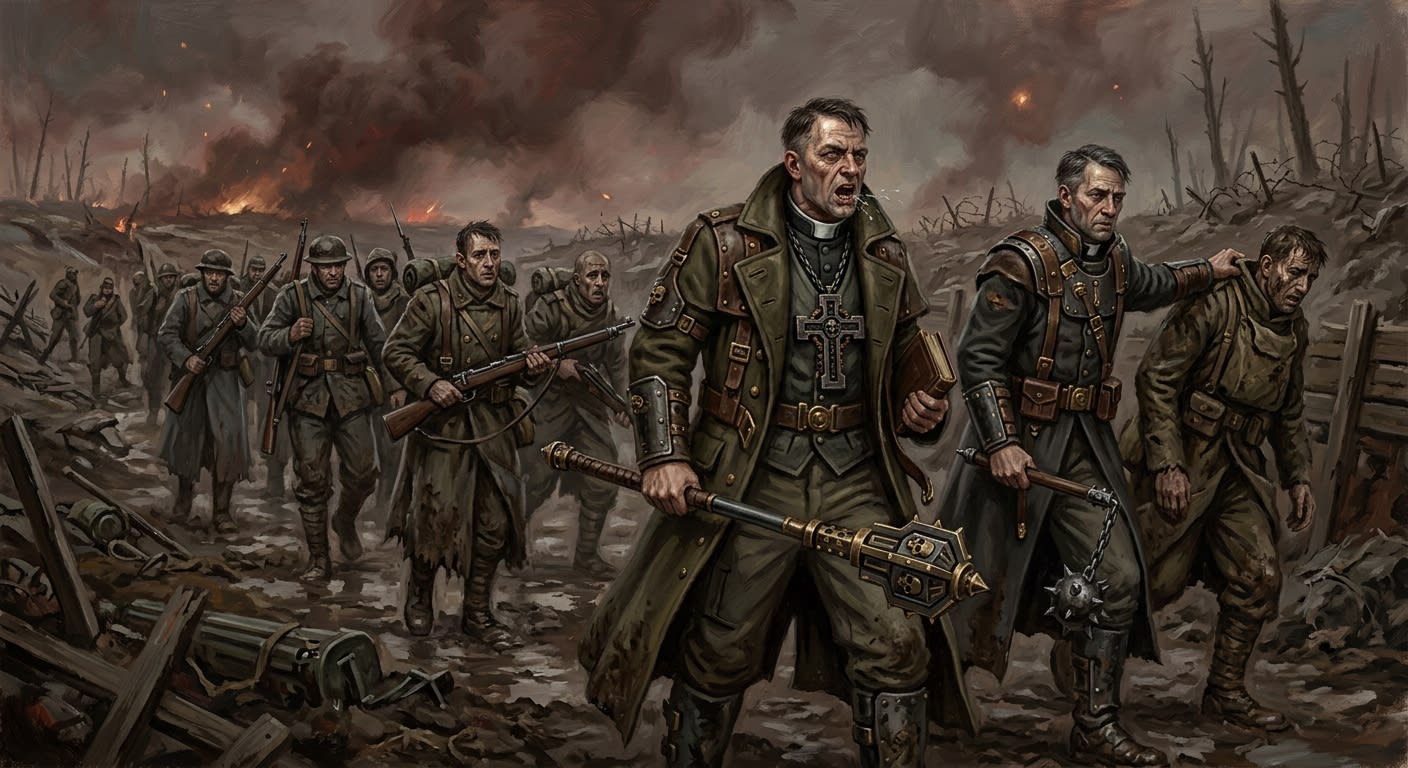
The Tribune-Chaplains are the Bureau of War’s throat at the moment when command, terror, mud, and liturgy become one filthy sacrament. They lead both prayer and assault. That phrase is often repeated in training halls, usually by men who have never watched a chaplain climb over a parapet with a stole tucked into his cartridge belt and a revolver in the hand not holding the field missal. Repetition has not made the phrase less true.
They sit beneath the Warden-General in the sanctified chain beside Vexillators and Litany-Engineers, those public men of cloth, banner, and charge-wire whom War classifies together because each solves the same battlefield problem by different means: how to make frightened men move in the correct direction while the world offers excellent counterarguments.
Their collar is black under crimson field braid. Their hem is weighted against wind. Their sleeves carry prayer-strips, casualty chalk, and the little stitched pocket where a absolution wafer may be kept dry if the Creator, quartermasters, and weather are all briefly merciful. The senior ranks carry campaign batons marked in chapel ash. The younger ones carry mud, lice, and the astonishing conviction that dying loudly can still be useful.
#On the Formation of the Voice
A Tribune-Chaplain begins as a priest who has failed the luxury of peace. Some come from seminary houses whose abbots were relieved to see them weaponised. Some come from the Continental Levy, discovered after shouting dying men back into formation with sufficient grammar to impress a clerk. Some are sons of minor nobles donated to War as family penance. A few are true believers of such bright and dangerous simplicity that Doctrine sends them to the front in self-defence.
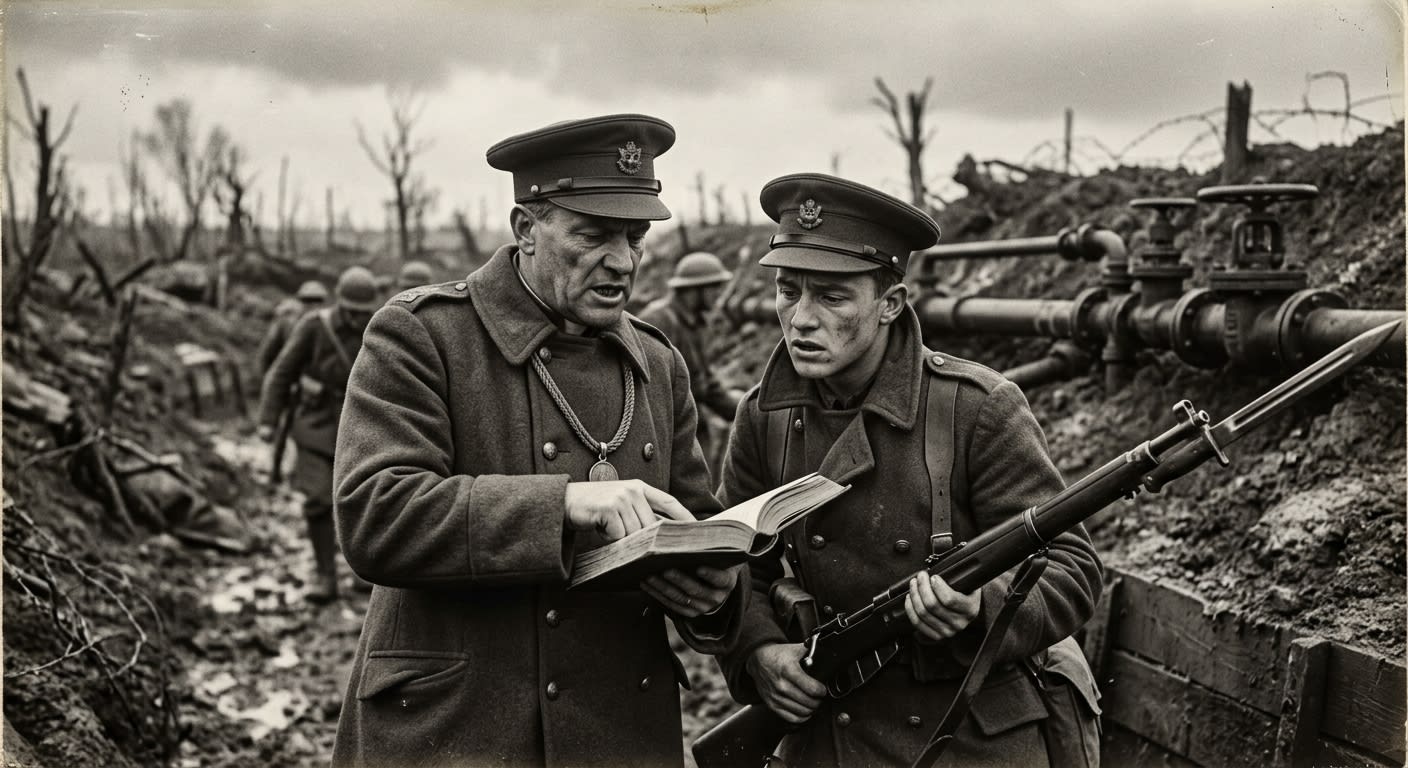
Training occurs at Metz, Stuttgart, Lyon, and whichever forward school currently possesses more walls than graves. Candidates learn doctrine, field medicine, casualty notation, funeral abbreviation, voice projection under bombardment, sermon composition in rain, last rites delivered at a run, pistol drill, map reading, and the sacred distinction between inspiring courage and causing a stampede. The examination includes a flooded trench, a dead mule, three recruits pretending panic, and a senior chaplain coughing blood into a handkerchief while marking errors.
The voice is the first instrument. A Tribune-Chaplain must cut through shell-burst, bell, sobbing, rain on helmets, and the animal grunt of men discovering bayonet work is intimate. He learns to pitch a psalm so that the back rank hears command inside prayer. He learns which syllables carry through smoke. He learns to bless a machine-gun crew without obstructing their traverse. He learns to stop saying “children” when addressing the Levy, because children die badly if permitted to remember they are children.
Their prayers are short in assault. The full liturgies belong to cathedrals and rear hospitals. A trench prayer must fit between two volleys, a grenade throw, or the seven seconds before a breach wave reaches the wire. The Tribune-Chaplain’s art is compression: doctrine folded small enough to pass through terror without losing its edge.
#On the Baptism of Mud
The public first meets the Tribune-Chaplain in the Baptism of Mud. A recruit is marched chest-deep into a flooded trench and held while the chaplain reads the Litany of First Earth. When the boy emerges, caked and gasping, he is pronounced a soldier of the Faith. The mud remains three days. War calls it sacrament. Conscription calls it completed transfer. The boy calls it cold, if rustic honesty has not yet been drilled out of him.
Provincial catechisms describe the Baptism of Mud as a rite of voluntary dedication.
Corrected for field instruction: the rite marks legal transfer into martial custody. Voluntary language remains approved for household consolation, recruitment broadsheets, and mothers whose sons have already been loaded onto trains.
The Tribune-Chaplain’s role is not ceremonial. He watches the recruit. Which hand clutches the trench board. Whether he faces home. Whether he spits, prays, sings, bites, laughs, or goes quiet in the wrong way. These marks travel with the boy as informal tendency notes, then drill adjustments, then assignments. A chaplain’s blessing can become a rifle company, a mortar pit, a baggage train, or a coffin-shaped future with excellent paperwork.
The rite also trains the chaplain. He must read while boys tremble, while clerks mishear names, while fathers shout at the fence, while one recruit faints and another tries to climb out before the final line. If he falters, the mud wins the room. If he shouts, the rite becomes punishment too early. The correct tone is paternal cruelty with a funeral undertone. War has schools for this. Of course it does.
#On Assault Liturgy
On the line, the Tribune-Chaplain is the officer whose sermon has a bayonet schedule. He stands where sound still matters: behind the Shield-Paladins as they lock, beside the Radiant Fusiliers before banner-light, near the Litany-Engineers while they prepare charges, beside the Processional Band when drum and step must become one legal fact. His presence tells the men that the assault is more than movement. It is an authorised interpretation of fear.
In the Doctrine of Layered Death, his task appears simple: keep the prayer spine aligned while wall, charge, ash, drum, and body do their assigned work. Simple tasks are where War hides its worst jokes. A breach does not wait for homiletic neatness. Men fall out of cadence. Paladins overbrace. Engineers cut fuses too close. Ash Chaplains cough relic dust into their own masks. The Tribune-Chaplain must correct without interrupting, command without sounding secular, and give absolution in syllables short enough to fit through a broken jaw.
FIELD REPORT — BREACH LITURGY FAILURE, SOUTHERN WORKS Chaplain initiated Saint Bartholomew cadence two beats late. Engineer charge answered on third beat, not fifth. Shield line knelt in unison without order. ██████ men entered breach singing backwards. Official cause: enemy pressure. Training cause: voice discipline deficiency.
The Night of the Three Bridges preserves the office at its most honest. At Saint Hadrien’s Ford in A.S. 172, Tribune-Chaplain Sorellus began the Psalm of Iron while the water rose and the Vexillators moved. He lost the lower half of his jaw on the fourth verse. The men continued the psalm without him. Bureau pamphlets call this evidence of perfect instruction. Veterans call it panic given melody. I see no contradiction worth correcting.
#On Sermons Under Fire
The Tribune-Chaplain writes constantly. Before assaults, after assaults, during bombardments, during dysentery, during ration failure, during mutiny weather, during those gray hours when men have stopped asking who fired first and begun asking whether anyone in Strasbourg remembers they exist. His sermon is report, sedative, threat, legal shelter, and after-action scaffold. War turns campaigns into Scripture. Tribune-Chaplains provide the first draft.
The most infamous example remains the Bombardment of Bastion-Constantinople, A.S. 188, when a Tribune-Chaplain named Seraphinus composed a fourteen-stanza homily on the theological significance of dysentery while shells cratered the ground around him. The Bureau printed it. The soldiers, according to a surviving quartermaster note, wanted medicine. Both requests were processed. One was answered faster.
Popular retellings identify the A.S. 188 Tribune-Chaplain Seraphinus with Legate Seraphinus of Lyon.
False. The names were confused by provincial copyists, sermon merchants, and families eager to attach a famous hunger-doctor to a man whose principal contribution was making bowel flux sound providential.
The office attracts absurdity because War demands rhetoric under conditions hostile to dignity. A chaplain has blessed a cannon whose crew was dead because the gun continued firing by recoil-jump. A chaplain has absolved a mule for biting a captain during retreat. A chaplain at Bastion-Shipka preached wakefulness for six hours while three listeners slept standing and one listener died awake. These acts are comic until one remembers that men obeyed because someone had made the mud speak grammar.
#On Their Rivalries and Their Use
Tribune-Chaplains distrust ordinary officers for confusing command with volume. Ordinary officers distrust Tribune-Chaplains for making disobedience sound like sin. Litany-Engineers tolerate them so long as they do not touch the fuses, alter the metre of the Counter-Sorcery Verses, or declare a stalled generator “spiritually hesitant” within earshot of men holding tools. Vexillators adore them in public, compete with them in memory, and privately resent any sermon that makes cloth seem less miraculous than speech.
Their closest kin are the Ash Chaplains, field confessors, Orison instructors, and the old battle-preachers from whom the office grew. Their predators are auditors, Purity examiners, enemy sorcery, friendly artillery, ambition, and the terrible vanity of discovering that frightened men will walk into fire if one phrases the order beautifully.
The Bureau uses them because they reduce panic. Doctrine uses them because they convert slaughter into meaning before unauthorised witnesses can do so. Records uses them because a chaplain’s field note can explain why three hundred men are missing without forcing a clerk to write “we lost them.” The families use them because a letter from a Tribune-Chaplain smells more holy than a casualty slip, though both may contain the same ruin.
#On the Present Discipline
As of A.S. 201, Tribune-Chaplains remain classified as War specialists under joint doctrinal certification, deployed across the training garrisons, bastion chapels, breach cohorts, convoy escort columns, and punishment battalions whose morale requires supervision by a man authorised to threaten heaven. Their numbers are not published. War says this protects security. Doctrine says it protects humility. Tithes says it prevents pension projection. Tithes is the honest one, accidentally.
The office has hardened since Trenchline Harmonisation. Combat-cant training now overlaps with Litany-Engineer drill. Silent-command modules have been added after Silence Dome incidents. Jaw-injury continuance is mandatory. Sermons over three minutes during active assault are punishable unless the chaplain dies before the fourth minute, in which case the sermon may be classified as exemplary depending on witness survival.
A Tribune-Chaplain walks at the front because men are ashamed to lag behind a priest. He prays because men are ashamed to die without words. He assaults because War learned long ago that a sermon delivered from safety is merely theatre, while a sermon delivered under fire becomes command.
Amen is an order, if shouted correctly.