
#On the Men Who Carry Permission
“Keep the cloth upright.” — Prayer of Saint Hermas, stolen by War from Pilgrimage and improved by danger
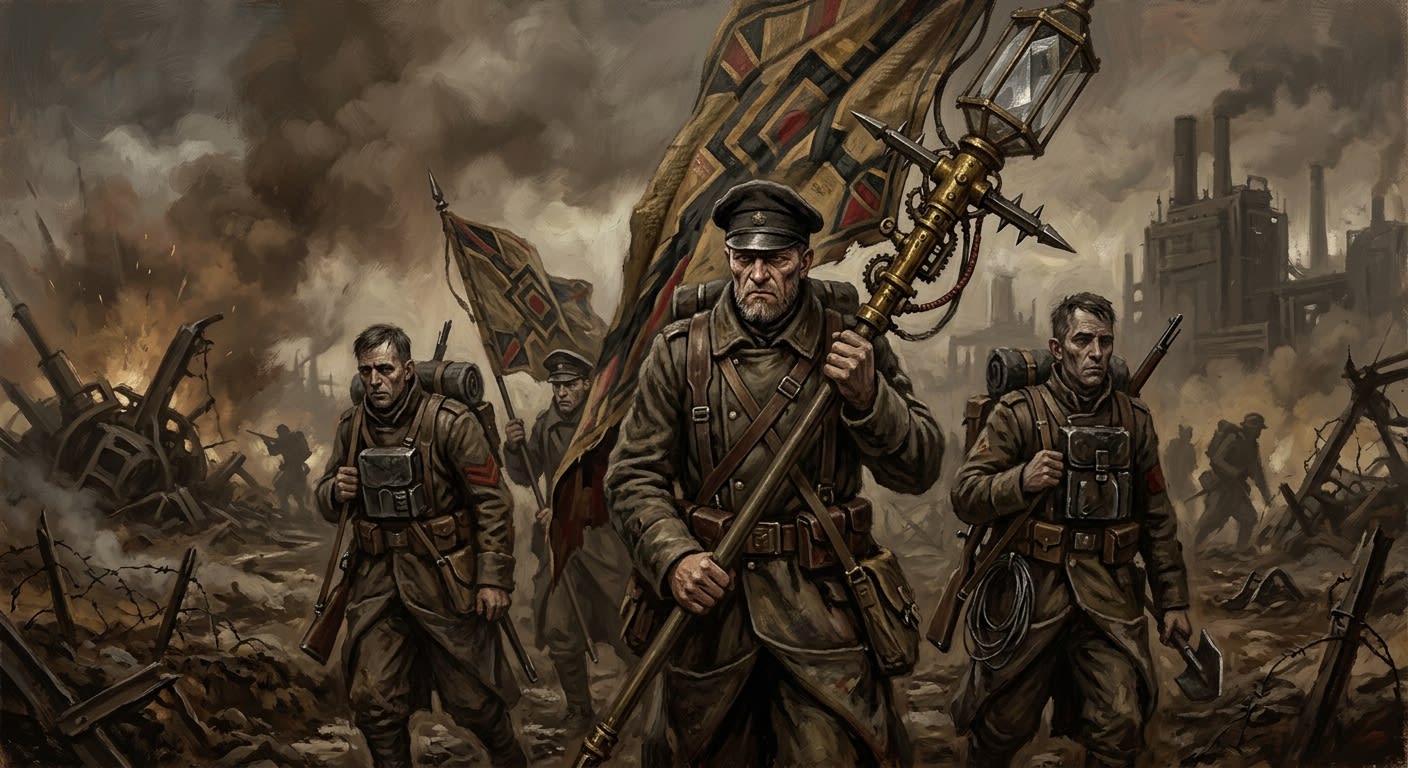
The Vexillators are the Bureau of War’s visible command, the cloth-speaking corps, the standard-bearers whose poles mark not where soldiers are, but where soldiers are still permitted to become a formation. A regiment may lose its officers, drums, maps, half its vocabulary, and most of its intention. If the standard remains upright, War can claim the regiment continues. If the standard falls, every surviving man acquires the hideous freedom to make decisions.
This is why the Bureau places Vexillators beneath the Warden-General in the sanctified chain beside Tribune-Chaplains and Litany-Engineers. The chaplain makes fear grammatical. The Engineer makes powder obey metre. The Vexillator makes bodies follow cloth when voices fail. These are battlefield necessities. They are the three hands by which War reaches into panic and gives it a filing number.
Their official title is Standard Officer, Campaign Vexillary Arm. The men call them cloth captains, pole-saints, bright fools, target-priests, and, in river units after A.S. 172, drowning rods. The title Vexillator persists because War likes Latin where plain speech might make a job sound suicidal.
#On Their Foundation and Their Patronage
The office is older than its charter. Men have followed cloth since men first discovered that shouting orders across smoke works poorly and that bright objects attract both loyalty and bullets. The Synod, in its usual mercy, took an ancient battlefield habit and improved it into a licensed hazard. By A.S. 92, after War’s Concordat expansion, Vexillators were already appearing in campaign lists as standard-bearers attached to levy columns. By A.S. 120 they had become indispensable to river batteries, breach cohorts, and those marching squares whose officers considered maps a rear-area superstition.
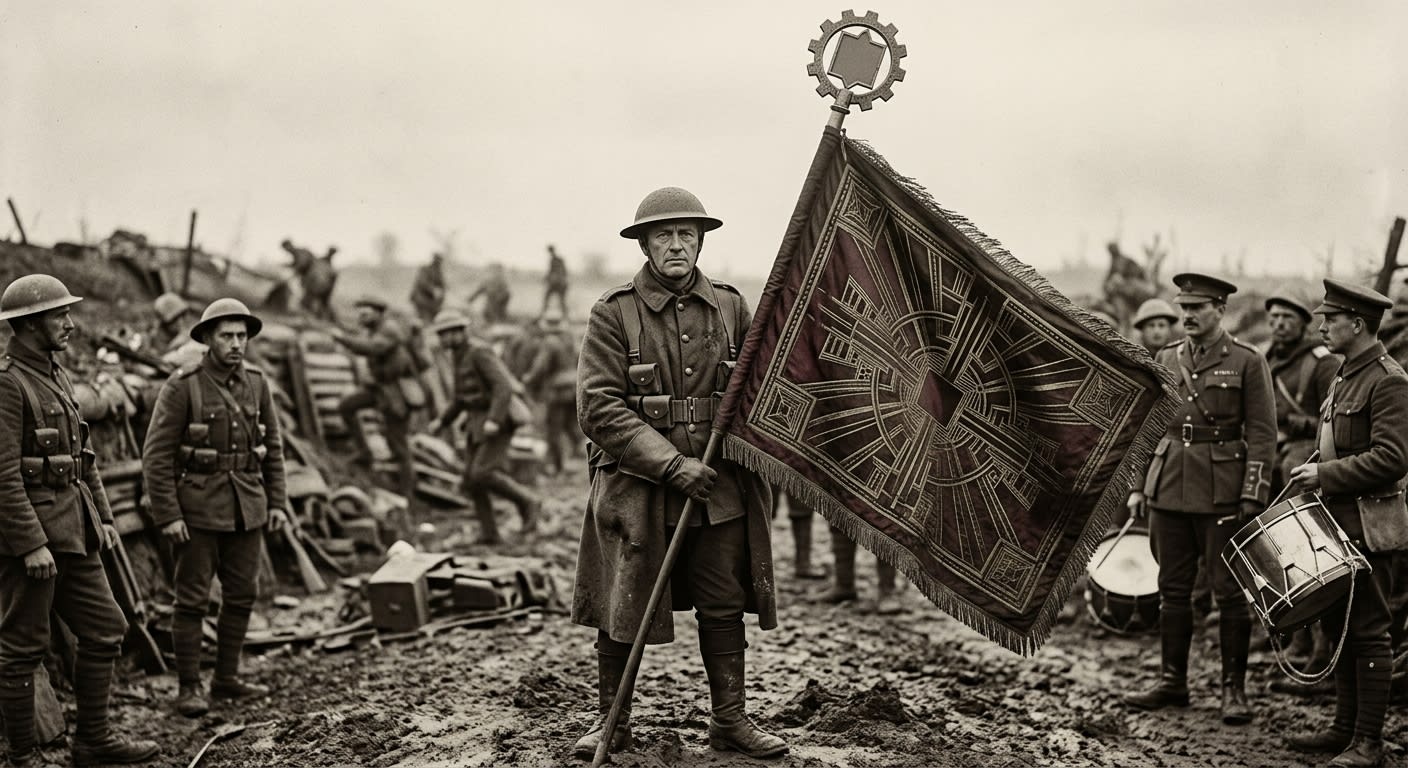
Their patron is Saint Hermas, banner-bearer of Dinan, whose prayer is so short even War could not ruin it completely: Keep the cloth upright. Pilgrimage licenses the prayer on blue cards. War prints it in recruit chapbooks without attribution. Doctrine permits the theft because piety, like flour, tastes better once requisitioned.
Earlier quartermaster primers described Vexillators as ceremonial personnel attached to grand campaigns.
Withdrawn. A ceremonial man may stand behind a governor. A Vexillator stands where enemy fire needs a useful landmark. Confusing the two has caused unnecessary embroidery and necessary deaths.
Training houses at Strasbourg, Metz, Lyon, and Budapest teach height tolerance, hand strength, signal grammar, flag-cant, smoke recognition, formation geometry, sacred colour law, and the unattractive art of remaining upright while every sensible instinct recommends lying flat. Candidates carry weighted poles across mud yards while instructors beat drums out of cadence. They learn to plant a staff one-handed after losing the other. They learn to knot torn fabric with teeth. They learn to die slowly enough that another hand can reach the pole.
#On the Standard Itself
A Vexillator does not carry “a flag.” The language is vulgar and should be fined. He carries a standard: cloth, pole, relic-thread, brass socket, campaign plates, signal rings, tassel-code, saint-mark, and a field history sewn so densely into the seams that the thing becomes less equipment than portable bureaucracy in a gale.
The cloth may be crimson, black-edged, brass-lipped, river-blue, ash-gray, or white for units expected to become theological examples before supper. Each colour has permissions. Each tear has meaning if Records notices it in time. A horizontal slash means rally. Three downward cuts mean withdrawal by sanctioned sequence. A reversed field means officer death, command passed to cloth. A black ribbon tied below the finial means hold without rescue. Men pretend not to know that last code until they need it.
The pole matters as much as the cloth. Ashwood for light formations. Oak for heavy breach cohorts. Iron-cored staffs for river work, which explains why Vexillators drown with such doctrinal efficiency. The socket is weighted so the banner may stand in mud without a hand, a practical feature that Doctrine has repeatedly called miraculous when witnesses are provincial enough to cooperate.
The Vexillator’s body is part of the instrument. Sleeve reinforcement identifies the corpse if the river returns it. Shoulder harnesses transfer weight. Hip hooks allow a planted stance under recoil. Gloves are stitched with prayer knots and waxed against rain. Teeth are inspected quarterly because veterans use them on knots, straps, torn cloth, and occasionally enemy fingers.
#On Signal, Formation, and the Theatre of Obedience
In clear weather a Vexillator is signal. In smoke he is geometry. Under artillery he is permission. Men follow him because the human eye clings to movement when the ear has been ruined, and because a standard rising above shell-smoke tells the frightened mind that someone, somewhere, has decided which way forward is.
The Vexillary grammar is not subtle. Subtlety gets men lost. Lift: advance. Drop to shoulder: brace. Circle: wheel formation. Dip twice: incoming friendly fire, which is a phrase rich in Synodal optimism. Plant and kneel: hold. Plant and remain standing: hold while being watched by history. Wrap the cloth: silence signal. Unwrap: scream with the lungs if any remain.
The standard also creates a legal field. A soldier within sight of sanctioned cloth is still in formation unless declared otherwise. A deserter who claims he lost direction while the banner was visible will be whipped for cowardice and bad eyesight. A captain who abandons his Vexillator loses command priority. A corpse found within three staff-lengths of the fallen standard earns better language in the death roll. Not better money, naturally. Language is cheaper.
The Vexillator and the Tribune-Chaplain work as paired instruments. The chaplain commands the ear. The Vexillator commands the eye. The Litany-Engineer commands the charge beneath the earth, and if all three agree, a breach cohort can move through conditions that would turn ordinary troops into a committee of widows. If they disagree, the battlefield receives three doctrines at once and chooses the stupidest.
#On the Night That Made Their Cult
The Vexillators had prestige before A.S. 172. After the Night of the Three Bridges, they had a cult.
The ratified account is familiar enough to bore schoolchildren and trouble veterans: the Danubian forward corridor between Budapest and Bastion-Irongate, supply wagons trapped against the western bank, enemy batteries ranging the flats, bridges gone, river high, winter sharpening its teeth. Warden-Submarshal Calev Rohn ordered the Vexillators of Strasbourg forward. Three standards were chosen: the Crimson Pennant of Saint Marcellus, the Brass-Lipped Banner of the Sixth Levy, and the black-edged river standard called Widow’s Rag by men with taste and “Standard 14-D, Hydrological Operations” by a clerk with none.
At Saint Hadrien’s Ford, Litany-Engineers drove iron pegs into mud while Tribune-Chaplain Sorellus (Unregistered) began the Psalm of Iron and lost his lower jaw on the fourth verse. At the Chain-Pier Ruin, Lorn of Metz fixed the Brass-Lipped Banner between broken stones and left it standing for ninety seconds under fire with no hand upon it. At Mark Seven, Sister-Vexillator Anje Rusk planted Widow’s Rag on the eastern bank and rang a hand bell until the striker froze to the rim.
Popular broadsheets state that Anje Rusk crossed the Danube without wetting the banner-cloth.
Corrected. The banner was soaked, frozen, torn, and later stiff enough to stand in a chapel corner without a staff. Holiness does not require dryness. Only pamphleteers do.
War called the crossing a miracle of locomotion. The men did not swim, War insists; they were carried. The Vexillary schools preferred another lesson: cloth held where officers could not. Before A.S. 172, Vexillators were standard-bearers, signal officers, visible anchors for formations whose command voices had been chewed by smoke. After the Danube, War began teaching that cloth can command terrain when held by the correct zealot. Recruitment improved. Casualties also improved. War enjoys tidy columns.
BUREAU OF SHADOWS MEMORANDUM — A.S. 173 — DANUBIAN PATROL ANNEX Quarterly listening beneath moving water authorised. Voices matching translated Vexillators detected under Mark Seven current. One voice repeats: “Hold the cloth lower.” One voice gives bearing corrections. Recommendation: ███████████████████████████████ Do not issue river standards from recovered fabric.
#On Ranks, Rivalries, and Private Customs
The lowest Vexillary rank is Staff-Novice, a boy or girl old enough to stand, young enough to believe soreness is destiny. Above them stand Cloth-Bearers, Signal Vexillators, Campaign Vexillators, River Vexillators, and the rare Grand Vexillators whose banners have survived three ratified disasters and acquired the right to be addressed before junior officers.
Their internal factions are predictable. The Old Cloth school insists that a standard must be seen by men, not interpreted by devices. The Signal Moderns love shutter-lamps, semaphore paddles, coded tassels, and any contrivance that lets a Vexillator command while not being quite so attractively shootable. The Relic-Thread Devout believe old martyr cloth changes outcomes. The Quartermaster school believes old martyr cloth changes requisition priority. Both factions kiss the same seam.
They are adored by Tribune-Chaplains, who require visible courage for their sermons, and tolerated by Litany-Engineers, who prefer anything that draws enemy attention away from fuse work. Ordinary officers resent them because a Vexillator can gather men by standing up, while an officer often needs orders, threats, and a revolver. Soldiers love them after survival and curse them before assault. Both reactions are correct.
Their superstitions are practical enough to deserve doctrinal suspicion. Never mend a bullet-hole on the same day. Never let a fallen standard touch a table before it touches chapel stone. Never count staff-fragments aloud. Never carry a river banner past a dry well. Never accept a banner that smells of vinegar unless Purity has signed the crate. Every Vexillator touches the pole to the tongue before first light. If the wood tastes sweet, he reports to the chaplain. If it tastes of iron, he writes a letter home. If it tastes of nothing, he worries.
#On Their Present Condition
As of A.S. 201, Vexillators remain one of War’s favoured contradictions: archaic enough to please Doctrine, useful enough to survive Engineering, photogenic enough for Pilgrimage, and lethal enough that Tithes has never succeeded in classifying the banners as decorative property. They serve across the Sagittal Line, with concentration in river crossings, breach cohorts, levy musters, grand reviews, punishment marches, and those miserable forward sectors where fog eats sound before orders can reach the third rank.
The schools have altered since the Danube. River work is now its own discipline. Sleeve reinforcement is mandatory. Standards used in hydrological operations must carry weighted sockets, waxed seams, bell-rings, and recovery tags written in ink that remains legible after three days underwater. No one mentions why three days is the number. The river knows. Records knows. The families are given ribbons.
A Vexillator is not brave because he feels less fear. He is brave because fear has been given a pole, a grip, a socket, a regulation stance, and witnesses. The cloth rises. Men follow. The Bureau writes down the direction afterward and calls it Providence.
Keep the cloth upright.