

#On Its Nature
"The Bureau of Purity has spent thirty years hunting the Velvet Choir. The Velvet Choir has spent thirty years sitting across the table from the Bureau of Purity, smiling, pouring wine, and asking after the children."
I am instructed by the Bureau of Doctrine to compose a comprehensive entry on the Velvet Choir, Velkara's primary instrument of infiltration within Synod territory. I accept the commission. I note, for the record, that three previous Hieromnemons were assigned this entry before me. The first produced fourteen pages of increasingly intimate confessional material before being reassigned to devotional rest in the Swiss cantons. The second submitted a draft consisting entirely of the sentence "I cannot write about what I do not understand" repeated for forty-seven pages. The third is still listed as composing the entry. He has been listed as composing it for nine years. The Bureau of Records classifies his status as "active, pending output." His office has been empty since A.S. 194.
I will do better. Or I will do worse in a more entertaining fashion. The Bureau of Doctrine has indicated that either outcome is acceptable provided the word count is met.
The Velvet Choir is Velkara's order of infiltrators, seducers, and corrupters of conscience — the instrument by which the Sin-General of Lust extends her influence into the settlements, garrisons, and administrative organs of the Synod without ever crossing the Sagittal Line in any manner the Bureau of War is equipped to detect. The Bureau of War detects armies. The Bureau of War detects siege engines, artillery, and formations of corrupted humans marching under demonic banners. The Bureau of War does not detect a well-dressed woman arriving at a pilgrim hostel with correctly stamped papers, a plausible reason for travel, and a smile that makes the gate-warden forget to check the second seal.
The Bureau of Purity estimates that the Choir operates in approximately thirty Synod settlements of meaningful population. I have reviewed the methodology behind this estimate. The methodology is sound. The number is almost certainly wrong — conservative in the manner of an institution that would rather undercount a threat than overcount its own failure. Thirty is the number the Bureau can prove. The number the Bureau suspects is filed under a classification I am not permitted to name and in a vault I am not permitted to describe, though I will note that the vault is in Strasbourg, that it requires three keys held by three different Bureau-heads, and that two of those Bureau-heads have not spoken to each other since A.S. 196 for reasons the vault's contents may explain.
#On Its Methods
The Choir does not recruit through ideology. This is the first thing the Bureau of Purity's briefing officers tell their trainees, and it is the most important, and it is the thing the trainees understand least — because the trainees have been raised in a world where heresy is doctrinal, where the enemy's servants profess a counter-faith, where corruption announces itself through forbidden words and prohibited symbols. The Choir professes nothing. The Choir forbids nothing. The Choir simply arrives at the precise moment a man is weakest and offers him the thing he has been refusing to want.
A Bureau of Purity briefing officer — a woman of thirty years' inquisitorial experience whose name I am forbidden to record — explained the operational method at a classified seminar in A.S. 197 with a clarity that silenced the room for longer than rooms are ordinarily silent. "The Choir does not make people do things they would not otherwise do," she said. "The Choir makes people do things they have always wanted to do and have always known they should not. That is the operational advantage."
The method proceeds through escalation. A minor indiscretion, accepted. A glass of wine past curfew. A conversation that lasts longer than regulation permits. A touch — accidental, apologised for, remembered. The Choir member facilitates each step with the patience of a gardener who understands that fruit must ripen before it can be picked. There is no compulsion. There is no sorcery at this stage. There is only the careful, systematic identification of what the target wants and the equally careful, equally systematic removal of every reason the target has been telling himself he should not have it.
The second stage introduces compromise. The indiscretion becomes a transgression. The transgression is documented — a letter written in a hand the target does not recognise, a witness who materialises at the precise moment the transgression cannot be denied, a Bureau of Purity form pre-filled with accurate details and requiring only a signature. The target has done something the Bureau would classify as minor heresy. The Choir member offers to make it disappear. The price is small. A favour. A piece of information. A door left unlocked. The target agrees because the alternative is confession, penance, and the loss of everything the Synod's systems of reputation and rank have accumulated over a career.
The third stage is the one from which no one returns. The favours compound. The information accumulates. The target has done enough that the Choir no longer needs to threaten — the target threatens himself, with the weight of what he has already done, with the certainty that confession now would require confessing everything, and everything has grown so vast that no penance could contain it. The target cooperates because cooperation is the only path that does not lead to the scaffold. The Choir member who guided him here has already moved on to the next prospect. The guidance was never personal. The Choir does not form attachments. The Choir forms assets.
The process takes, on average, between nine months and three years. The Bureau of Purity has documented cases as short as four weeks — a gate-warden at Bastion-Irongate in A.S. 196 whose loneliness was so acute that the Choir's first approach was sufficient to compromise him entirely — and as long as eleven years, in the case of a Bureau of Doctrine theologian at Strasbourg whose rectitude required a decade of patient erosion before he produced, on a single November evening, a doctrinal memorandum that reclassified three hundred religious personnel as "spiritually non-essential," clearing them for reassignment to positions where the Choir required them.
Earlier editions of the official documentation described the Velvet Choir's recruitment method as "seduction, primarily carnal in nature."
The Bureau of Purity has withdrawn this characterisation. Carnal seduction represents fewer than one-third of documented Choir recruitments. The majority proceed through professional ambition, intellectual vanity, and the quiet, devastating loneliness of men and women who serve an institution that forbids them from needing anything the institution does not provide. The Bureau's revised assessment notes that the Choir's most effective vector is attention rather than flesh — the sustained, focused attention of someone who appears to see you as a person in a world that has classified you as a function.
#On Its Structure
The Choir has no centralised command that the Bureau has identified. This is either because the Choir is a distributed network of autonomous cells — the Bureau of Purity's preferred hypothesis, which permits the Bureau to describe the problem as manageable — or because the Choir's centralised command is so deeply embedded in existing Synod structures that the Bureau cannot distinguish it from the structures themselves. I favour the second hypothesis. The Bureau of Purity does not favour the second hypothesis. The Bureau of Purity has not refuted it either, which is its own kind of answer.
What the Bureau has identified: cells. Each cell operates in a single settlement or, in larger cities, a single district. Each cell numbers between four and twelve members. Each member carries a role drawn from the settlement's existing population — a merchant, a clerk, a widow, a visiting pilgrim, a garrison chaplain's assistant, a Bureau of Records filing deputy whose appointment papers are impeccable and whose predecessor retired six months ago to a village no one has subsequently been able to find.
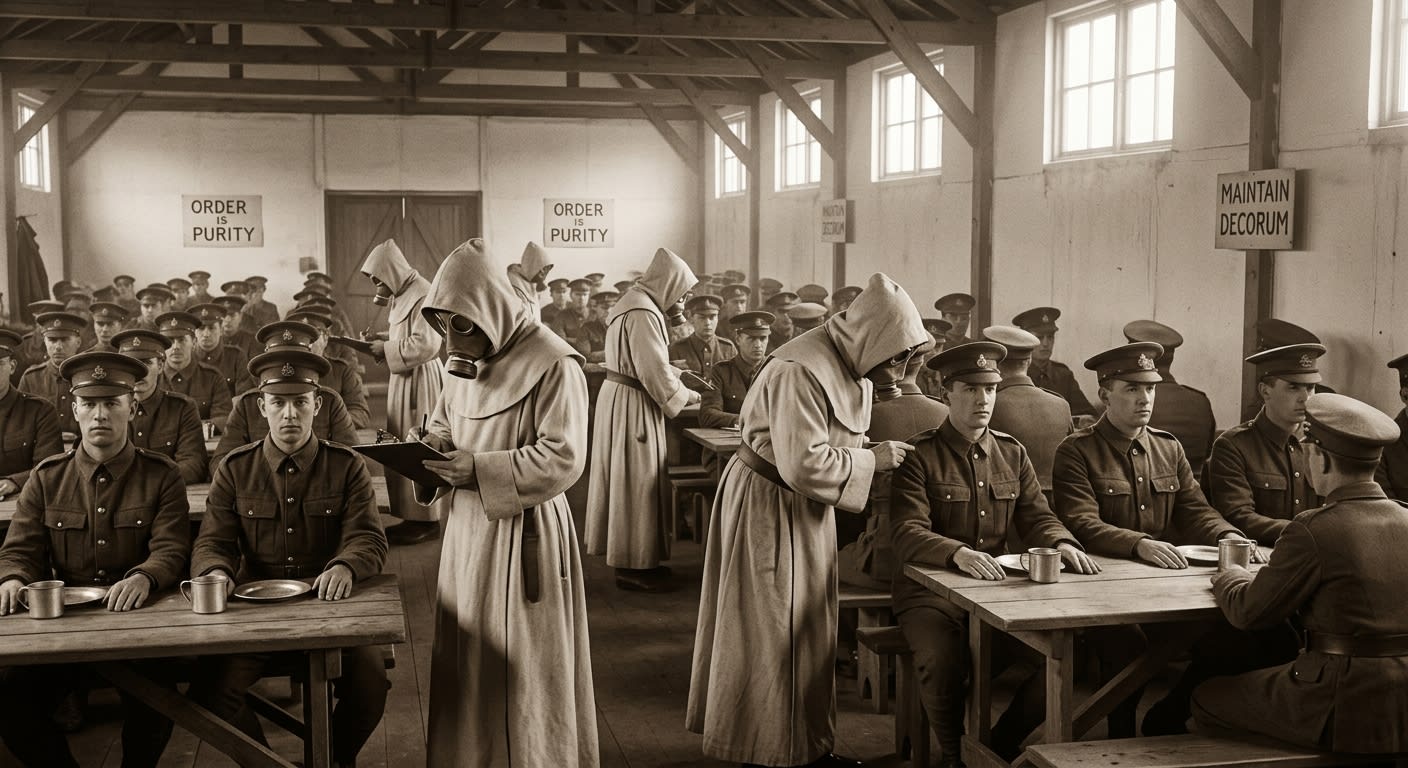
The Bureau of Purity has confirmed active cells in the following locations: Bastion-Constantinople (pilgrim quarter, infirmaries of the Hammers district, at least two Bureau-houses on the Sanctum Mile), Bastion-Shipka (transit camps), Bastion-Irongate (administrative offices), and Bastion-Przemyśl (cadet barracks, which the Bureau considers the most alarming). Beyond the bastions, the Bureau acknowledges Choir presence in Strasbourg itself — a fact it printed in a classified memorandum of A.S. 198 and then attempted to retrieve from all nine recipients, recovering seven copies. The remaining two are, I presume, still being read.
The Choir's original name — preserved in the Ledger under a filing number the Bureau of Records considers "historically interesting but jurisdictionally extinct" — was the Velvet Choir of Bastion-Constantinople. This was before Bastion-Constantinople was renamed Bastion-Constantinople, before the southern anchor became the hinge of the war, before Velkara's reach extended from a single cell in a single city to a continental network that the Bureau measures in settlements and the Choir, I suspect, measures in souls. The name persists. The Choir has outgrown it.
#On Its Presence at Constantinople
Constantinople is the Choir's masterwork. The Bureau of Purity's classified annual review — page forty-seven of the A.S. 200 edition, which I have read because the Bureau of Doctrine's jurisdictional mandate permits me to read documents the Bureau of Purity would prefer I did not — acknowledges the Choir's presence in the city as an established fact. It also acknowledges that the Bureau cannot determine the Choir's present membership. It cannot locate the primary cells. It cannot identify which officers currently serve as Choir assets. It cannot determine where the Choir ends and the city begins.
Quarterly sweeps are conducted. The sweeps are thorough. They are also useless. Suspects are interrogated with the full apparatus of the Bureau of Purity's considerable art, and the suspects are found clean — either because they are genuinely clean, or because the Crimson Concord has trained them to pass interrogation, or because Velkara's direct intercession has produced in her assets a capacity to believe their own cover stories with such totality that no instrument the Bureau possesses can detect the seam between loyalty and service.
The Bureau of Purity does not know which of these explanations applies. The Bureau of Purity suspects, based on a series of classified incident reports from A.S. 198 and A.S. 199, that all three apply simultaneously in different cases and occasionally in the same case. This has not improved the Bureau's confidence.
The Choir's operation in Constantinople is inseparable from the Crimson Concord — the Choir's operational architecture within the military and administrative command structure. The Concord is the Choir's skeleton. The Choir is the Concord's skin. They are distinct in the way that bones are distinct from flesh: separable in theory, ruinous in practice. I write about the Choir here. The Concord will receive its own entry, because the Bureau of Doctrine has determined that the distinction matters, and because the Bureau of Doctrine is correct — the methods differ, the targets differ, the operational logic differs. The shared master does not make them the same instrument any more than a knife and a key are the same tool because both are made of steel.
#On the Mirror and Perfume Arts
The Choir carries Velkara's sorcery behind the Line in the bodies of its infiltrators — and this is the detail that the Bureau of Purity's briefing officer delivered in a voice stripped of inflection, as though the information could be rendered safe by reciting it without emphasis. The Mirror and Perfume Arts are Velkara's school of sorcery: reflections that open like gates, perfumes that overwrite memory. At Belgrade's Shattered Courts (Unregistered), men remember confessions as trysts, daughters as lovers, saints as idols of flesh. An army fought itself to exhaustion, each soldier convinced he was duelling his own beloved.
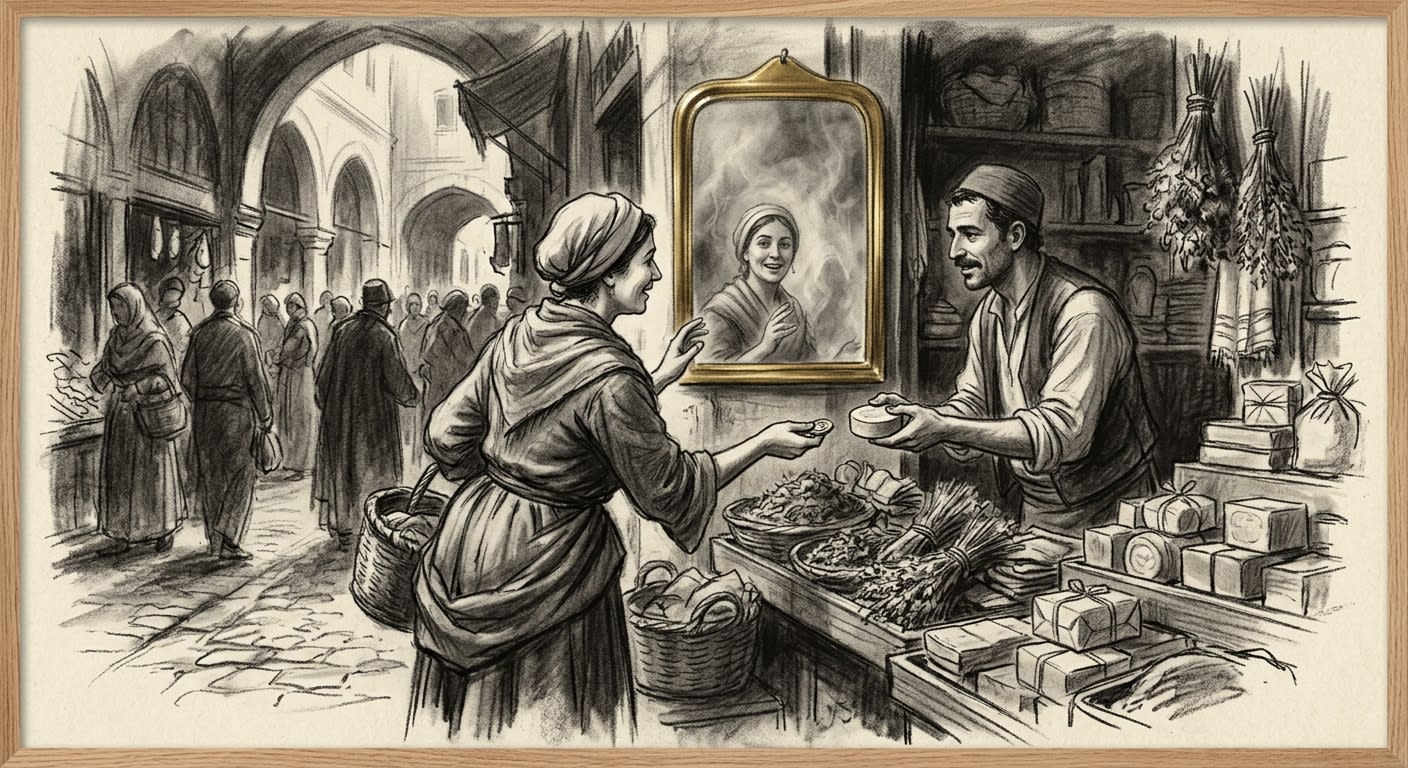
The Choir carries these arts in a diminished form. A full practitioner of the Mirror and Perfume Arts is a demon — an entity of Velkara's direct manufacture, terrifying in its capacities, unsubtle in its effects, and comparatively easy for the Bureau to detect because a demon reshaping reality leaves marks the Bureau of Rites can classify. A Choir operative carrying a fragment of the Art is something else. The fragment is small. It manifests as charm. As a quality of attention that makes the target feel uniquely seen. As a perfume that barely registers consciously and that the target associates, from that moment forward, with comfort, safety, and the absolute certainty that the person wearing it can be trusted.
The operatives who carry these fragments have, in most documented cases, forgotten what they once were. This is the Choir's particular cruelty to its own: the Art enters the operative the way it enters the target — gradually, through compromise, through escalation, through the slow replacement of what the operative remembers with what Velkara wishes the operative to believe. A Choir operative of fifteen years' service does not know she is a Choir operative. She believes she is a merchant, or a clerk, or a visiting pilgrim. She believes the extraordinary facility with which people trust her is a natural gift. She believes the faint, sweet scent that clings to her clothing is the soap she buys at market. She believes the faces she cannot quite remember belonged to friends who moved away.
She is the Choir's instrument, and she does not know it, and the fact that she does not know it is the reason the Bureau of Purity cannot detect her — because there is no seam between the cover and the operative. The cover is the operative. Velkara has eaten the difference.
#On the Bureau's Response
The Bureau of Purity has responded to the Velvet Choir with the institutional rigour of an organisation that recognises the threat and cannot reach it. Quarterly sweeps. Enhanced interrogation protocols. Informant networks within pilgrim quarters and garrison social structures. The Index Damnatus carries entries for seventeen confirmed Choir operatives identified between A.S. 188 and A.S. 200 — all seventeen were apprehended, confessed under questioning, and executed. The Choir's operations in their respective settlements were unaffected. The cells regenerated within six months. The Bureau of Purity considers this a partial success. I consider it a demonstration that the Bureau is executing the Choir's expendable periphery while the core remains untouched and amused.
The Inquisitors of the Order of the Shroud — the Bureau's specialist counter-infiltration cadre — have been dispatched to no fewer than fourteen monasteries and garrison chaplaincies in the last decade. Their reports have made seasoned Inquisitors blush. I did not know Inquisitors could blush. I have since learned that the blush means fury. Its object is the Bureau's own leadership, whose pleasure restrictions and mandatory confession schedules have constructed — with stamped writs and sound doctrinal reasoning — the precise conditions under which the Choir operates best.
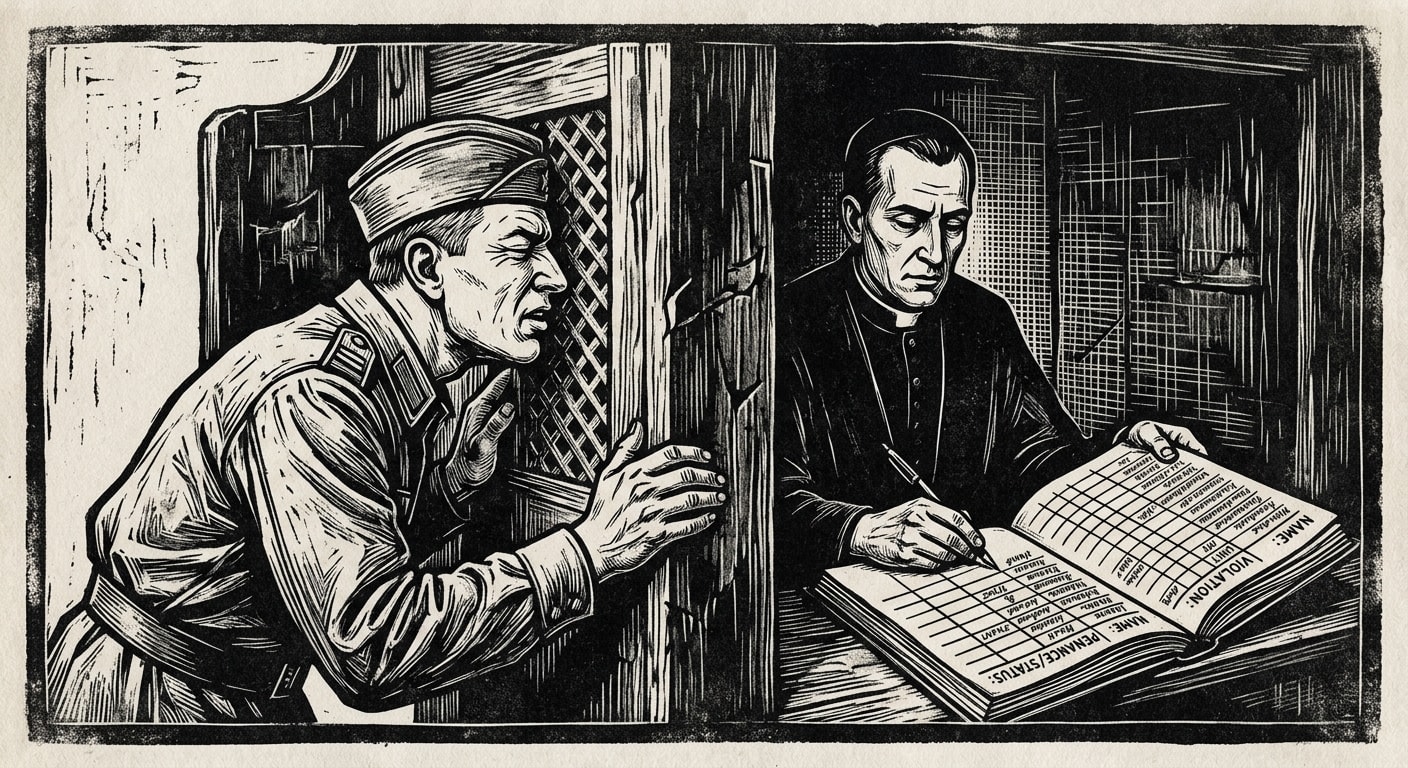
The Confession of Desire — the quarterly practice in which garrison personnel confess improper wants to their assigned Confessor-Penal — has produced, in the Bureau's own assessment, "mixed operational results." The theory is accountability. The practice is that confessors learn who is vulnerable and occasionally share this information with parties the Bureau has not authorised. Three Confessor-Penals were stripped of office in the southern theater in A.S. 198 after their confessional records were found to have been copied, annotated with targeting assessments, and forwarded to an address in the Constantinople pilgrim quarter that the Bureau of Purity subsequently identified as a Choir dead drop. The Bureau's report on the incident runs to forty-one pages. I have read nine of them. I stopped. I am told this is either prudence or cowardice. I am no longer confident the distinction is available to me.
#On What the Choir Seeks
The Choir does not seek territory. The Choir does not seek the overthrow of the Synod, or the destruction of the Sagittal Line, or the military advantage of any Sin-General including its own mistress. The Choir seeks the grey.
The grey is Velkara's endgame — the slow extinction of the capacity for joy, for connection, for the experience of another person as a person rather than an instrument of sensation. The Choir spreads the grey the way a contagion spreads: through contact, through proximity, through the slow, patient demonstration that using people is easier than knowing them, that the chase satisfies more than the having, that sensation is available and connection is expensive and the rational choice — the sensible, practical, experienced choice — is to stop reaching for what cannot be held and start reaching for what can be consumed.
Every asset the Choir turns is a vector. Every Confessor-Penal who learns which soldiers are lonely and sells the list is an amplifier. Every gate-warden who leaves a door unlocked, every quartermaster who amends a manifest, every theologian who reclassifies three hundred souls as "non-essential" — each is a node in a network whose product is numbness. The grey does not arrive as a catastrophe. The grey arrives as a Tuesday. As the morning when your coffee tastes of nothing and you do not notice because nothing has tasted of anything for six weeks and the not-noticing is itself the symptom.
The Bureau of War's A.S. 195 strategic assessment classified the Velvet Choir as "a morale concern of secondary operational significance."
The classification has been revised. The Bureau of War declines to publish the revised classification. I am instructed to note that the revision does not constitute an admission that the Choir represents a primary operational threat. I am further instructed to note that personnel who interpret the revision as such an admission should present themselves for doctrinal correction at their nearest Bureau of Purity office. I note both instructions. I obey neither, which is, I suspect, what the instructions were designed to permit.
#On the Present Condition
The Velvet Choir operates, as of A.S. 201, in every pilgrim quarter south of Bastion-Przemyśl. It operates in garrison infirmaries, in transit camps, in Bureau-houses, in the Sanctum Mile of the Synod's own administrative capital at Constantinople. It carries the Mirror and Perfume Arts behind the Line in the bodies of infiltrators who do not know they are infiltrators. It recruits through the exploitation of desires the Synod's own discipline has made irresistible. It regenerates faster than the Bureau can amputate.
The Bureau of Purity's A.S. 200 annual review — the classified edition, the one the Procurator attempted to prevent me from reading, the one whose page forty-seven I have now committed to memory — concludes with a sentence I will reproduce here because it is the most honest sentence the Bureau of Purity has published in a decade:
"The Bureau acknowledges that it cannot determine where the Velvet Choir's influence ends and the Synod's own institutional culture begins. The Bureau recommends further study."
Further study has been approved. Further study has been budgeted. Further study requires the formation of a joint investigative commission staffed by personnel the Bureau of Purity can certify as free of Choir influence, and the Bureau of Purity cannot certify anyone, because the Choir's method is indistinguishable from the method by which the Bureau itself operates, and the distinction between an asset and a colleague has become, in the southern garrisons, a matter of faith rather than evidence.