
#On the Relic Under Survey
The First Knot-Cloth is the principal relic of Saint Liora Knot-Hand, patron of the Bureau of Oaths. Its claim to sanctity is modest. Hungry people once kept their word over it, and the Church has been trying to repeat the effect at scale ever since.
This survey is entered in A.S. 201. It covers the relic as the faithful and the offices hear of it in that year: its traditional use, the single description of it I am permitted to give, and the three places where it is said to lie. The survey year is the only year in this file I will certify. Nobody knows the year the cloth was tied. The hagiography places Liora in the first years after the Sundering and before the Concordat of Strasbourg. That is an era rather than a date, and pious arithmetic has made worse errors with less. Her feast on 14 Ember is an observance. It honours the woman and puts no date on her knots.
Three parties dispute where the cloth now rests, and each is certain. In my experience, three certainties added together come to roughly none.
#On the Thirty Households
The patronal account is short. Food had run out, and trust had gone sooner. A district of thirty households was failing in the ordinary way such districts fail: cellars were barred, mouths were hidden in lofts, and neighbours learned to hate each other's chimney smoke. Liora went from door to door. At each threshold she made the household say aloud what hunger makes indecent, meaning how much meal, how many beans, how many children and how many sick. Then she heard the pledge. Each house promised its share to the others, and the others promised theirs. Two neighbours stood witness at every door. For each obligation Liora tied a knot in a strip of linen, and her hands bled into the work.
The rations came later. The record disagrees on who sent them, by which road and under what seal, and I have no intention of settling the matter with a guess. When they arrived, the thirty households were alive.
The earliest copies give the district no name. Later tradition has made up for the omission with enthusiasm, placing it near Mainz, near Worms, at a burned Rhine hamlet, at a road chapel whose foundations nobody can find and, in one Iberian version, outside Seville. Each of these is a localisation and none of them is a finding. None supplies a birthplace, a parish, a pilgrim road or a field for spades. The Bureau of Records declines to choose among them, and so do I. An unnamed district belongs to every starving parish at once, which is doctrinally convenient and commercially intolerable. Relic-sellers detest it.
Thirty is the sacred number of the file. It counts the households. The parent dossier speaks in thirties throughout, thirty knots and thirty doors, and that is hagiography in its proper Sunday clothes. It tells you nothing about the knots surviving on any object today, and it does not prove one knot per household. Liora tied a knot for each obligation, and a hungry house may owe more than one thing. I have seen people attempt to assign particular knots to particular families. They should stop.
#On the Linen and Its Knots
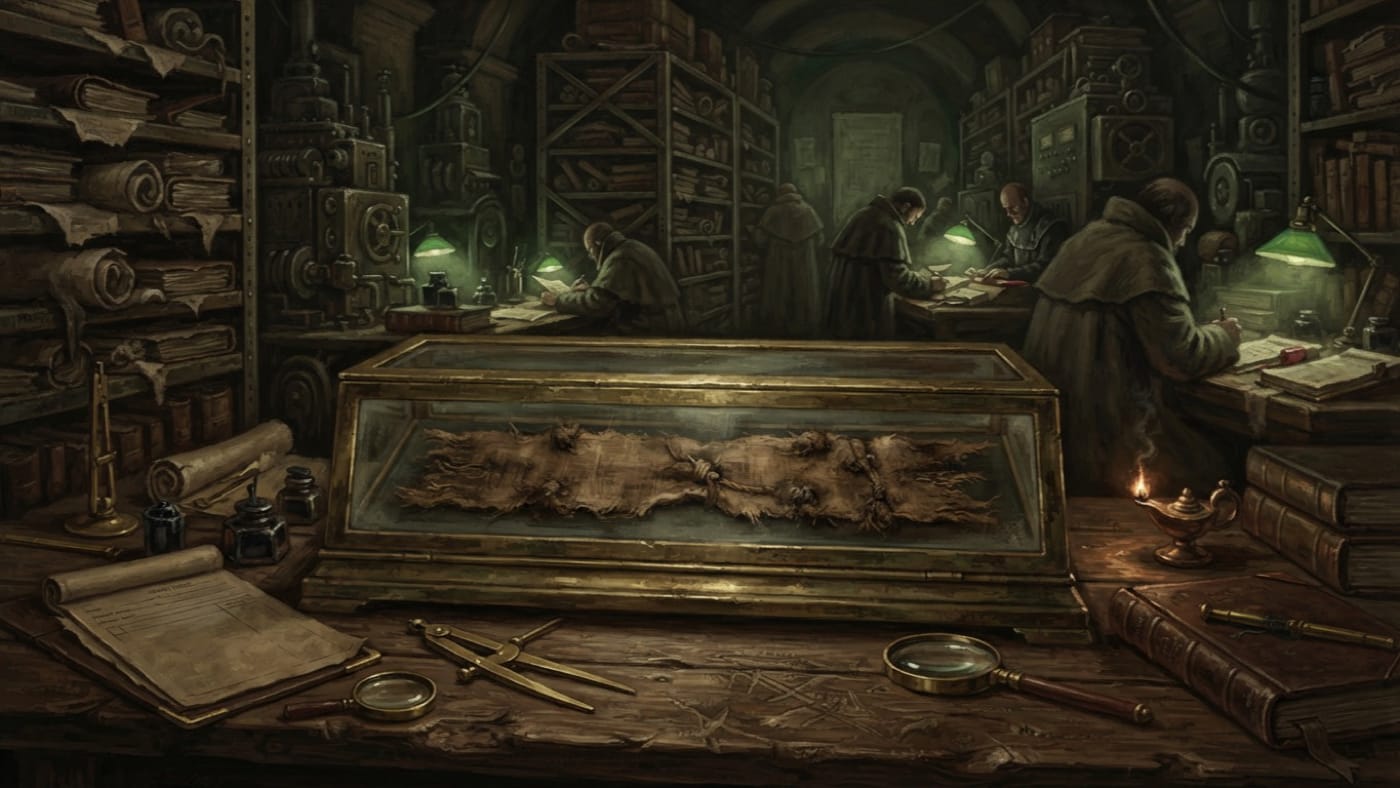
I was permitted one viewing of the object presented to me as the First Knot-Cloth. The permission required me to sign a form whose penalty clause had elbows. The patronal dossier's handling note records the viewing as restricted and touch as prohibited to all but a short list of officers, and I was not on that list. I did not touch it. What follows is my account of what I saw, and nothing more.
The cloth is brown linen about the width of a finger, which describes my finger and should not be mistaken for a measurement. One edge is frayed. In places the fibre has stiffened where something entered it and refused to leave: blood, grease or kitchen smoke. I name all three because I tested none. The hagiography mentions bleeding hands, but a saint's blood does not identify itself to a theologian across a viewing table. The knots are uneven. Some are drawn tight as a confessor's mouth, and some sit loose enough to shame whoever they stand for. One knot has been reinforced with thread of a later date than the linen.
The Bureau of Oaths insists that no knot has ever failed.
I set that assertion next to the reinforced knot and leave the two where they are. The reinforcement proves no fraud, since linen ages, custodians mend and even sacred things suffer moths. The Bureau's assertion proves no miracle, since a knot that has been helped has not obviously held by itself. Doctrine may weigh one against the other if it wishes. The Bureau of Doctrine has settled harder questions by vote.
My viewing does not authenticate the object, and I have said so in writing to anyone who asked. Several people asked in a tone that suggested they hoped I would say otherwise.
#On the Claims of Custody
The public guide states that "the cloth is preserved." It does not say where, and in this it is the most honest document in the file.
The first account places the cloth whole in the Registry of Bonds beneath the Basilica of the Ledgered Saints in Strasbourg. The patronal dossier names this location first, and the Bureau of Oaths prefers it, because an office likes its saint kept close to its ledgers.
The second account places the cloth whole in the Third Vault. The Breach-Rite Witnesser file says the vault's number changes with the speaker. I record "Third" as one reported version, and I will not make it more definite by repeating it.
The third account belongs to the Bureau of Relics. It holds that the cloth was divided into five strips during the early Concordat inventories. In that tradition, two strips are now sewn into the sashes of the Synod Registrar of Bonds and of the Senior Breach-Rite Witnesser. The tradition does not say where the other three went, and I will not do its filing for it. No inventory year survives in the account, and I supply none.
These accounts cannot all be true. A cloth cannot lie whole beneath the Basilica, whole in a vault and in five pieces at once, except in a sermon. I have heard that sermon. It was poor.
Relic Custody: Registry of Bonds beneath the Basilica of the Ledgered Saints.
Qualified. The patronal dossier of Saint Liora Knot-Hand gave this as its infobox custody entry, yet its own body lists the Third Vault and the five-strip division as rival accounts. Custody is disputed. The Registry of Bonds is one claim among three.
The Witnesser file supports the strip tradition only to the extent of reporting it. Its author records the sash strip as a tradition, admits to never having examined the sash and declines to name its wearer. That author was me, and I meant every refusal. Here the strip tradition is corroborated as a story people tell and authenticated as nothing at all.
#On Witness and Unbinding
The cloth's use was binding. Its descendants in the profession are the Oaths Witnessers, who hear marriage vows, debt covenants and guild bonds, write down the exact words, record the conditions and note any sign of coercion. A Witnesser's knot token is an ordinary cord, waxed or stamped according to provincial habit. It has no share in the First Knot-Cloth's sanctity and borrows only its form.
The profession also keeps the breach rite, and that is where the Bureau's insistence starts to strain. Ordinary vows fail every day. Brides recant, debtors run and soldiers walk home. The Bureau of Oaths maintains a whole specialist office to dissolve failed vows, assign penance and close the record. If witnessed knots bound people by their own power, that desk would have nothing to do. It is never short of work.
Professional doctrine holds that a broken vow ruptures the speech that made it, and that a rupture left unburied invites rot. I report that as doctrine. The survival of the First Knot-Cloth, or of parts of it, does not show that every witnessed promise is enforced from heaven. The Bureau's claim covers this cloth and its knots alone. It covers no marriage contract in Strasbourg, and any notary who tells a creditor otherwise ought to lose his seal.
On 14 Ember every Witnesser reties a knot in their own cord-sash and recites the axiom: a vow unwitnessed is vapor. The Breach-Rite Witnessers fast that day and call on Liora before breach rites throughout the year. These are ceremonies of ordinary cords. Nothing in them involves taking out, handling, retying, cutting or sharing the ancient cloth, and the feast has never been an occasion for the relic to appear in public.
The cloth remains preserved, according to the guide. It is brown, frayed, unevenly knotted and mended once, according to me. Its location is whole or divided, below the Basilica, in a vault of variable number or around the waists of two officers, according to everyone else.
The survey closes with the relic still in three places.