
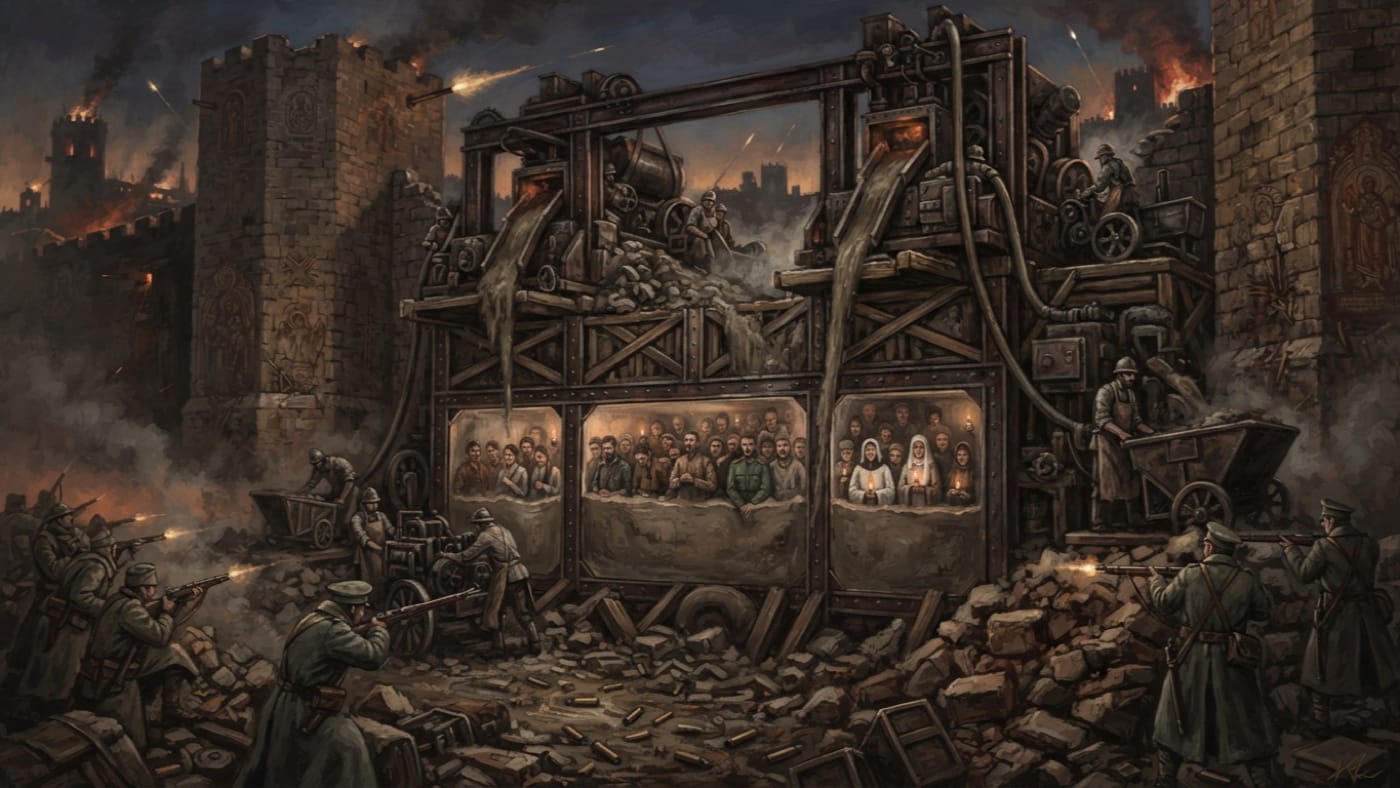
#On the Apparatus Designated
Breach-Sealing Apparatus Model 7 is a pour-frame belonging to the Bureau of Engineering. It is standard emergency fortification equipment, kept in Engineering custody and issued to forward teams when a curtain wall has stopped being a curtain. It is formwork. It holds wet consecrated cement in the shape of a wall until the cement consents to become one. Every bastion on the Line has seen frames of its kind, and in the ordinary run of things none would earn a Codex entry for honestly filling a gap.
One did, on the 23rd of Argent, A.S. 170, in the southern curtain of the Sixth Ravelin at Bastion-Constantinople. The Codex catalogues the result separately as Chamber 7, and the Reader will keep the two apart. The frame is equipment. The structure is a sealed section of wall with seven permitted words and a chapel lamp of forty-seven wicks. Doctrine rations the language allowed for the second. It has never bothered to ration the first, because no one in Strasbourg believes a specification is capable of blasphemy.
#On the Empty Breach
The specification is short, as the best liturgies are. The frame is to be erected in thirty minutes and filled in sixty, and the cement is to cure within a fortnight. Those three figures make up the entire public catechism of Model 7. I quote them from the specification itself. I have seen it once and was not invited to see it twice.
The document presumes an empty breach. The rubble has been cleared, the wounded carried off, the dead removed or at least counted, and the gap stands as vacant as a confessional after Compline. The crew raise the frame across it. The carts come up and the cement goes in. The wall returns. A breach is a hole, and Model 7 is the Bureau's formal opinion that holes ought to be temporary.
At no point does the specification consider persons inside the pour. It has no subsection for volunteers and no clause telling the crew what to do if the people they came to protect climb into the formwork and begin a hymn. A document cannot be faulted for failing to imagine what its authors would have refused to imagine. The authors in this case are men who weigh devotion by the cartload and file the receipt.
The Church does license certain masons to wall up the condemned. They work under warrant, and the paperwork is heavy enough to bury a man without further assistance. Model 7 holds no such licence and appears on no such warrant. It is a fortification tool, and what it was made to hold is consecrated cement and nothing that breathes.
#On the Deployment at Correction
The Sixth Ravelin is the Ravelin of Correction. It faces the Rail Spur, and supplies and condemned men come in through it in roughly equal numbers. On the eve of the 23rd a Night Paper reached the bastion naming the 14th Parish Regiment, which manned the artillery of the southern curtain. Before dawn its three hundred and twelve artillerymen had burned and the guns stood unmanned. Maldrake's Hellbow Legion came at first light. Seven of the Hollowed reached the curtain and six of them detonated. The seventh paused, turned its head as if listening, and fell against the stone. One hundred and forty metres of wall came down.
That figure measures the breach. It does not measure the frame. Nothing I have seen records Model 7's dimensions, and the Reader will not picture a single timber cradle spanning the whole wound because a pilgrim's tract once drew it that way.
The garrison held the gap for nine hours with rifle, pike and hymn. At the fourteenth bell the Engineering forward team came up from the inner works carrying the frame, sixteen cartloads of consecrated cement, and instructions. The cement had been mixed with bone-aggregate, relic powder and the ash of a standard-issue Synodal hymnal. This particular apparatus had been modified for rapid deployment, and the modification was made in the field. The record says so and says nothing more about it. I will not supply hinges and bolts where the archive offers none.
Thirty minutes to erect and sixty to fill are drafting-room figures. No surviving abstract records how long the frame actually took to rise in the Sixth Ravelin, or how long the carts took to empty. The specification describes a quiet afternoon. The afternoon of the 23rd was something else.
#On the Occupied Pour
The volunteers gathered before the frame was half erected. There were forty-seven of them: twenty-nine soldiers, eight civilians, four confessors, three ammunition-handlers, two clerks of the Bureau of Records, and one widow listed in the Ledger only as K., assigned to Pilgrimage Intake. That list is the parent account's tally of who they were. It is not a crew complement, and no edition of the specification will ever include it as one.
The Bureau of Doctrine states that they came "of their own volition, moved by the Spirit of Obedience." I record the phrase exactly. Doctrine owns it and may answer for it.
They stepped inside the line of pour, and the crew poured anyway. That moment is the whole of Model 7's notoriety. A frame built for an empty breach was filled around living people, and the specification had nothing to say about any of it. The forty-seven sang the Antiphon of Endurance, all thirty-two verses, while the cement rose past their boots, then their knees, then their chests. The shorter voices stopped first. At the end a single voice remained, a woman's, finishing the final stanzas alone.
The witnesses disagree about whose voice it was. Some say K. and some say one of the confessors. Records settled the dispute by sealing both candidates' files, and the names of all forty-seven are sealed with them.
Instructional summaries once entered the sealing of the Sixth Ravelin breach under "standard emergency fortification practice."
Withdrawn. The frame was standard, and so were the cement, the carts and the instructions. What happened inside the frame was not, and no summary may borrow the equipment's respectability to cover the afternoon.
#On the Result Entered as Chamber 7
The section cured. Maldrake's forces kept pressing through the rubble on either side and found that one stretch of wall would not give. They burned it and it did not burn. Their Forge-Beasts cracked the stone around it and left it intact. They drove a siege ram into it at full charge, and the ram split.
Engineering's Structural Analysis Report 7-C/170-Ravelin-6, filed in A.S. 171, records that the section performs above specification. It is the strongest stretch of the Sixth Ravelin's curtain. The figures exist, redacted, and I have no intention of restoring them for the Reader's arithmetic. The Bureau of Rites credits faith. Engineering credits "relic-calcium aggregate bonding at molecular scales inconsistent with standard mineralogy," a phrase that confesses a great deal while seeming to explain. Doctrine has ruled that the two explanations are the same. The report's recommendation line reads none. The Bureau does not interfere with work that exceeds specification.
The wall is warm, and men stationed behind it report a low hum. Engineering files the warmth under residual exothermic curing. The specification it wrote itself gives a fortnight for curing. These are observations of the wall, and I leave them as observations. A frame cannot be held responsible for what its contents do once it has finished holding them. For access rules, maintenance-gallery protocol and the instruction not to count the hum, the Reader is referred to Chamber 7. The pilgrimage day is under the Vigil of the Hollowed.
#On the Specification Retained
The Model 7 specification has not been amended since the Vigil. It still says thirty, sixty and a fortnight, and it still presumes an empty breach. It still has no subsection for volunteers. Thirty-one years have passed, and Engineering has apparently decided that the absence of a paragraph is the best paragraph available. Revising the document would mean admitting what the document left out, and an admission of that kind would need a heading, a number and a signature. Nobody at Engineering wants to supply any of the three.
I have one question left, and it concerns the frame and nothing else. The forward team arrived at the fourteenth bell with the apparatus already modified, the carts already loaded, and the instructions already written. The Bureau of Engineering's deployment schedules for the 22nd and 23rd of Argent are sealed under the Fourth Ratification, and so are the Bureau of War's dispatch logs for the same two days. Without them, nobody can show when that team was ordered forward: after the wall fell, or on the evening the Night Paper arrived, before there was any breach to seal. I do not claim to know. I note that the evidence which would answer the question has been placed where questions cannot reach it.
The frame did what frames do and held the cement in place until it set. Everything else belongs to other Bureaus, and they have stamped it accordingly.